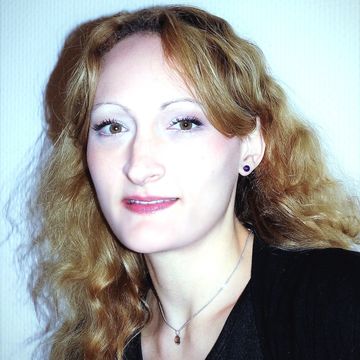
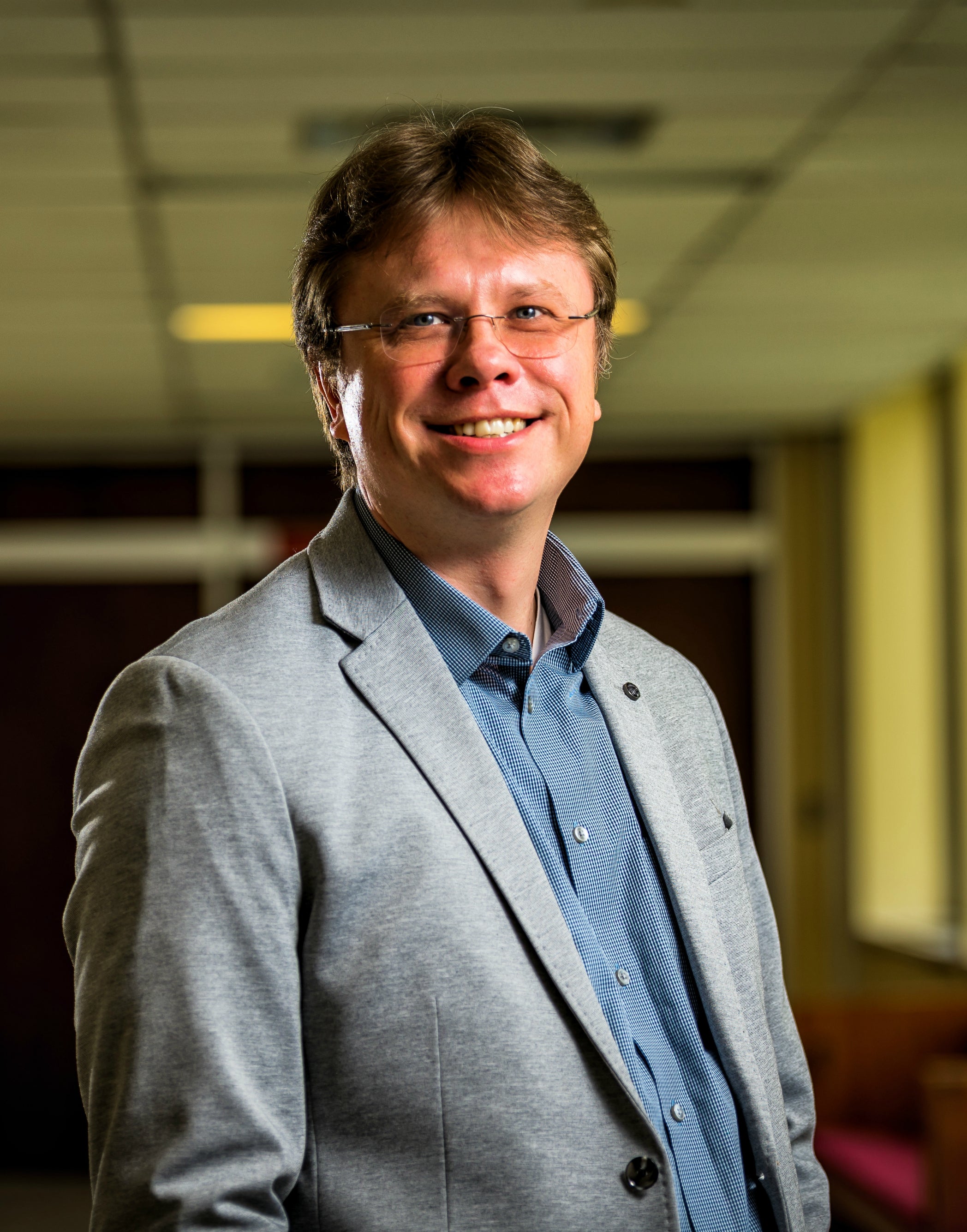
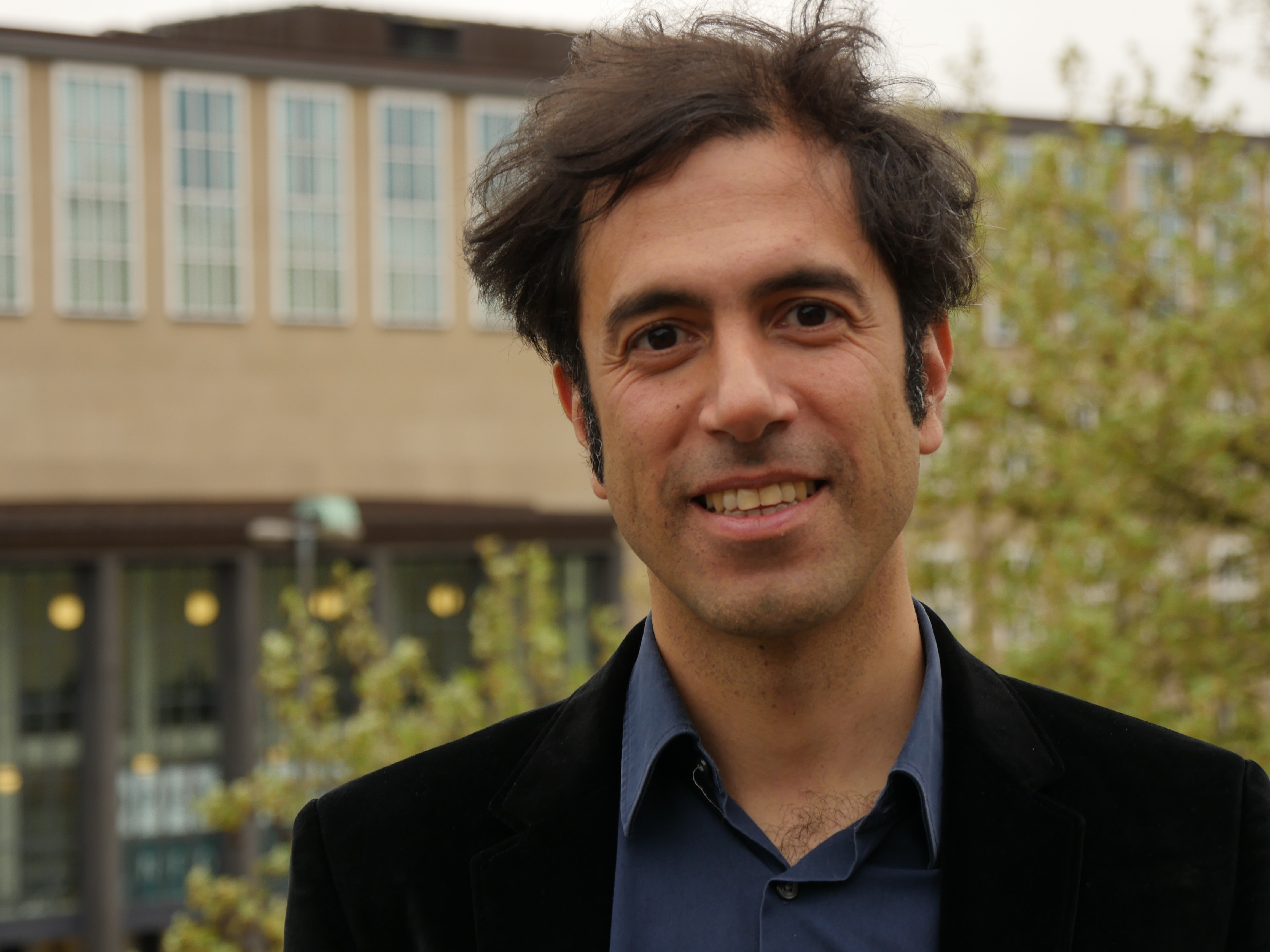
Susan Sayehli is an Associate Professor at the Department of Swedish Language and Multilingualism , Stockholm University. She specializes in psycholinguistics and second language acquisition, with a focus on crosslinguistic influence and morphosyntactic processing. Research Interests: Neurocognitive aspects of language learning Focus intonation development in Swedish children Policy impact on SFL (Spanish/French/German) education ERP and eye-tracking methodologies for language processing Urban-rural educational disparities in language programs Current Projects: TAL – Alignment study on oral proficiency in Swedish schools Att lära sig fokusera – Intonation perception in Stockholm/Skåne children Prior Projects: SWOP2 – Swedish word order processing in L2 learners PSUII – Precursors of sign use in intersubjectivity
Szende Thomas is a full Professor at Inalco (Institut National des Langues et Civilisations Orientales). He serves as Director of the EA 4514 Plidam research center and heads the Hungarian Studies section at Inalco. His academic work focuses on language teaching, cultural differences in dictionaries, and applied linguistics. Director, EA 4514 Plidam Research Center Head of Hungarian Studies Section, Inalco Member, UNESCO Chair "Language Policies for Multilingualism" Executive Committee Jury member, Paris University Thesis Prize Member, Inalco Scientific Council His research spans language didactics , applied linguistics , and lexicography . He has published extensively on second culture teaching, bilingual dictionary analysis, and language appropriation dynamics, with recent work on language-culture pedagogy and grammatical instruction methodologies. Key publication themes include: intercultural education , language policy in Central/Eastern Europe , bilingual dictionary design , and Hungarian language didactics . His academic contributions extend to methodological works like the Assimil Hungarian language series and specialized dictionaries.
Jonathan Ginzburg is a Researcher in the Department of Linguistics at Université Paris Diderot, affiliated with the CLILLAC-ARP research group. His work bridges linguistics, cognitive science, and computational models, focusing on dialogue semantics, pragmatic functions, and developmental language acquisition. Education details are not explicitly provided in the text, but his research spans formal semantics, syntax, and multimodal interaction. His studies on laughter dynamics and infant communicative behaviors have advanced understanding of pragmatic functions in early development. Key research interests include dialogue structure, question-response systems, and the integration of cognitive science with linguistic theory. Recent work explores neural correlates of language processing through type-theoretical semantics and corpus-based methodologies. He has pioneered the analysis of non-sentential utterances and their role in social interaction. His contributions to dialogue systems design for low-resource languages and the DUEL corpus (analyzing disfluencies, exclamations, and laughter) reflect his interdisciplinary approach. Current projects investigate laughter's pragmatic functions across developmental stages and cross-linguistic variations in exclamatory constructions. Laboratory affiliations include the CLILLAC-ARP laboratory, where he develops computational tools for analyzing dialogue semantics and cognitive interactions. His work on 'response spaces' for questions integrates machine learning and formal pragmatics to model conversational coherence.
Dr Paul Sidwell is an Honorary Associate in the Department of Linguistics at The University of Sydney. His research focuses on Austroasiatic languages, particularly their classification, historical development, and syntactic structures. He has authored and edited numerous works including A Grammar of May: An Austroasiatic Language of Vietnam (2021) and contributed to major volumes like The Languages and Linguistics of Mainland Southeast Asia: A Comprehensive Guide (2021). His work spans comparative linguistics, epigraphy, and the prehistory of Southeast Asian languages. Recent publications include studies on Nicobarese language classification (2022), Austroasiatic syntax (2020), and Tai-Kadai language history (2021). His research integrates phylogenetic analysis, historical reconstruction, and areal linguistics to explore language relationships across Mainland Southeast Asia. Notable contributions include foundational works on Palaungic languages (2015), Old Khmer (2014), and the Munda Maritime Hypothesis (2019). His scholarship combines rigorous linguistic fieldwork with theoretical insights, advancing understanding of Austroasiatic linguistic diversity.
Hugues Azérad is a Professor in the French department at the Faculty of Modern and Medieval Languages and Linguistics , University of Cambridge. He holds the title of Fellow and College Lecturer at Magdalene College. His research interests center on comparative literature , with a focus on modernisms across French, Francophone, and global contexts. Key areas include postcolonial theory , Caribbean literature , aesthetics , and visual culture . He has published extensively on authors like Édouard Glissant, Aimé Césaire, and Nerval, exploring intersections between literature, philosophy, and political theory. Recent publications analyze Édouard Glissant's Discours antillais , Caribbean modernisms, and poetic practices in post-1945 France. His work engages with eco-criticism , relational aesthetics , and transnational pedagogy . Scientific achievements : Co-edited Twentieth-Century French Poetry: A Critical Anthology (CUP, 2010) Co-editor of European Connections: Studies in Comparative Literature series Recipient of 2017 Cambridge University Best Undergraduate Supervisor Award Teaching spans MPhil modules in European Literature , French culture , poetry , and world cinema . He supervises PhD students in French and comparative literature.
Dr. Anne-France Pinget is an Assistant Professor in Linguistics at Utrecht University's Department of Languages, Literature and Communication, where she has been working since 2015. She is embedded within the Institute for Language Sciences (ILS) and holds an active position in the research domain of Language structure: variation and change. Her academic journey began with a PhD completed in 2015 on 'The Actuation of Sound Change,' supervised by Prof. Hans Van de Velde and Prof. René Kager, funded by an NWO doctoral scholarship. Her research spans three interconnected domains: sociolinguistics (sound change, imitation, language attitudes), sociophonetics, and language acquisition (acquisition of variation, language policy, fluency, accent, and attitudes). She has taught various courses primarily focused on Sociolinguistics at Utrecht University and has been involved in multiple educational programs including Linguistics (BA & RMA), Multilingualism and Language Acquisition (MA), and Language and Cultural Studies (BA). Her recent publications demonstrate a consistent focus on language variation and change, with particular attention to Dutch language phenomena, accent recognition, and multilingual contexts. Her work combines experimental and sociolinguistic approaches, often examining the intersection of social factors and phonetic variation. Scientific Contributions: NWO XS Project (2023-2024): 'Growing up in multilectal and multilingual Netherlands: The acquisition of sound variation by primary school children' Editor of Journal Nederlandse Taalkunde/Dutch Linguistics (2022-present) Member of editorial team for Journal Glossa Psycholinguistics (2023-present) Treasurer of NVFW (Netherlands Association for Phonetic Sciences) (2018-present) Dr. Pinget has been actively involved in academic service, serving on Utrecht University's Examination Board (2017-present), previously as a member of the Ethics Committee (2017-2020) and Study Programme Committee (2016-2018). She also contributed to the development of laboratory and experimental sociolinguistic research as a postdoctoral researcher at the Fryske Akademy (2021-2025).
Dr. Alan Bale is a Professor in the Department of Classics, Modern Languages and Linguistics at Concordia University, specializing in semantics and syntax-semantics interfaces. His work integrates generative linguistics frameworks with experimental methods to explore grammatical representations of meaning, particularly focusing on number, comparison, and scalar competition across languages like Mi’gmaq, English, and Western Armenian. He investigates how conceptual development interacts with linguistic structures through both linguistic and non-linguistic meaning analysis. His research emphasizes teasing apart contributions from pure semantics, psychological categories, and pragmatic reasoning. Key topics include the mass-count distinction, scalar implicature, and experimental methodologies. He maintains a website and has published extensively on topics ranging from linguistic pragmatics to formal syntax. His CV provides additional details on his academic contributions. Bale's publications (2020–2025) reflect a sustained focus on scalar implicature mechanisms, mass-count distinctions, and cross-linguistic syntax-semantics interactions. Recent work explores how online experimental methods and cognitive load influence pragmatic reasoning. His research bridges formal linguistic theory with empirical cognitive science approaches.
Robyn Creswell is an Associate Professor of Comparative Literature and Director of Graduate Admissions at Yale University. He specializes in Modern Arabic Literature, Translation Studies, and Modernist Poetry, with a focus on the intersection of literature and politics in the Middle East. Creswell holds a Ph.D. from New York University (2011) and a B.A. from Brown University (1999). His research explores Cold War intellectual movements, pan-Arabism, and the role of translation in preserving literary heritage. Education: Ph.D., Comparative Literature, New York University, 2011 B.A., Comparative Literature, Brown University, 1999 (Magna cum laude) Research Interests: Creswell’s work spans Modernist Poetry, Arabic literature, translation theory, and the politics of Middle Eastern cultural production. He has written extensively on 20th-century Arab poets like Nazik al-Mala’ika and Adonis, analyzing how literary forms reflect broader sociopolitical shifts. His current project, The Ruins: Arabic Poetry in an Age of Extremes , examines post-WWII Arab intellectual history through poetic analysis. Publications: His book City of Beginnings: Poetic Modernism in Beirut (2019) won the Gaddis Smith International Book Prize. He has translated works by Iman Mersal, Sonallah Ibrahim, and Abdelfattah Kilito, including the National Translation Award-winning The Threshold (2022). His essays appear in The New York Review of Books , Daedalus , and Critical Inquiry . Awards and Fellowships: Guggenheim Fellowship (2021) National Translation Award (2023) Berlin Prize (American Academy in Berlin, 2015–16) Cullman Center Fellowship (2011–12) Teaching and Service: Creswell has taught courses on Arabic poetry, literary translation, and the global history of sports writing. He directed Yale’s Comparative Literature Department (2021–23) and served as poetry editor for The Paris Review (2011–18). He has organized academic symposia such as Translation/Tarjama (2018), exploring Arabic literary translation’s political dimensions.
Ludovic Vetea Mompelat is an Assistant Professor at the University of Miami 's College of Arts and Sciences . His research focuses on linguistics, natural language processing (NLP), and computational analysis of creole languages such as Martinican and Haitian Creole. He specializes in integrating artificial intelligence into language education and exploring syntactic typology, ellipsis constructions, and linguistic barriers in healthcare. Research Interests Dr. Mompelat investigates: POS tagging and error analysis in creole languages AI-driven solutions for linguistic barriers in healthcare Computational approaches to ellipsis constructions and syntactic finiteness Corpus development for discourse analysis (e.g., conspiracy theories) and event sequencing Publications & Trends Recent articles highlight his work on NLP for under-resourced creole languages, contrasting classical NLP with modern LLMs, and leveraging AI to address linguistic challenges in healthcare and education. His studies often involve comparative syntax analysis across Martinican, Haitian, and French languages, alongside creating annotated corpora for machine learning applications.
Prof. Dr. Helen Engemann is a Junior Professor at the Department of English, School of Humanities, University of Mannheim. Her research focuses on multilingualism, language acquisition, and cognitive aspects of bilingualism. She is affiliated with the Research Team JP Multilingualism and is a member of the Deutsche Gesellschaft für Sprachwissenschaft (DGfS), European Second Language Association (EUROSLA), and International Association for the Study of Child Language (IASCL). Her work investigates how language structures influence cognitive processes, particularly in bilingual children and heritage speakers. Key topics include motion event constructions, crosslinguistic influence, and syntactic packaging in multilingual environments. Recent studies explore language change mechanisms in Italian heritage speakers and the impact of typological factors on memory and event encoding. Publications span prestigious journals like Linguistic Approaches to Bilingualism , Journal of Child Language , and Bilingualism: Language and Cognition . Her research bridges linguistics, psychology, and education, addressing both theoretical and applied questions in multilingual development.
Katie Carmichael is an Associate Professor at Virginia Tech's College of Liberal Arts and Human Sciences, Department of English. She serves as Director of Language Sciences and Co-director of the Speech Lab. Her research focuses on language variation/change, language ideologies, and language-place connections, particularly in Louisiana French and Southern US dialects like New Orleans English and Cajun English. Director of Language Sciences Co-director of Speech Lab Active in language research and teaching Carmichael's work centers on variationist sociolinguistics, exploring topics such as: Low-back vowel mergers in New Orleans English Intergenerational dialect change Raciolinguistic identity in Creole communities Phonetic/phonological diffusion patterns Language endangerment in Louisiana French Place-linked dialect awareness Scientific recognition includes: Roger W. Shuy Best Paper of the Year in American Speech (2024) Exemplary Program Award for Language Sciences (2024) University Award for Excellence in Teaching (2024) College of Liberal Arts Certificate of Teaching Excellence (2024) She teaches graduate-level courses like "Language and Place" and undergraduate courses including "Language and Ethnicity," "Language and Society," and "Contemporary Approaches to Linguistics II." As Co-director of Virginia Tech's Speech Lab, she leads research on acoustic phonetics and sociolinguistic variation.
Marie Candito is a Lecturer at the School of Linguistics, Paris Cité University. She serves as Deputy Director of the Laboratoire de Linguistique Formelle (LLF, CNRS) since January 2025 and Head of the M2 Computational Linguistics program at Paris Cité University. Her research focuses on natural language processing, computational linguistics, and linguistic abilities of large language models. Current Projects : Co-PI of ANR SELEXINI (2021-2025) and scientific coordinator for LLF in ANR PANTAGRUEL (2023-2025) Past Projects : PI of ANR ASFALDA-French FrameNet (2013-2016), scientific coordinator for ANR PARSEME-FR (2015-2019), and member of ANR SEQUOIA (2010-2013) Her work involves measuring and mitigating biases in language models, inducing semantic lexicons from corpora, and studying human vs. LLM word associations. She supervises PhD students including Maria Andueza Rodriguez, Anna Mosolova, and David Kletz.
Joop van der Horst is an associate professor at Károli Gáspár Reformed University, Faculty of Humanities and Social Sciences, specializing in Dutch Studies. Previously, he held professorial roles at KU Leuven and the University of Amsterdam. PhD in Linguistics (University of Amsterdam, 1986) MA in Dutch Language and Literature (Leiden University, 1975) His research spans historical linguistics, focusing on grammaticalization, collocations, and language change, as well as descriptive linguistics (syntax, morphology) and sociolinguistics. He has extensively studied fixed verb constructions, Dutch-French grammatical comparisons, and long-term language-society interactions. His publications and conference contributions from 2002-2013 highlight trends in Dutch syntax evolution, comparative German-Dutch verb patterns, and the decline of Renaissance language culture in Europe. Key themes include grammatical theory, European multilingualism, and language education reforms. LOT Publication Award Our Language Award He has supervised PhD students Freek Van de Velde, Judith Schonenboom, and Bert Cappelle, while serving as an opponent in doctoral defenses including Evie Coussé and Rinaldo Neels. His guest professorships include institutions in Berlin, Maastricht, Cologne, Münster, and Wroclaw.
Kanstantsin Tsedryk is an Associate Professor at the University of Waterloo's Department of French Studies, specializing in second language acquisition and French language didactics. He has extensive experience in developing internet-based French language resources and teaching full-time since 2008. Education: BA from Minsk State Linguistic University (2003), MA in French Studies from Western University (2004), PhD in French Studies from Western University (2014) His research focuses on grammatical structure acquisition in second languages, French pedagogy, and computer-assisted language learning. He has contributed to virtual French grammar presentations and interactive exercises, including co-founding one of the best French grammar websites. Publications highlight his work on clitic pronouns in French L2 acquisition, sociolinguistic variation, and online course development. While no explicit scientific awards are mentioned, his contributions to French grammar education and digital pedagogy are significant. He has taught full-time at the University of Waterloo, with expertise in virtual presentations (Flash/PDF) and self-correcting grammar exercises. His pedagogical innovations include diagrammatic grammar explanations and syntactic transformations for language learners.
Aria Adli is a Professor of Romance Linguistics at the University of Cologne , where he founded and directs the Sociolinguistic Lab . He holds a tenured W3 professorship and previously held positions at Humboldt University Berlin, University of Strasbourg, and University of Freiburg. Education : Diplom in Psychology (University of Bonn, 1998) Double degree: Maitrise in Linguistics (Université de Toulouse II) and Licence in Psychology (1998) Habilitation (University of Freiburg, 2011) PhD in Romance Philology (University of Tübingen, summa cum laude, 2003) His research focuses on grammatical variation , examining syntax-information structure interfaces, social stratification (Bourdieu's lifestyle), and register effects. He uses cross-linguistic comparisons (French, Spanish, Catalan, Persian) and methods like corpus analysis, computer simulations, and fieldwork. Scientific Awards : Emmy-Noether Fellowship (DFG) DAAD grants for multilingualism research art, science & business-Stipendium (Akademie Schloss Solitude) Thyssen-Stiftung funding Grants & Projects : Principal investigator for SFB 1412 subproject 'Register: Language-Users' Knowledge of Situational-Functional Variation' DFG grant for 'Grammar-Usage Relationship in Spanish/Persian' Organized international workshops on sociolinguistics, register, and variation Academic Leadership : Head of the Sociolinguistic Lab Geschäftsführender Direktor of Fachgruppe 5 (Phil Fakultät UzK) Member of Excellence Cluster 'Choice in Expression' initiation group