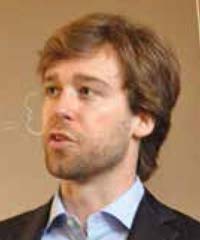
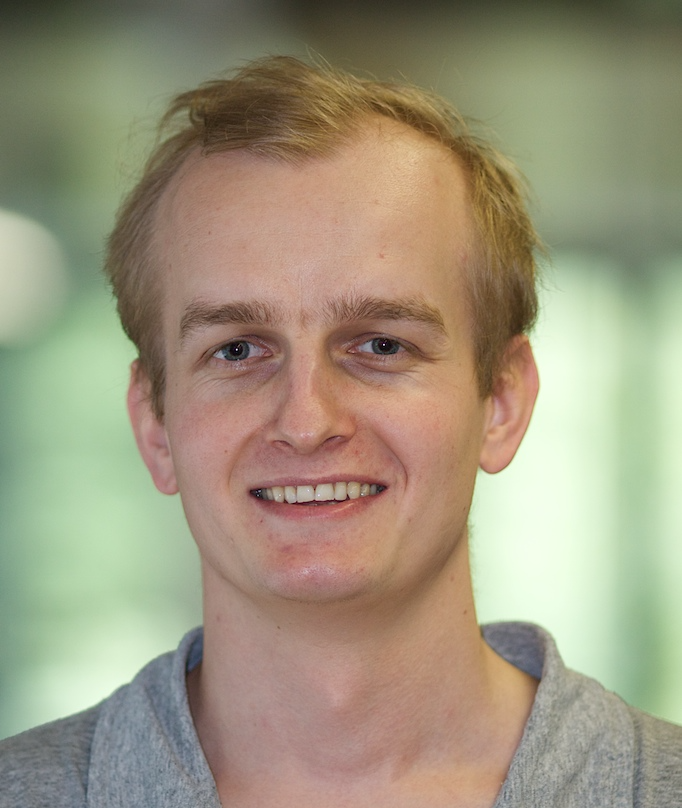
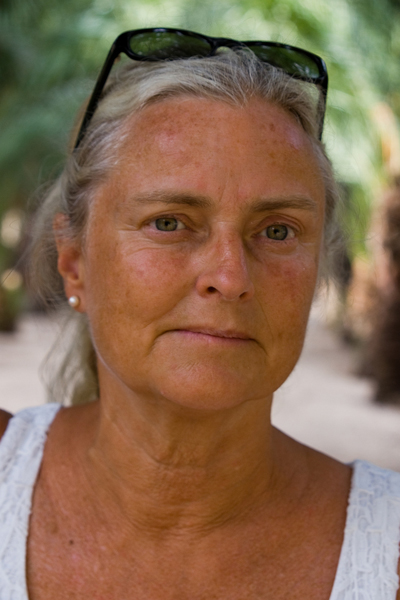
Philipp Koralus is the McCord Professor of Philosophy and AI at the University of Oxford and serves as Director of the Human-Centered AI Lab (HAI Lab) within the Institute for Ethics in AI. He is also a member of St Catherine's College. Koralus holds a Ph.D. in Philosophy and Neuroscience from Princeton University and a B.A. from Pomona College. His research focuses on the human capacity for reasoning and decision-making, exploring how these processes relate to artificial intelligence agents and large language models like GPT. He advocates for the Erotetic Theory of Reason (ETR), which posits that reason aims to resolve issues or questions directly, explaining both human rationality and fallibility. His work extends to moral judgment, definitions of intelligence, and interdisciplinary collaboration with computer scientists, psychologists, linguists, and neuroscientists. Koralus is preparing to launch the HAI Lab in Fall 2024, aiming to advance human-centered AI ethics and cognition research. His educational background includes advanced studies in philosophy and neuroscience, combining analytical rigor with empirical insights. Collaborations span diverse fields, including fisheries management through agent-based modeling and healthcare ethics in AI applications. He has published widely on topics such as attention mechanisms, visual perception, and the theoretical foundations of AI reasoning. Koralus regularly teaches graduate seminars on philosophy and AI, including upcoming sessions like 'Building the Philosophy to Code Pipeline' starting in 2025. He has supervised doctoral students in both philosophy and computer science but currently lists no specific advisees. His research has been recognized in symposia and commentary, though no formal scientific awards are explicitly mentioned.
Dr. Teresa Wang is a Senior Lecturer in Data Science at Monash University's Faculty of Information Technology, specializing in entity/user modeling, relational/structural machine learning, and graph/network analysis. She holds a Ph.D. from the University of Queensland and degrees from Nanjing University. Currently, she directs the Master of Data Science Program and teaches courses like FIT5201 Machine Learning. Her research focuses on social, e-commerce, and health data modeling, with notable projects including the Knowledge Enriched Approach for Effective Personalization (2025–2027) and collaborations on AI in Mental Health and Site Safety. Dr. Wang has co-authored over 59 publications, emphasizing areas like ontology matching and multimodal data analysis. She actively supervises PhD students and contributes to initiatives like the CSIRO Next Generation Graduates Program for clean energy and sustainability. Education: Ph.D. in Computer Science (2017), University of Queensland Master of Computer Science (2013), Nanjing University Bachelor of Software Engineering (2010), Nanjing University Research Interests: Entity modeling, spatio-temporal data analysis, graph mining, recommender systems, and health/medical records mining. She explores applications in social media, e-commerce, and healthcare sectors. Projects: "Knowledge Enriched Approach for Effective Personalization" (2025–2027) "AI for Clean Energy and Sustainability" (2023–2027) "CSIRO Next Generation Graduates Program: AI in Mental Health" (2023–2027) "Large-scale multimodal knowledge management" (2022–2025) Grants & Collaborations: Engaged with CSIRO, Crank Group, and Pola Practice Pty Ltd. Her work aligns with UN SDGs in education and sustainable energy systems. Labs/Teams: Part of the Monash Energy Institute and Monash Data Futures Institute, contributing to interdisciplinary AI and energy research.
Przemyslaw Grabowicz is an Assistant Professor of Computer Science at University College Dublin and an Adjunct Professor at the University of Massachusetts Amherst. He leads the SIMS (Socially Intelligent Media and Systems) Lab and the EQUATE initiative, and is actively involved in the Knowledge Discovery Lab (KDL). His work bridges computer science, social science, and public policy, focusing on responsible AI and digital society. Research Interests: Fair and Explainable Machine Learning Computational Social Science Social Media and Network Science Public Opinion Modeling Algorithmic Bias and Discrimination Prevention Open-World Learning His research develops statistical and machine learning methods to understand and augment public opinion in digital environments, ensuring fairness, transparency, and societal benefit. He emphasizes legal compliance and ethical design in AI systems. Recent Research Trends: His recent publications focus on social media polls, political bias, misinformation, and fairness in machine learning. He investigates how algorithmic systems shape public discourse, especially during elections and global crises, and develops methods to detect and mitigate bias in data and models. Scientific Awards and Recognition: Best Paper Honorable Mention, ICWSM’25 WICI Data Challenge Main Prize (2013) Arnold O. Beckman Research Award Multiple UMass Amherst Interdisciplinary Research Grants Volkswagen Foundation Grants (over €900k total) Advising and Grants: Dr. Grabowicz supervises several PhD students in the SIMS and KDL labs and collaborates with MS students. He has secured significant funding from the Volkswagen Foundation, UMass Amherst, and the University of Illinois, supporting research on political misinformation, media bias, and global agenda setting. He is currently recruiting a postdoc at UCD. Labs and Initiatives: He heads the SIMS Lab and the EQUATE initiative, and contributes to the KDL. His project socialpolls.org explores public opinion through social media, and he maintains an active presence through the Uncommon Good blog on responsible AI.
Lauren Hall-Lew is a Professor and Personal Chair of Sociolinguistics at the University of Edinburgh's School of Philosophy, Psychology and Language Sciences. She holds a BA from the University of Arizona (2002) and MA/PhD from Stanford University (2009). Her research focuses on phonetics, social meaning, language change, and sociopolitical identity. She has pioneered projects like the Lothian Diary Project, studying linguistic impact of the pandemic, and analyzed Scottish political speech, tourist language attitudes, and ethnicity-linked variation in San Francisco. Teaching contributions include courses on sociophonetics and language variation/change, earning her EUSA Teaching Award (2013). She has supervised over a dozen PhD students and is involved in EDI initiatives, including founding the Staff BAME Network Mentoring Programme (2019-2021), recognized via CAHSS Award and Principal's Medal nominations. Active in grant work, she leads projects on homelessness and linguistic variation (British Academy-funded), Scottish tour guide discourse, and political identity in phonetics. Awards include teaching accolades and EDI recognition. Her publications span sociolinguistic theory, phonetic analysis, and applied linguistic methods.
Professor Qing Cao is Professor, Director of Studies, and Director of the Centre for Comparative Modernities at Durham University's School of Modern Languages and Cultures. His research examines Chinese media, communication, and modern intellectual history through three interconnected strands: the role of media in China's modernization, the impact of media language on social perceptions, and mutual China-West representations shaping identity politics. His research interests encompass China's modern intellectual history, Chinese politics, mass media dynamics, Western reporting on China, Chinese linguistics, and translation studies. Current projects include a book on Chinese state media's construction of alternative modernity and editorial work for the Routledge Research Encyclopaedia on Chinese Studies. Previously funded by AHRC and British Academy, his work explores the discursive transformation of Chinese society. Professor Cao's publications demonstrate sustained focus on discursive constructions of modernity and identity across historical periods, with recent work examining late Qing intellectual transformations through linguistic analysis. His supervision includes PhD students researching Western media representations of China, diplomatic language, and gender discourses in Chinese newspapers.
Malvina Nissim is a leading researcher in computational linguistics and NLP at the University of Groningen's Department of Artificial Intelligence, with a focus on multilingual modeling, bias mitigation, and human evaluation frameworks. Key Contributions : Developed CALAMITA (Italian LLM benchmark), IT5 models for Italian language processing, and ReproHum framework for NLP evaluation reproducibility Research Pillars : Multilingual reasoning consistency, perspective-based text analysis, and figurative language modeling Her work spans activation steering techniques, cross-lingual transfer learning, and the creation of specialized language resources like the EurekaRebus dataset and MAGPIE idiom corpus. She pioneered methods for gender bias measurement in BERT and developed the SocioFillmore tool for perspective visualization. Recent publications explore model uncertainty as MCQ difficulty proxy, Italian headline generation benchmarks, and multilingual multi-figurative language detection. She actively participates in teaching initiatives like the "NLP with Bracelets" workshop for Italian high school students. Scientific Awards : ACL Best Paper Award (2025) EMNLP Outstanding Reviewer (2023) EVALITA Leadership Recognition (2024) She advises PhD students in model bias analysis and has contributed to the development of the Dutch Abusive Language Corpus (DALC) and the ReproNLP reproducibility framework. Her collaborations span institutions in Italy, Netherlands, and international NLP communities.
Carlo A. Furia is an Associate Professor at the Software Institute within the Faculty of Informatics at Università della Svizzera italiana (USI). He leads the ATOM research group and is actively involved in advancing formal methods in software engineering. His work bridges theoretical rigor with practical applicability, particularly in verification, automated repair, and empirical analysis of software systems. PhD in Computer Science, Politecnico di Milano Master of Science in Computer Science, University of Illinois at Chicago Laurea in Computer Science and Engineering, Politecnico di Milano His research focuses on making formal methods practical through automation, combining diverse techniques, and conducting thorough empirical evaluations. He is particularly interested in using Bayesian data analysis to assess software engineering data. His work spans program verification (e.g., AutoProof), contract inference, API usability, and multilingual program analysis. His recent publications highlight trends in automated program repair, JVM bytecode analysis, Android security, and empirical methodologies. These works reflect a consistent emphasis on correctness, reliability, and empirical validation in software development. Scientific service includes: Associate Editor, Empirical Software Engineering (EMSE) journal Program Committee member, FM 2026, FormaliSE 2026, ASE 2025, iFM 2025 He has advised students and leads the ATOM group, which develops tools for software analysis. He teaches courses such as Software Analysis, Programming Fundamentals, and Software Design & Modeling. Current research directions include improving empirical evaluation rigor and enhancing verification at lower code levels like bytecode.
Hao Liu is a researcher affiliated with institutions like Chinese Academy of Sciences , Beihang University , and Stanford University . His work spans Computer Science , Artificial Intelligence , and Robotics . Key affiliations: National Space Science Center (Beijing), School of Astronautics (Beihang), Key Laboratory of Pervasive Computing (Tsinghua) Research interests include Machine Learning , Image Processing , Graph Neural Networks , and Wireless Communication Optimization His recent publications focus on: Advanced control systems for fuzzy models Medical imaging via hyperspectral analysis Transformer-based approaches in NLP and vision Quantum-safe and edge computing protocols
Professor El Mustapha Lahlali is a distinguished academic at the School of Languages, Cultures and Societies, University of Leeds, where he holds the position of Professor of Applied Linguistics and Media. His research and teaching focus on Arabic media discourse, critical discourse analysis, translation, ideology, and pedagogy. Education: BA in Applied Linguistics MA in Applied Linguistics PhD in Critical Discourse Analysis and Classroom Discourse His research interests span Arab media and society, discourse analysis in educational and political contexts, appraisal theory, translation and ideology, and teaching Arabic as a foreign language. He has published extensively on media discourse, political rhetoric, and translation practices in Arabic contexts, contributing significantly to the understanding of linguistic strategies in media and political communication. His recent publications reflect a strong focus on discourse in conflict, media framing, translation challenges, and pedagogical development. These works collectively emphasize critical analysis of Arabic media, political transitions, and intercultural communication, revealing trends in ideological representation and linguistic power dynamics. Scientific Awards: No specific awards listed in the text. Professor Lahlali has supervised 27 PhD students to completion and currently mentors several more on topics including media translation, ideology, discourse analysis, and pedagogy. He has served as internal and external examiner for over 100 PhD theses across the UK and internationally. He has secured and contributed to numerous research grants in Arabic, linguistics, and Middle Eastern studies. His leadership extends to organizing over 45 academic events, including conferences and workshops. He is actively involved in research groups and welcomes PhD applicants in areas related to Arabic media, discourse analysis, and translation. He is a key figure in professional associations such as BATA (Founder and President), BRISMES, UCML, and APETAU.
Huaizu Jiang is an Assistant Professor at Khoury College of Computer Sciences, Northeastern University. His research bridges computer vision, graphics, and natural language processing to develop AI systems that understand and reconstruct 3D visual environments. Prior to joining Northeastern, he was a Postdoc Researcher at Caltech and Visiting Researcher at NVIDIA. He holds a Ph.D. from UMass Amherst (advised by Prof. Erik Learned-Miller), and M.E./B.E. degrees from Xi'an Jiaotong University. His research focuses on fundamental challenges in 3D scene understanding, including geometry reconstruction, semantic interpretation, novel view synthesis, motion generation, and optical flow estimation. Core interests span video processing, human-object interactions, multimodal reasoning, and efficient edge-device implementations. Recent publications emphasize diffusion models for motion/scene generation, transformer-based 3D perception, and video interpolation. Key trends include multi-view consistency techniques, text-to-3D synthesis, and efficient real-time algorithms for robotics applications. Awards & Honors: Winner of the VQA Challenge 2020 He advises 15+ graduate students on projects spanning 3D reconstruction, motion synthesis, and vision-language models. His group collaborates with institutions like NVIDIA and Caltech, focusing on generative AI for dynamic scene understanding.
George Kesidis is a Professor in Computer Science and Engineering and Electrical Engineering at Penn State University. His research spans deep learning security, virtual reality optimization, and cloud computing. College of Engineering (Penn State University) Research Focus: Backdoor Attacks, DNN Robustness, Edge Caching Active in NSF and U.S. Navy-funded projects (2022-2026) His work addresses backdoor data poisoning , test-time evasion attacks , and DNN overfitting mitigation . He develops techniques like activation clipping, perturbation analysis, and statistical defense models. Recent projects include edge caching systems for VR and security-driven AI frameworks. Key article trends reveal expertise in adversarial deep learning, immersive media delivery, and cloud resource optimization. Current grants focus on multi-user VR, GPU scheduling, and serverless-cloud hybrid architectures. He collaborates extensively with researchers like David J. Miller and Xinyu Li, particularly on cloud-based adversarial defense mechanisms and VR streaming benchmarks.
Yoshiko Matsumoto is the Yamato Ichihashi Professor in Japanese History and Civilization and Professor of East Asian Languages and Cultures at Stanford University, with a courtesy appointment in Linguistics. She has been a faculty member at Stanford since 1992, progressing from Assistant Professor to her current distinguished position. Matsumoto also serves as coordinator of the Japanese Language Program and has held significant administrative roles including Chair of the Department of Asian Languages (2003-2005) and Interim Chair of the Department of East Asian Languages and Cultures (2016). Matsumoto earned her Ph.D. in Linguistics from the University of California, Berkeley (1989), following M.A. degrees in Linguistics from UC Berkeley and General and Applied Linguistics from the University of Tsukuba, an M.I.A. in American Studies from the University of Tsukuba, and a B.A. in English Language & Literature from Japan Women's University. Professor Matsumoto's research focuses on linguistic pragmatics from cross-linguistic perspectives, with particular expertise in Japanese language. Her work spans structural and sociocultural aspects of language in use, including noun-modifying clause constructions, honorifics, discourse markers, and the intersection of language with gender and aging. She has pioneered research on conversational narratives of older adults, examining how ordinary framing strategies help individuals navigate difficult experiences. Her current projects explore intergenerational communication through haiku, communicative abilities of people with dementia, and noun-modifying constructions across Eurasian languages. Matsumoto's scholarship consistently bridges theoretical linguistics with practical applications for understanding human communication in diverse social contexts. Matsumoto's recent publications reveal a growing focus on practical applications of linguistic research for social benefit, particularly in intergenerational communication and dementia care. Her work increasingly integrates arts-based approaches, especially haiku poetry, to bridge generational divides and enhance communication with elderly populations. The research shows a consistent trajectory from theoretical linguistic frameworks toward applied, human-centered language studies that address real-world challenges in aging societies, with particular attention to how ordinary language practices help individuals navigate life transitions and difficult experiences. Dean's Award for Distinguished Teaching, School of Humanities and Sciences, Stanford University (2000) Richard E. Guggenhime Faculty Scholar, Stanford University (2000-2003) Violet Andrews Whittier Fellow, Stanford Humanities Center (2019-2020) Faculty Research Fellow, Michelle R. Clayman Institute for Gender Research (2014-2015) Research Fellow, Japan Foundation (2002) Internal Fellow, Stanford Humanities Center (2005-2006) Presidential Fund for Innovation in the Humanities, Stanford University (2009-2011) Professor Matsumoto has mentored numerous students through her teaching in Japanese language and linguistics courses, including specialized offerings on language and aging, points in Japanese grammar, and haiku-based communication. Her research has been supported by prestigious grants from the National Endowment for the Humanities, the Japan Foundation, and Stanford's Presidential Fund for Innovation in the Humanities. She has served on multiple editorial boards including the Journal of Pragmatics since 1992, demonstrating long-standing leadership in her field. Matsumoto has also advised students through individual studies and thesis projects in East Asian Languages and Cultures. Matsumoto leads several collaborative research initiatives including the 'Sharing Conversations' project which examines intergenerational communication through haiku, and research on communicative abilities of people with dementia. Her work often involves interdisciplinary teams spanning linguistics, gerontology, and creative arts, with fieldwork conducted in both Japan and the United States. The 'Noun-Modifying Constructions in Languages of Eurasia' project represents a major international collaboration examining linguistic structures across cultural boundaries. She also directs the 'Language, Old Age and Gender in Japan' project supported by the Stanford University/Japan Foundation, and the 'Difficult Conversations Continue: Memories of the 3.11 Disaster and Bereavement Narratives' project focused on post-disaster communication.
Carita Paradis is a Professor Emerita at Lund University's Centre for Languages and Literature, specializing in English Linguistics. She holds a PhD from Lund University (1997) and has held leadership roles including Chair of the Swedish Research Council's Linguistics panel (2010–2015). She coordinates the Language, Cognition and Discourse@Lund (LCD@L) research group, focusing on discourse meaning, language acquisition, and sociocultural variation. Her research spans cognitive linguistics, discourse analysis, semantics, and sensory language. She has authored/co-authored over 100 refereed publications, 5 books, and edited 10 journal volumes. Awards include membership in Academia Europaea (2016) and leadership roles in Scandinavian linguistic associations. She has supervised 14 PhD students and 8 postdocs, taught at all academic levels, and participated in numerous national/international research projects. Her editorial roles include serving on Cognitive Semantics, Languages, and Human Cognitive Processing series.
Dr. Zhi Chen is a Lecturer in Computing at the School of Mathematics, Physics and Computing, University of Southern Queensland, specializing in Artificial Intelligence and Machine Learning with applications spanning digital agriculture and healthcare systems. Education: Master of Information Technology (MIT), University of Queensland, 2018 PhD, University of Queensland, 2023 Research Focus: His work centers on zero-shot learning, domain adaptation, and multimodal systems, addressing core challenges in computer vision and deep learning. Current projects integrate AI with agricultural risk modeling and medical diagnostics, emphasizing real-world deployment of robust algorithms under data-scarce conditions. Publication Trends: Recent output (2022-2025) shows concentrated expertise in source-free domain adaptation and generalized zero-shot learning, with significant contributions to plant disease recognition (via mobile multimodal systems) and diabetes subgroup analysis. His work consistently appears in premier venues including AAAI, CVPR, and ACM MM, demonstrating methodological innovation applied to critical domains like climate-resilient agriculture and precision medicine. Supervision: Currently serves as Associate Supervisor for a doctoral candidate developing parametric insurance models for oyster farms to mitigate climate-related risks from king tides and extreme weather events. Awards: No scientific awards were documented in the provided materials.
Richard Futrell is an Associate Professor at the University of California, Irvine (UCI), affiliated with the Department of Language Science. He leads the Language Processing Group, focusing on computational models of human and machine language processing. His work bridges information theory, Bayesian cognitive modeling, and natural language processing (NLP) interpretability. University of California, Irvine Department of Language Science Language Processing Group leader His research examines how linguistic structures emerge from cognitive and communicative pressures. Key areas include dependency locality, surprisal theory in sentence processing, and efficiency-driven language evolution. He investigates how memory constraints, predictability, and information density shape syntactic and morphological patterns across languages. Recent publications analyze code-switching efficiency, syntactic priming, ERP component modeling, and agent-based language contact simulations. His work frequently employs Bayesian modeling, neural network analysis, and cross-linguistic corpora to uncover universal principles in language processing. ACL Best Paper Award (2024) Best Paper Award for Computational Modeling of Language (2023) Marr Prize for Best Student Paper (2017) He has developed datasets like SPACER for error repair analysis and contributed to phonotactic learning frameworks. His collaborations span cognitive scientists, computational linguists, and neuroscientists, advancing understanding of language production, comprehension, and structural optimization.