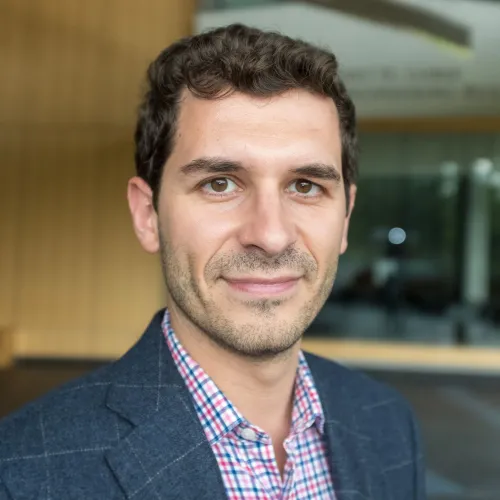
Dr. James Ewen is a Royal Academy of Engineering Research Fellow affiliated with the Tribology Group at Imperial College London's Department of Mechanical Engineering. He applies molecular simulations to study solid-liquid interfaces and links nanoscale behavior to macroscale performance, with applications in industrial lubrication and materials science. His work involves collaborations with multinational companies (Shell, SKF, Afton Chemical) and institutions like ETH Zürich and Diamond Light Source. Academic Affiliations : Imperial College London (Faculty of Engineering), Thomas Young Centre, Institute of Molecular Science and Engineering Research Themes : Tribology, mechanochemistry, biomimetic interfaces, molecular dynamics, thermal transport, and lubricant design His recent publications focus on friction control in biomimetic systems, mechanochemical decomposition of additives, and hybrid simulation methods. He has co-organized the Web Seminar Series on Tribology (WeSST) and the UK Fluids Network's NEMD-SIG, emphasizing non-equilibrium molecular dynamics. Scientific Awards : Wen Shizhu Maple Leaf Award (2022), RAEng Research Fellowship (2020), IOP Innovation in Tribology Award (2019) As an assistant supervisor to six PhD students, he bridges computational research with practical industrial challenges.
Professor Maths Halstensen is a distinguished faculty member in the Department of Electrical Engineering, Information Technology and Cybernetics at the University of South-Eastern Norway (USN), Faculty of Technology, Natural Sciences and Maritime Sciences, Campus Porsgrunn. With a career spanning over two decades since his 2002 PhD, he has established himself as a leading expert in chemometrics and process analytical technology, maintaining continuous research output through 2019 with significant contributions to industrial monitoring systems. His academic journey includes: PhD in Acoustic Chemometrics from NTNU (2002) MSc in Process Automation from Telemark University College (1997) BSc in Industrial Electronics from Gjøvik University College (1995) Professor Halstensen's research program centers on developing multivariate data analysis techniques for industrial process monitoring, with particular emphasis on: Acoustic chemometrics for multiphase flow characterization CO2 capture process optimization using spectroscopic methods Real-time monitoring of scale deposition in pipelines Multivariate regression modeling for energy and process prediction Raman and NIR spectroscopy applications in industrial settings His work bridges theoretical chemometrics with practical industrial implementations, focusing on solutions for metallurgy, chemical processing, and carbon capture sectors. Analysis of his 15 most recent publications reveals a dominant focus on carbon capture technologies (60% of recent work), particularly equilibrium measurements in ammonia-CO2 systems and real-time monitoring of absorption processes. His research demonstrates consistent application of multivariate modeling to solve industrial challenges, with strong emphasis on sensor development and practical implementation. Key methodological contributions include acoustic chemometric approaches for velocity measurement and novel calibration techniques for complex industrial mixtures. As leader of the ACRG Laboratory, Professor Halstensen directs research in: Acoustic sensor development for industrial environments Spectroscopic monitoring system integration Multivariate data analysis for process optimization Real-time control system implementation His teaching encompasses BSc, MSc, and PhD levels with focus on practical engineering skills. The research group benefits from institutional support through USN's strategic focus on 'Energy, climate and the environment,' with likely connections to Research Council of Norway funding and EU research programs. Professor Halstensen maintains active industry collaborations through his applied research on process monitoring solutions for energy-intensive industries.
Dr. Shobha Muthukumaran is an Associate Professor in Civil Engineering at Victoria University's College of Sport, Health and Engineering, and a Research Fellow at the Institute for Sustainable Industries & Liveable Cities. With over twenty-three years of experience including nine years in industry with the Pollution Control Board, she brings substantial practical expertise to her academic role. Her career progression at Victoria University shows steady advancement from Lecturer (2010) to Senior Lecturer (2013) to her current position as Associate Professor (2020). Her research expertise spans membrane separation processes, advanced water treatment, water recycling, resource recovery, green infrastructure, and circular economy applications in water and waste management. She has developed numerous practical solutions through strong collaborations with national and international universities, industry partners, and government bodies. Her work addresses critical sustainability challenges aligned with UN Sustainable Development Goals including Clean Water and Sanitation (SDG 6), Sustainable Cities and Communities (SDG 11), Climate Action (SDG 13), and Industry, Innovation and Infrastructure (SDG 9). Dr. Muthukumaran has secured over $2 million in competitive research grants from organizations including the Victorian State Government, National Centre of Excellence in Desalination Australia, and Australian Water Recycling Centre of Excellence. Her recent publications show a strong focus on practical water management solutions, with particular emphasis on membrane technologies, nature-based treatment systems, and sustainable waste management approaches that address climate change impacts and urbanization pressures. Vice Chancellor's Peak Award Citation for Excellence in Research & Research Training (Research Team Category) Two-and-a-half-year teaching time relief award through Victoria University's Collaborative Research Network As an active supervisor, she has guided 9 PhD students to completion and currently mentors 5 ongoing research students. Her supervision portfolio demonstrates strong industry engagement with projects addressing real-world water management challenges. She also contributes extensively to academic service, serving as a Detailed Assessor for ARC grant funding schemes, editorial board member for Environmental Quality Management journal, and peer reviewer for numerous high-impact journals.
Dr. Alfred Herritsch is a Senior Lecturer in the Department of Chemical and Process Engineering at the University of Canterbury's Faculty of Engineering, actively engaged since 2015. His research bridges industrial process optimization and educational innovation, with dual focuses on: Chemical process modelling (drying kinetics, steam methane reforming, bio-product extraction) Immersive learning technologies (VR plant simulations, Python integration in curriculum) His recent publications emphasize computational approaches to reaction engineering (2021 steam reformer studies) and electrochemical systems (2018-2019), alongside earlier foundational work on timber drying and virtual reality education tools. He actively supervises graduate researchers in extraction technology and sustainable process design. Dr. Herritsch champions educational modernization through: Virtual field trips replacing physical plant visits Active Video Watching for skill development Open-source Python adoption for engineering problem-solving
Jovan Kamcev is an Associate Professor of Chemical Engineering and Macromolecular Science and Engineering at the University of Michigan, where he leads the Kamcev Research Lab. His work bridges fundamental polymer science with practical applications in water purification, energy generation, and sustainable technologies. After joining the department in Fall 2019, he has built a thriving research group of nearly 20 members and recently earned tenure. Dr. Kamcev's research centers on membrane science, particularly ion-exchange membranes with applications ranging from desalination to energy storage. His lab investigates fundamental transport phenomena while developing next-generation polymeric materials that address pressing global challenges like water scarcity and sustainable energy. His work spans both water-focused applications (desalination, brine waste management, resource recovery) and energy applications (batteries, fuel cells, electrolysis). His recent publications reveal a strategic expansion from water purification toward energy applications, with a growing emphasis on hydrogen production through water electrolysis using novel anion-exchange membranes. His team has made significant breakthroughs in overcoming the permeability-selectivity trade-off that has long limited membrane performance, particularly through the development of ultrahigh charge density membranes with carefully controlled water content. ECS Toyota Early Investigator Fellowship Award (2025) AIChE 35 Under 35 Award (2023) NSF CAREER Award (2023) PMSE Early Investigator Award (2024) DOE Early Career Research Award (2021) NAMS Young Membrane Scientist Award (2021) Dr. Kamcev has successfully mentored numerous students, including José Carlos Díaz (now at Berkeley National Laboratory), and secured substantial funding from diverse sources including NSF, DOE, and the National Alliance for Water Innovation. His lab actively engages in outreach, including STEM programs for underrepresented students and hands-on water filtration demonstrations for K-12 students. Current research directions include developing membranes for brine valorization, carbon-neutral fertilizer production, and advancing hydrogen technologies through improved anion-exchange membranes.
Dr. Yujie Qi is a Senior Lecturer at the University of Technology Sydney (UTS), specifically within the School of Civil and Environmental Engineering. She serves as Program Co-leader of the UTS Transport Research Center (TRC) within the Faculty of Engineering and Information Technology. Her academic journey began with Bachelor's and Master's degrees in (Civil/Geotechnical) Engineering at Zhengzhou University, China, followed by a PhD from the University of Wollongong (UOW), Australia, which she completed in 2018 with an 'Industry Engagement Award' and 'Special Commendation' for outstanding doctoral research. Dr. Qi's educational background includes: PhD in Geotechnical Engineering from University of Wollongong (2014-2018) Master's degree in Geotechnical Engineering from Zhengzhou University (2011-2014) Bachelor's degree in Engineering from Zhengzhou University (2007-2011) Bachelor of Art from Zhengzhou University (2009-2011) Dr. Qi's primary research focuses on soil dynamics, granular mechanics, geo-mathematical modeling, and large-scale dynamic testing , with particular emphasis on the innovative use of waste and marginal materials in transport infrastructure . Her pioneering work on energy-absorbing materials has revolutionized approaches to railway track design, specifically through the utilization of waste rubber to enhance rail substructure performance. She has conducted extensive investigations on three key waste materials: discarded coal wash from Australian coal mines, steel furnace slag from steel manufacturing plants, and rubber crumbs derived from off-the-road vehicle tires. For the first time, she identified optimal ratios of these waste materials to enhance railway longevity and developed energy-absorbing concepts to analyze and interpret track substructure deformation mechanisms. Dr. Qi has been instrumental in introducing energy-absorbing materials to enhance rail substructure performance, and her research has been recognized by national and international firms including Bridgestone and Sydney Trains. The recent publications by Dr. Qi demonstrate a strong focus on sustainable transportation infrastructure using recycled materials, particularly rubber-based solutions for railway engineering. Her work spans from fundamental material characterization to large-scale field testing, with particular emphasis on energy absorption properties, track performance improvement, and circular economy applications. The research consistently bridges theoretical modeling with practical engineering applications, showing how waste materials can be effectively repurposed to solve infrastructure challenges while reducing environmental impact. A notable trend in her recent work is the integration of machine learning methodologies with traditional geotechnical approaches to predict material behavior and optimize infrastructure design, as evidenced by her publications on hybrid ML methodologies for predicting rail ballast breakage. Dr. Qi's exceptional contributions have been recognized with numerous prestigious awards: John Carter Young Professional Award (2024) Sir M. Visvesvaraya Award from ICE (UK) (2023) Bright Spark Lecture Award from ISSMGE (2018) Best Paper Award at the 9th Asian Young Geotechnical Engineers Conference (2019) Award for Industry Engagement Impact from University of Wollongong (2017) Examiners' Commendation for Outstanding Thesis (2018) Dr. Qi has successfully secured significant research funding, including ARC Discovery Projects (DP220102862) titled 'The Role of Energy Absorbing Rubber Grid on Ballast Track Performance' (2022-2025) and ARC Linkage Projects (LP200200915) titled 'Field Data based Predictive Maintenance and Enhanced Track Design Procedure' (2021-2025). She actively supervises research students across multiple projects focused on energy-absorbing materials, track performance, and waste material applications in transportation infrastructure. Her teaching portfolio includes subjects such as Problematic Soils and Ground Improvement Techniques, Road Engineering Practice, Mechanics of Solids, and Soil Behaviour, where she has served as coordinator, teacher, and tutor. As Program Co-leader of the UTS Transport Research Center, Dr. Qi collaborates with a multidisciplinary team of researchers focused on innovative transportation solutions. Her laboratory work involves advanced testing facilities including large-scale process simulation testing apparatus (PSTA) and prototype cubic triaxial facilities for evaluating material behavior under cyclic loading conditions. The research group has conducted significant field trials, including a fully instrumented track section at Chullora, New South Wales, to validate laboratory findings in real-world conditions. Dr. Qi's team maintains strong industry connections with organizations such as Sydney Trains and Bridgestone, ensuring practical relevance and implementation potential for their research outcomes, while promoting sustainable and cost-effective practices in transportation infrastructure.
Professor Matthias Hannig is a distinguished researcher and faculty member at Saarland University's Faculty of Medicine, based at the University Hospital of Saarland in the Clinic for Restorative Dentistry, Periodontology and Preventive Dentistry in Homburg, Germany. His research program focuses on the fundamental mechanisms of oral biofilm formation and strategies for its control, with particular emphasis on the initial stages of bacterial colonization in the oral cavity. Professor Hannig's research interests span oral biofilm science, dental materials, periodontology, and preventive dentistry. His work investigates protein adhesion mechanisms on dental surfaces, pellicle composition and dynamics, and the development of novel strategies to control bacterial colonization through nanoscale approaches, natural compounds, and surface modifications. His research has significant implications for developing improved preventive strategies against dental caries, periodontal disease, and peri-implantitis. Analysis of Professor Hannig's recent research output reveals a strong focus on the molecular and nanoscale mechanisms underlying initial oral biofilm formation. His work bridges fundamental science with clinical applications, exploring both natural compounds (like polyphenols and milk components) and engineered solutions (such as antifouling surfaces) for preventing bacterial adhesion. The research spans multiple disciplines including microbiology, biochemistry, materials science, and biophysics, demonstrating an interdisciplinary approach to solving complex problems in oral health. Professor Hannig has secured significant research funding from the German Research Foundation (DFG), serving as principal investigator for numerous projects examining various aspects of oral biofilm formation and prevention. His research program includes both basic science investigations into protein adsorption and biofilm dynamics, as well as applied research developing practical preventive strategies for clinical dentistry. His laboratory work focuses on characterizing interactions between biological fluids, dental materials, and oral microorganisms at the molecular level. This research provides foundational knowledge for developing improved dental materials, preventive treatments, and diagnostic approaches in restorative dentistry and periodontology.
Mogens Larsen Andersen serves as a Professor with special responsibilities in the Department of Food Science at the University of Copenhagen's Faculty of Science. His research centers on mechanistic understanding of oxidative changes in foods, with expertise in Electron Spin Resonance (ESR) spectroscopy applications for studying lipid/protein oxidation and molecular mobility in complex food systems. Education: PhD in Chemistry, University of Copenhagen (1993) MSc (cand.scient.) in Chemistry, University of Copenhagen (1990) Research Focus: Professor Andersen investigates antioxidant-prooxidant dynamics in food matrices, particularly in beverages (beer/wine) and dairy products. His work combines physical chemistry principles with practical food stability challenges, examining how microviscosity, phase transitions, and radical intermediates affect shelf-life. Current projects explore ozone applications for grain preservation and molecular mechanisms behind beer haze formation. Publication Trends: Recent work (2025-2026) reveals concentrated efforts in beverage stabilization (addressing oxidation in beer), dairy powder functionality , and alternative preservation methods like ozone treatment. These studies consistently bridge fundamental radical chemistry with industrial food quality challenges. Professional Engagement: Editorial Board, Journal of the American Society of Brewing Chemists (2013-present) Invited Member, Brewing Science Group (European Brewery Convention) Co-Chair, Joint Committee on Brewing Science Education (University of Copenhagen & Scandinavian Brewing School) Teaching & Mentoring: He leads the BSc "Food Chemistry" course and PhD "ESR Spectroscopy" course while contributing to beverage technology and brewing modules. Though specific student names aren't documented, his courses train next-generation food scientists in analytical techniques and stability mechanisms. Research Infrastructure: Andersen operates within the Ingredient and Dairy Technology section, utilizing ESR spectroscopy facilities for radical studies while collaborating with brewing industry partners through the European Brewery Convention network.