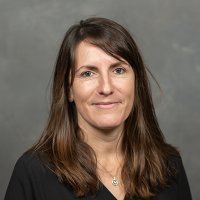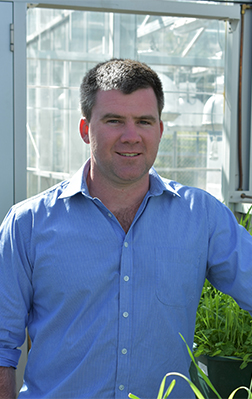
Robert MitchellView profile
Adjunct Professor
Robert Mitchell serves as a USDA Research Agronomist and Adjunct Professor in the Department of Agronomy and Horticulture at the University of Nebraska-Lincoln's College of Agricultural Sciences and Natural Resources. His work bridges federal agricultural research with academic instruction, focusing on practical applications for crop producers. Education: B.S. Natural Resource/Wildlife, University of Nebraska, 1989 M.S. Agronomy/Range & Forage, University of Nebraska, 1992 Ph.D. Agronomy/Range & Forage, University of Nebraska, 1995 Mitchell's research centers on bioenergy crop development and grassland management systems , with emphasis on perennial grass establishment, growth physiology, and ecological integration. His investigations address critical challenges in converting marginal cropland to sustainable bioenergy production while maintaining soil health and ecosystem services. Key themes include switchgrass agronomy, carbon sequestration dynamics, and balancing biomass yield with environmental stewardship across Midwestern landscapes. Analysis of his 25+ publications (2012-2016) reveals consistent focus on perennial grass bioenergy systems , particularly switchgrass genetics and management. His work demonstrates interdisciplinary integration of agronomy, ecology, and soil science, with recurring themes in feedstock sustainability, genetic improvement, and landscape-scale environmental impacts. Collaborative studies often involve USDA-ARS, university partners, and multi-institutional bioenergy initiatives. Scientific Awards: No awards documented in source material Mitchell's project activities emphasize applied research for producer adoption, including optimizing grass establishment protocols and marginal land utilization strategies. While specific grants aren't listed, his publications reflect sustained funding through USDA programs and regional bioenergy partnerships. No student advisement details appear in the provided text. His research operates within USDA-University collaborative frameworks, leveraging field trials across Nebraska and the Midwest to develop practical management guidelines for perennial bioenergy systems.