Thomas Brunet is a researcher at the University of Bordeaux, specializing in physical acoustics and functional materials for acoustics. His work spans ultrasound physics, material characterization, and advanced modeling/simulation techniques. Key collaborations with research groups: APY (Physical Acoustics) , Functional Materials for Acoustics , and GCE (Civil and Environmental Engineering) . Focus areas: acoustic metamaterials , Anderson localization , contactless micromanipulation , and viscoelastic wave propagation . His publications (over 30 in the last decade) demonstrate expertise in ultrasonic imaging, nanophononics, and multiphysics problems involving mechanical, thermal, and fluid interactions. Collaborative projects include DuMAS (Sustainability of Materials) , IMC (Mechanical Engineering) , and MPI (Materials-Procedes-Interactions) initiatives. No formal awards or student advising details are publicly available in the provided data.
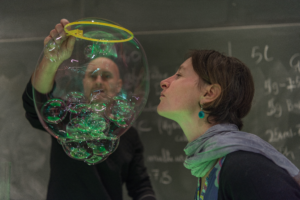
Emmanuelle RIO is a Professor of Physics at Paris-Saclay University, specializing in soft matter physics with a focus on interfacial flows and the stability of soapy objects such as foam films, bubbles and foams. She is affiliated with the Laboratoire de Physique des Solides (LPS) at Université Paris-Saclay and has maintained a strong research presence in the Physics Department. Her research interests span multiple areas of soft matter physics, particularly examining the mechanical properties of interfaces and their relationship to the macroscopic behavior of foams. She investigates surface rheology, thin film thinning, drainage and evaporation processes, and the stability mechanisms of foam films and bubbles. Her work bridges fundamental physics with practical applications in fluid dynamics. Analysis of her recent publications reveals a strong emphasis on foam coarsening dynamics, bubble stability under various conditions, and the effects of surface properties on foam behavior. Her research frequently employs experimental approaches to study thin film hydrodynamics, interfacial phenomena, and the impact of environmental factors like humidity on foam stability. Accreditation to direct research (HDR), 2013, Paris Sud University PhD in Hydrodynamics, 2005, Paris 6 University Post-doctoral fellowship at Danish Technological University (2005-2006) Professor RIO actively contributes to science communication, having authored popular science articles in The Conversation, participated in TV programs like 'Incroyables expériences' and 'C'est toujours pas sorcier,' and conducted workshops on bubble physics for educational outreach.
Luc Avérous is a University Professor at the School of Chemistry, Physics, and Materials (ECPM) at the University of Strasbourg, France, where he teaches bioplastics, composites, and polymer processing. He is a leading researcher at ICPEES (Institute of Chemistry and Processes for Energy, the Environment and Health), heading the BioTeam research group and directing the Mutaxio joint laboratory with the Soprema group. His research spans biopolymers, sustainable macromolecular architectures from renewable resources, and biomaterials for environmental and biomedical applications. Key interests include biodegradable polyesters, vitrimers, enzymatic catalysis, bio-recycling, tissue engineering, and 3D/4D printing. His work emphasizes a cradle-to-cradle approach, integrating green chemistry and circular economy principles. The recent publications highlight a strong trend in biosourced materials, particularly from lignin, tannins, fatty acids, and sugars. Research focuses on developing sustainable alternatives to conventional polymers, including non-isocyanate polyurethanes (NIPU), polyamides (PA), and polyisocyanurates (PIR), with applications in foams, membranes, and biomedical devices. There is a clear emphasis on enzymatic processes, degradation mechanisms, and life cycle sustainability. TOP 1% of scientists in the world Luc Avérous has supervised numerous PhD and postdoctoral researchers through his BioTeam and Mutaxio lab. He has secured funding from major national (ANR, BpiFrance, PIA) and international (H2020, EU-China, AUF) programs. He collaborates extensively with industry (Soprema, Tereos, Stellantis, Veolia) and academic partners worldwide (Australia, Canada, Latin America, EU). He serves on research advisory boards, editorial boards of scientific journals, and international grant juries (ERC, Horizon, FWO). He leads the BioTeam at ICPEES and the Mutaxio joint laboratory with Soprema, focusing on translational research in sustainable polymers. These labs integrate expertise in synthesis, formulation, characterization, and processing of advanced bio-based materials for industrial and biomedical applications.
Ronan Lebullenger is an Associate Professor at the University of Rennes, specializing in materials science and biomedical engineering. His research focuses on bioactive glasses, 3D-printed bone scaffolds, optical fiber fabrication, and catalytic materials for environmental applications. Recent publications highlight advancements in bioactive glass for cleft palate surgery additive manufacturing of chalcogenide glass components catalytic glass foams for VOC degradation His work spans interdisciplinary domains including biomedical engineering, optical materials, and sustainable chemical processing. Collaborations with researchers in France and abroad demonstrate his role in advancing glass-based technologies for medical and environmental uses.
Zengxu GUO is a researcher affiliated with Université de Technologie de Troyes (UTT), holding a Doctorate. His research focuses on thermal energy storage systems, phase change materials (PCMs), and operations research with particular emphasis on inventory optimization. Key areas of expertise include enhancing thermal performance through metal foam integration, analyzing inclination effects on heat transfer, and modeling inventory systems for omnichannel environments. His work bridges experimental and computational methods, with notable contributions to understanding PCM behavior in porous media and optimizing inventory policies under dual demand classes. Recent studies (2021-2024) explore thermal tank design, aspect ratio impacts, and cost evaluation frameworks for inventory models. Publications highlight interdisciplinary approaches combining materials science with thermal engineering and supply chain optimization, demonstrating strong methodological rigor through experimental validation and numerical simulations.
Peter Spelt is a Professor in the Department of Mechanical Engineering at École Centrale de Lyon, where he conducts research in the Laboratory of Fluid Mechanics and Acoustics (LMFA - UMR 5509). He leads research in the Turbulence & Instabilities and Complex Fluids and Transfer teams, focusing on advanced numerical simulations of fluid phenomena. His primary research interests include fluid mechanics with emphasis on two-phase flows, capillary flows, wetting dynamics, cavitation phenomena, multi-scale modeling of suspensions, and the effects of surfactants in two-phase systems. His work bridges fundamental fluid dynamics with practical applications in engineering systems. Professor Spelt's recent publications demonstrate a strong focus on numerical methods for simulating complex fluid interfaces, particularly using level-set methods for tracking moving contact lines in three-dimensional flows. His research shows consistent contributions to understanding instabilities in multi-layer flows and the dynamics of bubble suspensions. He currently supervises several PhD students including Aurore Loisy, Zlatko Solomenko, Andrea Titta, and Marion Capuano, and collaborates internationally with researchers from institutions including University of Science and Technology of China, University College Dublin, Xi'an Jiaotong-Liverpool University, Queen Mary University of London, and The University of Edinburgh. Professor Spelt leads ANR-funded projects including ICEWET and SURFBREAK, which focus on advanced numerical simulations of capillary flows and two-phase flows with surfactants. His research group regularly offers laboratory internships for M2 students in these specialized areas of computational fluid dynamics.
Anne-Laure Biance is a CNRS Research Director at the Institut Lumière Matière (iLM) in Université Lyon 1, where she leads the "Liquid and Interfaces" team. Since 2018, she has also held teaching duties as a Professeur Chargée de Cours at École Polytechnique in the mechanical engineering department. Her research spans multiple institutions, including previous visiting positions at Tanaka's soft matter lab at Tokyo University (2014-2016). Her educational background includes a PhD from the Collège de France (2001-2004) under Quéré's group, a Master in liquid physics from Université Paris 6 (2000-2001), and studies at ESPCI (1997-2001). Biance's research focuses on interfacial hydrodynamics , particularly in nanofluidic systems, bubbles and foams, droplet dynamics, and the interactions of fibers, grains and water. Her work combines experimental approaches with theoretical modeling to understand transport phenomena at small scales. She has developed innovative experimental platforms to probe ionic flows, femtoL/s flow rates, and heat transfer in nanometric liquid films. Her research has applications in filtration, depollution, desalination, energy harvesting, and biomolecular analysis. Analysis of her recent publications reveals a strong focus on nanofluidic transport phenomena, particularly ionic transport in confined geometries, interfacial electrokinetics, and the behavior of soft matter systems like foams and droplets under various stimuli. Her work increasingly bridges fundamental physics with practical applications in environmental technology and energy conversion. Biance leads major research projects including ANR SoftNanoflu, FET-OPEN Progeny, and Nectar projects. She has supervised numerous PhD students including Yedhir Mezache (defended 2022), Grégoire Martouzet (defended 2022), and Aymeric Allemand (defended 2023), while currently mentoring Changwoo Bae, Rachel Piednoir, and others. Her research is funded by CNRS, ANR, and international collaborations. She maintains an active laboratory at Institut Lumière Matière (Campus de la Doua, Brillouin building), where her team develops novel experimental approaches for studying nanofluidic systems, foam stability under electrical stimuli, and droplet dynamics. Her work environment fosters collaboration between physicists, chemists, and engineers working on complementary aspects of interfacial phenomena.
Oriane Bonhomme is an Assistant Professor at Université Claude Bernard Lyon 1 , affiliated with the Institut Lumière Matière (ILM) and its Optique Non-Linéaire Et Interfaces (ONLI) team. Her research focuses on molecular-scale analysis of soft matter systems, particularly soap films and interfaces, using advanced non-linear optical techniques like Second Harmonic Generation (SHG) and Rayleigh scattering. She leads the ANR SOLSTICE project on soap film stability and collaborates on the PROGENY FET OPEN project studying electronic soap films. Teaching : Institut Universitaire de Technologie de Lyon (Department of Mechanical and Manufacturing Engineering) Key Techniques : QM/MM polarizable embedding, SHG diagnostics, electrokinetic modeling Her work intersects non-linear optics , surface science , and soft matter physics , with recent publications analyzing surfactant behavior under electric fields, hyperpolarizability fluctuations in water, and nanoscale diagnostics of liquid interfaces. She actively recruits postdoctoral researchers for projects involving molecular-scale stability and optical probing of complex systems. Scientific Awards : ANR SOLSTICE Project funding FET OPEN Project PROGENY Contact: oriane.bonhomme@univ-lyon1.fr
Sandrine Tusseau-Nenez is a Research Engineer and Head of the X-ray diffraction platform (DIFFRAX) at École Polytechnique's Department of Physics, within the Condensed Matter Physics Laboratory. With a PhD in Chemistry and Physics from the University of Dijon, she has developed extensive expertise in materials characterization, particularly X-ray diffraction techniques for both polycrystalline and thin film materials. Member of the PANalytical Users Club office since 2010 Member of the Reciproqs professional network Member of the French crystallography association Competent person in radiation protection since 2005 Her educational background includes a Professional License in Materials Analysis from Paris-Diderot University and specialized courses at CNAM-entreprises, focusing on metallurgy, metallography, and X-ray diffraction. Her technical expertise spans X-ray diffraction, thermodynamic analyses (ATD-ATG, DSC), material characterizations (SEM-EDX, BET), and phase diagram calculations using the Calphad method. Dr. Tusseau-Nenez's research focuses on applications of powder diffraction techniques for analyzing materials microstructure, with recent expansion into XRD thin film analysis. Her publication record shows consistent output across materials science, nuclear physics, and chemistry, with particular emphasis on uranium carbide targets for radioactive beam production, cement chemistry, and nanomaterials characterization. The analysis of her 15 most recent publications reveals a strong interdisciplinary approach connecting materials characterization with applications in nuclear physics, energy production, and civil engineering. 64 total publications with 874 citations Research spanning nuclear target materials, cement chemistry, and nanomaterials Active collaboration across physics, chemistry, and engineering disciplines As a research supervisor, she has co-supervised multiple PhD theses and numerous internships, demonstrating her commitment to training the next generation of materials scientists. Her leadership of the DIFFRAX platform provides critical characterization capabilities for researchers across École Polytechnique and collaborating institutions.
Marie Duquesne is a Teacher-Researcher affiliated with the University of La Rochelle, working within the E2 - BVD research team. Her research bridges thermal science and sustainable engineering, with a focus on optimizing energy efficiency in buildings and electronics through advanced materials. Research Interests: Dr. Duquesne's work centers on three interconnected pillars: Thermal Energy Storage : Developing latent heat systems using phase-change materials (PCMs) for seasonal energy conservation. Phase Change Materials : Innovating bio-based and shape-stabilized PCMs for eco-friendly applications. Eco-Responsible Building : Designing sustainable construction materials (e.g., hemp concrete composites) to enhance hygrothermal performance and reduce carbon footprints. Publication Trends: Her recent articles (2021–2025) emphasize experimental and computational approaches to thermal management. Key themes include infrared thermography for material analysis, numerical modeling of building envelopes, and bio-sourced PCMs. Collaborative works frequently address electronics cooling, passive energy storage, and hazard reduction in consumer products. Affiliations & Collaboration: She actively collaborates with multidisciplinary teams (e.g., materials scientists, building physicists) and contributes to projects involving carbon foams, metal alloys, and electronic device safety. The E2 - BVD team facilitates applied research in energy-efficient technologies.
Richard MARCHAL is an Associate Professor at the University of Reims Champagne-Ardenne, where he conducts extensive research in wine chemistry with a particular focus on Champagne wine properties. His work primarily centers on understanding the complex relationship between wine composition and foaming properties, with numerous publications spanning over two decades in this specialized field. Dr. MARCHAL's research interests encompass multiple aspects of enology and oenology, with particular expertise in Champagne wine chemistry, protein composition in wines, macromolecules in wine, and the physical chemistry of wine foam. His work bridges fundamental chemistry with practical applications in winemaking, particularly focusing on how various factors such as grape variety, processing techniques, and microbial activity affect the final product's quality characteristics. His research has significantly contributed to understanding the scientific basis behind Champagne's distinctive effervescence and foam stability. Analysis of his publication record reveals a consistent research trajectory focused on the physicochemical properties of wine, particularly Champagne. His work demonstrates expertise in analytical techniques including proteomics, mass spectrometry, and various physicochemical characterization methods. The research shows progression from basic characterization of wine components to more complex investigations of how these components interact to create Champagne's unique sensory properties. His collaborations span multiple institutions and countries, indicating his work's international recognition in the field of enology. Throughout his career, Dr. MARCHAL has maintained an active research program with consistent publication output, demonstrating sustained contribution to the scientific understanding of wine chemistry. His work has practical implications for winemakers seeking to optimize Champagne production processes and maintain consistent quality in their products.
Emmanuelle RIO is a Professor of Physics at Paris-Saclay University, specializing in soft matter and interfacial flows. She holds an HDR (Accreditation to Direct Research) from Paris Sud University (2013) and a PhD in Hydrodynamics from Paris 6 University (2005). Her research focuses on the stability and dynamics of foams, bubbles, and thin films, with particular emphasis on surface rheology and evaporation-driven processes. Education: PhD in Hydrodynamics, 2005, Paris 6 University Accreditation to Direct Research (HDR), 2013, Paris Sud University Professor at Paris-Saclay University since 2020 Research Interests: Her work explores the interplay between physical chemistry and fluid dynamics in soft matter systems. Key areas include: Stability mechanisms of soapy objects (foams, bubbles, films) Surface rheology and its impact on macroscopic behavior Evaporation-driven film thinning and rupture Coarsening dynamics in viscoelastic foams Recent Publications Trends: Her articles analyze foam dynamics under varying conditions (e.g., microgravity, viscoelastic matrices) and focus on surface-driven phenomena such as bubble mobility and film stability. Key themes include: Friction reduction in foams using textured surfaces Surfactant dynamics in elongational flows Coarsening transitions in wet foams Awards: Recipient of the Three Physicists Prize Teaching & Leadership: She heads the Soft Matter and Biophysics track in the ICFP Master’s program and teaches courses on complex fluids and interfacial flows. Her educational contributions include: Master’s lectures in Fundamental Physics and Applied Fluid Dynamics Development of experimental teaching modules for physics undergraduates Research Teams & Labs: Her research is conducted within the Physics Department at Paris-Saclay University, collaborating with interdisciplinary teams to explore fluid interface phenomena and soft matter systems.
Jean-Philippe BONNET is a Lecturer at Aix-Marseille University (AMU) , affiliated with the Membrane Processes team . His research focuses on membrane technology applications in industrial and environmental contexts, particularly ultrafiltration and pervaporation processes. Key Research Areas: Membrane separation, fluid dynamics, wastewater treatment, olive oil processing, and fouling analysis Collaborations: Extensive work with Philippe Moulin and other researchers at M2P2 laboratory His recent publications address membrane performance in pharmaceutical solvent recovery, water reuse systems, and industrial effluent treatment. Notable projects include landfill leachate management and olive oil decantation studies. Scientific Expertise: Membrane Fouling and Aging Process Intensification Fluid Dynamics in Porous Media Ultrafiltration for Aquaculture Pervaporation for Solvent Recovery Membrane Integrity Testing
Antoine Bérut is a Lecturer at the University of Lyon 1, affiliated with the Institute of Light and Matter and the GMP (Génie Mécanique et Productique) department. His research focuses on soft matter physics, including granular media, fracture mechanics, and non-equilibrium statistical physics. Previously, he conducted post-doctoral research at the IUSTI laboratory (studying plant gravitropism and shear-thickening suspensions) and the Institut de Physique de Rennes (foam stability under shear). His doctoral work at the Laboratoire de Physique de l'ENS de Lyon involved optical tweezers studies of Brownian particles. Current role: Lecturer, University of Lyon 1 (2018–present) Post-doctoral positions: IUSTI (2015–2017), Institut de Physique de Rennes (2017–2018) Ph.D. in Physics (2012–2015), École Normale Supérieure de Lyon His research spans diverse topics such as: Non-equilibrium thermodynamics and information theory Shear-thickening suspensions and granular flows Biological systems (plant gravitropism) Quantum-classical analogies in statistical mechanics Experimental methods using optical tweezers and particle tracking Scientific accolades include: Young Researcher Award (2019), Metropolis of Lyon Ph.D. Prize 'Prix Saint Gobain' (2015), French Physical Society He contributes to educational tools via Python data analysis scripts and LaTeX thesis templates. Current projects explore foam stability, granular media rheology, and biophysical sensing mechanisms.
Professor Isabelle Cantat is a leading researcher in soft matter physics at the Institute of Physics of Rennes (IPR), University of Rennes 1. She holds the position of Professor and served as Head of the Soft Matter Department from 2016 to 2023. In 2022, she was appointed as a Senior Member of the Institut universitaire de France for the period 2022-2027. Her research primarily focuses on the rheology of liquid foams and soap films, with significant contributions to understanding foam stability and dynamics. Professor Cantat earned her doctoral degree from Grenoble University in 1999 with a thesis on "Dynamical behavior of adhering vesicles" under C. Misbah's supervision. She completed her habilitation to supervise research in 2006. Her academic career includes positions as assistant professor at University of Rennes 1 (2000-2007), postdoctoral fellowships at Düsseldorf University (1999-2000) and Cornell University (2006-2007), and visiting fellowships at Princeton University (2014) and DAMTP, Cambridge (2023). Her research interests center on the physics of liquid interfaces, with particular emphasis on foam rheology, soap film dynamics, and interfacial phenomena. Professor Cantat combines theoretical modeling with experimental approaches to investigate small-scale free-surface hydrodynamic flows in the presence of surfactants—including drops, bubbles, and soap films—and larger-scale liquid foams. Her work has significant applications across multiple industries, including cosmetics, food production, and construction materials where foam properties are critical. Professor Cantat was awarded the prestigious CNRS Silver Medal in 2023, recognizing her outstanding contributions to science. She previously served as Principal Investigator for the ERC DISFILM project (2017-2023), a Consolidator Grant focused on "Stability and dissipation properties of soap films and liquid foams," where her team highlighted how liquid circulates between bubbles when foam is deformed and understood the role of surfactants in this process. She has supervised numerous PhD students and postdoctoral researchers, contributing significantly to training the next generation of scientists in soft matter physics. Professor Cantat is also the co-author of the authoritative book "Foams: Structure and dynamics" (Oxford University Press, 2013), which has become a standard reference in the field. Her laboratory at IPR continues to produce cutting-edge research on foam mechanics and interfacial phenomena.