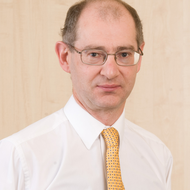
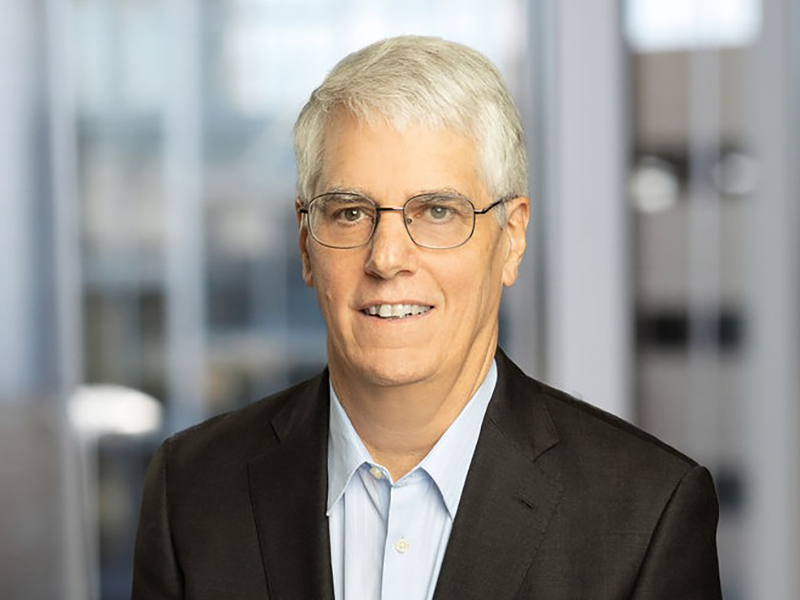
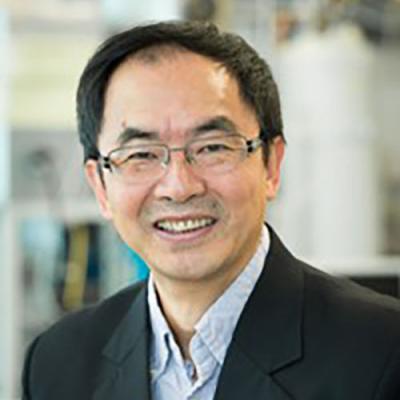
Dr John Longley is a Senior Lecturer in Engineering at the Whittle Laboratory, Department of Engineering, University of Cambridge. He specializes in unsteady and non-uniform flow phenomena in turbomachinery and leakage flow effects on aerodynamic performance. Education: PhD at Cambridge University; BSc in Applied Mathematics Prior Employment: Ruston Gas Turbines (aerodynamic design of transonic turbines); MIT (VSTOL aerodynamic research) Research Focus: His work bridges theoretical and applied fluid dynamics in aerospace and mechanical engineering, particularly in turbomachinery optimization. Publication Trends: Recent research explores stator platform geometry impacts on turbine efficiency and unsteady flow modeling in gas turbines. Awards: ASME 2009 Gas Turbine Award for air-curtain over-tip seal research GPPS 2019 Best Paper Award (with Dr Derek Taylor) Contact: jpl@eng.cam.ac.uk | Phone: 01223 337583
Miroslav Bulíček is an Associate Professor at the Mathematical Institute of the Faculty of Mathematics and Physics, Charles University in Prague, Czech Republic. He has been with Charles University since 2006, progressing from Researcher to Senior Assistant Professor (2012-2021) and currently serving as Associate Professor since January 2022. He is also a Senior Researcher at the University Center for Mathematical Modeling, Applied Analysis and Computational Mathematics (MathMac) since 2014. His educational background includes a habilitation in Mathematics-Mathematical Analysis from Charles University (2021), a Ph.D. in Mathematical and Computational Modeling from Charles University (2003-2006), and a Master's degree in Mathematical modeling in physics and technology from Charles University (1998-2003). Bulíček's research focuses on Partial differential equations, Continuum thermodynamics, and Mathematical modelling . His work primarily addresses the mathematical analysis of nonlinear systems describing flows of incompressible fluids, with particular emphasis on thermodynamically compatible models, implicit constitutive relations, and viscoelastic rate-type fluids. He has made significant contributions to the understanding of existence, uniqueness, and regularity of solutions to complex fluid models, especially those describing far-from-equilibrium systems in continuum thermodynamics. His recent publications demonstrate a strong focus on advanced mathematical analysis of fluid models with applications in material sciences. The research trends show increasing sophistication in handling non-Newtonian fluids, stress-diffusion phenomena, and thermodynamically consistent models. His work bridges pure mathematical analysis with practical applications in continuum mechanics, particularly in the analysis of viscoelastic rate-type fluids with stress diffusion. NEURON Fund for Support of Science Award (2012) for the project "Qualitative analysis of incompressible Navier-Stokes-Fourier equations" Czech Mathematical Society Award for young researchers (2014) for publications during 2009-2013 Bulíček has successfully supervised multiple PhD students including Mark Dostalík, Michael Zelina, Michal Bathory, and Tomáš Los. He serves as principal investigator for the GAČR project 20-11027X "Mathematical analysis of partial differential equations describing far-from-equilibrium open systems in continuum thermodynamics" (2020-present). His research has been supported by various grants including GAČR project 18-12719S, GAČR 16-03230S, and ERC-CZ no. LL1202, demonstrating sustained funding for his research program. He is actively involved in the University Center for Mathematical Modeling (MathMac) and has organized several international conferences and workshops, including the "Modelling, partial differential equations analysis and computational mathematics in material sciences" conference in Prague (2024) and the "Mathematical Aspects of Fluid Flows" EMS School in Kácov (2024), contributing significantly to the mathematical community in fluid dynamics and partial differential equations.
Dr. Robert D. Moser is a Professor at the University of Texas at Austin and holds the W.A. "Tex" Moncrief, Jr. Chair in Computational Engineering and Sciences I. He is affiliated with the Thermal and Fluid Systems program, the Institute for Computational Engineering and Sciences (ICES), and serves as Director of the DOE-funded Center for Predictive Engineering and Computational Sciences (PECOS). Ph.D. in Mechanical Engineering from Stanford University (1984) His research focuses on computational methods for turbulence modeling, cardiovascular fluid mechanics, and uncertainty quantification in complex physical simulations. He develops large-eddy simulation techniques for aerospace applications and biological flow analysis, while pioneering methods to characterize uncertainties in reentry vehicle simulations and turbulence modeling. Dr. Moser leads interdisciplinary research at PECOS and ICES, combining computational engineering with biomedical applications. His work spans theoretical turbulence physics, numerical methods for Navier-Stokes equations, and practical implementations for aerodynamic and medical device design.
Nagu Daraboina serves as Associate Professor of Chemical Engineering and Associate Director of the Tulsa University Paraffin Deposition Projects at The University of Tulsa’s Russell School of Chemical Engineering. His research pioneers hydrate-based technologies for flow assurance, carbon capture, storage and utilization (CCSU), produced water desalination, and energy recovery, with significant experimental advancements in water treatment and carbon capture systems. His educational background includes: Ph.D. in Chemical & Bio Engineering from University of British Columbia (2008) MBA from The University of Tulsa (2019) M.S. from Indian Institute of Science (2006) B.S. in Technology from Jawaharlal Nehru Technological University (2002) Dr. Daraboina's research focuses on critical energy sector challenges through flow assurance in oil/gas pipelines, CCSU, produced water management, and energy recovery. His group develops innovative hydrate-based experimental approaches that enhance sustainability and efficiency in hydrocarbon production while addressing environmental concerns through novel water treatment and carbon capture methodologies. His 2024-2025 publications reveal concentrated expertise in hydrate technology applications for desalination and carbon capture, alongside flow assurance challenges like wax/paraffin deposition. The research integrates thermodynamic modeling, kinetic studies, and experimental validation to optimize energy efficiency in produced water treatment and pre-combustion CO2 capture systems, with direct industry relevance for oil and gas operations. Notable awards include: Society of Petroleum Engineers Regional Projects, Facilities, and Construction Award (2025) University of Tulsa Faculty Champion of Global Engagement Award (2025) University of Tulsa Distinguished Graduate Mentor Award (2024) Zelimir Schmidt Outstanding Researcher Award (2023) Donald W. Davidson Gas Hydrates Research Award (2023) Stanford University Top 2% Most Cited Scientist (2022) Influential Researcher Award (2021) Rising Star in Energy Research (2021) Recognized with the Distinguished Graduate Mentor Award (2024), Dr. Daraboina actively supervises graduate researchers despite specific student names not being publicly listed. His research group's extensive publication record and industry partnerships indicate substantial grant funding from energy sector stakeholders and federal research agencies. He leads the Daraboina Research Group and directs the Tulsa University Paraffin Deposition Projects, which operates specialized laboratories for flow assurance testing, hydrate formation studies, and multiphase flow experiments. The group collaborates with industry partners on pipeline transport challenges and develops next-generation technologies for sustainable energy production.
Malte Laurens Kampschulte serves as Assistant Professor at the Department of Mathematical Analysis, Faculty of Mathematics and Physics, Charles University in Prague. He leads research within S. Schwarzacher's fluid structure interaction group and the OP JAK project FerrMion, following his role as Substitute Professor at the University of Leipzig during Summer 2024. His academic credentials include: B.Sc in Mathematics (2009) and Computer Science (2010) from RWTH Aachen M.Sc in Mathematics (2012) from RWTH Aachen Ph.D. in Mathematics (2018) with thesis "Gradient flows and a generalized Wasserstein distance in the space of Cartesian currents" Dr. Kampschulte's research centers on fluid structure interaction, calculus of variations, partial differential equations, and geometric measure theory. His work examines variational aspects of Eulerian-Lagrangian frameworks, relaxation methods for generalized solutions, topological invariants in PDEs, and current transport on manifolds. This integrated approach bridges theoretical analysis with physical applications in continuum mechanics. Analysis of his 2023-2024 publications reveals concentrated focus on three-dimensional fluid-structure systems with viscoelastic solids, compressible fluids, and self-collision phenomena. Key contributions include global weak solution frameworks for contact problems, variational approaches to hyperbolic evolutions, and regularity analysis for free surface dynamics—demonstrating both mathematical rigor and physical relevance. As Principal Investigator for the PRIMUS grant "Qualitative and quantitative Analysis for non-linear non-uniformly elliptic models" (previously held by Anna Balci), he oversees active research funding while mentoring through an open PostDoc position. His leadership extends to the FerrMion project where he develops mathematical frameworks for fluid-matter interactions. Based in the Department of Mathematical Analysis at Charles University, Dr. Kampschulte collaborates within S. Schwarzacher's research group to advance mathematical understanding of fluid-structure systems through both theoretical innovation and computational modeling.
Katherine Romanak is a Research Professor at the Bureau of Economic Geology, The University of Texas at Austin, specializing in geochemistry and carbon capture/storage (CCS) technologies. She pioneered the process-based soil gas monitoring approach for detecting CO2 leakage, which has become a global standard. Her work bridges scientific research and policy, with contributions to UNFCCC COPs and U.S. Class VI CCS regulations. Ph.D. in Geology (1997), UT Austin M.S. in Geology (1988), UT Arlington B.S. in Geology (1984), Southern Methodist University Her research focuses on: Geochemistry of carbon cycling in vadose zones and aquifers Development of environmental monitoring protocols for CCS sites CO2 leakage attribution and stakeholder engagement Integration of machine learning with field monitoring techniques Recent publications emphasize simplifying monitoring complexity, offshore CCS applications, and machine learning for anomaly detection. She holds two U.S. patents and collaborates globally on projects in Japan, Australia, Canada, and the U.S. Gulf Coast. Scientific awards include: 2015 BEG publication award 2017 U.S. patents for CO2 leakage detection Her team seeks partnerships with vadose zone modelers and microbiologists to advance industrial-scale monitoring systems. Romanak also co-developed UT Austin’s online CCS certification program and provides technical training for petroleum professionals transitioning to CCS roles.
Anne-Laure Dalibard is a Professor at Sorbonne University's Faculty of Science and Engineering, affiliated with the Jacques-Louis Lions Laboratory (UMR CNRS 7598). She also serves as a Junior member of the Institut Universitaire de France (2020-2025) and was previously a part-time professor at the École Normale Supérieure in Paris (2021-2024). Her research focuses on mathematical analysis of fluid mechanics with applications to geophysical and oceanographic phenomena. Education: Student at ENS Ulm (2001-2005) PhD at CEREMADE, Paris-Dauphine University (defended October 8, 2007) Dalibard's research centers on geophysical fluids, boundary layers in fluid mechanics, congestion models, roughness models, scalar conservation laws, and homogenization theory. She specializes in asymptotic analysis of fluid equations relevant to oceanographic models, particularly those involving rotating fluids and boundary layer phenomena. Her work bridges rigorous mathematical analysis with practical applications in environmental fluid dynamics. Her recent publications demonstrate a consistent focus on boundary layer phenomena in fluid mechanics, with particular emphasis on geophysical applications. She has made significant contributions to understanding boundary layers in rotating fluids, congestion models in Navier-Stokes systems, and wave phenomena in stratified fluids. Her mathematical approach typically involves rigorous analysis of partial differential equations with singular perturbations, often using asymptotic methods, homogenization theory, and kinetic formulations. Scientific Awards: Junior member of the Institut Universitaire de France (2020-2025) Principal Investigator for ERC Starting grant BLOC (2015-2020) Leader of ANR BOURGEONS project (2023-2027) Dalibard leads substantial research initiatives including the ANR BOURGEONS project (2023-2027), which involves over 30 researchers, PhD students, and post-docs working on fluid dynamics aspects relevant to geophysical flows. She has supervised several PhD students including Jean Rax and Gabriela Lopez-Ruiz, and mentored post-doctoral researchers such as Frédéric Marbach, Marc Briant, and Matthew Paddick. Her research has been supported by prestigious grants from the European Research Council and the French National Research Agency. She is actively involved with the Jacques-Louis Lions Laboratory at Sorbonne University and collaborates extensively with researchers across France and internationally. Her work often intersects with oceanographic applications, connecting mathematical theory with environmental fluid dynamics problems.
Xiaotao Bi is a Professor in the Department of Chemical and Biological Engineering at the Faculty of Applied Science, University of British Columbia. He is a Fellow of The Canadian Academy of Engineering, recognized for his significant contributions to the field of chemical engineering, particularly in biomass energy systems and environmental technologies. Dr. Bi's research focuses on developing environmental systems analysis and life cycle assessment tools to model and evaluate biomass energy systems. His work encompasses Canadian wood pellets, animal wastes, agricultural residues, and integrated impacts assessment of various biomass conversion processes including combustion, gasification, torrefaction, and pelletization. Current research interests include electrostatic charging of dielectric particles in gas-solids fluidized beds, dual fluidized bed for biomass steam gasification, and novel i-CFB reactors for catalytic NOx reduction. His extensive publication record demonstrates expertise across multiple domains of sustainable energy and environmental engineering. Recent work shows a strong emphasis on biomass conversion technologies, particularly microwave-assisted processes, fluidized bed systems, and waste valorization. There's a clear trend toward developing more efficient and environmentally friendly processes for converting various biomass feedstocks into energy and valuable products, with particular attention to addressing technical challenges like tar formation in gasification and electrostatic issues in particle handling. Dr. Bi has been recognized with the prestigious honor of being named a Fellow of The Canadian Academy of Engineering, which acknowledges his significant contributions to engineering research and practice in Canada. As a research leader, Dr. Bi has supervised numerous graduate students and secured funding for his research team to investigate innovative approaches to biomass conversion and environmental engineering challenges. His work bridges fundamental research with practical applications for sustainable energy systems. Dr. Bi leads a research team focused on developing advanced technologies for biomass conversion and environmental protection. His laboratory facilities likely include specialized equipment for fluidized bed operations, biomass processing, and analytical tools for characterizing biofuels and byproducts.
Hermann M. Fritz is a full Professor at the Georgia Institute of Technology within the College of Engineering's School of Civil and Environmental Engineering. With expertise spanning tsunamis, coastal hazards, hurricane storm surges, landslides, and submarine volcanic eruptions, his research focuses on the fluid dynamics aspects of these natural hazards and their mitigation strategies. Dr. Fritz earned his Doctorate degree (Dr. sc. ETH Zurich) in 2002 from the Swiss Federal Institute of Technology in Zurich. His extensive field experience includes leading or participating in more than a dozen post-disaster reconnaissance campaigns across multiple continents, documenting tsunami events from the 2004 Indian Ocean tsunami through the 2017 Greenland event, and hurricane surveys from Hurricane Katrina (2005) to Hurricane Nate (2017). His research integrates physical modeling with field observations, with recent work focusing on tsunamis generated by submarine volcanic eruptions, as evidenced by his development of a unique volcanic tsunami generator for large-scale wave basin experiments. His publication record shows consistent high-impact research in natural hazard science, with a particular emphasis on understanding wave generation mechanisms, coastal inundation patterns, and sediment transport processes during extreme events. Among his notable recognitions is the Plinius Medal from the European Geosciences Union (2014), highlighting his significant contributions to natural hazard research. His work bridges fundamental fluid dynamics with practical applications for coastal protection and disaster risk reduction. Plinius Medal, EGU (European Geosciences Union) - 2014 Dr. Fritz has mentored numerous students through his research projects, though specific names aren't provided in the available information. His collaborative approach is evident through his extensive co-authorship network spanning multiple institutions worldwide. Current research directions include advanced physical modeling of tsunami generation mechanisms, particularly those related to volcanic activity and landslides, as well as improving coastal resilience against extreme events. His laboratory work at Georgia Tech involves sophisticated experimental setups including large three-dimensional wave basins and specialized generators for simulating complex natural phenomena under controlled conditions. This experimental approach complements his extensive field survey experience, creating a powerful research methodology that connects theoretical understanding with real-world observations.
Kirill Serkh is an Assistant Professor in the Department of Mathematics at the University of Toronto, with a cross-appointment to the Department of Computer Science. His research focuses on advanced numerical methods for solving complex mathematical problems. Key Research Areas: Numerical analysis, Scientific computing, Partial differential equations, Numerical linear algebra, Quadrature and approximation theory, Special functions His recent work explores high-order numerical schemes for PDEs on non-smooth domains, adaptive methods for oscillatory integrals, and efficient evaluation of Newtonian potentials. He has contributed to the development of hybrid boundary integral methods and spectral techniques for challenging computational problems. While no specific scientific awards are mentioned in the provided text, his publications demonstrate expertise in computational mathematics and interdisciplinary applications in fluid dynamics, wave propagation, and machine learning. His methodological innovations span both theoretical and applied domains.
Anne Seidlitz is a Professor of Pharmaceutical Technology at the Free University of Berlin since October 2024, previously holding the same position at Heinrich Heine University Düsseldorf (2021-2024). Affiliated with the Institute of Pharmacy , she leads the Seidlitz Pharmaceutical Technology Group , focusing on solid dosage forms and biorelevant drug release studies using 3D printing and hydrogel compartments . Doctorate in Pharmaceutical Technology (Greifswald, 2009) Habilitation in Natural Sciences (Greifswald, 2015) Qualified Person under German Medicines Act (AMG) Visiting Professorships: Hamburg, Jena Research Interests: Formulation development for implants , intravitreal injections , and subcutaneous delivery systems , with emphasis on biorelevant dissolution testing under physiological flow/movement conditions. Her group pioneers 3D-printed drug delivery devices and custom hydrogel models for vitreal , ear canal , and vascular implants . Publication Trends: Recent articles focus on thermal stability of steroids during extrusion, individualized implant design , and hydrogel compartments for non-oral dissolution testing . Key collaborations include EUFEPS Network and APV (Association for Pharmaceutical Process Engineering). Scientific Involvement: Member of EUFEPS Network on Bioavailability Scientific Council, German Federal Chamber of Pharmacists Active in APV (Arbeitsgemeinschaft für Pharmazeutische Verfahrenstechnik) Student Supervision: Mentored 24+ theses including 3D-printed tablets , implant coatings , and vitreal drug distribution . Collaborates with institutions in Düsseldorf , Jena , and Hamburg .
Vladimir Sverak serves as a Distinguished McKnight University Professor in the School of Mathematics at the University of Minnesota, where he maintains an active research program and teaches graduate courses in partial differential equations. His office is located in Vincent Hall 236 (206 Church Street SE, Minneapolis, MN 55455) with contact details including email sverak@umn.edu and phone (612) 625-1899. As of 2020, he continues to instruct courses such as Complex Analysis (Math 5583) and Topics in PDE (Math 8590), demonstrating ongoing academic engagement. Professor Sverak's research centers on fundamental questions in partial differential equations, particularly concerning existence, uniqueness, and singularity formation in fluid dynamics systems. His work focuses extensively on Navier-Stokes and Euler equations, examining behavior in critical function spaces where standard analytical methods often fail. He employs both rigorous mathematical techniques and numerical investigations to explore phenomena like non-uniqueness, blowup scenarios, and scale-invariant solutions, contributing significantly to the theoretical understanding of fluid mechanics. Analysis of his 15 most recent publications (2012-2017) reveals consistent thematic focus on Navier-Stokes equations, with particular attention to borderline spaces, axisymmetric flows, and singularity analysis. His collaborative approach is evident through frequent co-authorships with leading researchers including G. Seregin, H. Jia, and T. Gallay, reflecting the interdisciplinary nature of modern mathematical fluid dynamics research. His scientific recognition includes: Distinguished McKnight University Professor Research support comes from the National Science Foundation (grant DMS 1956092), while his teaching contributions span both foundational and advanced topics. Course materials for offerings like Elementary Partial Differential Equations (Math 5587/5588) and Introduction to Ordinary Differential Equations (Math 5525) remain accessible through university platforms, demonstrating commitment to pedagogical resources. Though student advising details aren't specified, his graduate-level course instruction indicates active mentorship within the mathematics community. Professor Sverak's work continues to advance mathematical fluid dynamics through rigorous analysis of nonlinear PDEs, maintaining strong connections between theoretical developments and physical fluid behavior while contributing to both research and education in mathematical sciences.
Markus Schubert is Professor of Process Engineering at Dresden University of Technology's Faculty of Mechanical Science and Engineering, appointed in September 2022. Previously, he served as Group Leader for Fluid Process Engineering at Helmholtz-Zentrum Dresden-Rossendorf's Institute of Fluid Dynamics (2017-2022) and led the 'Mehrphasenreaktoren' group (2012-2016). His academic background includes: Doctorate (summa cum laude) in Mechanical Science and Engineering, Technische Universität Dresden (2007) Studies in Process Technology and Engineering, Technische Universität Dresden (1997-2003) Professor Schubert's research centers on multiphase flow phenomena and reactor innovation, with expertise spanning bubble column hydrodynamics, distillation tray efficiency, and advanced reactor systems including rotating and foam-based designs. His experimental and computational work addresses mass transfer optimization and flow pattern characterization in complex industrial processes. Analysis of his 2009-2023 publications reveals consistent focus on multiphase flow visualization and reactor design, particularly using X-ray tomography (ERC XFLOW project) and CFD modeling for distillation and bubble column systems. Key trends include the integration of advanced imaging techniques with process optimization for separation efficiency. His scientific recognition includes: ERC Grant for XFLOW project (Ultrafast X-ray tomography of turbulent bubble flows, 2013-2016) Professor Schubert has secured competitive research funding including the ERC grant and led international collaborations at institutions like Université Laval and UNSW. His work bridges fundamental hydrodynamics with industrial applications in chemical and process engineering. He currently leads process engineering research at TU Dresden, building on his leadership of the Fluid Process Engineering group at HZDR where he directed experimental facilities for multiphase flow characterization and reactor development.
Waseeq Siddiqui is a Doctoral Researcher at the Department of Energy and Mechanical Engineering, Aalto University. His academic affiliation aligns with the College of Engineering, focusing on interdisciplinary research in aerospace and mechanical engineering domains. Research Groups: Energy Conversion and Systems Email: waseeq.siddiqui@aalto.fi Phone: +358504340184 His research interests span computational fluid dynamics (CFD), aircraft stability analysis, and non-linear aerodynamic phenomena. Recent work includes studies on wing rock dynamics in blended wing–body aircraft and micro aerial vehicles, alongside crosswind stability control systems and vortex lattice method comparisons. Key trends in publications highlight advanced applications of CFD for both aviation and biomedical systems (e.g., vocal fold particle transport), with emphasis on numerical modeling and stability optimization in complex flight scenarios.
Dr. Zak Mansouri serves as a Senior Lecturer in Aerospace Engineering at Nottingham Trent University's School of Science & Technology, where he acts as Course Director for Aerospace Engineering and leads the Development and Diagnostic of Alternative Fuels (DDAF) Laboratory. A core member of the Imaging, Materials and Engineering Research Centre (IMEC), he oversees critical engineering modules including Solid Mechanics & Dynamics and Advanced Dynamics & Vibration as Module Leader, shaping curriculum for undergraduate and postgraduate aerospace programs. His academic foundation includes a PhD from Algeria's University of Laghouat (2016), doctoral research at France's CNRS, and postdoctoral work at the French Alternative Energies and Atomic Energy Commission. Key milestones: PhD in Combustion Engineering, University of Laghouat (2016) Doctoral Researcher, CNRS France (2013-2016) Postdoctoral Researcher, CEA France (2016-2017) Mansouri's research pioneers net-zero combustion technologies, with current focus on iron fuel systems (funded by The Royal Society), hydrogen combustion dynamics, and aerothermal optimization of gas turbines. His expertise bridges experimental diagnostics and computational fluid dynamics to address combustor-turbine interactions in next-generation aero engines, directly supporting global decarbonization efforts in aerospace and energy sectors through industry-academic partnerships. Analysis of his 2021-2025 publications reveals a cohesive research trajectory centered on turbine performance under non-ideal conditions, with growing emphasis on alternative fuels. His work consistently targets aerothermal challenges in gas turbines—particularly hot-streak and swirl effects—while expanding into micro-combustion systems for hydrogen and metal powders, demonstrating a strategic shift toward scalable net-zero propulsion solutions. His scientific recognition includes: ANR Research Fellowship (2017) for low-carbon combustion technology (€50,000) Mansouri secures competitive funding from The Royal Society and previously from French National Research Agency, with industrial consultancy contributions to €2.5M projects at GE Renewable Energy modernizing hydropower infrastructure. He actively supervises PhD candidates through NTU's Doctoral School, prioritizing projects in sustainable combustion and turbomachinery, and maintains open collaboration channels for industrial R&D partnerships. He directs the DDAF Laboratory's experimental research on alternative fuel diagnostics and leverages IMEC's multidisciplinary facilities for thermal-fluid investigations. His global network integrates industrial partners (Lanemark, ArcelorMittal, TSI) with academic institutions across France and Algeria, driving innovation in turbine cooling systems and zero-emission combustion through shared expertise in computational modeling and experimental validation.