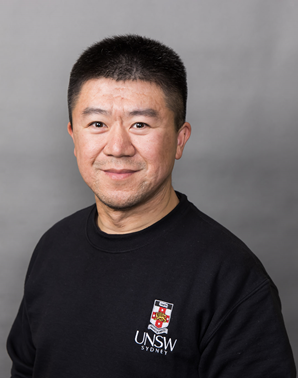
Professor Yansong Shen is a faculty member in the School of Materials Science and Engineering at the University of New South Wales (UNSW). His research spans chemical engineering, process control, and metallurgy, with a focus on sustainable technologies in ironmaking, hydrogen generation, and recycling. He leads the SCoPE research group and actively engages in industry collaborations. Research Focus : Reacting flow simulation, particle technology, pyrometallurgy, and circular economy applications Teaching : Advanced Transport Phenomena, Heat and Mass Transfer, Chemical Reaction Engineering Engagement : President of the Australasian Particle Technology Society (2019-present) His recent work involves hydrogen injection in blast furnaces , non-spherical particle dynamics , and electrolyser design for green hydrogen . This aligns with UNSW’s strengths in clean energy and advanced manufacturing .
Haedong Kim is a Professor at Sejong University's Department of Aerospace Engineering. With over two decades of research activity, his work spans computational fluid dynamics, structural dynamics, and aerospace systems, focusing on advanced modeling techniques and computational efficiency. Research areas include reduced-order modeling, rotor blade analysis, and aerodynamic studies. His collaborations extend to international institutions, emphasizing composite materials and nonlinear structural behavior. Recent publications highlight applications in CFD , satellite orbit determination , and nonlinear structural dynamics . Key trends involve model-order reduction and computational efficiency in aerospace systems.
Katarzyna Danuta Bizon serves as an Associate Professor in the Department of Chemical and Process Engineering within the Faculty of Chemical Engineering and Technology at Cracow University of Technology. Her academic profile demonstrates deep expertise in chemical engineering with a focus on reactor design, process optimization, and advanced modeling techniques. She maintains an active research program evidenced by 86 publications and significant bibliometric indicators including an h-index of 12 (Scopus) and total Impact Factor of 61.1. Her research interests center on fluidized bed reactors, combustion systems, model reduction methodologies, and diffusion processes in porous media. She investigates energy systems, imaging techniques for process analysis, and optimization of hybrid reactor configurations. Current work emphasizes carbon dioxide capture technologies, reaction-diffusion dynamics, and the application of reduced-order modeling to complex chemical processes. Her methodology integrates computational simulations with experimental validation to address challenges in environmental protection and energy efficiency. Analysis of her recent publications (2022-2024) reveals three dominant research thrusts: (1) Advanced CO 2 capture using structured sorbents and hybrid fixed-bed reactors, (2) Development of reduced-order modeling techniques (POD/DEIM) for reaction-diffusion systems, and (3) Fundamental studies of bubble dynamics and multicomponent diffusion in membrane systems. This work consistently bridges theoretical modeling with practical applications in emission control and process intensification. Dr. Bizon has successfully supervised 2 PhD students to completion, demonstrating her commitment to academic mentoring. Her research is supported by the infrastructure of Cracow University of Technology's Department of Chemical and Process Engineering, where she contributes to both fundamental research and applied process engineering solutions.
Professor Ramanarayanan Balachandran is Professor of Energy Technologies in the Department of Mechanical Engineering at University College London. His academic career spans over two decades with expertise in combustion science, alternative fuels, and energy technologies, focusing on experimental approaches to solve complex engineering challenges in propulsion and power generation. His educational background includes: Doctor of Philosophy from University of Cambridge (2005) Master of Science from Indian Institute of Technology, Chennai (2003) Bachelor of Engineering (Honours) from Madurai Kamaraj University (1998) Professor Balachandran's research focuses on energy and combustion science with applications to propulsion and power generation systems. His work spans experimental combustion, multiphase flow dynamics, and alternative fuel technologies. He has made significant contributions to understanding hydrogen and ammonia combustion, thermoacoustic instabilities in gas turbine combustors, and pollutant formation mechanisms. His research employs advanced laser diagnostics to study complex combustion phenomena at high temporal and spatial resolution, with strong industry collaboration particularly with Siemens Energy. His recent publication record (including works dated 2025) demonstrates a strong focus on hydrogen and ammonia combustion technologies, with particular emphasis on lean direct injection systems, combustion dynamics, and stability characteristics. The work spans fundamental research on flame structure and dynamics to applied studies addressing practical challenges in gas turbine combustors. His research team has made important contributions to understanding the transition to thermoacoustic instabilities and developing methods for their prediction and control. Professor Balachandran has received numerous prestigious awards for his research contributions: Research Excellence Award (2020) from the Combustion Institute Distinguished Paper on Turbulent Flames (2015) from the Combustion Institute Sugden Award (2011) from the Combustion Institute British Section Most Cited Author Award (2008) from Combustion and Flame Instrumentation Award (2004) from Scientific Instrument Makers Company ASEM DUO-India Professorship Fellow (2020-2022) As an educator, Professor Balachandran has taught key modules including Introduction to Thermodynamics and Fluid Mechanics, Advanced Thermodynamics and Fluid Mechanics, and Thermal Power and the Environment. His research aligns with multiple United Nations Sustainable Development Goals including Affordable and Clean Energy, Climate Action, and Sustainable Cities and Communities, reflecting the societal relevance of his work on clean energy technologies. Professor Balachandran leads an active research group at UCL equipped with state-of-the-art facilities for combustion diagnostics and alternative fuel testing, with strong international collaborations spanning the UK, Europe, and Asia.
Janna Martinek serves as a Researcher IV at the National Renewable Energy Laboratory (NREL) within the Center for Energy Conversion and Storage Systems and the Thermal Systems Group. She joined NREL in 2012 as a postdoctoral researcher and has since advanced to a senior research position, contributing over a decade of expertise in solar thermal energy and storage systems. Dr. Martinek completed her entire formal education in Chemical Engineering at the University of Colorado: Doctor of Philosophy (PhD) Master of Science (MS) Bachelor of Science (BS) Her research centers on Concentrated Solar Power (CSP) and thermal energy storage, with a focus on computational modeling of high-temperature solar receivers. Key areas include fluidized bed particle receivers, light-trapping cavity designs, and thermomechanical analysis to enhance system efficiency and durability. Her work addresses the integration of thermal storage with CSP plants to enable dispatchable renewable energy. Dr. Martinek's publication record shows consistent growth, totaling 59 research outputs. Recent years (2023-2025) account for over half of her publications, indicating active and expanding research. The topics reveal a strong emphasis on particle-based storage systems, reduced-order modeling for receivers, and thermal analysis of novel receiver concepts, aligning with industry trends toward cost-effective and efficient solar thermal plants. As a national laboratory researcher, Dr. Martinek does not formally advise university students but collaborates extensively with academic partners, providing opportunities for student involvement in NREL projects. Her work is funded through competitive grants, notably the CSP Systems Analysis project (2022-2024), which delivered critical insights for the solar industry. Dr. Martinek operates within NREL's Thermal Systems Group, a dynamic team focused on advancing thermal energy conversion and storage technologies. The group leverages state-of-the-art facilities to develop innovative solutions for renewable energy integration, with a strong emphasis on practical applications and industry partnerships.
Matteo Dellacasagrande serves as a Researcher at the Department of Mechanical, Energy, Management and Transport Engineering (DIME) within the Polytechnic School of the University of Genoa. His academic appointments include membership on the Joint Teacher-Student Commission and teaching responsibilities for advanced courses in aircraft propulsion systems. His research focuses on fluid dynamics in turbomachinery , particularly low-pressure turbine optimization, separated flow modeling, and aircraft engine design. Key methodologies include computational fluid dynamics, experimental validation using large databases, and statistical modeling techniques like Bayesian Lasso for flow prediction. His work bridges theoretical fluid mechanics with practical aerospace engineering applications. Recent publications demonstrate consistent focus on turbine blade aerodynamics (2024-2025), with significant contributions to loss mechanism analysis in low-pressure turbines and novel approaches to modeling separation bubbles. His research integrates experimental data with advanced statistical methods to improve prediction accuracy in complex flow scenarios. Teaching activities: AIRCRAFT ENGINES (Master's Degree in Mechanical Engineering - Energy and Aeronautics) AIRCRAFT PROPULSION (Master's Degree in Mechanical Engineering - Energy and Aeronautics) DESIGN OF MACHINES AND ENERGY SYSTEMS Professional engagement: Member of the Joint Teacher-Student Commission at the Polytechnic School, with office hours by appointment via institutional email.
Prof. Dr.-Ing. habil. Kai Willner is a distinguished Professor at the Chair of Engineering Mechanics within the Department of Mechanical Engineering at Friedrich-Alexander-Universität Erlangen-Nürnberg (FAU). His research spans multiple domains of computational mechanics with significant contributions to structural dynamics, uncertainty quantification, and biomechanics. His current work focuses on innovative applications of fuzzy arithmetic in engineering systems and the mechanics of brain tissue. Principal Investigator for SFB 1540 EBM (Erforschung der Mechanik des Gehirns) Lead researcher on multiple DFG-funded projects including polymorphic uncertainty modeling Active participant in international collaborations on structural dynamics Member of the research group FOR 2271 on process-oriented tolerance management Willner's research interests center on computational mechanics with emphasis on uncertainty quantification , fuzzy-stochastic finite element methods , contact mechanics , and brain biomechanics . His work addresses fundamental challenges in modeling systems with uncertain parameters, particularly in heterogeneous materials and biological systems. His research group develops advanced computational frameworks that integrate fuzzy arithmetic with traditional finite element methods to handle epistemic and aleatoric uncertainties simultaneously, with applications ranging from microstructural analysis to brain mechanics. Analysis of his recent publications reveals a strong trend toward interdisciplinary research, particularly at the intersection of computational mechanics and neuroscience. His work on brain mechanics within the SFB 1540 EBM project represents a significant shift toward biomedical applications of traditional mechanical engineering methods. His publications consistently demonstrate expertise in vibration analysis, structural dynamics, and uncertainty quantification, with increasing focus on applying these methods to biological systems and complex material behaviors. Prof. Willner has secured substantial third-party funding from the German Research Foundation (DFG), including multiple collaborative research center (SFB/TRR) projects, research units (FOR), and individual grants. His current major projects include the SFB 1540 EBM (2023-2026) investigating brain mechanics, and continuing work on polymorphic uncertainty modeling in heterogeneous materials. Within the SFB 1540 EBM consortium, Willner leads research on model-based matching of ex vivo and in vivo test data (project X01), focusing on resolving contradictions in mechanical properties of ultraweak brain tissue materials across different testing modalities. His team develops continuum-based simulation models to unify various experimental observations into a coherent mechanical framework for brain tissue.