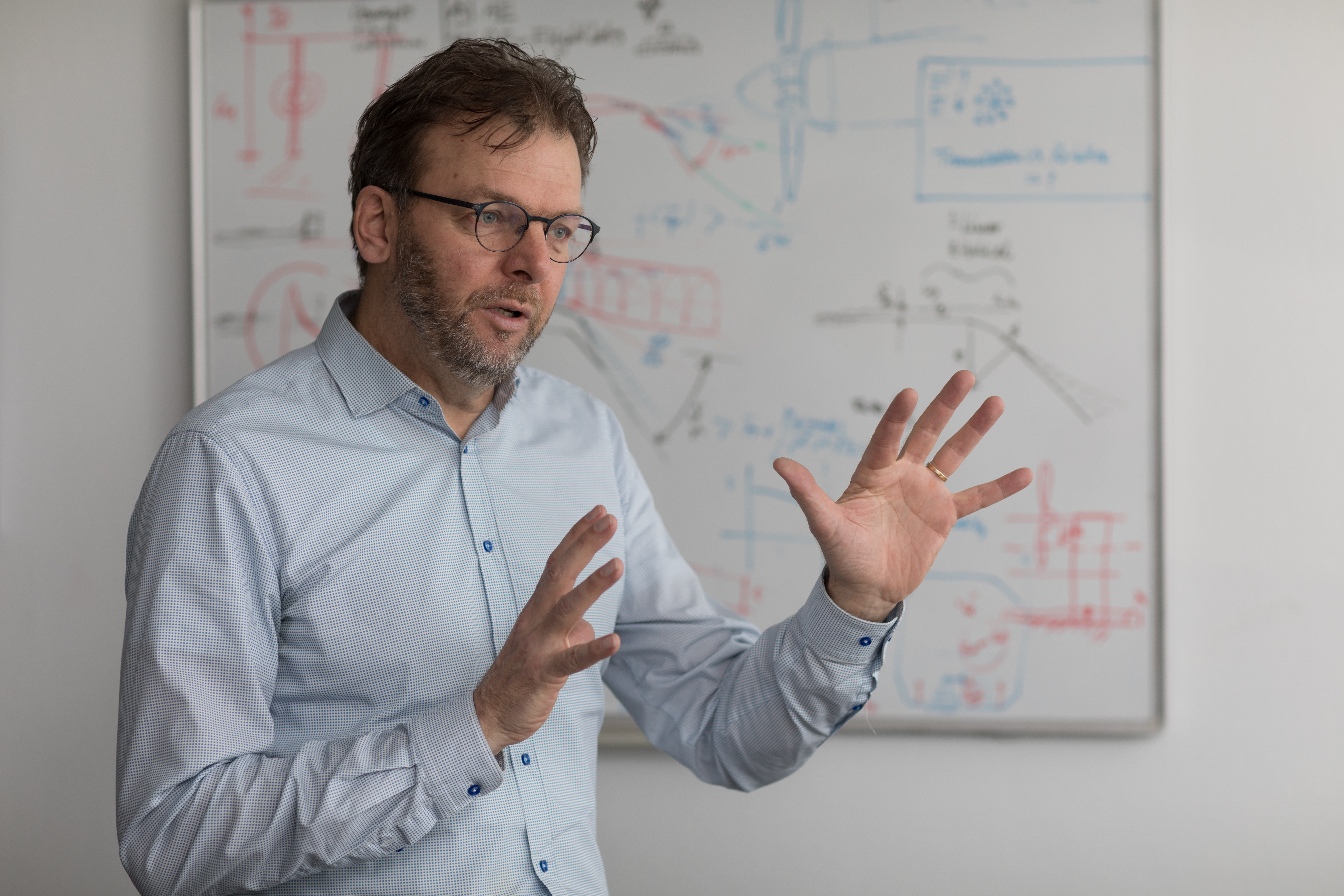
Richard HaleView profile
Professor
Richard Hale serves as the Spahr Professor and Chair of Aerospace Engineering at the University of Kansas and Associate Director of CReSIS (Center for Remote Sensing of Ice Sheets), leading research in composite materials, unmanned aerial systems, and radar remote sensing for polar ice sheet studies. His academic credentials include: B.S. in Aerospace Engineering from Iowa State University (1988) M.S. in Mechanical Engineering and Materials Science from Washington University (1991) Ph.D. in Aerospace Engineering from Iowa State University (1995) Dr. Hale's research focuses on experimental stress analysis of composite structures, UAS development for scientific applications, and advanced radar systems for cryospheric remote sensing. His laboratory work encompasses composite material testing and radar instrumentation design, with particular emphasis on airborne systems for polar environments. Key innovations include ultra-wideband radar sounders for ice sheet characterization and specialized antenna arrays for ice-penetrating applications. Analysis of his 15 most recent publications (2025-2018) reveals dominant themes in radar remote sensing for polar research, featuring significant contributions to airborne radar technology development and polar ice sheet measurement. Projects like CReSIS and EcoSAR demonstrate his leadership in NASA/NSF-funded initiatives, though the 2019 microbiology publication represents an outlier in his aerospace-focused portfolio. Dr. Hale has secured major funding as PI/Co-PI for programs including the NSF CReSIS Science & Technology Center, NASA EcoSAR, and the NASA National Space Grant Consortium. His grants support radar instrumentation development, polar aircraft operations, and composite materials research. He directs the Composite Materials Laboratory and leads CReSIS's Air Vehicles team, which integrates radar systems on NASA aircraft (P-3, DC-8) and unmanned platforms for cryospheric surveys across Antarctica and Greenland.