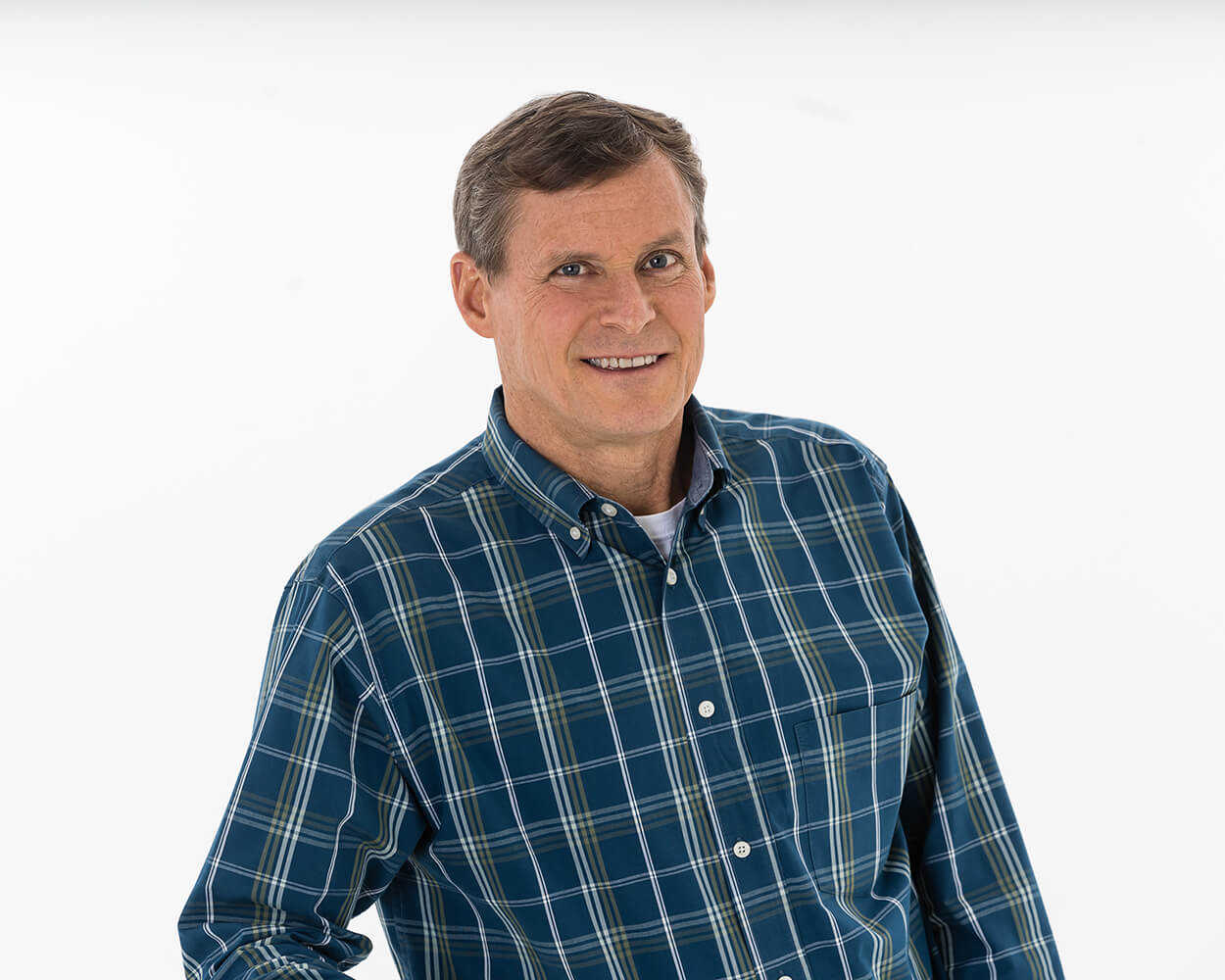
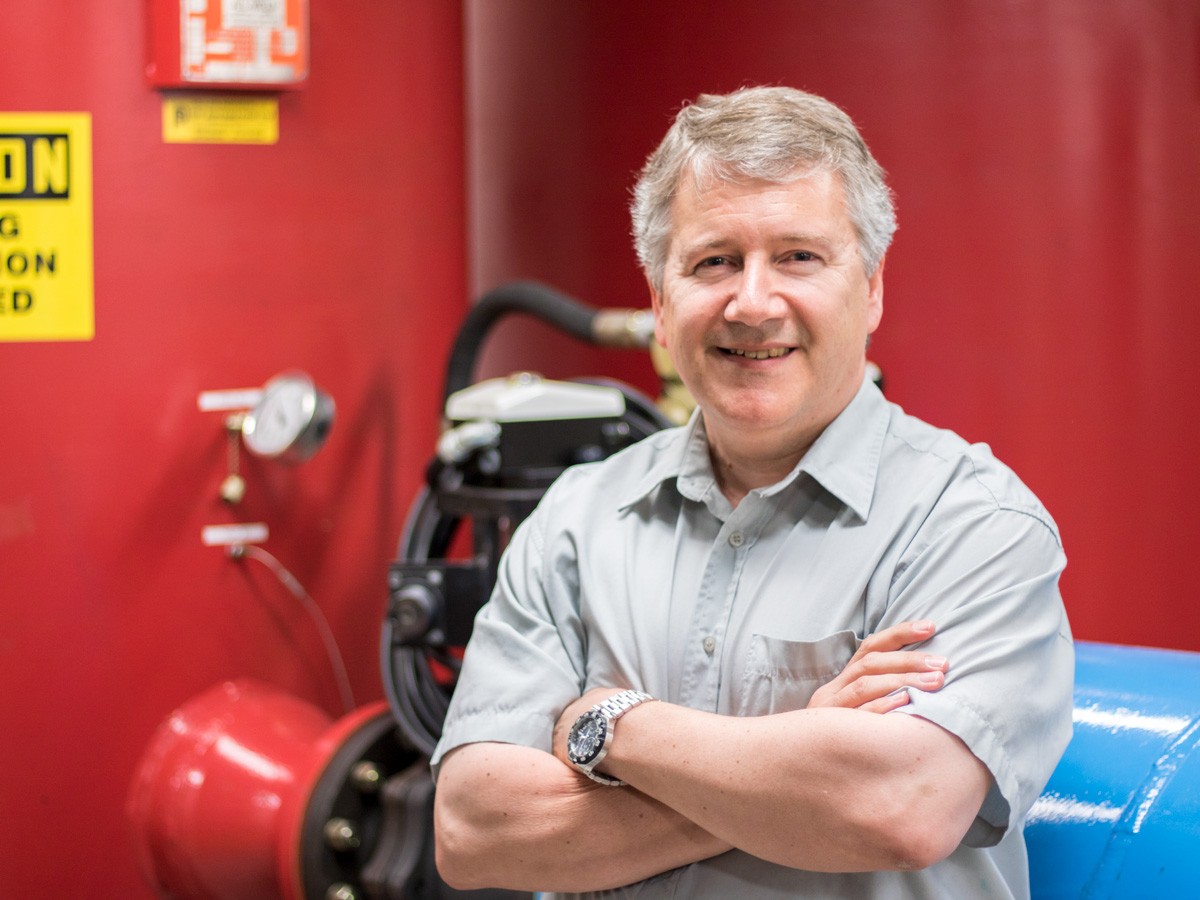
Jesse French is a Professor of Mechanical Engineering and Dean of the School of Engineering at Spring Arbor University. He holds a PhD in Mechanical Engineering from The University of Tulsa with a focus on Solid Mechanics, Polymer and Composite Materials, and Sustainable Energy. His career spans academia, military service, and international missionary work. Education: PhD (2010), MS (2007), Mechanical Engineering, The University of Tulsa; BS (1995), Mechanical Engineering, Rose-Hulman Institute of Technology His research focuses on composite materials , sustainable energy systems , and humanitarian engineering applications . Recent projects include thermal failure detection algorithms , portable power solutions for disaster zones , and experimental validation of solar energy systems . Selected publications highlight interdisciplinary work across aerospace engineering, sustainable energy, and fluid dynamics. Key collaborations include research with Jason N. Small, Ben S. Carpenter, and Amber E. Keith. Professional affiliations : American Institute of Aeronautics and Astronautics (AIAA) Engineers Without Borders (EWB) American Society of Mechanical Engineers (ASME) Christian Engineering Society (CES) Jesse actively directs undergraduate engineering projects and promotes vocational training for students in both technical and spiritual contexts.
Hüseyin Önder ALDEMİR serves as an Assistant Professor and Vice Dean at Ozyegin University's Faculty of Aviation and Aeronautical Sciences. With extensive expertise in aviation systems and strategic management, he bridges academic theory with practical industry applications. His educational background includes: Doctorate in Aviation Management, Graduate School of Social Sciences, Anadolu University (2018) Master's in Mechanical Engineering, The Pennsylvania State University (2005) Bachelor's in Systems Engineering, Army School/Military Academy (2000) Kuleli Military High School (1996) Dr. ALDEMİR's research focuses on cutting-edge areas in aviation technology and management strategy. His expertise spans Unmanned Aerial Vehicle Systems, Strategic Management, Aviation Management, and Competition Strategies. His work integrates theoretical frameworks with practical applications in the rapidly evolving aviation sector, particularly in UAV technology which represents a frontier with significant commercial and military implications. As an educator, he teaches Safety Management Systems, Airport and Operations, Airline Marketing, and Introduction to UAV Systems. His teaching methodology is enriched by his substantial practical experience, including over 2,500 flight hours across various UAV platforms as a pilot, test pilot, and instructor. During his doctoral studies, he was accepted as a member of Air Transport and Regional Development (ATARD), an organization under the European Cooperation in Science and Technology (COST). This affiliation led to his participation in PhD schools at the University of Bergamo, Italy (2017) and Poznan University of Economics and Business, Poland (2018), demonstrating his international academic engagement and collaborative research efforts.
Isabel López Calle is a Researcher at the Universidad Complutense de Madrid, working in the Department of Sistemas Físicos, Químicos y Naturales. Her research focuses on radiation effects in electronic devices, laser testing for space systems, and nanotechnology applications in aerospace engineering. Academic Rank: Researcher Education: PhD in Physical Chemistry from Universidad Complutense de Madrid Her work explores the emulation of ionizing radiation effects using femtosecond lasers, with applications in spacecraft safety and semiconductor reliability. Recent publications address space debris detection, cubesat failure risks, and dielectric laser accelerators. Key trends in her research include: Radiation-hardened electronics Space debris mitigation technologies Nanostructured photonic devices Memory error detection systems Laser-based radiation simulation Power circuit reliability No scientific awards were mentioned in available sources. Supervisor: Dr. Francisco Javier Franco Peláez She contributes to educational materials for engineering programs, including manuals for aerospace and industrial electronics courses.
Dr. Dominic Halsmer serves as a Senior Professor of Engineering at Oral Roberts University (ORU), embodying ORU's Whole Person concept through his integration of faith, athleticism, and academic excellence. He earned B.S. and M.S. degrees in Aeronautical and Astronautical Engineering from Purdue University and a Ph.D. in Mechanical Engineering from UCLA in 1992. Education: B.S., M.S. - Purdue University (Aeronautical & Astronautical Engineering) Ph.D. - UCLA (Mechanical Engineering) Halsmer's research bridges engineering principles with theological inquiry, focusing on spacecraft dynamics and the design of the universe as evidence of divine purpose. His work has involved undergraduate teams in developing instruments to test spacecraft stability under thrust and exploring astrophysical implications of cosmological engineering. Scientific Awards: NASA/ASEE Summer Faculty Fellowship (1996, 1997) at NASA Goddard Space Flight Center A committed Christian, Halsmer actively engages with students through informal activities like lunchtime runs, while maintaining his role as a husband to Kate (his high school sweetheart) and father to four children aged 15-23. His career spans over 30 years of teaching and research at ORU.
Robert McMurray is a Lecturer at the School of Engineering, Ulster University, with active research contributions in drone control systems, reinforcement learning, and engineering education. He is based at the Belfast campus and serves as a key member of the Engineering Research group. Recent research focuses on applying digital twin technology and AI-driven control strategies to unmanned aerial vehicles (UAVs), particularly the MADNI drone platform. His work explores hybrid control systems for adverse conditions, obstacle avoidance algorithms, and tactile force prediction models using deep learning. Key Research Areas: Drone autonomy, materials testing, and pedagogical best practices 2024-2025 Trends: Integration of reinforcement learning with fault detection in UAVs, digital twin simulations Contact: rj.mcmurray@ulster.ac.uk

Santiago Paternain is an Assistant Professor in the Department of Electrical, Computer and Systems Engineering at Rensselaer Polytechnic Institute's School of Engineering. He joined RPI in 2020 after completing his Ph.D. and postdoctoral work at the University of Pennsylvania, where he developed foundational algorithms at the intersection of machine learning and control theory. His research bridges theoretical rigor with practical applications in robotics, power systems, and autonomous vehicles. His academic credentials include: B.Sc. in Electrical Engineering, Universidad de la República, Uruguay (2012) M.Sc. in Statistics, The Wharton School, University of Pennsylvania (2018) Ph.D. in Electrical and Systems Engineering, University of Pennsylvania (2018) Paternain's research centers on reinforcement learning and control of dynamical systems, with emphasis on safety guarantees, optimization, and real-world deployment. He develops algorithms that integrate model-based control with data-driven methods to overcome limitations of pure reinforcement learning, particularly for constrained and safety-critical applications. Current projects explore in-context learning for robotics, physics-guided AI for power grids, and multi-agent coordination in uncertain environments, always prioritizing theoretical soundness and practical viability. Analysis of his 15 most recent publications reveals a dominant focus on constrained reinforcement learning (60% of works), with growing applications in power systems (20%) and robotics (15%). A clear trend shows increasing integration of foundation models with control theory, particularly for safety-critical decision making. His work consistently addresses scalability challenges while maintaining rigorous safety guarantees, reflecting his commitment to bridging theoretical and applied research. His scientific contributions have earned significant recognition: Best Student Paper Award at ICASSP 2020 Joseph and Rosaline Wolfe Best Doctoral Dissertation Award (2019) Best Student Paper Award at CDC 2017 Best Student Paper Award at I2MTC 2014 Best Teaching Assistant at University of Pennsylvania (2017) CTL's Graduate Fellowship for Teaching Excellence (2018) Paternain actively mentors six doctoral students across diverse research areas including safe reinforcement learning, multi-robot systems, and power grid applications. His research is supported by substantial funding including multiple RPI-IBM Future of Computing Research Collaboration grants (quantum computing and LLM reasoning), a DOE grant for EV battery assessment, an ONR grant for autonomous helicopter refueling, and industry partnerships with Boeing and ARM. He leads a high-impact research group that organizes influential workshops like "Learning under Requirements" at premier conferences including AAAI and L4DC. His laboratory focuses on translating theoretical advances into industrial applications through partnerships with GE Research, The Boeing Company, and national laboratories. Current projects include autonomous helicopter aerial refueling systems, real-time power grid stability assessment tools using graph neural networks, and safety-certified multi-robot coordination frameworks, all emphasizing deployable solutions for critical infrastructure challenges.
Mohamed Ben Ahmed serves as an Associate Professor in Quantitative Logistics at Molde University College's Logistics Department, specializing in optimization and decision support systems for complex logistics networks. His work integrates mathematical modeling with real-world transportation challenges across maritime, airline, and urban mobility sectors. Educational Background: PhD in Quantitative Logistics, Molde University College (2023) - Thesis: 'Analysis of Integrated Planning Models in Logistics' MSc in Industrial Engineering, National School of Engineering, Tunis (2013) BSc in Physics and Chemistry, Preparatory Institute of Engineering Studies, Monastir (2010) His research focuses on developing robust solutions for logistics under uncertainty, with particular expertise in hybrid algorithms combining exact and heuristic methods. Key areas include sustainable micromobility systems, green maritime transportation, automated container terminal operations, and integrated airline scheduling. Current work emphasizes automation in logistics processes and decision-making frameworks resilient to disruptions. Analysis of his 15 most recent publications (2017-2025) reveals a strong trend toward practical applications of optimization in emerging logistics domains, particularly micromobility simulation and green technology adoption. His work consistently bridges theoretical algorithm development with industry-relevant case studies, showing increasing emphasis on sustainability metrics and real-time decision support systems. No scientific awards are currently listed in available sources. His research is conducted within the Planning, Optimization and Decision Support group, focusing on mathematical modeling of logistics networks. While specific grant information isn't provided, his publications indicate collaboration with major industry partners in maritime and aviation sectors. Current projects include developing open-source simulation tools for micromobility planning and optimization frameworks for automated container terminals.
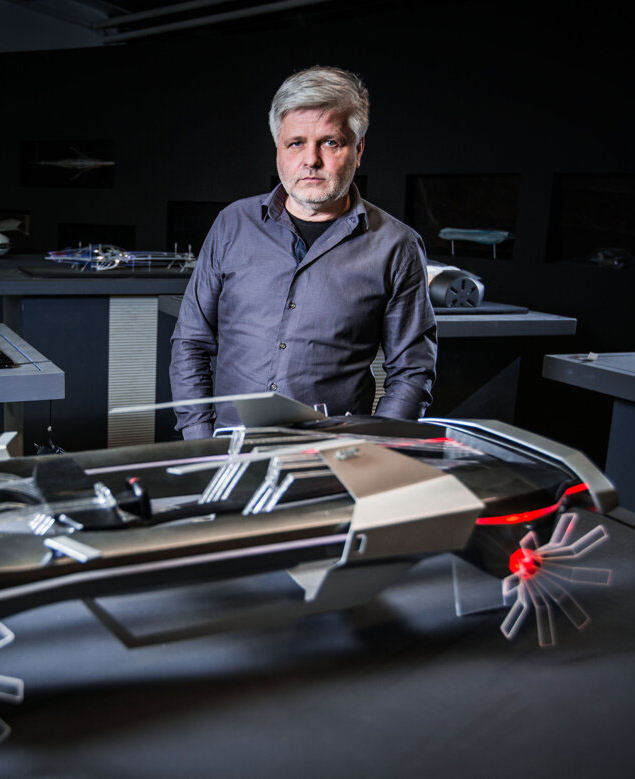
Štefan Klein is a Professor at the Academy of Fine Arts and Design (AFAD) in Bratislava, Slovakia, and leads the Department of Transport and Design . He is also a Visiting Professor at the Mackintosh School of Art in Glasgow since 2005. As founder and CEO of KleinVision, s.r.o. (co-founded with Anton Zajac in 2017), he pioneered the AirCar flying car prototype, achieving Certificate of Airworthiness from Slovak Transport Authority in 2022. Education: Slovak University of Technology (1983) Academy of Fine Arts and Design (AFAD), Slovakia École des Beaux Arts et Design, Saint Étienne (1993) Leadership: Head of Department for Transport and Design at AFAD Co-founder of AirExplore charter airline Founder of KleinVision, s.r.o. Research Interests focus on transport design and aerospace engineering , blending automotive innovation with flight dynamics . His work emphasizes composite materials and CFD/FEM simulation methods for optimizing aerodynamics and structural integrity. Key Publications include press releases and technical reports on AirCar’s inter-city flight (2021), certification milestones (2022), and 2025 production prototype unveilings. Earlier works from 1989–1996 detail foundational flying car designs like AeroMobil I/II. Collaborations span automotive giants (Audi, Volkswagen, BMW) and academic institutions like VUT Brno. He holds 12 patents for AirCar’s transformation technology. Labs & Teams include KleinVision’s R&D group and AFAD’s Transport Design Studio. Partnerships with SKMODEL (composite materials) and ADEPT Airmotive (engine development) are central to his projects.
Dr Jens Kunze is a Postdoctoral Research Fellow at the School of Mechanical and Mining Engineering within the Faculty of Engineering, Architecture and Information Technology at The University of Queensland. His research focuses on advancing hypersonic propulsion technologies through experimental and computational studies in scramjet systems and supersonic flow dynamics. His academic background includes a Doctor of Philosophy from The University of Queensland (2020) with thesis research on 3D shape-transitioning nozzles and experimental thrust measurements, and a Master's degree from Technical University of Munich (2014) in flight propulsion engineering. Dr Kunze's research centers on hypersonic vehicle propulsion, specializing in scramjet nozzle design for cross-sectional shape transition and electric supersonic propeller systems. His work addresses critical challenges in hypersonic flow control, thermal management, and thrust optimization for next-generation aerospace applications. Analysis of his 2018-2024 publications reveals a clear progression from fundamental nozzle geometry research toward integrated flight systems development, with increasing emphasis on electric propulsion solutions for supersonic applications and full-scale flight testing programs. Dr Kunze currently leads two major industry-funded research initiatives: Project STAJe (2023-2025) with MBDA UK Limited focused on supersonic flight payload development STELaRLab for Mach 4 Electric Engine (2021-2026) with Lockheed Martin Australia advancing electric propulsion for hypersonic systems His research activities are embedded within UQ's Hypersonics research group, where he contributes to flight experiment design including the STAJe-1 payload system for supersonic validation testing and collaborative industry partnerships driving practical hypersonic technology deployment.
Dr Will Landsberg is an Adjunct Fellow at the School of Mechanical and Mining Engineering, The University of Queensland. His work focuses on hypersonics, scramjet combustion, and supersonic flow dynamics, particularly in fuel injection strategies, cavity flameholding, and combustor design. He has contributed extensively to experimental and computational studies in hypersonic propulsion systems. PhD Thesis: Improving performance of high Mach number scramjets (2018) Honours Thesis: Performance comparison of hydrogen, methane, and ethylene-fueled scramjets (2013) Research interests include: Supercritical fuel injection systems Cavity-based flameholding mechanisms Dual-mode combustion stability Flow field manipulation via injectors High-enthalpy flow testing in shock tunnels Thermal analysis for hypersonic vehicles His publications span journal articles and conference papers from 2013 to 2025, emphasizing scramjet performance optimization, optical diagnostics, and numerical algorithm validation. Key collaborations include research with Ananthanarayanan Veeraragavan, Vincent Wheatley, and Damian Curran.
Professor Allan Paull is the Chair in Future Hypersonic Technology at the School of Mechanical and Mining Engineering, Faculty of Engineering, Architecture and Information Technology at the University of Queensland. His research focuses on advancing hypersonic propulsion technologies through experimental and theoretical approaches, with significant contributions to scramjet development and flight testing programs. Professor Paull's research interests span hypersonics, scramjet propulsion, hypersonic airbreathing propulsion systems, shock tunnel testing methodologies, supersonic combustion phenomena, boundary layer combustion effects, skin friction measurements in hypersonic flows, hypersonic engine design, plasma fuel engine development, and radical farming technology for enhanced combustion. His work bridges fundamental fluid dynamics with practical aerospace applications, particularly in the challenging regime of hypersonic flight where traditional propulsion systems face significant limitations. An analysis of Professor Paull's recent publications reveals a strong focus on advancing hypersonic flight capabilities through innovative propulsion concepts. His work spans experimental testing of scramjet configurations, computational analysis of hypersonic flows, development of novel propulsion concepts like electric supersonic propellers, and practical flight testing programs such as the HyShot and STAJe projects. The research demonstrates a consistent progression from fundamental combustion physics to integrated flight systems, with increasing emphasis on practical implementation and flight validation of hypersonic propulsion technologies. Professor Paull has successfully supervised numerous PhD and Master's students throughout his career, with completed projects including Ethylene Augmentation of JP-8+100 in a Supersonic Combustor, Forebody Combustion Experiments on an Unducted Scramjet, HYSHOT SCRAMJET TESTING, and SCRAMJET EXPERIMENTS USING RADICAL FARMING. His current supervision includes Experimental Investigation of Plasma Fuel Engine Performance. His research has been supported by significant funding from diverse sources including MBDA UK Limited, ARC Linkage Projects, Lockheed Martin Australia, Commonwealth Defence Science and Technology Group, Japan Aerospace Exploration Agency, and various government research bodies. Professor Paull leads research activities centered around the HyShot program and related hypersonic initiatives, working with teams that include international collaborators from the United States, Japan, and Europe. His laboratory facilities at the University of Queensland support advanced testing of hypersonic propulsion concepts, with particular emphasis on translating theoretical concepts into flight-ready technologies through rigorous ground testing protocols.
Hadas Porat is a Research Fellow at the School of Mechanical and Mining Engineering, The University of Queensland. Her work focuses on hypersonic flows, radiative heat transfer, and spacecraft atmospheric re-entry dynamics. PhD (2016): Measurement of radiative heat transfer in simulated Titan and Mars atmospheres Her research explores hypersonic boundary layer turbulence , planetary entry conditions , and radiation measurement techniques using expansion tubes and shock tunnels. Publications include studies of Titan atmospheric entry, Mars re-entry simulations, and advanced sensor design. Key trends in her work include radiation gauge development , super-orbital re-entry analysis , and multi-spectral emission spectroscopy for high-temperature flows.
Dr. Matteo Pini is an Associate Professor in the Flight Performance and Propulsion department at Delft University of Technology's Faculty of Aerospace Engineering. His research focuses on advanced turbomachinery design, non-ideal compressible fluid dynamics, and thermal systems with applications in aerospace propulsion and energy recovery. His educational background includes a PhD (Dr.ir. designation) in Aerospace Engineering, reflecting the Dutch academic tradition. Pini has established himself as a leading researcher in the field of non-ideal fluid behavior in turbomachinery applications, particularly in organic Rankine cycle systems and supersonic turbine design. Dr. Pini's research interests span Turbomachinery , Fluid Dynamics , Non-Ideal Compressible Fluid Dynamics , Organic Rankine Cycle Systems , Aerospace Propulsion , Thermal Engineering , and Computational Fluid Dynamics . His work bridges theoretical fluid mechanics with practical engineering applications, particularly in the design of high-efficiency thermal systems for aerospace and energy applications. Analysis of his recent publications reveals a strong focus on optimizing turbomachinery performance under non-ideal fluid conditions, with particular emphasis on supersonic flow regimes, organic working fluids, and advanced computational methods. His research demonstrates consistent innovation in applying adjoint-based optimization techniques to complex thermal systems design. NWO Open Technology Program Grant (2019) for Organic Rankine Cycle technology development Dr. Pini actively supervises graduate students (9 supervised works documented) and contributes to major research initiatives including waste heat recovery systems for aircraft. He serves in editorial roles for publications like the Global Propulsion and Power Forum and participates in key academic events such as the International Seminar on Non-Ideal Compressible Fluid Dynamics. His research group appears to focus on the ORCHID facility for studying non-ideal compressible fluid dynamics and testing ORC expanders, indicating a strong experimental component to complement computational work.
Dr. Paul Walsh is a Professor in the Aerospace Engineering Department at Toronto Metropolitan University and serves as the Director of the Advanced Engineering Research and Innovation in Aerospace (AERIAS) center. His academic expertise spans aerodynamics, computational fluid dynamics, and wind energy systems, with a focus on integrating industry collaboration into student training. Education PhD in Aerospace Engineering (University of Toronto, 1998) MASc in Mechanical Engineering (University of British Columbia, 1992) BASc in Mechanical Engineering (University of British Columbia, 1989) Walsh has pioneered the establishment of an aerospace research hub at Downsview Park, neighboring Bombardier and Downsview Airport, aiming to create a European-style innovation cluster in Canada. His teaching emphasizes real-world testing, exemplified by the Capstone Design Course where industry professionals rigorously evaluate student projects. As former department chair for nearly a decade, he cultivated a leadership style centered on enabling others’ success through facilitation and mentorship. His research interests bridge low/high-speed aerodynamics, wind power generation, and advanced computational modeling techniques. Scientific Awards Associate Fellow, Canadian Aeronautics and Space Institute
Dr. Fengfeng (Jeff) Xi serves as Professor and Industrial Research Chair in Advanced Systems and Interiors within the Department of Aerospace Engineering at Toronto Metropolitan University. His work bridges academic research with industrial applications in aerospace innovation. His educational foundation includes: PhD in Engineering from University of Toronto (1993) MSc from Shanghai University (1984) BEng from Shanghai University (1982) Xi's research centers on morphing wing technology for fuel-efficient flight, robotic manufacturing automation, and smart aircraft cabin systems. His expertise spans intelligent mechanisms, biomechanical modeling, and sensor-controlled adaptive structures, with emphasis on practical implementation through hands-on student projects involving composite wings and robotics. Analysis of his recent publications reveals consistent focus on morphing wing mechanics and robotics-driven aerospace manufacturing. Key trends include discretization methods for modular morphing structures, iterative learning control for robotic riveting, and contact mechanics applications in automated polishing systems. His scientific recognition includes: Green Aviation Research and Development Network (GARDN) Research award for Morphing Wing Xi previously directed the Toronto Metropolitan University Institute for Aerospace Design and Innovation (now Centre for Advanced Engineering Research and Innovation in Aerospace), fostering industry-academia collaboration. His research is supported through industrial partnerships and research chairs focused on advanced systems development. He leads the Intelligent Systems & Robotics / Micro Manufacturing (ISRMM) Laboratory, which develops sensor-responsive smart cabin designs and robotic solutions for aircraft manufacturing processes including fastening, polishing, deburring, and inspection.