Rich West is a Professor in the Department of Computer Science at Boston University, with a secondary affiliation in Electrical and Computer Engineering. He joined BU in 2000 after earning his PhD from Georgia Tech. His research focuses on real-time and embedded systems, operating systems, and resource management, leading the development of the Quest real-time OS and its separation kernel, Quest-V. His work emphasizes safety, predictability, and efficiency in systems like IoT devices and automotive/avionics applications. Education: PhD, Computer Science, Georgia Institute of Technology (2000) MS, Computer Science, Georgia Institute of Technology (1998) MEng, Microelectronics and Software Engineering, University of Newcastle-upon-Tyne (1991) Research Interests: Rich's work spans real-time operating systems, embedded systems design, multicore resource management, kernel architecture, hardware-software co-design, and secure separation kernels. He emphasizes practical applications, such as autonomous drones, automotive systems, and IoT devices. His lab develops systems like Quest-V for predictable execution and FlyOS for drone avionics. Awards and Recognition: Outstanding Paper Award at ECRTS 2020 Best Student Paper Award at RTAS 2017 Nominated for Best Paper Award at EMSOFT 2021 Best Paper Award at RTAS 2022 (FlyOS) Advising and Labs: He advises numerous PhD/MSc students on real-time systems, embedded computing, and safety-critical software. His lab collaborates on projects like the Quest OS, ModelMap automotive frameworks, and drone control systems (FlyOS). He also leads the BOSS, RTCC, and iBench research groups.
Ali Elkamel is an Adjunct Professor Emeritus at the University of Waterloo's Department of Chemical Engineering, Faculty of Engineering. His research focuses on Process Systems Engineering, Energy Systems, Environmental Engineering, and Carbon Management. He specializes in applying machine learning to optimize complex systems such as energy production, waste management, and material science. His work spans sustainability initiatives, including hydrogen production methodologies, municipal waste valorization, and eco-friendly grid modernization. He has also contributed to advancements in CO2 capture technologies and renewable energy integration. Elkamel's research often intersects with industrial applications, addressing challenges in petrochemical operations, membrane technology, and process modeling. Elkamel has published extensively on topics ranging from AI-driven education tools to novel materials for gas adsorption. His recent articles highlight trends in machine learning applications for process optimization, energy-water nexus solutions, and sustainable infrastructure design. Despite his prolific output, no formal awards or student advisement records are noted. His academic profile reflects a commitment to bridging theoretical research with practical industrial solutions, particularly in the energy and environmental sectors. Collaborations likely extend to interdisciplinary teams given his diverse research portfolio.
Alberto Lerner is a Senior Researcher at the Department of Informatics within the Interfaculty Informatics Department at the University of Fribourg. His research focuses on advancing database systems, storage architectures, and hardware-software co-design. He holds a strong interest in computational storage, network-accelerated query processing, and the integration of modern hardware technologies like CXL into database engines. Lerner's work emphasizes performance optimization and scalable solutions in data-intensive computing environments. His research interests include database architecture, storage co-design, hardware acceleration, and network-driven computing. Recent publications highlight innovations in point cloud data processing, reprogrammable storage devices, and software-defined controllers for NAND flash systems. Lerner's articles reflect a trend toward leveraging modern hardware advancements to enhance database and storage performance. He has contributed to frameworks like BABOL and Data Pipes, advancing declarative control over data movement and network-based graph mining.
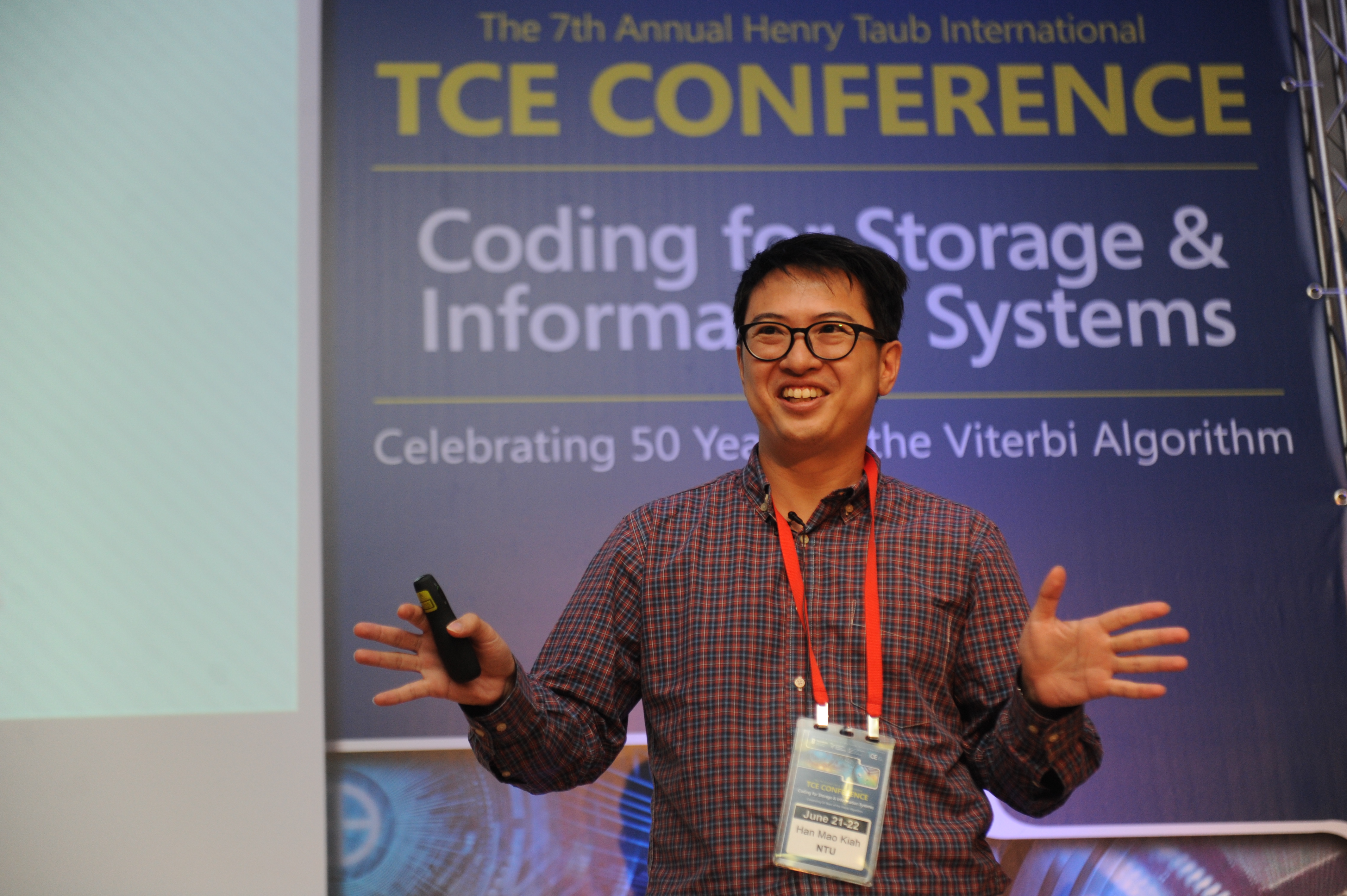
Han Mao Kiah is an Assistant Professor at Nanyang Technological University , specializing in Coding Theory and Combinatorics . He earned his Ph.D. in Mathematics at NTU under Yeow Meng Chee and held a postdoctoral position at the Coordinated Science Lab, University of Illinois at Urbana-Champagne with Olgica Milenkovic . Current Role: Assistant Professor, NTU, Department of Mathematics Education: Ph.D. in Mathematics (NTU), Postdoc (University of Illinois) His research focuses on Coding Theory for applications in DNA-based data storage , Reed-Solomon codes , and combinatorial designs . Recent work includes Private Information Retrieval , Sequence Reconstruction , and Error Correction in distributed systems. Key trends in his publications involve Reed-Solomon codes , Private Information Retrieval , and DNA sequence profiling with a focus on Efficient Algorithms and Constrained Coding for error control in emerging storage systems. ISITA Early Career Researcher Paper Award (2022, Researcher: D. T. Dao) Memorable Paper Award Finalist (2021, Student: J. Chrisnata) Best Student Paper Award (2020, Student: J. Chrisnata) Student Paper Award Finalist (2012)
Liljana Gavrilovska is an Associate Professor at the Faculty of Electrical Engineering and Information Technologies (FEIT) of Ss. Cyril and Methodius University of Skopje (UKIM), specializing in the Department of Telecommunications. Her work focuses on advanced telecommunications systems, including 5G/Beyond 5G networks, mobile edge computing (MEC), blockchain applications in healthcare and IoT, cognitive radio networks, and network virtualization. She leads research groups addressing challenges in wireless resource management, energy efficiency, and distributed consensus mechanisms. Her research interests span telecommunications infrastructure , blockchain for healthcare systems , IoT optimization , and network slicing . Recent work includes developing the BloHeS consensus mechanism for blockchain systems and the Shapeshifter framework for MEC latency optimization. She also investigates dynamic spectrum allocation strategies and energy-efficient WuR-based IoT protocols. Publications emphasize practical implementations like the CHEST COPD e-Health platform and the FALCON project for virtualized network resource allocation. While no specific awards are listed, her contributions to open-source solutions like eWALL and SmartWine reflect industry engagement. Advising activities and grants are not explicitly detailed in the provided texts, though her involvement in EU projects like 5G-MEC and cognitive radio initiatives suggests significant collaborative work. Current projects include system design for blockchain-based public healthcare systems and analysis of heterogeneous network performance in LTE and DVB-T coexistence scenarios. She is actively involved in the FEIT Telecommunications Institute, contributing to both academic and applied research in telecommunications engineering.
Gülay YALÇIN is an Assistant Professor at Abdullah Gul University since 2016. Prior to this, she held a post-doctoral position at the Barcelona Supercomputing Center (BSC) from 2014-2015 and was a researcher there from 2009-2014. She obtained her Ph.D. from Universitat Politècnica de Catalunya in 2014, focusing on Computer Architecture. Her academic background also includes an M.S. from TOBB University (2007) and a B.S. from Hacettepe University (2003), both in Computer Engineering. Education: Ph.D.: Universitat Politècnica de Catalunya, Department of Computer Architecture (2008-2014) M.S.: TOBB University of Economics and Technology, Computer Engineering (2007) B.S.: Hacettepe University, Computer Engineering (2003) Research Interests: Computer Architecture Reliable Computer Design Fault Detection and Recovery Parallel Computer Architectures Hardware Transactional Memory Low-Power Designs Her work emphasizes improving system reliability through innovative fault tolerance mechanisms and energy-efficient computing solutions. Scientific Awards: ParaDIME Project Shortlisted for the 2016 Innovation Radar Prize Advising and Projects: Supervised: Albert Njoroge Kahira (M.S. Candidate) on "Designing Reliable Microarchitectures According to Application Requirements" Project Roles: Researcher in ParaDIME (2012-2015) and Velox (2008-2011)
Onur Mutlu is a Full Professor of Computer Science at ETH Zurich (since 2015), with adjunct professor positions at Carnegie Mellon University (since 2016) and Bilkent University (since 2015). His academic career spans prestigious institutions including Carnegie Mellon University where he served as Assistant Professor (2009-2013) and Strecker Early Career Endowed Professor (2013-2016). His research focuses on computer architecture, particularly memory systems, with expertise in: Computer memory systems and DRAM architecture Multi-core processor design Fault tolerance and reliability Hardware/software interactions Systems security related to hardware Emerging memory technologies Dr. Mutlu's work has significantly impacted both academic research and industry practices. His discovery of the RowHammer problem created a new field at the intersection of hardware reliability and systems security. His research on memory controllers, flash memory reliability, and emerging memory technologies has been adopted by major technology companies including Samsung, Intel, IBM, and Microsoft. His numerous scientific awards include the IEEE Computer Society Harry H. Goode Memorial Award (2025), IFIP Jean-Claude Laprie Award (2024), Huawei OlympusMons Award (2023), IEEE Computer Society Edward J. McCluskey Technical Achievement Award (2020), and ACM SIGARCH Maurice Wilkes Award (2019). He is an IEEE Fellow (2018), ACM Fellow (2017), and member of Academia Europaea (2018). Dr. Mutlu has received significant industry recognition with Faculty Awards from Google, Facebook, HP, Huawei, IBM, Intel, Microsoft, NSF, and VMware. His work has earned over 20 Best Paper awards and 12 papers selected for IEEE Micro's Top Picks as some of the most influential papers in computer architecture. He maintains strong industry connections, having worked at Microsoft Research (2006-2009), Intel (multiple summers), AMD (multiple summers), VMware (2016), and Google (2016), enabling direct technology transfer of his research ideas into commercial products.
Dr. Chang Y Choo is a Professor of Electrical Engineering at San José State University, where he also serves as Director of the AI/ML FPGA/DSP Systems Laboratory. His academic career spans over three decades, with previous positions at Worcester Polytechnic Institute and industry experience at Altera Corp. (now Intel). Dr. Choo maintains an active research program focusing on hardware acceleration for AI and signal processing applications, with particular emphasis on FPGA-based implementations for real-world systems. Dr. Choo's educational background includes: Ph.D. in Computer and Systems Engineering, Rensselaer Polytechnic Institute (1986) M.S. in Operations Research and Statistics, Rensselaer Polytechnic Institute (1982) B.S./M.S. in Engineering, Seoul National University, Korea Dr. Choo's research interests center on the intersection of hardware design and artificial intelligence. His work focuses on implementing computer vision, deep learning, and digital signal processing algorithms on specialized hardware platforms including FPGAs, GPUs, and custom ASICs. Current projects include developing real-time illumination/view-independent object recognition systems for autonomous vehicles, wideband acoustic echo cancellation for wearable technology, and FPGA-based accelerators for medical imaging applications. His research bridges theoretical algorithm development with practical hardware implementation constraints. Analysis of Dr. Choo's recent publications reveals a clear trajectory toward increasingly sophisticated hardware-accelerated AI systems. His work has evolved from foundational research in digital signal processing and image compression to cutting-edge applications of deep learning on specialized hardware. Recent publications demonstrate expertise in implementing CNN architectures on FPGAs, developing metabolic syndrome prediction models, and creating food object detection systems using transformer models. This progression reflects the broader field's shift toward hardware-aware AI development. Dr. Choo's significant scientific contributions include multiple patents that have advanced the state of the art in several domains: U.S. Patent No. 9,025,763 (2015): 'Apparatus and Method for cancelling wideband acoustic echo' U.S. Patent Nos. 7,058,675 (2006) and 7,124,161 (2006): 'Apparatus and method for implementing efficient arithmetic circuits in programmable logic devices' U.S. Patent Nos. 5,943,096 (1999) and 6,621,864 (2003): 'Motion vector based frame insertion process' U.S. Patent Nos. 5,832,131 (1998) and 5,991,455 (1999): 'Hashing-based vector quantization' U.S. Patent No. 5,587,710 (1997): 'Syntax based arithmetic coder and decoder' Throughout his career, Dr. Choo has been actively involved in both academic and industry collaborations. He has served as a technical consultant for numerous Silicon Valley companies including National Semiconductor (now Texas Instruments), Philips Semiconductor, Skybox Imaging (acquired by Google), Novariant (now AgJunction), and Ricoh Innovations. His industry experience informs his teaching approach, which emphasizes practical implementation considerations alongside theoretical foundations. Dr. Choo has also served as an expert witness in intellectual property court cases involving audio and video compression algorithms and FPGA hardware. Dr. Choo directs the FPGA/DSP AI/DL Laboratory at San José State University, which focuses on developing hardware-accelerated solutions for real-time AI applications. The lab maintains strong connections with Silicon Valley technology companies and provides students with hands-on experience in cutting-edge hardware design methodologies. Current research directions include autonomous vehicle navigation systems, medical imaging applications, and edge AI deployment strategies.
Joshua Lacey is a Senior Lecturer in the Department of Mechanical Engineering , affiliated with the Faculty of Industrial Engineering Sciences at KU Leuven . He leads the EnergyVille TME Subdivision and is actively involved in promoting sustainable energy systems and combustion technologies through the KIEM – KU Leuven Institute for Energy and Society . His research focuses on hydrogen combustion , CO2-reduction strategies , and numerical simulation tools for energy systems. He has contributed to projects such as the Decarbonization Lab and the University of Melbourne Global PhD Partnership , emphasizing hydrogen engine optimization and wind-assisted shipping. Joshua Lacey serves as a promotor or co-promotor for numerous ongoing research initiatives, including flame-wall interactions , CO2-diluted oxy-fuel combustion , and tomographic PIV systems for fluid dynamics analysis. He supervises students such as M. Ghorbani Poshtmashhadi and contributes to the development of carbon-free emission engines using direct-injected hydrogen and wind propulsion technologies.
Toru Tanzawa is a Professor at Waseda University's Faculty of Science and Engineering, Graduate School of Information, Production, and Systems. He holds a Ph.D. from the University of Tokyo (2002) and maintains an active research laboratory focused on power electronics and energy harvesting systems. His professional memberships include IEEE and IEICE, and he has served on various technical committees including the IEICE Electronics Society's Integrated Circuit Research Committee and the IEEE ESSCIRC Technical Program Committee. Professor Tanzawa's research focuses on low-power analog circuits , energy harvesting , greening of integrated circuits , IoT systems , power management , and circuit design . His work bridges theoretical circuit analysis with practical implementations for real-world applications, particularly in memory systems and energy-constrained environments. He has pioneered numerous innovations in switched-capacitor converters, charge pump circuits, and power management solutions for NAND flash memory and IoT devices. His publication record shows a clear progression from fundamental circuit theory to practical implementations, with recent work focusing on energy harvesting from thermoelectric generators, microwave wireless power transfer, and ultra-low-voltage operation. The research demonstrates consistent innovation in power conversion efficiency, particularly in the 1-100 μW range relevant for IoT applications. His publications span top venues including IEEE journals and conferences like VLSI Symposium. Test of Time Award, Symposium on VLSI Technology and Circuits (2023) IEEE Fellow (2016) Professor Tanzawa leads an active research group with numerous industry collaborations. His current research projects include "Understanding the operation principle of boost converters from extremely low voltage and application to IoT terminals" (2022-2025), funded by the Japan Society for the Promotion of Science. He has also secured multiple patents related to power conversion circuits and rectenna systems. His laboratory maintains strong connections with semiconductor industry leaders, particularly in memory technology and power management ICs.
Tong Zhang is a Professor in the Electrical, Computer and Systems Engineering Department at Rensselaer Polytechnic Institute (RPI). He joined RPI in 2002 as an assistant professor, advancing to associate professor in 2008 and full professor in 2013. His research focuses on computer systems, particularly memory and data storage across software and hardware stacks, with interdisciplinary applications in computer architecture, VLSI signal processing, and error correction coding. He holds a B.S. and M.S. from Xian Jiaotong University (China) and a Ph.D. from the University of Minnesota. His work emphasizes energy-efficient storage solutions, transparent compression, and hardware-software co-design. Notable contributions include innovations in SSD arrays, computational storage drives, and database systems. He is an IEEE Fellow and maintains affiliations with RPI's Computer Science programs. Research interests span memory systems optimization, storage architectures, and emerging technologies like CXL-based AI acceleration. His publications highlight advancements in reducing energy consumption, improving data deduplication, and enhancing B+-tree performance on modern storage hardware. Awards: IEEE Fellow (2023) Grants/Advising: Extensive grant-funded research in storage systems; no student advisees explicitly listed. Labs/Teams: Engaged in interdisciplinary collaborations within RPI's computational storage and memory research groups.
Dr. Miguel Algueró is a Senior Researcher at the Instituto de Ciencia de Materiales de Madrid (ICMM), part of the Spanish National Research Council (CSIC). He holds a BSc in Physics from Universidad Autónoma de Madrid (1992), an MSc in Physics of Materials (1995), and a PhD in Physics of Materials (1998). His career includes roles as a Ramón y Cajal Researcher (2001–2006) and Marie Curie Postdoctoral Fellow (1998–2000). He has led multiple research projects, including MAT2017-88788-R on magnetoelectric materials. His work focuses on multiferroic and ferroelectric materials, particularly their synthesis, processing, and applications in advanced technologies like ceramics, thin films, and composites. He has published 103 JCR-indexed articles, co-edited a book on nanoscale ferroelectrics, and contributed to the European COST Programme in ferroics research. Recognitions include a visiting researcher role in Brazil (2014–2017) and editorial board membership at Journal of Advanced Dielectrics . Research interests span multiferroic ceramics , magnetoelectric composites , and advanced processing techniques like spark plasma sintering. His projects emphasize sustainable, high-performance materials for energy, MEMS, and sensor applications. Key contributions include optimizing BiFeO₃-PbTiO₃ thin films and developing lead-free piezoelectric ceramics with enhanced strain responses. Scientific Awards: Ramón y Cajal Researcher (2001–2006) Marie Curie Postdoctoral Fellowship (1998–2000) Ciência sem Fronteiras Visiting Researcher (2014–2017) Grants & Projects: Leader of 6 major projects (e.g., MAT2017-88788-R on magnetoelectric layered materials) Participant in 33 EU/Spain-funded initiatives Labs & Facilities: Thin Film Preparation Lab Ceramics Processing Lab Magnetoelectric Characterization Lab
Dr. Zoltán Siménfalvi serves as Dean of the Faculty of Mechanical Engineering and Informatics at the University of Miskolc, Hungary, holding the academic rank of Professor. His leadership encompasses oversight of academic programs, research initiatives, and administrative functions within the faculty, positioning him at the forefront of mechanical engineering education and innovation in Central Europe. His research spans explosion protection, biogas technology, combustion engineering, and sustainable energy systems. Key focus areas include computational fluid dynamics (CFD) simulations for hazardous area classification, flash point determination of flammable mixtures, hydrogen/methane dispersion modeling, and optimization of anaerobic digestion processes. His work bridges theoretical analysis with industrial applications in energy safety and renewable resource utilization. Analysis of his 15 most recent publications (2022-2024) reveals dominant themes in explosion hazard analysis (60% of works), particularly 2D/3D hazardous area modeling, gas detector performance in ammonia environments, and FLACS-CFD simulations for hydrogen-methane mixtures. Biogas technology constitutes 25% of output, emphasizing mixing efficiency in anaerobic digesters and process optimization. Remaining research addresses sustainable engineering through carbon capture strategies for V4 countries, coal gasification efficiency, and propane leakage dynamics. No scientific awards were documented in the available materials. Information regarding student advising, research grants, or laboratory supervision was not provided in source materials. His administrative role as Dean suggests strategic oversight of research funding and academic programs, though specific grant details remain unreported. No dedicated research laboratories or specialized teams were explicitly referenced, though his publications indicate collaboration with computational modeling groups and industrial safety partners for experimental validation of CFD simulations.
George Amvrosiadis is a Research Professor in the Department of Electrical and Computer Engineering at Carnegie Mellon University, with a courtesy appointment in Computer Science. He is a core member of the Parallel Data Lab and spends part of his time at Amazon S3 as an Amazon Scholar. Education: 2016 - Ph.D., Computer Science, University of Toronto 2009 - BA, Computer Science, University of Ioannina Research Interests: His work focuses on distributed systems , operating systems , data analysis , cloud computing , and storage technologies . He explores high performance computing (HPC), zoned storage , systems security , and storage solutions for machine learning . Scientific Trends: Articles highlight innovations in storage systems, including zoned storage , HPC data services , and machine learning infrastructure . Research spans distributed systems , I/O optimization , and data integrity in large-scale environments. Scientific Awards: DeltaFS project received the R&D 100 Award from R&D World Magazine Teaching & Service: He co-teaches graduate courses on storage and cloud systems, serves on program committees for top conferences (SOSP, OSDI, FAST), and mentors students in systems research and infrastructure projects.
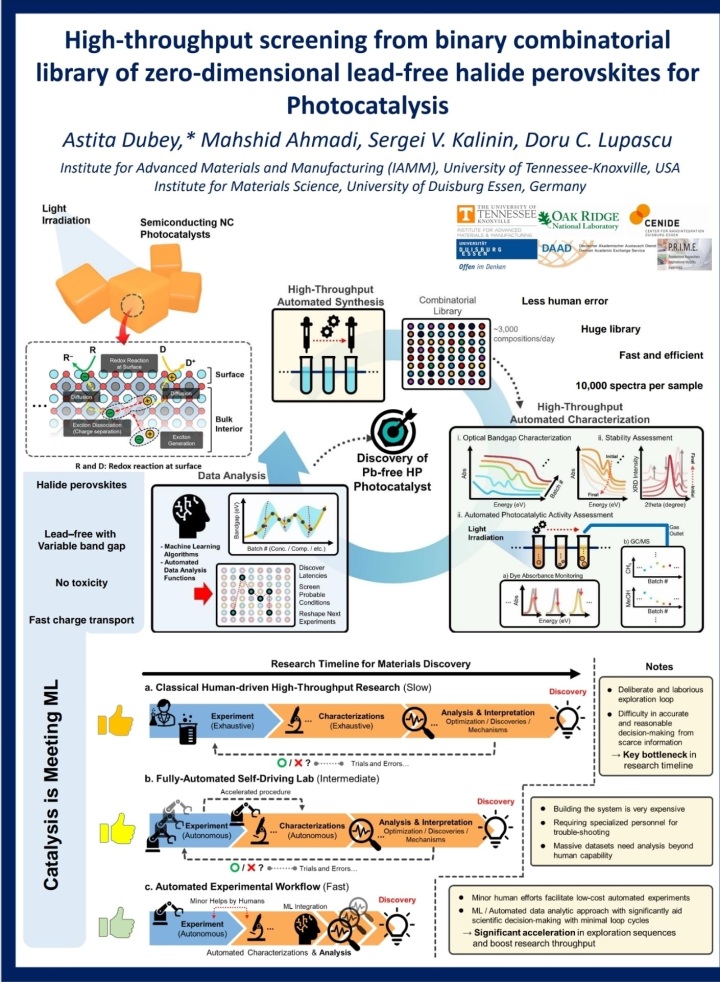
Prof. Doru C. Lupascu is a leading academic in Materials Science at the University of Duisburg-Essen . His research spans ferroic materials , perovskite solar cells , cement recycling , and electrocaloric effects . He supervises PhD students like Astita Dubey and Andrei Karabanov , whose work on photocatalysis and mechanical ice properties has earned recognition. Key Research Themes: Ferroic and multiferroic materials Lead-free perovskites for solar and photocatalytic applications Recycling of cement and concrete via thermal reactivation Electrocaloric and dielectric properties for cooling technologies Recent Article Trends highlight his group’s focus on machine learning in materials discovery , high-throughput screening of perovskites, and novel composite structures for energy storage. These works often intersect with environmental sustainability (e.g., UpCement project) and fundamental physics of ferroic systems. Notable Collaborations: The institute works with institutions like University of Cape Town (Antarctic sea ice expeditions), CentraleSupélec (relaxor ferroelectrics), and Oak Ridge National Lab (postdoctoral research). Projects such as UpCement and RelaxSolaire are funded by German and European agencies , including the Ministry for Economic Affairs and Climate Action (NRW) and DFG .