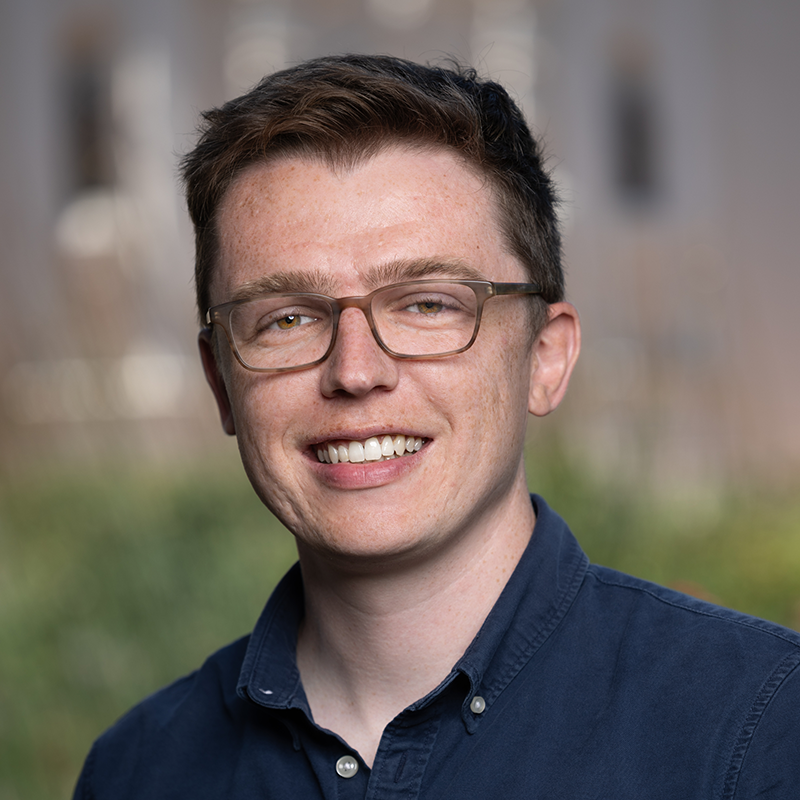
Dr. Chris Ciccarino is an Assistant Professor in the Department of Physics and Engineering Physics at Santa Clara University's College of Arts and Sciences. He holds a PhD in Chemical Physics from Harvard University and completed postdoctoral training at Stanford University. His research investigates quantum-mechanical phenomena in materials using first-principles computational methods. Research interests focus on: Quantum material interactions (electron-phonon coupling, exciton dynamics) Defect engineering in solids (diamond color centers, 2D material defects) Computational modeling of quantum systems Moiré superlattice behaviors in graphene and boron nitride His 12 recent publications (2018-2024) in journals like Nature Physics and Nature Materials demonstrate consistent focus on quantum defects, 2D materials, and computational methods. Primary themes include: Quantum emitter design in diamonds and boron nitride Electron-phonon coupling mechanisms Moiré superlattice dynamics Spin-valley locking in transition metal dichalcogenides No awards or current students are mentioned in the available information.
Kirsten von Bergmann is a Senior Research Associate at the University of Hamburg , affiliated with the Faculty of Mathematics, Computer Science and Natural Sciences and the Department of Physics . She works within the Institute of Nanostructure and Solid State Physics under the Wiesendanger Working Group. Research Focus : Solid-state physics, magnetic surfaces, spin textures, antiferromagnetism, skyrmions, and superconductivity. Methodologies : Scanning tunneling microscopy (STM), spin-polarized measurements, and density functional theory (DFT) calculations. Her recent work explores multi-Q magnetic phases , topological orbital moments , and antiferromagnetism-superconductivity interactions , published in journals like Nature Communications and Physical Review . These studies highlight applications in spintronics and quantum information technologies. She can be contacted via email at kirsten.von.bergmann@physnet.uni-hamburg.de .
Assoc. Prof. Dr. Ahmet İYİGÖR is an Associate Professor at the Vocational School of Technical Sciences of Ahi Evran University , specializing in the Machine and Metal Technologies Department . He holds a Ph.D. in Physics from Gazi University (2016) and has dedicated his career to computational materials science, particularly in Heusler alloys, perovskite materials, and intermetallic compounds. His research focuses on ab initio and Density Functional Theory (DFT) studies of structural, electronic, elastic, and thermodynamic properties. He has led and participated in 17 projects, including high-impact work on spintronic applications, hydrogen storage materials, and phase transitions under pressure. His recent publications (2024–2025) explore perovskite oxides and antiperovskite compounds for advanced technological applications. Key scientific awards include the 2025 Fen Bilimleri (Science and Technology) Award from Ahi Evran University. He has supervised four Master’s theses on topics like Heusler alloys and antiperovskite materials. Collaborating with researchers such as Nihat Arıkan and Osman Örnek , he has contributed to 65+ conference papers and 152+ publications, with a h-index of 14 (Google Scholar).
Prof. Abdullah CANDAN is a Professor at Kırşehir Ahi Evran University's Technical Sciences Vocational School in the Machinery and Metal Technologies Department. He has been serving in this position since 2025, following his promotion from Associate Professor (2020-2025) and Doctoral Lecturer (2017-2020). He also serves as Department Head since 2017. His academic career began with a role as an Expert at the Rectorate from 2013-2017. His educational background includes a PhD in Physics from Gazi University (2011-2016), a Master's degree in Physics (2008-2011), and a BSc in Physics (2004-2008), all from Gazi University. Prof. CANDAN's research focuses on Condensed Matter Physics, Materials Physics, and Semiconductors . His work primarily involves theoretical and computational studies of materials using density functional theory (DFT) and first-principles calculations. He investigates structural, electronic, elastic, vibrational, and thermodynamic properties of various materials including Heusler alloys, perovskites, intermetallic compounds, and hydrides. His research has significant applications in hydrogen storage, spintronics, and thermoelectric materials. His publication record shows a strong focus on computational materials science with over 114 publications and 948 citations according to Google Scholar. His recent work (2023-2025) demonstrates continued productivity with publications in high-impact journals, particularly in the areas of Heusler alloys, hydrogen storage materials, and rare earth compounds. His research output spans both theoretical investigations and potential applications in energy storage and electronic devices. Prof. CANDAN has been involved in 16 research projects, serving as Principal Investigator on several projects related to Heusler alloys, perovskite compounds, and high-pressure material studies. He has advised at least one Master's student, Abdulkadir Er, who completed research on Heusler compounds in 2024. He teaches various courses including Physics, Spectroscopy, Mathematics, and specialized engineering topics at both undergraduate and graduate levels. His international collaborations include researchers from institutions across Turkey and abroad, with frequent co-authorship with colleagues like Ahmet İyigör, Cihan Kürkçü, and Salih Akbudak.
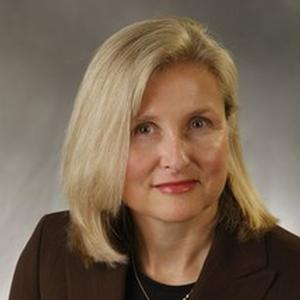
Kathleen Hidy serves as an Associate Professor of Legal Studies in the Department of Accounting and Business Law at Xavier University's Williams College of Business, where she has been a full-time faculty member since 2011. She teaches undergraduate business and MBA courses focused on the ethical, legal, and regulatory frameworks governing U.S. business operations. Her educational background includes: Juris Doctor from Columbia University School of Law (1988) Bachelor of Arts in Program of Liberal Studies (Great Books program) from University of Notre Dame, magna cum laude (1985), recipient of Nutting Award Professor Hidy's research centers on technology's disruptive impact on foundational legal principles. Her work systematically examines digital-era conflicts between corporate interests and individual rights, particularly in social media governance, free speech boundaries, and employment law evolution. Using interdisciplinary analysis, she develops frameworks for balancing innovation with constitutional protections in business contexts. Her publication pattern since 2013 reveals consistent focus on social media's legal ramifications across employer-employee relationships, international commerce, and constitutional challenges. This body of work demonstrates increasing sophistication in addressing digital property rights and viewpoint discrimination within regulatory gray areas. Her scholarly recognition includes: Williams College of Business M.B.A. Teacher of the Year Award Ignatian Educator of Distinction Award for the Jesuits Midwest Province Professor Hidy mentors students through business law curriculum development and has presented research at national conferences. Her teaching integrates two decades of corporate litigation experience with federal clerkship perspectives to contextualize legal theory within real-world business constraints.
Prof. Dr. Ralph Ernstorfer is a leading physicist holding dual appointments at the Technical University Berlin (Professor, Institute for Optics and Atomic Physics) and the Fritz Haber Institute of the Max Planck Society (Group Leader, Department of Physical Chemistry). His career includes tenure as a Max Planck Research Group leader (2010–2017) and W2 scientist (2017–2021) at FHI. He specializes in ultrafast dynamics of quantum materials, with affiliations spanning TU Berlin, Max Planck Institutes, and international collaborations. His research explores electron-phonon interactions, topological materials, and surface dynamics using advanced spectroscopic methods. Key themes include: Ultrafast electron and lattice dynamics in 2D systems (e.g., bismuthene, black phosphorus) Singlet fission mechanisms in organic semiconductors Non-equilibrium phenomena in ferromagnets and ferroelectrics Development of time-resolved photoemission techniques Recent publications (2019–2025) demonstrate prolific output in high-impact journals, focusing on momentum-resolved spectroscopy, phonon scattering, and computational materials science. His lab pioneers methodologies for studying energy flow in solids at femtosecond timescales. Prof. Ernstorfer advises researchers at the Fritz Haber Institute and TU Berlin, though specific student names are not listed. His group maintains active instrumentation development for ultrafast experiments, including momentum microscopes and spectral analysis tools.
Bill Tumas serves as Associate Lab Director for Materials/Chem Science & Technology at the National Renewable Energy Laboratory (NREL), where he provides overall leadership, management, technical direction, and workforce development for materials, chemical, and computational science capabilities. With over 30 years of experience in national laboratories and industry, Dr. Tumas joined NREL in December 2009 as director of the Chemical and Materials Science Center after spending 17 years at Los Alamos National Laboratory. Dr. Tumas earned his Bachelor's degree in Chemistry from Ithaca College and his PhD in Chemistry from Stanford University. His educational background in chemistry forms the foundation for his extensive work in renewable energy research and development. His research interests span a broad spectrum of renewable energy technologies, with particular focus on photovoltaics and solar energy conversion, electrochemistry, hydrogen production, materials discovery, and energy storage. Dr. Tumas oversees NREL's solar, hydrogen and fuel cells, basic energy sciences, advanced computing, and ARPA-E programs, driving innovation across multiple energy technology domains. Analysis of his 24 research publications from 2001-2024 reveals a consistent focus on advancing materials science for renewable energy applications, with recent work emphasizing photovoltaics scaling, carbon cycle management, renewable hydrogen, and high-throughput materials discovery. His publications appear in high-impact journals including Nature Reviews Chemistry, Science, and Nature Materials, demonstrating the significance of his contributions to the field. Fellow of the American Association for the Advancement of Science Leader of two Energy Frontier Research Centers: Center for Next Generation of Materials Design and Center for Inverse Design Significant research impact with multiple highly cited publications As NREL's laboratory point of contact for the Office of Science's Basic Energy Sciences program, Dr. Tumas manages critical sponsor relationships and program execution. His leadership extends to creating numerous multi-institution and international collaborations that advance renewable energy research globally. Dr. Tumas's work bridges fundamental science with practical applications, addressing some of the most pressing energy challenges of our time. He leads the Materials, Chemical, and Computational Science division at NREL, which serves as a hub for innovative research in renewable energy materials and technologies. Under his direction, the division pursues cutting-edge research that spans from basic science to applied technology development, creating pathways for commercial implementation of advanced energy solutions.
Stephan Roche is an ICREA Research Professor and Group Leader at the Institut Català de Nanociència i Nanotecnologia (ICN2), specializing in Theoretical and Computational Nanoscience. His research bridges fundamental physics with potential applications in next-generation electronics and quantum technologies. Primary Affiliation: Institut Català de Nanociència i Nanotecnologia (ICN2) Research Position: ICREA Research Professor Research Group: Theoretical and Computational Nanoscience Professor Roche's research focuses on quantum transport phenomena in nanoscale systems, particularly two-dimensional materials and van der Waals heterostructures. His work combines advanced computational techniques including first-principles calculations, quantum transport simulations, and analysis of topological properties. Key research areas include spintronics, graphene-based systems, topological materials, and quantum effects in disordered systems. His recent work has made significant contributions to understanding spin-orbit torques, quantum transport in twisted bilayer graphene, and topological phases in disordered systems. Analysis of his recent publications (2020-2025) reveals a strong focus on emerging phenomena in 2D materials, with particular emphasis on spin transport mechanisms, topological properties, and quantum effects. His work often combines theoretical modeling with practical implications for next-generation electronic and spintronic devices. The interdisciplinary nature of his research spans condensed matter physics, materials science, and quantum information. Key Research Themes: Quantum transport, Spintronics, Topological materials, 2D materials, Computational nanoscience Methodologies: First-principles calculations, Quantum transport simulations, Machine learning for materials Professor Roche maintains extensive international collaborations, with co-authors from institutions across Europe, Asia, and North America. His research group provides opportunities for students and postdocs interested in computational approaches to nanoscale physics and materials science. The group's work has significant implications for the development of next-generation electronic devices, quantum technologies, and advanced materials.
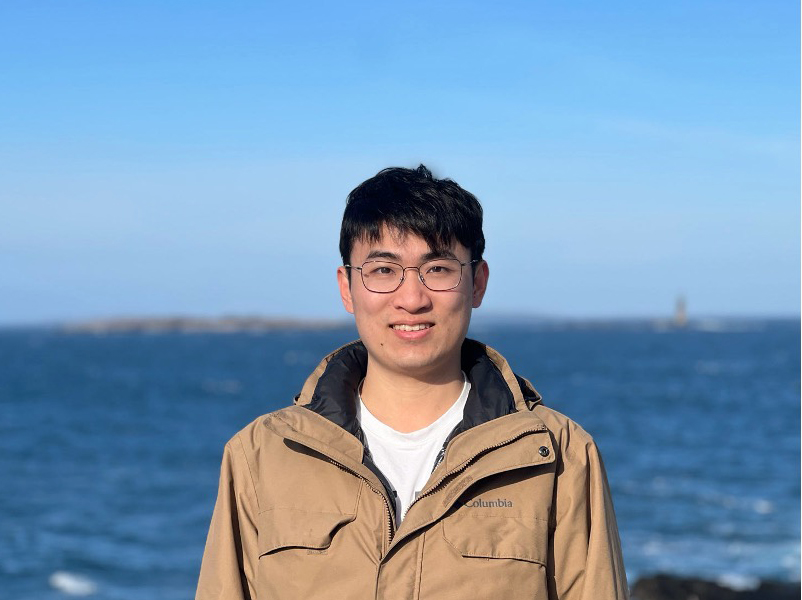
Kent Zheng is an Assistant Professor in the McKetta Department of Chemical Engineering at the University of Texas at Austin, officially joining in Spring 2024 after serving as an Affiliate PI since May 2023. His research focuses on electrochemical synthesis of crystalline materials for energy and sustainability applications, with particular emphasis on next-generation batteries and quantum materials. He leads the Crystalline Materials for Energy & Sustainability (CMES) research group within the Cockrell School of Engineering. Dr. Zheng earned his B.S. in Materials Science & Engineering and History from Shanghai Jiao Tong University (2017), followed by a Ph.D. in Materials Science & Engineering from Cornell University (2020), and completed postdoctoral research at MIT in Physics (2021-2023). His educational background reflects the interdisciplinary nature of his current research program. His research interests center around understanding and controlling electrochemical synthesis of crystalline materials for energy & sustainability. This unifying theme spans multiple disciplines including electrochemistry, materials science, chemical engineering, and condensed matter physics. His group's work encompasses next-generation batteries, atomically-precise additive manufacturing, exotic quantum phases, and fundamental electrochemistry. The research aims to accelerate the realization of next-generation materials that underpin 'electrification of everything' for energy security and sustainability. Analysis of his recent publications reveals a strong trend toward understanding dynamic electrochemical interfaces in battery systems, with particular focus on metal anodes. His work bridges fundamental materials science with practical energy storage applications, often incorporating computational guidance with experimental efforts. The publications span multiple subfields including electrodeposition control, interfacial phenomena, crystal growth mechanisms, and novel electrolyte design. Forbes 30 Under 30 in Science, 2025 ACS National Chemistry Olympiad Coach (USNCO), 2025 Associate editor, ECS Advances, 2024-present ECS Electrodeposition Division Early Career Investigator Award, 2021 Neware Research Excellence Award, 2021 Top Prize in National Competition of Science Innovations, 2017 Dr. Zheng actively mentors both graduate and undergraduate students through his i-REU (Independent Research Experiences for Undergraduates) program, which emphasizes early research experiences leading to first-author publications. His lab functions as a 'crucible' that fosters active exchange of ideas and fruitful collaboration. The group has secured competitive fellowships for students including the DoD NDSEG Fellowship, NSF GRF, and Bard CEC Fellowship. Dr. Zheng also serves as a coach for the American Chemical Society US Chemistry Olympiad. The CMES research group operates with strong values of individual opportunity and team synergy, bringing together members from diverse backgrounds united by the shared goal of pursuing world-class interdisciplinary research. The lab is structured to encourage members at all education levels to identify distinctive career paths and develop independent research projects that maximize their potential.
Prof. Dr. Robert Honke serves as Research Group Leader for System Simulation at the Institute for Hydrogen and Energy Technology (iwe) and sits on the Advisory Board of the Institute for Circular Economy of Bio:Polymers (ibp) at Hof University of Applied Sciences. His office is located in Building C, Room C117, with Wednesday office hours from 13:00-14:00. With over two decades of academic service since 2003, he bridges theoretical physics and practical engineering applications. Education: Physics studies at University of Regensburg Doctorate in Theoretical Physics (University of Regensburg) focusing on ab initio calculations of nonlinear vibrations on semiconductor surfaces Research Interests: Prof. Honke's work spans sustainable materials engineering and advanced simulation techniques. His primary focus areas include construction materials derived from biogenic residues, efficient thermal storage systems, control mechanisms for building energy management, and lightning strike damage simulation on composite structures. His research integrates computational physics with practical engineering challenges, particularly in aerospace and sustainable energy systems. The consistent thread through his career—from semiconductor surface physics to modern composite materials—demonstrates deep expertise in applying simulation methodologies to real-world structural and energy problems. Publication Trends: His recent publications (2015-2022) emphasize lightning protection for composite aerospace materials, thermal energy storage solutions, and biomass conversion technologies. Earlier works (1996-2002) established foundational contributions to surface physics, semiconductor vibrations, and satellite mirror design. Collectively, his research shows a strategic evolution from fundamental surface physics toward applied sustainable engineering, with computational modeling as the unifying methodology across all periods. Scientific Awards: No scientific awards were documented in the provided materials. Advising and Grants: Prof. Honke teaches core subjects in Master's programs for Composite Materials (structural mechanics) and Mechanical Engineering (CFD/FEM/Mathematics), maintaining strong industry connections from his prior Daimler Group experience. While specific student names and grant details aren't listed, his research group leadership indicates active supervision of graduate projects in simulation-based engineering. Labs and Teams: He directs the System Simulation research group at iwe, focusing on hydrogen technology applications, while contributing strategic guidance to ibp's circular economy initiatives for bio-polymers. These dual roles position him at the intersection of sustainable energy systems and advanced materials research within the university's engineering ecosystem.
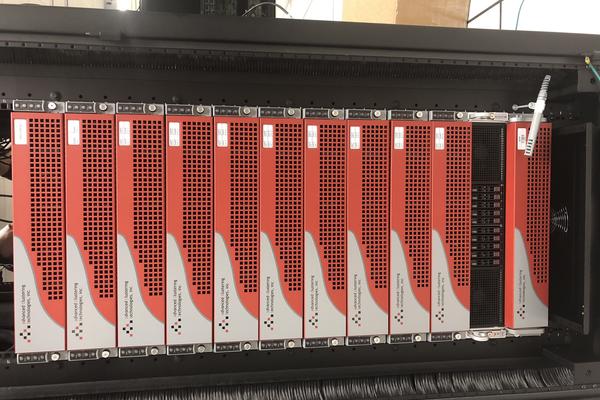
Amit Raj Sharma is an Associate Professor and Chair of the Department of Physics at Wright State University, where he also serves as the IASM Program Director and Interim Chair of the Department of Math and Statistics. He holds office at Fawcett Hall 241, 3640 Colonel Glenn Hwy, Dayton, OH. His educational background includes a PhD in Computational Physics (2008) from Max-Planck-Institut für Plasmaphysik, Germany, an M.S. in Physics from Pt. Ravishankar Shukla University, India (1997), and a B.S. in Physics and Mathematics from St. Thomas College, India (1995). His research focuses on: Theoretical and computational atomic/molecular physics Atomic and molecular chemical kinetics Computational molecular ro-vibrational spectroscopy Spectral line shapes First-principles computational material research Modeling non-linear processes in ionospheric plasmas (collaboration with Air Force Research Laboratory) His publications demonstrate strong focus on quantum dynamics, molecular spectroscopy, plasma physics, and computational material science, with recent work emphasizing ionospheric phenomena and interatomic potential modeling. Awards: Best Poster Award at the 7th International Conference on Chemical Kinetics (2011) Student Advising: He has supervised 12+ graduate students on topics including plasma turbulence modeling, material crystallization, atomic potentials, and ionospheric simulations. Current advisees include Nathan Zechar (PhD), James Serna, Sudip Acharya (MS), and Richard Vanderburg (MS). Infrastructure: Manages an NSF-funded high-performance computing cluster featuring 34 compute nodes, GPU acceleration, and FDR InfiniBand networking for scientific computation.
Professor Shuji Ogata serves in the Department of Physical Engineering, Applied Physics Field at Nagoya Institute of Technology's Graduate School of Engineering. His research spans nanomaterials, composite interfaces, and computational materials science with focus on molecular dynamics simulations of ferroelectric systems and polymer-metal adhesion. His educational background includes a Doctor of Science from The University of Tokyo (1991), preceded by undergraduate studies in Physics at the same institution. Key research interests include: Nanomaterials and composite interfaces Ferroelectric domain dynamics in materials like BaTiO 3 Moisture effects on polymer-metal adhesion Hybrid quantum-classical simulation methods Multiscale modeling from electronic to continuum levels Recent publications (2023-2024) demonstrate consistent focus on molecular dynamics simulations of ferroelectric materials and interfacial phenomena, particularly examining domain wall behavior in barium titanate and protonation mechanisms in epoxy resins under wet conditions. His work integrates machine learning potentials and first-principles calculations to address multiscale challenges. Award highlights include: Editors' Pick in Applied Physics Letters (2024) Featured Article in Journal of Applied Physics (2023) Best Technical Paper at Supercomputing 2001 Excellent Achievement Research Project from RIST (2015) His research program includes significant grants from JSPS, MEXT, and NEDO, particularly the "Super-fast development of super-materials" project (2016-2021) and current MEXT initiatives using the Fugaku supercomputer. He advises multiple doctoral students including Hikaru Azuma and Ryo Kobayashi who frequently co-author his recent publications. His Opto-Biotechnology Research Center affiliation enables cross-disciplinary collaborations in materials simulation.
Hirotaka Maeda is a Professor in the Department of Life and Applied Chemistry, Environmental Ceramics at Nagoya Institute of Technology's College of Engineering. His research focuses on environmental ceramics, inorganic materials, and nanotechnology with applications in water purification, energy storage, and biomaterials. Dr. Maeda received his Doctor of Engineering from Nagoya Institute of Technology in March 2006. His professional affiliations include the Society of Inorganic Materials (since 2006), Japanese Society of Inorganic Phosphorus Chemistry (since 2001), and The Ceramic Society of Japan (since 2000). His research interests span multiple domains including environmental ceramics for water purification, solid-state electrolytes for batteries, glass surface engineering, and conversion of biomass into functional materials. His work combines structural science with mimetic approaches to develop novel functional materials. His recent publications demonstrate strong activity in developing materials for environmental applications, particularly in water purification using garnet-based materials and conversion of agricultural waste into carbon materials. His research also extends to solid-state electrolytes for batteries and surface modification of glasses. 65th Society of Inorganic Materials Academic Award (2024) Poster prize winner, International Symposium on Inorganic and Environmental Materials 2018 57th Society of Inorganic Materials Nagai Memorial Encouragement Award (2016) 23rd Japanese Society of Inorganic Phosphorus Chemistry Encouragement Award (2014) 68th Ceramic Society of Japan Progress Award (2013) Dr. Maeda actively mentors graduate students across multiple projects, including research on rice husk conversion, humic acid removal, and solid-state battery materials. He serves on various academic committees including as General Affairs Director for the Japanese Society of Inorganic Phosphorus Chemistry and on the Editorial Committee of the Society of Inorganic Materials. His teaching includes Advanced Materials Creation Seminar, Ceramics Physical Chemistry, and Environmental Materials Special Lecture. His laboratory focuses on capturing phenomena at material surfaces and interfaces to create new functional materials, with particular emphasis on environmental applications and sustainable material solutions.