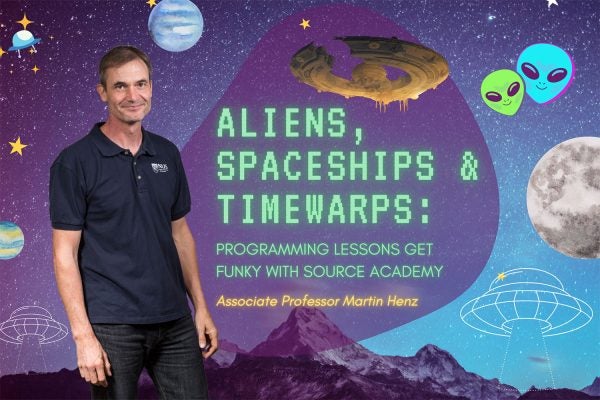
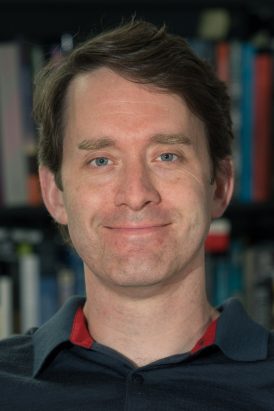
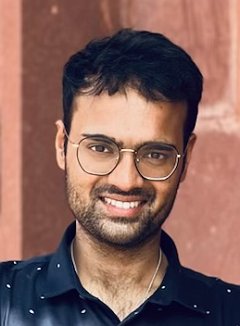
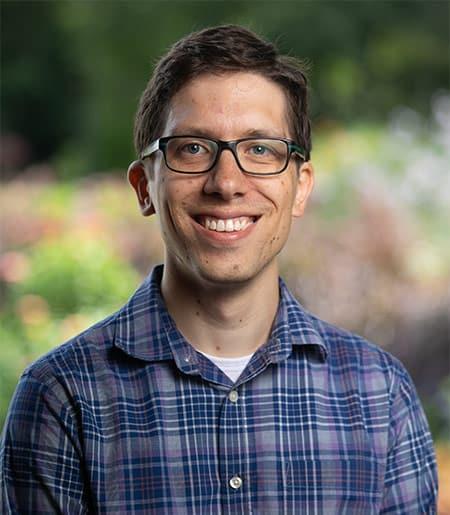
Martin Henz is an Associate Professor at the National University of Singapore , affiliated with the School of Computing and its Department of Computer Science . His academic journey includes an M.Sc. in Computer Science from Stony Brook University (1993) and a Dr.rer.nat. in Computer Science from Saarland University (1997). He has also worked as a Research Scientist at the German Research Centre for Artificial Intelligence. Research Focus : Scalable Experiential Learning, Systems for Teaching/Learning, AI in Education, Programming Languages, Algorithms, and Constraint Programming. Key Projects : Source Academy (immersive programming environment), Deep Teaching (LMS enhancements), and NUS Seafarers (maritime experiential learning). Publications span education technology, programming languages, and sustainable engineering, with recent works focusing on JavaScript-based pedagogy, automated question generation, and electric vehicle conversions. He supervised Rahul Singhal 's PhD, leading to the educational startup Cerebry, and co-founded Workforce Optimizer Pte Ltd with Alan Sevugan. Awards : NUS Annual Digital Education Award (2021) NUS Annual Teaching Excellence Award (2016/17) Fulbright Scholarship (1990) Startup @ Singapore Champion (2001)
Lars Kristiansen is Professor II (part-time Professor) at the Department of Mathematics, University of Oslo . His research centres on the intersection of mathematical logic, computability theory, and computational complexity, with recent emphasis on computable analysis, weak first-order theories, subrecursive degree structures, and implicit computational complexity. Research Interests Computable Analysis: Representations and computational complexity of irrational and real numbers. Weak First-Order Theories: Decidability, interpretability and fragments of concatenation theories. Subrecursive Degree Theory: Fine structure of honest subrecursive degrees and the Grzegorczyk hierarchy. Implicit Computational Complexity: Reversible computing, type systems that capture complexity classes, and resource-bounded program analysis. Across more than 50 refereed publications since 1996, a clear trend emerges: an early focus on subrecursive hierarchies and honest degrees evolved into an intensive study of the computational content of real number representations and the logical strength of weak arithmetics. Recent work (2023-2025) deepens this agenda, analysing the complexity of converting between alternative representations of reals and the degree structures that these induce. Scientific Output While no named awards are listed, Kristiansen’s contributions are disseminated in top venues such as Bulletin of Symbolic Logic , Annals of Pure and Applied Logic , Archive for Mathematical Logic , Science of Computer Programming , and leading LNCS conferences. His work is frequently co-authored with Amir Ben-Amram, Jakob Grue Simonsen, Juvenal Murwanashyaka, Ivan Georgiev, and Neil D. Jones, indicating active collaborative networks in both logic and theoretical computer science. Research Groups & Collaborations Logic research group at the University of Oslo Data and Knowledge Management (DKM) group
Jieh Hsiang is a Distinguished Professor at National Taiwan University , with affiliations in the Department of Computer Science and Information Engineering, the Digital Archives and Automatic Inference Laboratory, and the Digital Humanities Research Center. He holds concurrent roles at the Institute of Information Science, Academia Sinica, and the Higher Education Research & Development Office, National Taiwan University. Education PhD in Computer Science, University of Illinois at Urbana-Champaign (1979–1982) BS in Mathematics, National Taiwan University (1972–1976) Research Interests Hsiang's work spans automated reasoning , digital libraries , digital humanities , and information retrieval . His research focuses on integrating computational methods with cultural heritage preservation , particularly through tools like DocuSky and databases such as the Taiwan Historical Digital Library . He explores AI applications in patent analysis , historical text mining , and semantic relationships in legal documents . Recent Trends in Publications His recent articles highlight advancements in BERT and GPT-2 fine-tuning for patent classification , LARGE language models for legal automation , and GIS-based analysis of historical archives . Themes include digital preservation , AI-driven legal text analysis , and cross-disciplinary computational tools for humanities scholars. Scientific Awards 2019 Ministry of Science and Technology Distinguished Research Fellow 2009 National Taiwan University Outstanding In-House Service Award 2008 Chinese Library Association Special Contribution Award 2006 IEEE Test-of-Time Award 1997 & 1999 National Science Council Outstanding Research Award 1997 Ministry of Education Outstanding Industrial-Academic Collaboration Award 1998–2001 Founder and First Chair of IFIP WG1.6 Labs and Collaborations Hsiang leads the Digital Archive and Automatic Inference Laboratory , developing platforms like DocuSky for digital humanities, Taiwan Historical Digital Library , and QGIS Cloud Maps for spatial analysis. His team collaborates internationally on projects involving historical document digitization , patent automation , and cross-domain knowledge integration .
Prof. Dr. Martin Hils is a Professor of Mathematical Logic at the University of Münster's Faculty of Mathematics and Computer Science, affiliated with the Institut für Mathematische Logik und Grundlagenforschung. His expertise lies in model theory and set theory, focusing on geometric stability, simplicity theory, valued fields with automorphisms, and Hrushovski amalgamation. Education: Habilitation in Mathematics (2013, Université Paris Diderot) PhD in Mathematics (2006, Université Paris 7 and Lyon 1) Master (DEA) in Logic and Computer Science (2002, Paris 7) Diploma in Mathematics with Philosophy (2001, University of Bonn) Research Interests: Model theory of valued fields, geometric stability/simplicity theories, Hrushovski amalgamation techniques, and applications to algebraic geometry and differential fields. His work bridges abstract model theory with concrete mathematical structures. Recent Research Trends: Focus on non-archimedean geometry, separably closed valued fields, Lang-Weil estimates in difference fields, and definable retraction principles. His articles explore topics like Ax-Kochen-Ershov principles, domination monoids in valued fields, and beautiful pairs in unstable theories. Grants & Projects: Lead investigator in DFG Cluster of Excellence EXC 2044 (Groups, Model Theory and Sets) Principal investigator in 'Model Theory of Valued Fields with Endomorphism' (DFG 2022-2025) GeoMod project (geometric/combinatorial configurations in model theory, DFG 2020-2024) Contributor to SFB 878 (model theory of valued fields and definable groups) Teaching & Supervision: Current courses include Model Theory of Pseudofinite Fields and Logic Foundations. Supervised PhD students include Pierre Touchard (2020) and Rémi Jaoui (2017). Jointly supervises Simone Ramello and Zixuan Zhu. Editorial Work: Editor-in-chief of Model Theory journal. Authored textbook A First Journey through Logic (AMS 2019).
John Lee is a senior fellow at the Hudson Institute and an adjunct professor at the University of Sydney, with prior adjunct roles at the Australian National University. He is a leading expert on the Chinese political economy and Indo-Pacific strategic affairs, having served as senior national security adviser to Australia’s Foreign Minister. Based in Sydney, he holds a doctorate in international relations from the University of Oxford and law and arts degrees from the University of New South Wales. Education: PhD and MA in International Relations, University of Oxford; LLB and BA (First Class, Philosophy), University of New South Wales Current Affiliations: Senior Fellow, Hudson Institute; Adjunct Professor, University of Sydney; Senior Fellow (Nonresident), United States Studies Centre Former Role: Senior National Security Adviser to Australian Foreign Minister Julie Bishop (2016–2018) Dr. Lee’s research centers on Indo-Pacific security, defense strategy, US-China rivalry, and global trade policy. He is particularly focused on China’s political economy, strategic deterrence, alliance burden-sharing, and the implications of American reindustrialization. His work critically examines the evolving global economic order, the role of tariffs, and the challenges posed by state-led industrial policies, especially in China. He frequently analyzes the AUKUS pact, US alliance dynamics, and the strategic implications of China’s growing influence in the Global South and Middle East. His recent publications demonstrate a strong trend toward policy-relevant analysis of US trade and defense strategy under the Trump administration, with recurring themes of economic statecraft, national security, and the need for allies to increase defense spending and industrial resilience. He emphasizes the strategic logic behind tariffs as tools for reindustrialization and views alliances through a transactional lens of burden-sharing and strategic contribution. Scientific Awards: No awards explicitly mentioned in the text. Dr. Lee is an active advisor and commentator on national security and economic policy. He has not been mentioned as supervising formal students, but his influence is evident through his extensive media contributions and participation in high-level policy discussions. He has co-authored reports, such as on deterring China through nonmilitary costs, indicating collaborative research. His work is frequently cited in major media outlets like The Australian , Financial Review , and The Interpreter . He is associated with research teams and events at the Hudson Institute, regularly participating in panels and conferences on US-China rivalry, Middle East policy, and Indo-Pacific strategy. His work is central to ongoing policy debates about American global leadership, the future of globalization, and the strategic competition with China.
Val Tannen is a Professor at the University of Pennsylvania, specializing in database systems, provenance analysis, and programming languages. His research focuses on data management, query languages, and systems like DBSP and ORCHESTRA. Collaborations include work with co-authors such as Zachary Ives, Susan Davidson, and Todd Green. Key research interests include provenance for databases, incremental view maintenance, and data integration. His work bridges theoretical foundations and practical applications in systems like DBSP for stream processing and ORCHESTRA for collaborative data sharing. Publications span provenance frameworks, query optimization, and distributed systems. While no awards are explicitly listed, his contributions to database theory and systems are widely recognized.
Liam Midzain-Gobin serves as Associate Professor in the Department of Political Science within the Faculty of Social Sciences at Brock University. A settler scholar who completed his PhD at McMaster University in 2020, he has rapidly established himself as a significant voice in critical Indigenous and settler colonial studies. His academic journey includes an M.A. from the University of Ottawa (2015) and a B.Soc.Sci. from the same institution (2012). Dr. Midzain-Gobin's research centers on how settler colonialism persists in contemporary political structures and how Indigenous peoples revitalize governance practices to challenge colonial sovereignty. His work examines the 'logic of improvement' as a constitutive element of international order, exploring how cosmological assumptions about human dominion over the earth underpin settler sovereignty. Employing community-engaged methodologies, he collaborates directly with Indigenous communities through two major research projects: 'Building Inter-National Sovereignty: The Case of the Big Salmon River' (funded by SSHRC) and 'Indigenous Visions for Making Home in Niagara' (funded by the Niagara Community Foundation). His scholarly output reveals a consistent focus across Indigenous politics, settler colonial theory, and decolonial international thought. The 15 most recent publications demonstrate his engagement with critical questions of sovereignty, Indigenous governance, and resistance across multiple disciplinary contexts including political science, international relations, security studies, and Indigenous studies. His work frequently addresses the material and epistemic dimensions of settler colonialism while highlighting Indigenous strategies of resurgence and self-determination. Among his professional activities, Dr. Midzain-Gobin serves as Associate Editor for Critical Studies on Security and is co-editing the 'Handbook of Critical Understandings of Canada in the World' with colleagues Heather A. Smith, David Black, and David J. Hornsby. His commitment to community engagement extends beyond research into teaching practice, where he emphasizes critical approaches to Indigenous-settler relations. In the classroom, he teaches foundational and specialized courses including Introduction to International Relations, Research Design and Methods, Canadian Political Thought, Indigenous Politics in Canada, Global Indigenous Politics, and Indigenous-Settler Relations. His pedagogical approach reflects his scholarly commitment to decolonizing knowledge production and fostering critical engagement with Indigenous governance and sovereignty questions.
Eric Swanson is a Professor of Philosophy and Linguistics at the University of Michigan, Ann Arbor, where he has been teaching since 2006. He serves as Placement Director and Course Scheduler for the Department of Philosophy within the College of Literature, Science, and the Arts. His office is located in Angell Hall, where he holds regular office hours for students. Dr. Swanson received his academic training from prestigious institutions: Ph.D. in Philosophy (minor in Linguistics), Massachusetts Institute of Technology, 2006 M.A. in Philosophy, Tufts University, 2001 M.A. in Slavic Languages and Literatures, Yale University, 1999 B.A. in Literature, Bard College, 1997 Professor Swanson's research spans multiple interfaces between language and philosophical domains. His current work focuses on social and political philosophy of language and metaethics, particularly examining how language force extends beyond apparent information shared among discourse participants. He has made significant contributions to understanding relationships between language and epistemology (epistemic modals and conditionals), language and metaphysics (causal talk), and language and ethics (deontic modals). His theoretical frameworks include 'constraint semantics' and 'ordering supervaluationism,' providing innovative approaches to linguistic theorizing across these domains. His recent publications reveal a trajectory moving from technical linguistic-philosophical work toward more socially and politically engaged analyses of language. The most recent articles increasingly address issues of ideology, normativity, and political dimensions of language use while maintaining rigorous formal approaches. His work consistently bridges analytic philosophy of language with broader social concerns, demonstrating how technical linguistic phenomena connect to larger questions about power, ideology, and social structure. Professor Swanson has taught a diverse range of courses from introductory philosophy to specialized graduate seminars. In Fall 2025, he will teach the graduate proseminar for first-year Ph.D. students and Philosophy 340 (Minds and Machines). His undergraduate teaching includes Introduction to Philosophy, Philosophy and Narrative, Introduction to Formal Philosophical Methods, Minds and Machines, Language and Mind, and specialized courses on Philosophy of Language with a focus on contemporary AI. At the graduate level, he has taught numerous proseminars and specialized courses on topics including metasemantics, normative language, social and political philosophy of language, underdetermination, and discourse constraints on anaphora.
Umang Mathur is an Assistant Professor at the National University of Singapore's School of Computing, where he leads the FOCS Lab and is affiliated with PLSE@NUS. His research focuses on Formal Methods , Concurrency , and Decidability in Programming Languages and Software Engineering . PhD in Computer Science from the University of Illinois at Urbana-Champaign (advisor: Prof. Mahesh Viswanathan) Former Research Scientist at Facebook Inc. and Research Fellow at the Simons Institute Recipient of Google PhD Fellowship, 2024 CPP Distinguished Paper Award, 2023 ACM SIGPLAN Award, and ASPLOS 2022 Best Paper Award His recent work explores algorithmic techniques for detecting concurrency bugs , decidable program verification , and synthesis , with a focus on weak memory models, predictive monitoring, and automata-theoretic approaches. Articles span topics like causal concurrency, tree clock data structures, and probabilistic counting algorithms, reflecting interdisciplinary intersections of logic and systems research. Scientific Awards Google PhD Fellowship 2024 CPP Distinguished Paper 2023 ACM SIGPLAN Distinguished Paper 2022 ASPLOS Best Paper 2018 ESEC/FSE Distinguished Paper He advises PhD students in Formal Methods and supervises teams in the FOCS Lab. Teaching includes advanced modules on Automata Theory, Logic, and Verification at NUS.
Steven O. Kimbrough is a Professor of Operations, Information and Decisions at the Wharton School, University of Pennsylvania. His research spans artificial intelligence, computational rationality, and strategic optimization with applications to political science, economics, and service innovation. He teaches courses like Agents, Games, and Evolution and Thinking With Models , focusing on experimental approaches to bounded rationality and uncertainty in decision-making. Primary Email: kimbrough@wharton.upenn.edu Office: 3730 Walnut Street, 565 Jon M. Huntsman Hall, Philadelphia, PA 19104 His research interests include: Artificial intelligence and metaheuristics for constrained optimization Evolutionary computation in electoral redistricting Agent-based modeling of market dynamics Logic modeling for normative reasoning Text mining applications in event analysis Publications demonstrate expertise in computational economics, political modeling, and service analytics. Recent work focuses on: Empirical validation of electoral compactness Strategic learning in oligopolies Multi-objective matching algorithms Feasible-infeasible solution spaces Service network optimization Teaching emphasizes: Game-theoretic approaches to strategic behavior Modeling life-cycle for energy sustainability Computational experiments in social science
Marten van Schijndel is an Assistant Professor of Computational Linguistics at Cornell University, affiliated with the Cognitive Science Program and the Department of Linguistics within the College of Arts and Sciences. His research focuses on incremental language processing, comparing human linguistic behavior with computational models like neural networks. He organizes the Computational Psycholinguistic Discussions (C.Psyd) and collaborates with the Cornell Computational Linguistics Lab (CLab) and Cornell NLP Group. Van Schijndel’s work bridges computational modeling and psycholinguistics, probing how humans and models process language incrementally, particularly through methodologies like fMRI and behavioral experiments. His research interests include computational modeling of language processing, neural network representations, and the interplay between syntax, semantics, and discourse. Notably, he investigates ungrounded learning in neural models, exploring what linguistic aspects emerge from statistical patterns alone. Recent contributions include studies on semantic change quantification, phonotactic effects in context, and discourse predictability in Hindi word order. Van Schijndel teaches courses such as Computational Linguistics II and leads seminars on natural language processing. He actively advises students like John R. Starr, Ashlyn Winship, and Zander Lynch, whose work spans experimental paradigms for semantic spaces, implicit arguments in sentence processing, and semantic role localization. His recent activities include co-organizing workshops on event representation (PEER 2025) and presenting at the University of Rochester on event construction from language. Media highlights include research on tracking anti-immigrant hate speech and semantic evolution in French texts.
Tamar Lando is an Associate Professor of Philosophy at Columbia University, affiliated with the School of Arts and Sciences. She holds a B.A. in Philosophy from Stanford University (2002), an M.A. in Mathematics from UC Berkeley (2008), and a Ph.D. in Philosophy from UC Berkeley (2012). Her research focuses on logic and epistemology, with specializations in modal logic, topological and probabilistic semantics, and philosophical theories of chance, coincidence, and luck. She joined Columbia in 2012 after completing her doctoral studies. Her work bridges formal logic, mathematics, and philosophy, with notable contributions to region-based theories of space, measure-theoretic semantics, and causal explanation. Her photography, exhibited in venues like the Autry Museum, explores landscapes such as the Mimbres River Valley, reflecting her dual passion for academic and artistic expression.
Adrian Francalanza is a Professor in the Department of Computer Science at the Faculty of Information and Communication Technology, University of Malta. His research is centered on formal methods, runtime verification, and concurrency, with a focus on monitorability and distributed systems. His research interests include: Runtime Verification and Monitor Synthesis Session Types and Protocol Safety Concurrency and Actor-Based Systems Branching and Linear-Time Temporal Logics Probabilistic and Decentralized Monitoring Formal Tools for Cyber-Physical and Distributed Systems The recent publications highlight a strong trend in theoretical and practical advances in monitorability, especially for branching-time and probabilistic systems. His work bridges theory with implementation, often resulting in tools like STMonitor and DetectEr. There is a clear emphasis on session types, runtime enforcement, and the verification of communication protocols in real-world systems such as REST APIs and SMTP. Scientific awards include: Distinguished Paper Award at ECOOP 2025 Best Paper Award at DisCoTec 2022 He has been actively involved in advising and organizing major academic events. He served as Program Chair for GandALF 2024 and 2025, FORTE 2024, and VORTEX workshops. He led a three-year project funded by Rannis on Theoretical Foundations for Monitorability in collaboration with Reykjavik University. He has received grants and recognition for developing practical tools such as DetectEr and STMonitor, which support runtime monitoring of Erlang and session-typed systems. He is associated with several research teams and labs, including: Runtime Verification and Monitorability Research Group at University of Malta Collaborators on the DetectEr project Developers of STMonitor and polyLarva tools International collaborators at Reykjavik University and beyond
Giles Reger is a Senior Lecturer in the Formal Methods Group of the School of Computer Science at the University of Manchester. He completed his BA in Computer Science at the University of Cambridge in 2009, followed by an MSc in Advanced Computer Science at the University of Manchester in 2010 (awarded Highest Achiever of the Year), and earned his PhD from the University of Manchester in 2014 with a thesis titled "Automata based monitoring and mining of execution traces". His research spans several key areas within computer science: Automated Theorem Proving (first-order) Saturation-based techniques Reasoning with theories and quantifiers Finite Model finding Collaborative and Concurrent proof attempts Runtime Monitoring/Verification Temporal specification languages Specification Mining/Inference Dr. Reger leads multiple EPSRC-funded research projects including SCorCH (Secure Code for Capability Hardware), CAPS (Collaborative Architectures for Proof Search), and QuTie (reasoning with Quantifiers and Theories). His work on the Vampire theorem prover and MarQ monitoring tool demonstrates his bridge between theoretical computer science and practical applications. Recent publications show strong focus on runtime verification, theorem proving, and program analysis with applications to security and performance monitoring. Notable awards: Highest Achiever of the Year Award for MSc studies Dr. Reger collaborates extensively with institutions including the University of Oxford, Arm, Amazon Web Services, and CERN (CMS Experiment). As Manchester lead on the SCorCH project, he develops formal analysis tools for security-aware hardware chips. His work on the VyPR framework enables developers to analyze Python program performance through temporal specification languages and monitoring algorithms.
Violetta Lonati is an Assistant Professor at the University of Milan 's Department of Computer Science since 2005. Her research spans Formal Languages and Automata (operator precedence languages, Wang automata, tiling systems) and Computer Science Education . She co-authored over 15 publications in theoretical computer science and education, focusing on 2D language recognition, logic characterization of automata, and pattern statistics in stochastic models. Education : PhD in Computer Science (2005) and Laurea in Mathematics (2001) from University of Milan Research Groups : ALaDDIn Lab for Didactics and Dissemination of Informatics, Bebras International Initiative Her work on Wang automata established their equivalence to tiling systems while introducing deterministic variants. In education, she designed workshops for schools and contributed to Italy's national computing curriculum proposal (2019). She held leadership roles at ACM ITiCSE (WG5 leader 2022), served as Associate Program Chair (2019-2022), and reviewed for top venues like ICER and SIGCSE TS. She received Google CS[4]HS and Informatics Europe awards for her educational contributions. Key Publications (2017-2001): Input-driven locally parsable languages (TCS 2017) Operator precedence logic characterization (SICOMP 2015) Snake-deterministic tiling systems (MFCS 2009) Graph fibrations and PageRank (RAIRO 2006) Pattern statistics in rational models (STACS 2005) Scientific awards include Google CS[4]HS (2011, 2017, 2019) and the Informatics Europe Best Practices in Education (2016). As part of ALaDDIn, she developed teacher training programs and graduate courses on computing education. Her teaching experience covers Algorithms & Data Structures (2013-2023), Computer Science Teaching (2014-2023), and courses for Biotechnology and Geological Sciences programs (2005-2007).