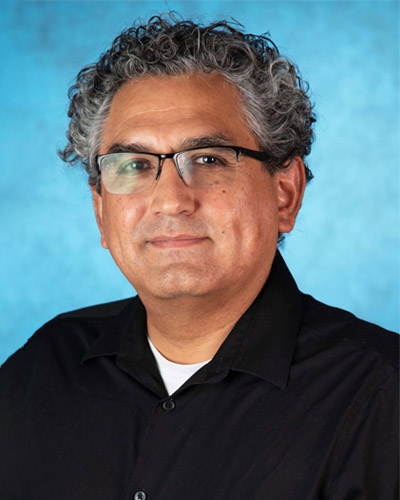
Fidel SantamariaView profile
Professor
Fidel Santamaria is a Professor in the Department of Neuroscience, Developmental and Regenerative Biology at the University of Texas at San Antonio (UTSA), within the College of Sciences. His research integrates experimental, computational, and theoretical approaches to study cerebellar function, learning and memory, and the role of biological complexity in neural computation. Education: Ph.D. in Neuroscience, California Institute of Technology B.S. in Physics, National Autonomous University of Mexico His research focuses on history-dependent dynamics across biological scales, employing fractional-order differential equations to model memory effects from molecules to behavior. He investigates intrinsic excitability and synaptic plasticity in cerebellar Purkinje cells, combining electrophysiology, multi-photon imaging, and biophysical modeling. His work extends into neuromorphic engineering , where he develops circuits with memory elements like mem-capacitors to emulate biological learning rules. Recent publications reveal a strong trend in modeling non-Markovian processes in neurons, information coding in networks with memory, and the biophysical basis of plasticity. This interdisciplinary approach bridges neuroscience, physics, and engineering. Scientific Contributions: Developed a unified framework using fractional calculus for history-dependent neural activity Demonstrated coupling between synaptic and intrinsic plasticity in Purkinje cells Explored calcium dynamics changes post-plasticity Advanced neuromorphic circuits with memory components Studied cerebellar excitability in autism models Santamaria actively mentors students through his research lab, where he supervises projects involving computational modeling, electrophysiology, and imaging. His work is supported by research grants (implied by lab activity and NCBI profile). He leads a multidisciplinary research team focused on understanding how biological complexity enables efficient neural computation. The lab combines experimental neuroscience with advanced mathematical modeling and engineering principles to explore fundamental questions in brain function.