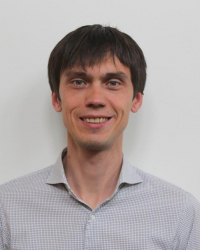
Volker Meden is a Professor at RWTH Aachen University's Department of Theoretical Physics, where he leads research in the theory of condensed matter. His work explores quantum transport phenomena, functional renormalization group methods, and nonequilibrium quantum systems, with specialized focus on quantum dots, topological materials, and many-body interactions. Research interests span: Quantum transport in nanostructures and mesoscopic systems Functional renormalization group techniques for correlated electrons Nonequilibrium quantum many-body physics and dynamics Topological phenomena in condensed matter systems Theoretical modeling of quantum dot systems Non-Hermitian quantum physics and PT symmetry Analysis of recent publications (2019-2024) reveals strong emphasis on quantum transport mechanisms in nanostructures, particularly through quantum dots coupled to bosonic modes and topological insulators. Significant methodological work advances functional renormalization group approaches for nonequilibrium systems and non-Hermitian quantum physics. Secondary research threads include biophysical modeling of metabolic processes. No scientific awards or distinctions are mentioned in available sources. No information is available regarding student advising, research grants, laboratory leadership, or team structures.
Philipp Werner is a Full Professor at the Department of Physics, Faculty of Mathematics, Natural Sciences and Medicine, University of Fribourg. His research focuses on quantum many-body systems, ultrafast phenomena, and strongly correlated materials. Affiliation: University of Fribourg Academic Rank: Professor Contact: philipp.werner@unifr.ch Research Interests: Werner's work explores the interplay of electron correlations, spin-orbit interactions, and ultrafast dynamics in quantum materials. He develops advanced computational methods like tensor cross interpolation and dynamical mean-field theory to study systems such as Mott insulators, Hubbard models, and transition metal compounds. Recent Publications: His recent studies investigate topics including high-harmonic generation in quantum systems, spin-orbit driven nonlinear dynamics, and hidden Kondo lattice physics. These works often involve nonequilibrium simulations and time-resolved spectroscopic techniques.
Dr. Kai Zhou is a Research Fellow at the Frankfurt Institute for Advanced Studies (FIAS) in the Theoretical Sciences division, where he leads the 'Deepthinkers' research group. Born in China in 1987, he completed his B.Sc. in Physics from Xi'an Jiaotong University in 2009 and earned his PhD with 'Wu You Xun' Honors from Tsinghua University in 2014. After postdoctoral research at Goethe University Frankfurt's Institute for Theoretical Physics, he joined FIAS in August 2017 as a Research Fellow focusing on Deep Learning applications in physics. Frankfurt Institute for Advanced Studies (FIAS), Theoretical Sciences (2017-present) Goethe University Frankfurt, Institute for Theoretical Physics (Postdoc) Tsinghua University, Physics (PhD, 2014) Xi'an Jiaotong University, Physics (B.Sc., 2009) Dr. Zhou's research bridges artificial intelligence and theoretical physics, with a focus on applying machine learning techniques to complex physical systems. His work spans heavy-ion collisions, lattice quantum field theory, seismology, and renewable energy systems. He has developed innovative deep learning approaches to extract physical insights from complex data, including constructing an Equation-Of-State meter for heavy ion collisions. His research demonstrates how physics can inform AI development while AI enhances our understanding of physical phenomena. Analysis of Dr. Zhou's recent publications reveals a strong trend toward integrating physics principles with machine learning architectures. His work increasingly focuses on Bayesian inference methods applied to QCD phase transitions, physics-informed neural networks for solving inverse problems in nuclear physics, and developing specialized architectures that preserve physical symmetries. The interdisciplinary nature of his research is evident in applications spanning from heavy-ion collisions to neutron star physics and industrial process optimization. Wu You Xun Honors (PhD) Third party funding through Samson AG: AI for science BMBF funding within ErUM data program: Deep Learning for CBM computing DAAD exchange program Xidian-FIAS International Joint Research Center: AI for science BMWI: AI for energy Nvidia: GPU Grant Dr. Zhou actively mentors doctoral and master's students, currently advising seven graduate students across multiple institutions. His research group 'Deepthinkers' has secured significant third-party funding from diverse sources including industrial partners (Samson AG), government agencies (BMBF, BMWI), and international collaborations (DAAD, Xidian University). His approach combines theoretical physics with cutting-edge AI techniques to address complex problems in both fundamental science and industrial applications. The 'Deepthinkers' research group operates at the intersection of AI and physics, developing novel methodologies that leverage physical principles to enhance machine learning and vice versa. Their work on applying deep learning to heavy-ion collisions represents a significant advancement in extracting meaningful physical insights from complex collision data. The group maintains strong international collaborations, particularly with Chinese institutions through the Xidian-FIAS International Joint Research Center.
Prof. Dr. Artur Widera is a Professor at RPTU Kaiserslautern in the Department of Physics, where he leads a research group focused on quantum physics and ultracold atoms. He has held this position since 2010 and previously served as a scientific assistant in the group of D. Meschede in Bonn (2007-2010). His academic background includes a PhD from University Mainz (2003-2007) under I. Bloch, a diploma thesis with T.W. Hänsch in München (2002-2003), and studies in physics at University Würzburg (1997-2002). Prof. Widera's research spans quantum physics, ultracold atoms, quantum thermodynamics, quantum information, and atomic physics. His work explores quantum gases in optical lattices, quantum simulation, quantum sensing with nitrogen-vacancy centers, and quantum thermodynamics. He has made significant contributions to understanding quantum phase transitions, quantum transport phenomena, and quantum metrology. His publication record shows a consistent output of high-impact research, with recent work focusing on quantum sensing applications, quantum thermodynamics, quantum education, and multiqubit quantum systems. The publications demonstrate a trend toward increasingly interdisciplinary research, connecting fundamental quantum phenomena with practical applications in sensing and quantum information processing. Teaching award of the state Rhineland-Palatinate (2020) APS Outstanding Referee (2020) Teaching award of the state Rhineland-Palatinate (2016) Teaching award of TU Kaiserslautern (2013) ERC Independent Starting Researcher Grant (2011) Prof. Widera has supervised numerous PhD students including Daniel Adam, Sian Barbosa, and Jennifer Koch. His research has been supported by significant grants including an ERC Starting Grant in 2011 and leadership of an independent research group funded by the state of Northrhine-Westphalia (2009-2010). He serves as Dean of Studies for the physics department and chairs the committee for the international Master's program 'Advanced Quantum Physics' at RPTU Kaiserslautern. His workgroup at RPTU Kaiserslautern includes researchers focusing on quantum gases, quantum sensing with NV centers, quantum thermodynamics, and quantum information processing. The team maintains strong collaborations with other institutions in Germany and internationally, particularly in the areas of quantum simulation and quantum metrology.
Zhen GAO is an Associate Professor in the Department of Electronic and Electrical Engineering at Southern University of Science and Technology (SUSTech), where he has been employed since April 2021. He received his PhD in Applied Physics from Nanyang Technological University, Singapore (2013-2018), following his Master's (2009-2012) and Bachelor's (2005-2009) degrees in Electrical Engineering from Zhejiang University. His educational background includes: PhD in Applied Physics, Nanyang Technological University (2013-2018) Master's in Electronics Science and Technology, Zhejiang University (2009-2012) Bachelor's in Electronic Information Engineering, Zhejiang University (2005-2009) Professor GAO's research focuses on cutting-edge areas in photonics and topological physics. His work spans multiple disciplines including electromagnetic wave theory, quantum phenomena in photonic systems, and novel material applications. He has established himself as a leading researcher in topological photonics, with significant contributions to the understanding of three-dimensional photonic topological insulators and Chern insulators. His research group, the Topological Physics Lab, actively investigates the intersection of topology, photonics, and condensed matter physics, pushing the boundaries of what's possible in wave manipulation and control. Analysis of his recent publications reveals a strong focus on three-dimensional topological systems across multiple physical platforms (photonic, acoustic, electronic). His work demonstrates a progression from fundamental theoretical concepts to experimental realizations, with increasing complexity from 2D to 3D systems. The research spans multiple disciplines including condensed matter physics, optics, acoustics, and electrical engineering, reflecting the interdisciplinary nature of modern topological physics research. His scientific achievements have been recognized through numerous prestigious awards: National Distinguished Youth Expert in 2020 Ten Major Advances in Chinese Optics in 2019 Top 10 Social Influential Events in Chinese Optical Field in 2019 Chinese Government Award for Outstanding Self-financed Student Award in 2016 National-level Talent in Shenzhen 2022 Asian International Conference on Communications and Photonics Young Scientist Award 2023 International Symposium on Electromagnetic Waves and Optics Young Scientist Award 2023 Global Optoelectronics Conference Young Scientist Award Professor GAO has secured significant research funding through various channels, including the National Natural Science Foundation of China Youth Project, General Project, International (Regional) Cooperation and Exchange Project, and the National Distinguished Expert Project of the Organization Department of the CPC Central Committee. He actively mentors students and researchers through his Topological Physics Lab, which recruits postdoctoral fellows, PhD students, Master's students, and interns with backgrounds in optics, physics, electronics, and communications. The Topological Physics Lab, located in Room 707 of the South Tower of Engineering Building at SUSTech, serves as a hub for interdisciplinary research at the intersection of topology, photonics, and condensed matter physics. The lab maintains strong collaborations with research groups both within China and internationally, particularly with institutions in Singapore.
Charles L. Kane is a renowned theoretical condensed matter physicist and the Christopher H. Browne Distinguished Professor of Physics at the University of Pennsylvania. He earned his B.S. in physics from the University of Chicago (1985) and his Ph.D. from the Massachusetts Institute of Technology (1989). His research focuses on topological insulators, quantum spin Hall effect, and novel quantum phases in condensed matter systems. Dirac Prize (2012) Oliver E. Buckley Prize (2012) Breakthrough Prize in Fundamental Physics (2019) His work has revolutionized the understanding of topological materials, particularly through predicting the quantum spin Hall effect in graphene and pioneering concepts in topological insulators. Recent research explores topological density correlations, multipartite entanglement, and nonlinear transport phenomena. Kane's scientific contributions have been recognized by numerous prestigious awards, including the Franklin Medal (2015) and the Frontiers of Knowledge Award (2018). He maintains active collaborations and continues to advance frontiers in theoretical condensed matter physics.
Pramey Upadhyaya is an Associate Professor in the Elmore Family School of Electrical and Computer Engineering at Purdue University, serving as Area Chair for Microelectronics and Nanotechnology. His research focuses on magnetism, quantum spintronics, and next-generation information processing technologies, including bio-device applications. He holds a B.Tech from IIT Kharagpur (2009), an MS from UCLA (2011), and a Ph.D. from UCLA (2015). His work integrates nanotechnology, quantum sensing, and spin dynamics to advance computing and sensing paradigms. Research interests span antiferromagnetic materials, probabilistic bits (p-bits), and quantum spin defects. His contributions include electrically tunable magnetism and plasmonic-enhanced spin emission. Notable projects include a CAREER grant-funded initiative on spin-magnon hybrid quantum devices (2020). His studies bridge fundamental physics and applied engineering, addressing challenges in neuromorphic computing and topological electronics. Advising and grants highlight collaborative efforts in spintronics and nanotechnology. His lab focuses on device fabrication, quantum metrology, and spin-based information processing. Ongoing work explores magnetic skyrmions, Majorana modes, and ultrafast stochastic systems.
Chris Greene is the Albert Overhauser Distinguished Professor of Physics and Astronomy at Purdue University. He leads research in ultracold quantum systems, electron-molecule collisions, and laser-atom interactions. His work bridges theoretical and experimental physics, focusing on few- and many-body quantum phenomena. Education: B.S. in Physics and Mathematics (University of Nebraska-Lincoln, 1976), M.Sc. and Ph.D. in Physics (University of Chicago, 1980), Postdoc at Stanford University (1980-1981). Awards include the IBM Graduate Fellowship and National Merit Scholarship. Research focuses on ultracold quantum systems (Efimov physics, Rydberg molecules), electron-ion collisions, and ultrafast laser interactions. His group explores quantum control, entangled photon sources, and applications in metrology and quantum information. Publications emphasize dissociative recombination, three-body recombination, and quantum many-body systems. Recent work includes attosecond photon sources, Efimov state interferometry, and theoretical models of cold gases. Awards: IBM Graduate Fellowship (1976-1980), National Merit Scholarship (1972-1976). Advising and Grants: Active in mentoring graduate students in theoretical and computational physics. Lab: Fermion Group (https://www.physics.purdue.edu/fermion/), focusing on few-body quantum systems and cold molecules.
Michael J. Manfra is the Bill and Dee O’Brien Distinguished Professor of Physics and Astronomy at Purdue University, with joint appointments in the School of Materials Engineering and the School of Electrical and Computer Engineering. He is the Director of the Purdue Quantum Science and Engineering Institute and Scientific Director of the Microsoft Quantum Lab at West Lafayette. His research focuses on solid-state quantum computing, semiconductor nanostructure fabrication via molecular beam epitaxy (MBE), and the study of quantum transport properties in low-dimensional systems. Manfra earned his A.B. in Physics from Harvard University (1992) and his Ph.D. in Physics from Boston University (1999). His research group explores exotic topological phases in fractional quantum Hall systems, semiconductor-superconductor hybrid structures for Majorana fermions, and spin-based quantum bits (qubits). They also develop novel light sources in III-Nitride materials in collaboration with the Malis Group. Key facilities include Purdue’s Birck Nanotechnology Center and low-temperature laboratories capable of achieving 10mK temperatures under high magnetic fields. Manfra leads interdisciplinary efforts in quantum computing through partnerships with Microsoft and global academic institutions. His technical background includes prior roles at Bell Laboratories (2001–2008) and a progression from Associate Professor to Distinguished Professor at Purdue since 2009.
Qi Zhou is a Professor in the Department of Physics and Astronomy at Purdue University. His research focuses on quantum gases, synthetic gauge fields, ultracold atoms, and quantum many-body dynamics. Key contributions include exploring breather dynamics in Bose-Einstein condensates, connections between geometry and quantum dynamics, and bosonization of SU(N) fermions. His work bridges theoretical physics with experimental applications, such as synthetic Hall tori and quantum control via SU(1,1) echoes. Research highlights include universal relations in chemical reactions of dilute molecules (Science Advances, 2020), geometric frameworks for quantum systems (PRL, 2020), and bosonization phenomena in 3D fermions (PRX, 2020). His group also investigates discrete time crystals and precision measurements (PRR, 2020). Recent efforts explore synthetic gauge fields in alkali atoms and universal thermodynamic relations in dilute systems. While his primary affiliation is in theoretical physics, his Google Scholar publications reveal a parallel focus on pharmaceutical sciences, particularly inhalable drug formulations and antimicrobial therapies. This includes aerosolized bacteriophage delivery systems, combination antibiotic formulations, and mechanistic studies of polymyxin toxicity in human epithelial cells.
Junyeong Ahn is an Assistant Professor of Physics at The University of Texas at Austin, within the College of Natural Sciences. His research focuses on theoretical investigations of quantum phenomena in condensed matter systems, including topological phases, many-body correlations, and quantum light-matter interactions. He integrates insights from condensed matter physics, quantum optics, and quantum information science to explore quantum materials' functional properties. Education includes a Ph.D. from Seoul National University (2020), followed by postdoctoral appointments at Harvard University (2020–2024) and RIKEN Center for Emergent Matter Science/The University of Tokyo (2020). His research areas span Materials Science, Quantum Information, and Computational/Theoretical Physics. Key research interests center on the geometric and topological aspects of quantum states, particularly electromagnetic response properties of quantum materials. Notable contributions include studies on topological circular dichroism, optical axion electrodynamics, and Riemannian geometry in optical responses. Awards include the Outstanding Young Researcher Award (2023), Dissertation of the Year (2021), and Young Physicist Award (2019). He is affiliated with the Center for Complex Quantum Systems and Texas Quantum Institute.
Birgit Kaufmann is a Professor in the Department of Mathematics at Purdue University, serving as Associate Head of Graduate Studies. She organizes the Mathematical Physics seminar and holds a joint affiliation with the Department of Physics. Her research focuses on Mathematical Physics, Quantum Information Science applied to statistical physics, non-equilibrium systems, quantum wire networks (particularly those based on triply-periodic minimal surfaces like the gyroid), and finite-size scaling in atomic models. Her academic achievements include the 2017 University Faculty Scholar Award and multiple teaching honors such as the Spira Teaching Award and Teaching for Tomorrow Fellow/Mentor Awards. Her work is supported by grants including NSF CAREER (PHY-1255409), Simons Fellowship, Purdue Quantum Seed Grants, and an NSF grant on boundary effects in critical phenomena (PHY-0969689). Research interests span topological insulators, quantum phase transitions, and the interplay between geometry (e.g., wire networks) and physical properties. She has explored applications of K-theory and noncommutative geometry to material science, with recent studies on Majorana transitions and quantum annealing techniques for molecular modeling. Teaching contributions include courses ranging from differential equations to graduate-level quantum mechanics and honors college quantum computing. She has developed the IMPACT program for foundational mathematics instruction and contributed to interdisciplinary courses like Phys 29000 (Mathematical Methods for Physicists).
Michael Manfra is the Bill and Dee O'Brien Distinguished Professor of Physics and Astronomy, Professor of Materials Engineering, and Professor of Electrical and Computer Engineering at Purdue University. He serves as Scientific Director of the Microsoft Quantum Lab West Lafayette. His research focuses on quantum-mechanical properties of electrons in III-V semiconductor and superconductor devices, with a strong emphasis on topological quantum computing. His group develops ultra-high purity semiconductor nanostructures via molecular beam epitaxy (MBE), studying quantum transport in 2D electron gases at cryogenic temperatures. Key projects include exploring Majorana fermions in semiconductor-superconductor hybrids, fractional quantum Hall effects, and quantum bit (qubit) development for scalable quantum computing. The group collaborates with leading institutions globally and has pioneered advancements in III-Nitride optoelectronics. Recent highlights include the creation of a Microsoft Quantum Purdue facility and leadership in developing fault-tolerant qubit arrays. Research Interests: Topological qubits and Majorana fermions Quantum transport in 2D electron systems Molecular beam epitaxy (MBE) growth Semiconductor-superconductor hybrid devices Quantum Hall effects (fractional and integer) Near-infrared photonic materials Awards and Leadership: Bill and Dee O'Brien Distinguished Professorship Director of Microsoft Quantum Purdue Collaborations with MIT, IBM, and other global quantum computing leaders Labs and Facilities: Microsoft Quantum Lab West Lafayette Birck Nanotechnology Center (Room 2050) Low-temperature quantum transport laboratories Molecular beam epitaxy (MBE) facilities
Anton Andreev is the Boeing Professor of Physics at the University of Washington. His research focuses on electron physics in low-dimensional systems such as quantum wells, wires, and dots, emphasizing electron-electron interactions and disorder effects. He explores phenomena like Luttinger liquids and Coulomb blockade, along with superconductivity and quantum coherence in disordered systems. Education: Ph.D. in Physics from MIT (1996). Research Interests Quantum transport in nanoscale systems Interplay between electron-electron interactions and disorder Superconductivity in layered and disordered materials Non-equilibrium quantum phenomena Selected Awards 1999 A. P. Sloan Fellowship 1999 David & Lucille Packard Fellowship 1999 NSF CAREER Award Key Contributions His work spans theoretical studies of Coulomb blockade, Luttinger liquids, and quantum criticality. Recent focus includes hydrodynamic plasmons in electron bilayers, nonreciprocal transport in superconducting junctions, and topological phenomena in Weyl semimetals.
Lukasz Fidkowski is an Associate Professor in the Department of Physics at the University of Washington, within the College of Arts & Sciences. His research focuses on identifying exotic phases of matter beyond traditional symmetry-breaking theories, such as fractional quantum Hall phases and topological insulators. He specializes in classifying strongly interacting topological phases, including symmetry-protected topological phases, using tools like topological quantum field theory and exactly solved models. His work also explores topological order in non-equilibrium systems, driven (Floquet) systems, and many-body localized environments. He teaches courses within the Department of Physics and is affiliated with the University’s broader research initiatives in condensed matter and quantum information. His research contributions span theoretical frameworks for understanding topological phases in fermionic systems, Floquet engineering, and symmetry fractionalization in topological superconductors. While specific awards are not listed here, his publications reflect significant contributions to the field of condensed matter physics, particularly in topological phases and quantum many-body systems. His advising and grant activities are integral to advancing these research areas, though specific details on grants or student advisement are not detailed in the provided text. Lukasz’s work often involves collaborations with institutions like Harvard University (via co-authors like Ashvin Vishwanath and Andrew C. Potter), and his research is supported by theoretical models and computational approaches to probe topological phenomena in novel materials and systems.