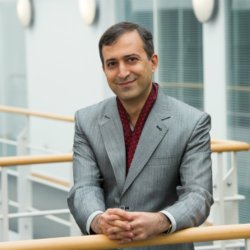
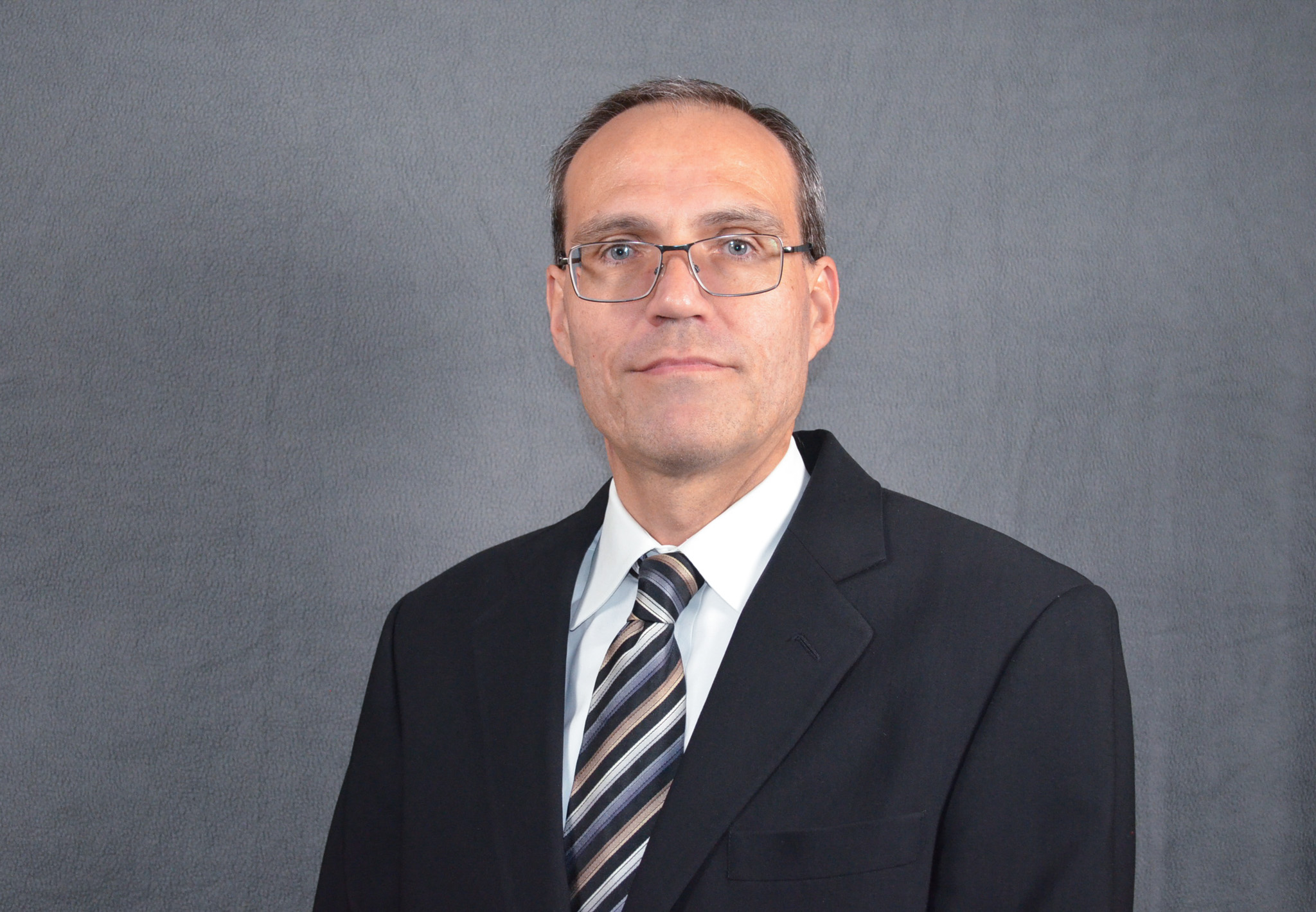
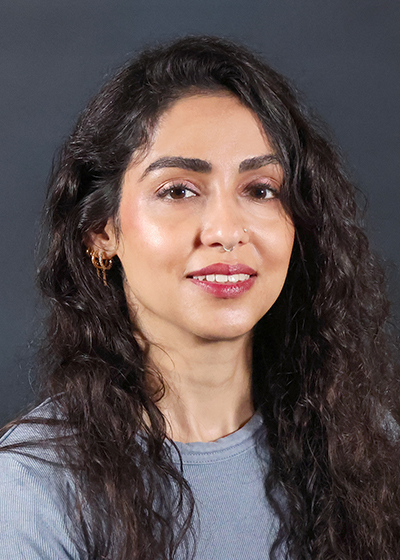
Srdjan Lukic is the Deputy Director of the FREEDM Systems Center and a Distinguished Professor in the Department of Electrical and Computer Engineering at North Carolina State University. His research focuses on power electronics, power systems, and electric vehicle infrastructure. He holds a Ph.D. in Electrical Engineering from the Illinois Institute of Technology (2007). His work emphasizes high-power converters, DC microgrids, and extreme fast charging (XFC) technologies for electric vehicles. Recent projects include the development of a 13.2 kV solid-state transformer for EV XFC stations and resilient distributed control frameworks for smart grids. He has contributed to wireless charging systems and modular medium-voltage fast chargers. Key Awards: University Faculty Scholars (2022) Grants: DOE-funded XFC projects, modular EV charging infrastructure Labs/Teams: FREEDM Systems Center, RIAPS control architecture development Publications highlight innovations in microgrid control, power electronics modeling, and privacy-preserving distributed systems. His work addresses grid resilience, cyber-physical integration, and high-efficiency energy conversion.
Dr. Artin Backtash-Rad is a Senior Lecturer in Global Strategy & International Business at the Surrey Business School, University of Surrey, where he also serves as the Director of the MSc International Business Management programme. He holds a PhD in Global Strategic Management from Royal Holloway, University of London, an MBA in International Management from Carleton University, Canada, and a BSc in Industrial Management from the University of Tehran, Iran. He has held academic positions at University College London, Royal Holloway, Cardiff Metropolitan University, and the University of South Wales. BSc in Industrial Management, University of Tehran, Iran MBA in International Management, Carleton University, Canada PhD in Global Strategic Management, Royal Holloway, University of London Artin's research focuses on Global Strategic Management, with a particular emphasis on strategy implementation. His doctoral research involved a large-scale comparative study across 20 sectors in 20 countries, resulting in a comprehensive model for corporate-level strategy execution. His work integrates resource-based, industry, and institutional perspectives to develop a holistic theory of strategy implementation. He has conducted extensive research on barriers to implementation, supply chain strategies, manufacturing strategies, and transcontinental investments. His recent publications reflect a strong trend in developing taxonomies and theoretical models in strategic management, particularly in international and cross-sectoral contexts. He frequently presents at top-tier conferences such as the Academy of International Business (AIB), British Academy of Management (BAM), and Euro-Asia Management Studies Association (EAMSA), with recent work focusing on organizational culture transfer, research populations, and Europeanization of strategy. Artin is actively involved in academic service and leadership: Director of MSc International Business Management Member of the Doctoral Programmes Review Committee Personal Tutor for 22 students Work Placement Programme Tutor He supervises postgraduate research, currently guiding two PhD students, and has previously supervised numerous master’s and MBA dissertations across multiple institutions. His teaching spans strategic management, international business, entrepreneurship, research methodology, and operations management at undergraduate and postgraduate levels. Artin is affiliated with leading academic organizations: Academy of International Business British Academy of Management Euro-Asia Management Studies Association
Jari Puttonen is a Professor of Structural Engineering at Aalto University's Department of Civil Engineering, School of Engineering. His research focuses on structural analysis, fire safety, materials science, and nuclear infrastructure safety. He has held roles as Principal Investigator in projects related to nuclear waste repository concrete modeling and aging management of NPP infrastructure. He has advised over 20 academic visitors and served in doctoral thesis committees. Education: Doctoral degree (1987), Licentiate (1984), and Master's degree (1979) in Engineering and Technology from Helsinki University of Technology (now part of Aalto University). Research Interests: Steel and composite materials behavior under extreme conditions Fire resistance of structural systems Long-term performance of concrete in nuclear facilities Non-destructive testing of construction materials Seismic resilience of critical infrastructure Awards: Recipient of the Knight, First Class of the Order of the White Rose of Finland (2020), PUUPalkinto 2010, and Schweighofer Prize 2011 for innovative energy facade research. Grants & Projects: Led 13 research projects including PERCO2_2023 (nuclear waste repository modeling) and CONAGE2022 (NPP concrete aging). Active in EU-funded initiatives and industry collaborations. Labs & Teams: Core member of Aalto's Structural Engineering Research Group, collaborating with Chalmers University and Technical University of Munich on advanced materials testing.
Thomas Grote is a Research Fellow at the University of Tübingen's Ethics and Philosophy Lab within the Cluster of Excellence 'Machine Learning: New Perspectives for Science'. His research focuses on philosophical and ethical dimensions of artificial intelligence, particularly interpretability, fairness, and reliability in medical and social contexts. He co-supervises the Carl-Zeiss-Stiftung-funded project 'Certification and Foundations of Safe Machine Learning Systems in Healthcare' and co-organizes the 'Philosophy of Science Meets Machine Learning' conference series. Research Focus Grote's interdisciplinary work bridges philosophy of science and applied AI ethics. Key areas include: Methodological foundations of AI ethics and epistemology Clinical reliability and safety of ML systems Fairness metrics in sociotechnical healthcare systems Interpretability requirements for medical AI Computational psychiatry and evolving mental health frameworks His recent publications demonstrate strong emphasis on healthcare applications, with critical analyses of reliability in foundation models, ethical paradigms for LLMs, and rethinking evaluation methodologies at the epistemology-ethics interface.
Dr. Vikas Srivastava is an Associate Professor of Engineering and Director of the Graduate Program in Biomedical Engineering at Brown University's School of Engineering. His research focuses on solid mechanics, continuum biomechanics, and cell mechanics, with applications in materials under extreme environments and biomedical science. He leads the Srivastava Lab for Solid Mechanics and Biomechanics, which integrates computational models with experimental techniques to address interdisciplinary challenges. Dr. Srivastava holds a Ph.D. in Mechanical Engineering from MIT (2010) and previously held senior roles at ExxonMobil, including leadership in materials mechanics and deepwater drilling engineering. His academic career at Brown began in 2018, during which he has directed over 15 graduate students and secured notable funding. His research interests span mechanobiology, hydrogel-based drug delivery systems, AI-driven predictive modeling, and biomaterial innovations for cancer therapies. He has pioneered physics-informed neural networks for material characterization and developed novel hydrogels to enhance chemotherapy efficacy. Recent articles highlight advancements in polymer fracture modeling, machine learning for non-destructive evaluation, and predictive epidemiological modeling for pandemics. Dr. Srivastava has received the Dean’s Award in Bioengineering and was promoted to tenured Associate Professor in 2023. He actively mentors students through grants like the NSF Graduate Research Fellowship and leads initiatives in biomedical technology translation. The Srivastava Lab collaborates extensively across engineering, biology, and medicine to advance translational research in materials science and clinical applications.
Kevin Mackie is Professor and Chair of the Department of Civil, Environmental and Construction Engineering (CECE) at the University of Central Florida’s College of Engineering. He has been a faculty member since 2006, advancing from assistant to full professor, and previously served as associate chair and interim department chair. His leadership includes spearheading departmental improvements in culture, workload policy, and digital accessibility. Education: Ph.D. in Civil Engineering, University of California, Berkeley (2004) M.S. in Civil Engineering, University of California, Berkeley (2000) B.E. in Engineering, Cooper Union, New York (1998) His research focuses on structural engineering , particularly in bridge engineering , performance-based seismic design , nonlinear analysis , and advanced materials for infrastructure repair . He integrates analytical, numerical, and experimental methods to assess and improve the resilience of civil infrastructure under extreme loads. His work addresses critical challenges in soil-structure interaction, seismic retrofitting, and the use of composites and smart materials. The 15 most recent publications reflect a strong emphasis on nonlinear modeling , seismic performance , and computational structural analysis of bridges and tall buildings. Key themes include fiber-based modeling, contact-friction problems, soil-structure interaction, and probabilistic assessment, demonstrating a consistent trajectory toward resilient and sustainable infrastructure systems. Scientific Awards: Faculty advisor of the year (2022, 2021, 2019) – ASCE East Central Branch and Florida Section Technical Contribution Leader Award Winner (2021) – ASCE East Central Branch Distinguished faculty member at UCF (2018) – Department of Housing and Residence Life Arthur N.L. Chiu Award for excellence as faculty advisor (2018) – Chi Epsilon Honor Society Mackie has been a dedicated mentor, supervising 11 doctoral , 18 master’s , and over 30 undergraduate students . His research has been funded by the National Science Foundation , U.S. Department of Transportation , Caltrans , FDOT , and industry partners. He has published nearly 200 papers and been cited over 7,000 times. He led the reaccreditation of CECE’s undergraduate programs and established the accelerated bachelor’s-to-master’s pathway. He leads the Structures Laboratory at UCF and collaborates with multidisciplinary teams on infrastructure resilience. His vision includes expanding graduate programs, strengthening industry partnerships, and diversifying the Senior Design curriculum to reflect real-world engineering challenges.
Nazanin Tajik is an Assistant Professor in the Department of Industrial and Systems Engineering at Mississippi State University (MSU). She holds a Ph.D. from the University of Oklahoma, an M.S. from the University of Tehran, and a B.S. from Sharif University of Technology. Her research focuses on integrating artificial intelligence, machine learning, and social science concepts to develop cross-disciplinary frameworks for infrastructure resilience, smart transportation systems, and disaster management. Her academic journey includes a Ph.D. at the University of Oklahoma where she contributed to the Risk-Based Systems Analytics Laboratory. At MSU, she established a research center bridging AI/ML tools with socio-technical systems. Key research domains include cyber-physical-social infrastructure resilience, search-and-rescue planning, and game-theoretic robotic designs. Tajik's work emphasizes optimization algorithms for network vulnerability assessment, resource allocation in disaster scenarios, and adaptive recovery strategies. She is actively involved with professional organizations such as INFORMS, ISE, and POMS, reflecting her commitment to advancing operations research and systems engineering methodologies.
Partha P. Mukherjee is a Professor of Mechanical Engineering and Associate Head for Research at Purdue University's School of Mechanical Engineering. His research focuses on energy storage systems (batteries, fuel cells), mesoscale physics, and materials interactions. He holds a Ph.D. from Pennsylvania State University (2007), an M.S. from IIT Kanpur (1999), and a B.S. from North Bengal University (1997). Research Interests include: Energy storage and conversion mechanisms Mesoscale physics and stochastic modeling Reactive transport in materials systems Thermodynamics and heat/mass transfer Notable Awards: Scialog Fellow (2017) Dean of Engineering Excellence Award (2017) Emerging Investigator distinction (2016) Morris E. Foster Faculty Fellowship (2016) His research group operates the Energy and Transport Sciences Laboratory (ETSL), advancing battery safety, solid-state battery architectures, and electrochemical systems. Recent work emphasizes solid-state electrolyte interfaces and fast-charging dynamics.
Kuanshi Zhong is an Assistant Professor in the Department of Civil and Architectural Engineering and Construction Management at the University of Cincinnati. He holds a PhD from Stanford University (2021) in Civil and Environmental Engineering, with prior degrees from Stanford (Master, 2017) and Tongji University (Bachelor, 2015). His research focuses on earthquake engineering, structural resilience, and advanced computational methods for infrastructure safety. Key research interests include seismic design of tall buildings, probabilistic modeling of structural response (e.g., using Probabilistic Learning on Manifolds), and material failure mechanisms in reinforced concrete. He also explores multi-hazard resilience, regional risk assessment, and software tools for disaster simulation (e.g., R2DTool and EE-UQ). Dr. Zhong has secured grant funding as PI/Co-PI, including a National Science Foundation grant (2023-2026) for equitable building decarbonization strategies and a Concrete Reinforcing Steel Institute grant (2024-2025) for bar performance improvements. He teaches graduate/undergraduate courses on concrete design and structural mechanics. His work spans collaborations with institutions like Stanford University and the SimCenter, contributing to open-source tools for regional loss assessments and hurricane impact modeling. Current projects address cascading hazards, steel reinforcement durability, and high-resolution seismic risk evaluation.
Rajesh Karki is a Professor in the Department of Electrical and Computer Engineering at the University of Saskatchewan’s College of Engineering. He holds a B.E., M.Sc., and Ph.D. in related fields. His research focuses on power system reliability, renewable energy integration, and microgrid resilience, with particular emphasis on addressing challenges posed by extreme weather, cyber threats, and decarbonization targets. Dr. Karki’s work spans theoretical modeling, probabilistic analysis, and practical implementation strategies for smart grids, energy storage systems, and distributed generation. His educational background includes advanced degrees in electrical engineering, complemented by professional engineering licensure (P.Eng.). His research has explored diverse topics such as wind energy curtailment mitigation, energy storage optimization, and demand response mechanisms in developing economies like Nepal. He has authored numerous peer-reviewed publications on grid resilience, reliability economics, and cyber-physical system security. Key themes in his work include: (1) quantifying the reliability value of energy storage in active distribution systems, (2) modeling cyber-physical threats to microgrids, and (3) developing frameworks for extreme weather-resilient infrastructure. Despite the volume of his publications (over 50 articles), no specific awards or grants are explicitly listed in the provided materials. His research often intersects technical, economic, and policy dimensions of sustainable energy systems.
Dr. Alastair Key serves as Director of Studies in Archaeology and Official Fellow in Archaeology at Queens' College, University of Cambridge. His research bridges Paleolithic archaeology, stone tool technology, and hominin behavioral evolution through experimental and computational approaches. Director of Studies and Official Fellow at Queens' College, Cambridge Specializes in Paleolithic stone tool analysis, Acheulean technology, and hominin adaptation Conducts experimental archaeology and computational modelling to assess tool functionality Key's research focuses on Acheulean handaxe production , lithic microwear patterns , and ergonomic constraints in prehistoric tool use . He has extensively published on topics including glacial-stage hominin occupations , Oldowan toolmakers , and machine learning applications to archaeological analysis . His recent publications (2025-2023) span diverse subfields: Acheulean chronology , hominin tool use biomechanics , experimental projectile testing , and computational morphometric methods . The work often integrates multidisciplinary datasets and open-source analytical tools to address fundamental questions about human technological evolution. Current research directions include stone tool sharpness quantification , handaxe social signaling potential , and cross-species tool use comparisons through primate studies.
Prof. Dr. Hakkı Polat Gülkan is a Professor at Başkent University's Civil Engineering Department. With a PhD (1971) and Master's (1968) from the University of Illinois in Civil Engineering and a Bachelor's (1966) from METU, his career spans over five decades in earthquake engineering, structural dynamics, and disaster management. PhD: University of Illinois, Civil Engineering (1971) Master's: University of Illinois, Civil Engineering (1968) Bachelor's: Middle East Technical University, Civil Engineering (1966) His research focuses on seismic risk assessment, structural behavior under extreme loads, and disaster mitigation strategies. Key contributions include earthquake simulator development, ground motion analysis, and retrofitting techniques for masonry and reinforced concrete structures. He has published extensively on deformation limits, response spectra, and historical building preservation. Recent work includes 15+ articles from 2024-2012 analyzing Istanbul's seismic hazards, Marmara region dynamics, and post-earthquake structural integrity. Conference papers address Turkey's endemic building vulnerabilities and deformation thresholds for seismic isolation systems. Scientific Achievements: Elected to U.S. National Academy of Engineering (2023) As an active journal reviewer for 13+ publications (2023-2024), he contributes to advancing earthquake engineering discourse. His teaching portfolio includes advanced structural analysis, concrete mechanics, and seismic design courses.
Professor John D. Cressler is a tenured faculty member at the Georgia Institute of Technology, holding a position within the School of Electrical and Computer Engineering in the College of Engineering. His research focuses on cutting-edge semiconductor technologies, particularly silicon-germanium heterojunction bipolar transistors (SiGe HBTs) for mixed-signal applications spanning RF, microwave, mm-wave, analog, and digital domains. His research interests center on atomic-scale bandgap engineering for next-generation semiconductor devices, with emphasis on SiGe HBT technology development, radiation-hardened circuits for space applications, cryogenic electronics, and device-circuit interactions. His team explores fundamental device theory, broadband noise analysis, profile optimization, 2-D/3-D simulation, compact modeling, and radiation effects. Current projects include Europa-surface mission electronics, D-band/sub-THz systems, and radiation-tolerant receiver designs. Analysis of his 15 most recent publications (2024-2025) reveals a dominant focus on radiation-hardened electronics for space applications (40% of works), millimeter-wave circuit design (30%), and SiGe HBT reliability optimization (30%). Key trends include Europa mission electronics development, D-band/sub-THz circuit innovation, and advanced radiation mitigation techniques using SiGe BiCMOS technology. Professor Cressler teaches multiple courses including ECE 3040 (Microelectronic Circuits), ECE 3450 (Semiconductor Devices), ECE 6444 (Silicon-Based Heterostructure Devices and Circuits), and the interdisciplinary IAC 2002 course on Science, Engineering and Religion. His research is supported by industrial collaborations and Georgia Tech facilities including the Georgia Electronic Design Center (GEDC), NanoTECH, and C-STAR.
Professor Dragan Jovcic is the Chair in Engineering at the University of Aberdeen's School of Engineering , where he has been a faculty member since 2004 and a full professor since 2012. Concurrently he serves as Director of the Aberdeen HVDC Research Centre , a role he has held since 2015. Education: PhD in Electrical Engineering, University of Auckland, 1999 Diploma Engineer in Control Systems, University of Belgrade, 1993 Postgraduate Certificate in University Teaching, University of Ulster, 2003 Research Interests: Professor Jovcic’s research centres on high-power electronics and HVDC transmission systems , with particular emphasis on the development of DC transmission grids that will enable large-scale integration of offshore wind energy . His work spans DC/DC converters , DC circuit breakers , modular multilevel converters (MMC) , flexible AC transmission systems (FACTS) , and advanced power system modelling and control . The overarching goal is to underpin the transition from fossil-fuel generation to renewable-dominated power systems, especially in the North Sea and European contexts. Publication Trends: Recent publications (2020-2023) reveal a strong focus on DC protection technologies —notably circuit breakers and energy absorbers—and on modelling methodologies for HVDC grids and offshore wind integration. The works address both theoretical advances (phasor and state-space models) and experimental validation (kV-level prototypes), reflecting a balanced portfolio of fundamental research and practical demonstration. Scientific Awards & Recognition: IEEE Fellow (2021) IEEE PES Distinguished Lecturer (since 2015) IET Fellow (2019) and Chartered Engineer (2018) Research Funding & Supervision: With over £5.5 million in external research income, Professor Jovcic is principal investigator or work-package leader on numerous EU Horizon Europe and EPSRC projects. He has supervised 9 PhDs to completion and is currently mentoring 2 PhD students and 2 post-doctoral fellows . Major grants include the €35 million PROMOTioN project on multiterminal DC networks and the €4 million MoWiLife project on wide-bandgap power electronics. Laboratory & Facilities: The Aberdeen HVDC Research Centre hosts a 0.9 kV DC grid demonstrator , 30 kW thyristor- and IGBT-based DC/DC converters , and 5 kV, 2 kA DC circuit breaker test benches , providing a world-class platform for experimental research and student training.
Jonas Faleskog is a Professor in the Department of Materials and Structural Mechanics at KTH Royal Institute of Technology. His research focuses on mathematical modeling of material deformation and failure mechanisms, particularly in metallic and polymeric materials. Key areas include ductile and brittle fracture analysis, fracture mechanics, and computational modeling of material behavior under various stress conditions. He leads a research group collaborating internationally to develop models describing material failure at microscopic scales. Faleskog teaches courses such as Fracture Mechanics (SE2139) and Modeling in FEM (SE2860), emphasizing practical applications of theoretical models. His work spans experimental and numerical methods, addressing challenges in material heterogeneity, porosity effects, and environmental degradation. Notable contributions include advancements in weakest-link modeling for brittle failure, probabilistic fracture models, and strain gradient plasticity analysis. His research bridges material science, applied mechanics, and numerical methods to optimize material utilization in engineering systems like reactor tanks, aircraft, and vehicles. Key collaborations involve international teams exploring microstructural influences on fracture behavior. While no specific awards are listed, his extensive publication record reflects sustained contributions to mechanical and materials engineering.