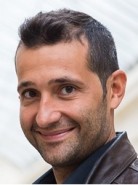
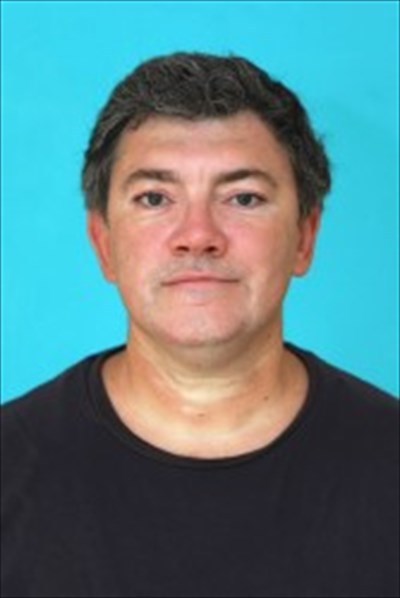
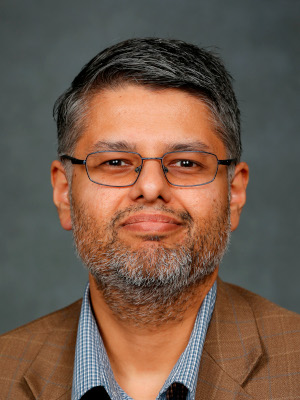
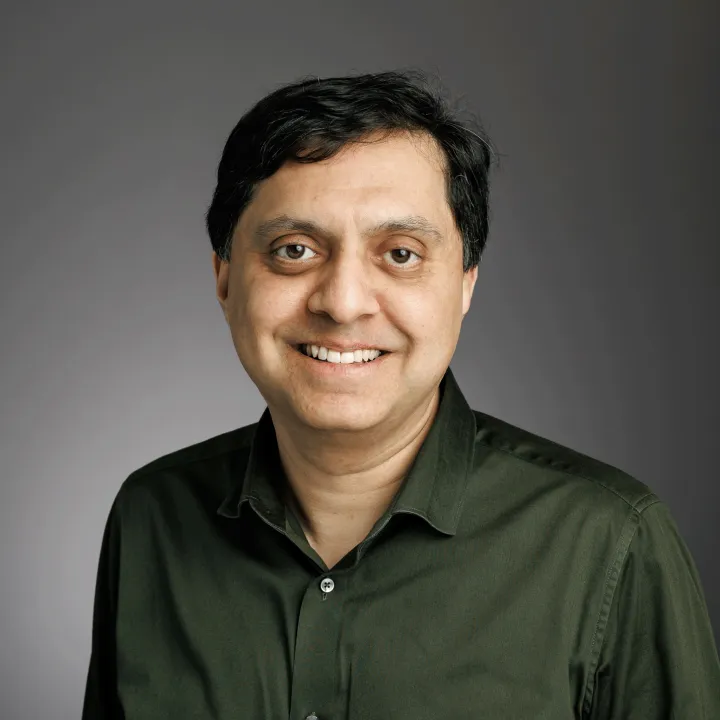
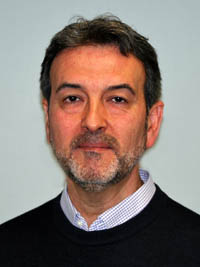
Javier García Zubía is a Professor at the University of Deusto, specializing in Computer Science. He teaches courses such as Digital Electronics, Programmable Logic, and Physics across various engineering degrees including Industrial Electronics, Industrial Technologies, and Informatics. His research focuses on Technology Enhanced Learning, remote laboratories, and FPGA devices. He is part of the DEUSTEK 2 research team, recognized by GV as Type B. Education: Engineer in Computer Science and PhD in Computer Science from the University of Deusto. Research Interests: Explores innovative applications of technology in education, with recent emphasis on remote laboratory development. Also investigates VHDL programming and FPGA device utilization in engineering education. His work bridges theoretical computer science with practical engineering applications. Office Hours: Monday 15:00-17:00 at Room D-Donosti Tuesday 08:00-10:00 at Room D-586
Michele Magno is a Senior Lecturer and Privatdozent at ETH Zürich's Department of Information Technology and Electrical Engineering (D-ITET), leading the D-ITET Center for Project-based Learning (pbl.ee.ethz.ch). He holds a PhD in Electronic Engineering from the University of Bologna (2010) and has held visiting roles at institutions like the University of Nice and Mid Sweden University. His research focuses on low-power systems, wearable devices, energy harvesting, and IoT applications. Magno has authored over 350 peer-reviewed papers, with a Google H-index of 49. Notable awards include the 2024 Best Paper Award at ECCV and multiple best poster/demo recognitions at IEEE conferences. His industrial collaborations include projects with STMicroelectronics, Texas Instruments, and Logitech. Teaching contributions include courses on embedded systems, FPGA programming, and machine learning on microcontrollers. Magno's innovations span smart sensors for wind turbines, bio-medical monitoring, and autonomous racing systems, with patents in touch communication and energy-neutral devices. Recent work emphasizes ultra-low-power solutions for AI-integrated wearables, energy-efficient IoT nodes, and real-time embedded vision systems. His labs and teams pioneer technologies like TinyssimoRadar for in-ear gesture recognition and WakeMod for ultra-low-power IoT connectivity.
Christos Kozyrakis is a Professor in the Departments of Electrical Engineering and Computer Science at Stanford University. His research focuses on computer architecture, computer systems, and cloud computing, with contributions to energy-efficient systems, machine learning infrastructure, and database-oriented operating systems. He leads the MAST research group and directs the Stanford Platform Lab. Education: Bachelor's Degree in Computer Science, University of Crete PhD in Electrical Engineering and Computer Sciences, University of California, Berkeley Research Interests: Kozyrakis explores cloud management, machine learning systems, energy-efficient architectures, and hardware-software co-design. Notable projects include DBOS (a database-oriented OS), the MAST group's work on serverless computing and storage systems, and energy-proportional data center design. Awards: ACM SIGARCH Maurice Wilkes Award ISCA Influential Paper Award NSF Career Award Okawa Foundation Research Grant ACM and IEEE Fellowships Advising & Grants: Supervised over 20 PhD and master's students, with notable alumni contributing to academia and industry. Supported by NSF, DARPA, SRC, Google, Microsoft, and other industry collaborations. Labs & Teams: Leads the MAST research group and directs the Stanford Platform Lab, focusing on cutting-edge systems research and prototyping.
Alpay DORUK is a Lecturer and the Head of the Cyber Security Department at the Faculty of Engineering and Natural Sciences, Bandirma Onyedi Eylul University. Previously, he served as a Lecturer at Tekirdag Namik Kemal University (2011–2020) and a Research Assistant at Izmir Institute of High Technology (1999–2011). His expertise spans Information Security, IoT, and Embedded Systems, with a focus on ontology engineering, machine learning applications, and sensor networks. Research highlights include developing ontology-based frameworks for IoT sensors and web services, designing wheelchair control systems using image processing, and analyzing superconductor properties via SEM image statistics. He has supervised over a dozen academic projects and one Master’s thesis on facial movement tracking using image processing. Active in academic administration, he coordinated Erasmus and Farabi programs and led departmental initiatives as Department Head. His refereeing roles include peer review for journals like Turkish Journal of Electrical Engineering and conferences such as ICECENG. He has authored/co-authored two books on cybersecurity and computer engineering, and contributed to international projects like the Sayısal Kontrol Sistemleri software development (2006–2010). Recent work emphasizes IoT device monitoring, blockchain-inspired data structures, and machine learning for automotive efficiency analysis. His teaching spans operating systems, software engineering, and agile development, reflecting his blend of theoretical and applied expertise.
Waleed Meleis is an Associate Professor in the Department of Electrical and Computer Engineering at Northeastern University and serves as Vice Provost for Graduate Education. He holds an MS and PhD from the University of Michigan and a BSE from Princeton University. His primary research focuses on combinatorial optimization, machine learning, assistive technology, and large-scale social experimentation platforms like Volunteer Science. He pioneered the Enabling Engineering student group, which designs assistive devices for individuals with disabilities, supported by over $350K in external funding. His leadership roles include Interim Vice Provost for Oakland Campus and Associate Dean for Graduate Education, driving significant enrollment growth and program development. Notable awards include multiple Martin W. Essigmann Teaching Awards and the Eta Kappa Nu Professor of the Year Award. His work bridges technical innovation with societal impact, particularly in healthcare and education. Education: PhD, Computer Science and Engineering, University of Michigan, 1996 MS, Computer Science and Engineering, University of Michigan, 1992 BSE, Electrical Engineering, Princeton University, 1990 Research: Combines algorithm design for engineering problems (e.g., cloud computing, spectrum management), social science experimentation platforms, and assistive technology development for rehabilitation. Leadership: Vice Provost for Graduate Education since 2023 Interim Vice Provost and Academic Lead for Oakland Campus (2023–2024) Associate Dean for Graduate Education (2020–2022) Awards: Recognized for teaching excellence and innovation in education across multiple years, including the 2010 Eta Kappa Nu Professor of the Year Award. Publications: Over 50 peer-reviewed papers in areas spanning reinforcement learning, distributed systems, and biomedical engineering. Grants: Secured funding from NSF, Army Research Lab, and private foundations for projects including Volunteer Science and Enabling Engineering initiatives. His interdisciplinary Dialogue of Civilizations course explores scientific revolutions, blending historical and computational perspectives. Enabling Engineering has delivered 60+ projects with clinical partners, emphasizing inclusive engineering education.
Adrian Wills is an Associate Professor in the School of Engineering (Mechatronics) at the University of Newcastle, Australia. He leads the Mechatronics Engineering program and holds academic appointments since July 2015. His research focuses on Bayesian estimation, system identification, and control engineering, with applications in robotics and mechatronics. Wills has collaborated with institutions globally, including Linköping University, Uppsala University, and the University of British Columbia. He earned his B.E. (Elec.) and Ph.D. from the University of Newcastle in 1999 and 2003, respectively. Teaching expertise includes delivering advanced courses in estimation and optimization within the Mechatronics Engineering program. Administrative roles include program convenor for Mechatronics Engineering. Research highlights include contributions to state-space models, nonlinear system identification, and model predictive control. His work bridges theoretical advancements with practical applications in engineering systems and healthcare. Key collaborations involve Professors Lennart Ljung, Thomas Schön, and Bhushan Gopaluni, among others. His technical contributions span MATLAB toolboxes (e.g., UNIT), FPGA/ASIC implementations for control systems, and interdisciplinary projects in strain measurement using neutron diffraction.
John O'Donnell is an Honorary Lecturer at the University of Glasgow's School of Computing Science. His research spans functional programming, hardware description languages, parallel computing, and computer science education, with notable applications in music technology. Key research areas: Functional approaches to hardware design and simulation Parallel data structures and algorithms for specialized architectures Programming misconception identification and pedagogical tools Computational modeling of musical performance techniques Publications demonstrate consistent innovation in applying functional programming paradigms to diverse domains, from circuit design to music pedagogy. Recent work focuses on educational aspects of computer systems and programming.
Marios Pattichis is a Professor of Electrical and Computer Engineering at the University of New Mexico (UNM), serving as Director of Online Programs since 1999. He leads the Image and Video Processing and Communications Lab (ivPCL) and co-founded Cosmiac. His work focuses on biomedical image analysis, video analytics for clinical decision support, and educational technology initiatives like the AOLME project targeting underrepresented middle-school students. Pattichis holds 10 patents, over 80 journal papers, and $15.9M in research funding from NSF, NIH, and AFRL. Education: Ph.D. and M.S. in Computer/Electrical Engineering from UT Austin (1998, 1993), with dual B.A./B.Sc. in Mathematics and Computer Sciences (1991). Research Interests: Biomedical CAD systems, explainable AI in imaging, dynamically reconfigurable architectures, and bilingual STEM education. His lab develops tools for stroke risk assessment via carotid ultrasound, solar coronal hole segmentation, and classroom activity analysis to measure student participation. Awards: 2022 EAMBES Fellow for contributions to biomedical image analysis. Editorships include IEEE Transactions on Image Processing and IEEE Signal Processing Letters. Grants & Teams: Directed over $15.9M in grants, advised numerous students (though none listed explicitly), and collaborates with educators on AOLME's integrated math/CS curricula. Active in codec comparisons for healthcare video streaming (VVC vs. AV1) and FPGA-based image processing acceleration. Labs/Initiatives: ivPCL (medical imaging/video systems); DRASTIC (adaptive video processing); ESTRELLA (bilingual STEM outreach). Involved in IEEE journal special issues on video analytics and multilingual education.
Dr. Rohit Dua is an Associate Teaching Professor at Missouri University of Science and Technology (Missouri S&T), where he teaches in the Cooperative Engineering Program with Missouri State University. He holds a PhD and MS in Electrical Engineering from Missouri S&T and a BE in Electronics & Telecommunications from the University of Pune, India. Previously, he served as an Assistant Professor at New York Institute of Technology. His office is located at Missouri State University’s Springfield campus. Research Focus: Dr. Dua specializes in Smart Embedded Sensing Systems, Artificial Neural Networks, Optoelectronic Sensors, and their applications in biomedical/energy engineering. He actively integrates engineering education innovation into his research, developing experiential learning tools for K-12 and undergraduate students. Awards & Honors: 2023 ASEE Midwest Section Outstanding Service Award 2015 ASEE Zone III Conference: 1st Place Student Poster 2014 Missouri S&T Experiential Learning Award 2014 ASEE Midwest Section: 3rd Place Undergraduate Poster 2007 NYIT Faculty Scholars Award Educational Initiatives: He leads experiential projects including the Embedded Systems Club, FPGA-based synthesizers, K-12 logic laboratories, and microprocessor design tools. He received grants for student projects (e.g., OURE grants) and developed courses like Fun With Electronics . He frequently chairs ASEE Midwest Conference programs.
Rajit Manohar is the John C. Malone Professor of Electrical & Computer Engineering at Yale University, with appointments in Applied & Computational Mathematics and Computer Science. He is a core member of the interdisciplinary Computer Systems Lab (CSL), which bridges ECE and CS departments. His research focuses on asynchronous VLSI design, neuromorphic computing, and hardware-software co-design. Education: Manohar holds a B.S., M.S., and Ph.D. from the California Institute of Technology. His academic career spans over two decades, with notable contributions to asynchronous circuit theory and neuromorphic engineering. Research Interests: Manohar's work emphasizes energy-efficient asynchronous architectures, concurrency control, and biologically inspired computing. He explores topics like formal methods for circuit verification, cognitive systems, and dynamic sensor networks. His lab develops tools like Fluid (asynchronous synthesis) and Neurobench (neuromorphic benchmarking). Publications: Recent work includes advancements in asynchronous logic synthesis (Maelstrom), neuromorphic frameworks (Neurobench), and scalable brain-computer interfaces (SCALO). His research often intersects NSF-funded projects in energy-aware computing and neuromorphic systems. Awards: Inaugural Misha Mahowald Prize (2025), MIT TR35 (2000s), IBM Goldberg Award (2023) Grants & Labs: Manohar leads NSF-supported initiatives in carbon-aware networking and neuromorphic hardware. The Computer Systems Lab collaborates across disciplines to advance sustainable computing and neuro-inspired architectures.
Dr. Charles James Gillan is a Senior Lecturer at Queen's University Belfast's School of Electronics, Electrical Engineering and Computer Science, part of the Faculty of Engineering and Physical Sciences. His research focuses on high-performance computing (HPC), heterogeneous accelerators (FPGAs and GPUs), and their applications in diverse fields such as clinical physiology, electromagnetic fields, and image analysis. He collaborates extensively with the QUB Medical School on data analytics and machine learning for ICU patient monitoring. Gillan has led multiple projects, including an InterTrade Ireland-recognized Fusion project with CreVinn Ltd, which transferred FPGA programming knowledge to industry. His work spans academic and industrial partnerships, emphasizing innovation in computing systems and real-world problem-solving. His research interests include KTP projects, EPSRC funding, and H2020 initiatives. He has contributed to high-impact projects like the HPC-NI center and handheld olfactory detection systems. Awards include an InterTrade Ireland award for his Fusion project. Gillan has also engaged in outreach, training graduates in OpenCL programming and fostering industry-academia collaboration. Publications highlight advancements in neural networks for blood pressure prediction, exascale computing algorithms, and AI-driven healthcare solutions. His work bridges theoretical computing and practical applications, with a focus on edge computing architectures and transparency in food systems.
Maurício Breternitz is an Invited Assistant Professor and Principal Researcher at ISTAR-IUL, ISCTE - University Institute of Lisbon. With a PhD in Computer Engineering from Carnegie-Mellon University and extensive industrial research experience at AMD, Intel, and IBM, he focuses on bridging academia and industry for practical innovation. His academic service includes leadership roles in conferences like IISWC and editorial responsibilities at IEEE Micro. Education: Electronics Engineer (ITA, Brazil), MSc in Computer Science (UNICAMP), PhD in Computer Engineering (Carnegie-Mellon) Research: Machine Learning acceleration, Neuromorphic systems, Cloud workloads optimization, Heterogeneous computing His work spans two decades of patents (56 issued, 55 pending) and projects like the Horizon 2020 DIVIDEND CHIST-ERA and the FCT-funded AIMHealth initiative for AI-based public health solutions. Recent publications emphasize weightless neural networks, edge computing, and federated learning applications. Key contributions include: GPU acceleration for Hadoop MapReduce APU code migration techniques Microcode compression algorithms saving $18M Founding the International Workshop on Architectural Support for Binary Translation He has advised 7 Master's theses and 1 ongoing PhD project at UNICAMP, while serving on editorial boards and program committees for top-tier conferences like ISCA and CGO.
Dr. Ian Stephenson is a Principal Academic in Computer Animation at Bournemouth University, Faculty of Media and Communication. He is based at the Talbot Campus and has been actively contributing to computer graphics research and education for decades. DPhil in Electronics, University of York (1995) His research focuses on rendering techniques, visual effects simulation, and shader development. Key areas include motion blur, film grain, diffraction in pinhole cameras, and real-time digital relighting for theatrical and concert applications. He has also explored FPGA-based hardware acceleration and stage lighting simulation using screen-space re-rendering. In recent years, he has contributed to educational computing through the development of the Sniff programming language, designed to help Scratch users transition to text-based coding for physical computing and robotics. His publications span journals like Imaging Science Journal and Journal of Graphic Tools , and conferences including ACM SIGGRAPH, Eurographics, and TPCG. His work shows a consistent trajectory from advanced rendering research to practical and educational applications in computer graphics. Essential RenderMan (Springer, 2006) Production Rendering (Springer, 2005) Essential RenderMan Fast (Springer, 2002) Dr. Stephenson has been involved in public engagement, presenting Sniff at events like Scratch@MIT and HEA STEM conferences. He advises on student projects and promotes physical computing in education. While no formal grants or awards are listed, his software (Sniff, Angel) and outreach demonstrate significant scholarly and educational impact. He leads or contributes to initiatives integrating IoT data into virtual environments and exploring N-body simulations for graphics. His lab work appears centered on real-time rendering, educational tools, and performance technology.
Dr. José Manuel Claver Iborra is a Full Professor at the Department of Computer Science, School of Engineering (ETSE-UV), University of Valencia. He holds a PhD in Computer Science (Parallel and Distributed Computing program) from the Technical University of Valencia and an MSc in Physics (specialized in Electronics and Computer Science) from the University of Valencia. As an IEEE Senior Member, he focuses on cloud computing, video coding, parallel/distributed systems, reconfigurable computing, and network protocols for real-time applications. Current Research: Cloud-based video encoding, GPU acceleration for DNA analysis, FPGA-based network protocols, and indoor localization systems Academic Leadership: Coordinator of the UV-Tirant node in the Spanish Supercomputing Network (RES) His recent publications analyze GPU-based motion estimation, heterogeneous computing for video standards (H.264/AV1), and QoS scheduling algorithms. He supervises PhD and Master's theses on sensor networks, FPGA programming platforms, and parallel applications. Scientific Awards IEEE Senior Member He has directed funded projects on cloud infrastructure, distributed video processing, and reconfigurable systems since the 1990s.
Dr. Christian Camilo Franco Frasser is a Lecturer in Electronic Engineering at the University of the Balearic Islands (UIB), where he teaches courses in Analog Electronics, Digital Electronics, Circuit Theory, and Electrical Engineering across multiple engineering degree programs including Industrial and Automatic Electronic Engineering, Telematics Engineering, and the Double Degree in Mathematics and Telematics Engineering. His educational background includes a PhD in Electronics Engineering from the University of the Balearic Islands (2022) with Cum Laude distinction, a Master's Degree in Electronic Systems for Intelligent Environments from the University of Malaga with First-class honors, and an Engineering degree focused on digital programmable devices. His professional development includes specialized training in high-speed PCB design and VHDL programming. Dr. Franco Frasser's research focuses on machine vision systems implemented on FPGAs, embedded device programming, and hardware implementation of non-conventional computing systems. His work bridges theoretical concepts with practical applications in robotics and electronics, with particular emphasis on real-time systems and efficient hardware implementations. He has developed expertise in designing multilayer high-integration printed circuit boards and programming low-power embedded devices. His publication record demonstrates consistent research output across multiple venues, with contributions spanning from foundational embedded systems design to advanced machine vision applications. His work shows a clear trajectory from practical engineering solutions toward increasingly sophisticated research contributions in electronic systems design. National mobile robotics competition winner Latin American LARC-OPEN participant (2007-2008) First-class honors for Master's Thesis on Advanced Machine Vision on FPGAs Cum Laude doctoral thesis in Electronics Engineering Best paper award at an international conference Dr. Franco Frasser has accumulated 495 regulated teaching hours at UIB across various engineering disciplines. He has participated in 4 state R&D projects since 2015 and 6 international private company R&D projects since 2018. He holds two patents, one as principal investigator. He is an active member of the GEE (Electronic Engineering) research group at UIB, where he continues to advance research in hardware implementation of non-conventional computing systems. His industry experience includes 6 years as an R&D engineer at Microsensory (Spain), designing multilayer PCBs and programming low-power embedded devices.