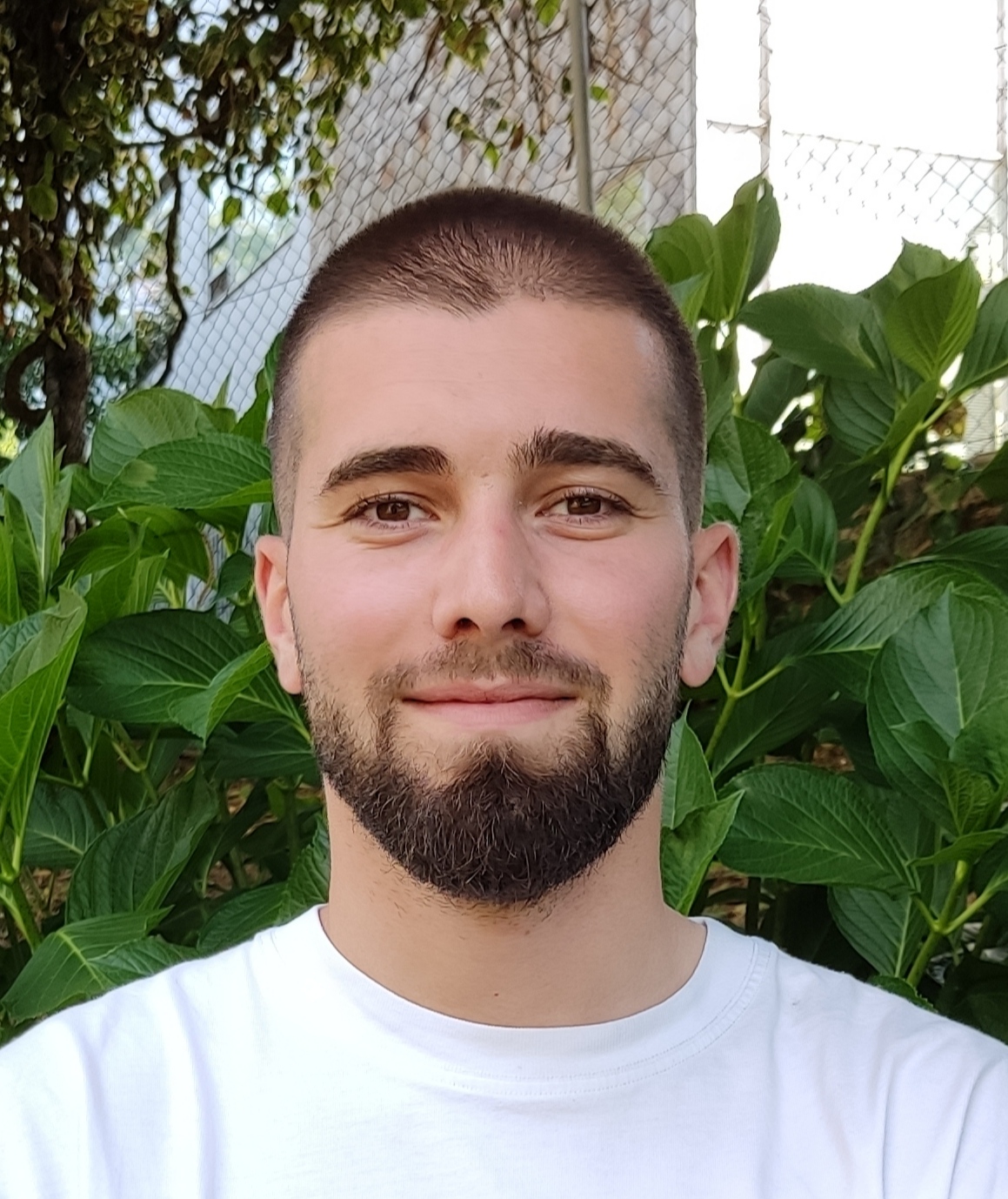
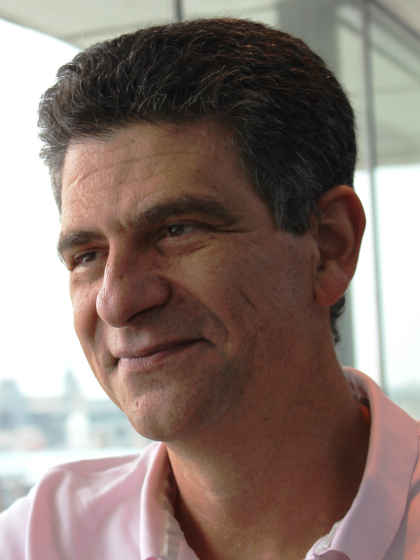
Gianluca Martino is a Research Assistant at the Technische Universität Hamburg , affiliated with the Institute of Embedded Systems and the Computer Engineering group. His work focuses on hardware acceleration, formal verification, and machine learning applications in digital systems. Role: Research Assistant Institution: Technische Universität Hamburg Department: Computer Engineering Research Interests: Gianluca's research spans hardware acceleration for machine learning, FPGA-based implementations, anomaly detection in critical systems, and formal verification of reactive systems. He explores the intersection of digital design and artificial intelligence. Publications Trends: Recent work emphasizes real-time machine learning on FPGAs, anomaly detection for particle accelerators, and formal verification of hardware using temporal logic. Key areas include embedded systems, neural network deployment, and high-integrity digital design. Contact: Email: gianluca.martino@tuhh.de
Álvaro Michelena Grandío is a researcher in the Department of Industrial Engineering at the University of A Coruña, specifically based at the Ferrol Engineering Polytechnic University College. His academic work focuses on automated systems engineering, with teaching responsibilities in control engineering, power electronics, data analysis, and smart monitoring systems across various degree and master's programs. Master in Industrial Engineering Automation and Industrial Electronics Engineering Master's Degree in Textile Technology and Sustainable Fashion Master's Degree in Energy Efficiency and Sustainability Master's Degree in Industrial Computing and Robotics His research interests lie at the intersection of intelligent systems, control engineering, and sustainable industrial technologies. He actively contributes to the development of IoT-based monitoring systems, embedded control solutions, and AI-driven energy applications. His work emphasizes practical, low-cost implementations for education and industry. The analysis of his recent publications reveals a strong focus on intelligent control, data analysis, and renewable energy systems. He frequently applies machine learning and neurocomputing techniques to industrial and environmental problems, including energy efficiency, sensor networks, and smart grids. His work bridges theoretical AI with real-world engineering applications. Álvaro Michelena is actively involved in research projects funded by the European Union, Telefónica, Navantia, and regional agencies. He supervises numerous final degree projects and master's theses, mentoring students in areas such as IoT, embedded systems, and intelligent control. He is a member of the 'Ciencia y Técnica Cibernética' (SUXI) research group and affiliated with the CITIC research center. He has contributed to multiple research projects in collaboration with institutions across Spain and Portugal. His work appears in high-impact journals like Neurocomputing , Applied Intelligence , and Sensors . He regularly presents at international conferences in Salamanca, Guimarães, and Bilbao, often in collaboration with multidisciplinary teams.
Емина И. Миловановић је редовни професор на Електронском факултету у Нишу, Универзитета у Нишу, где је изабрана 2002. године. Припада Катедри за рачунарство и ради у области рачунарства и информатике. Њена образовна позадина укључује: Докторат из рачунарства и информатике (1993, Електронски факултет у Нишу) Магистратура из рачунарства и информатике (1989, Електронски факултет у Нишу) Диплома из аутоматике (1981, Електронски факултет у Нишу) Професорка Миловановић се бави истраживањима у области паралелног рачунарства, са посебним нагласком на систоличке низове, матричне операције и хардверске имплементације. Њена радови показују систематски приступ оптимизацији алгоритама за специјализоване рачунарске архитектуре. Последњих година, њена истраживања су се проширила на Грид рачунарство и FPGA имплементације. Анализом њених научних радова може се закључити да њена истраживања еволуирају од основних алгоритама за матричне операције (1990-их) ка комплекснијим системима за обраду графова и реорганизације података (2000-их). Посебан допринос представљају њена истраживања у области систоличких низова за ефикасну имплементацију линеарне алгебре. Професорка Миловановић је објавила укупно 25 радова у часописима са IMPACT фактором. Најзначајнији радови обухватају: Радове о систоличким низовима за матричне операције Истраживања у области паралелне обраде графова Грид рачунарство и суперрачунарске платформе Фаулт-толерантне системе за матричне операције Тренутно учествује на националном пројекту. Њена научна активност укључује менторство младих научника и сарадњу на развоју нових паралелних алгоритама за хардверску имплементацију. Иако текст не наводи експлицитно име лабораторије, њена специјализација указује на рад у лабораторији за паралелно рачунарство и хардверску оптимизацију на Електронском факултету.
Dr. Fayez Gebali is a Professor in the Department of Electrical and Computer Engineering at the University of Victoria. He holds a BSc from Cairo University, another BSc from Ain Shams University, and a PhD from the University of British Columbia. His research focuses on computer communications, digital VLSI design, signal processing, and cybersecurity. He is particularly known for contributions to networks-on-chips, hybrid communication systems (e.g., FSO/RF), and cryptographic solutions for IoT devices. Education: BSc, Cairo University BSc, Ain Shams University PhD, University of British Columbia His research interests span computer architecture , communication networks , and secure embedded systems . Recent work emphasizes digital health applications, including AI-driven medical imaging (e.g., TongueTransUNet for tongue contour segmentation) and zero-trust frameworks for healthcare data protection (ZTCloudGuard). He has also published extensively on IoT security, cryptographic algorithms, and hardware acceleration techniques. Notable contributions include pioneering work on networks-on-chips (NoC) optimization, hybrid FSO/RF transmission systems, and efficient modular multipliers for constrained devices. His publications cover over 15 years of impactful research, with a focus on bridging theoretical advancements and practical implementations in high-performance computing and cybersecurity.
Adria Armejach Sanosa is a Senior Lecturer in the Department of Computer Architecture at the Faculty of Computer Science of Barcelona (FIB), Universitat Politècnica de Catalunya (UPC). He is also affiliated with the Barcelona Supercomputing Center (BSC-CNS), a leading institution in high-performance computing in Europe. His research spans computer architecture, high-performance computing, memory systems, and hardware acceleration for genomics and machine learning. PhD from UPC His research interests focus on optimizing computer systems for performance and efficiency, particularly in the areas of hardware transactional memory, cache optimization, RISC-V architectures, and acceleration of bioinformatics workloads. He investigates how to improve data movement, prefetching, and parallelism in large-scale heterogeneous systems. His work combines architectural innovations with practical implementations on real-world HPC platforms. The most recent articles reflect a strong trend towards high-performance computing for genomics, sparse data handling, and efficient hardware/software co-design. Topics include genomics benchmarking on ARM processors, tensor marshaling, RTL simulation scalability, and low-precision training for deep neural networks. These works demonstrate a consistent focus on bridging architectural research with real-world applications in science and AI. HiPEAC Paper Award 2024 HiPEAC Paper Award Armejach has advised several doctoral students, including J. Pavón, G. López, and J. Osorio. He has been involved in numerous competitive R&D+i projects such as Digital Autonomy for RISC-V in Europe, Laboratorio Zettaescala de Barcelona, and Genome Analysis Acceleration on HPC Architectures. These projects are often funded by national and European programs, indicating strong recognition and support for his research. He collaborates extensively within the CAP (High-Performance Computing) research group and with key figures like Miquel Moreto, Mateo Valero, and Osman Unsal. He is a member of the CAP research group and contributes to initiatives like the Laboratory for Open Computer Architecture and systems (RISC-V Chip Development) and the Barcelona Zettascale Lab. These labs focus on open hardware, European technology sovereignty, and next-generation supercomputing. His work on Metro-MPI for RTL simulation and hardware accelerators for databases highlights his contributions to both design automation and data-intensive computing.
Xianjun Jiao is a Researcher at the Department of Information Technology within the Faculty of Engineering and Architecture at Ghent University . His work focuses on wireless communication systems, particularly in the domains of Software-Defined Radio (SDR) , Wi-Fi , 5G , Radio Virtualization , and Network Densification . As a PhD supervisor, he has guided doctoral researchers including Felipe Augusto Pereira de Figueiredo Thijs Havinga Muhammad Aslam Baiheng Chen Robbe Gaeremynck on topics such as Next-Generation Wi-Fi Chip Design , Cell-Free Massive MIMO , and Hardware-Efficient Wireless Systems . His recent publications (2025) explore advanced Wi-Fi architectures, including OFDMA-based interference mitigation , joint transmission systems , and machine learning for handover optimization . Earlier works (2020-2024) address hardware efficiency in transceivers , time-sensitive networking , and NOMA schemes for concurrent transmission .
Georgi Gaydadjiev is a Professor in Innovative Computer Architecture at the University of Groningen's Faculty of Science and Engineering. Previously, he held roles including Chair Professor at TU Delft and Chalmers University of Technology, and served as VP of Dataflow Software Engineering at Maxeler Technologies. He holds a PhD from TU Delft and has over 35 years of industry and academic experience, focusing on reconfigurable computing, high-performance systems, and energy-efficient architectures. His research spans embedded systems, fault tolerance, and scalable architectures. Education: MSc Electrical Engineering (TU Delft), PhD (TU Delft), studies at Voenmeh (Baltic State Technical University). Research interests include reconfigurable computing, advanced architectures, parallel systems, and HPC. He leads projects funded by EU, Google, and Swedish Research Councils, addressing exascale computing and customized hardware. His work has been recognized with awards like the CES Design Showcase (1999) and best paper awards at ICS'10 and WiSTP'07. He advises PhD students and oversees labs like Maxeler IoT-Labs BV, focusing on deploying dataflow technology beyond data centers.
Dr. Ramadan Janissary is an Assistant Professor at Istanbul Technical University's Department of Aeronautical Engineering, specializing in Unmanned Aerial Vehicles (UAVs) and Field Programmable Gate Array (FPGA) technologies. His research spans computational fluid dynamics, hardware acceleration, and multi-sensor tracking systems. Recent research trends focus on FPGA-based solutions for aerospace applications, including 6-DoF dynamical models, quaternion-Euler angle conversion, and formation flight systems for UAVs. His work addresses technical challenges in ad-hoc networks, time delay management, and nonlinear dynamics. Scientific awards include the BOEING Academic Study Incentive Award (2017) and Best Doctoral Theses Award (2015). Current projects involve UAV recording systems, FPGA-based accelerators, and aviation CNS technology development.
Kadir Durak serves as Assistant Professor in Electrical and Electronics Engineering at Özyeğin University's Faculty of Engineering, specializing in quantum technologies. His research group operates within the Quantum Optics Laboratory focusing on cutting-edge quantum communication and sensing systems. Dr. Durak earned his B.Sc. in Physics from Middle East Technical University (2009) and completed his Ph.D. at National University of Singapore (2015). Following his doctorate, he led a research team at Singapore's Centre for Quantum Technologies developing space-ground quantum key distribution via CubeSat platforms. His research spans quantum cryptography, photonics, and quantum information with emphasis on: Optimization of entangled photon sources for secure communication Quantum key distribution networks (including satellite-based systems) Quantum radar and imaging technologies Single atom-photon interactions in cavity QED systems Quantum random number generation His recent publications demonstrate significant contributions to quantum security mechanisms, noise-tolerant quantum sensing, and practical quantum communication implementations. Notable scientific recognition includes: Bronze Medal for Quantum Cryptography Network invention at Istanbul International Inventions Fair (2019) Accepted publication in IOP Journal of Optics (2021) on vacuum fluctuation-based QRNG Dr. Durak actively recruits graduate students for quantum technology research through fully-funded positions offering tuition waivers, monthly stipends (5000-6000 TL), and research resources. His laboratory collaborates with defense institutions including TÜBİTAK and ASELSAN, with recent demonstrations of quantum radar and entangled photon imaging systems. Current projects focus on quantum communication networks, ultra-cold atom physics, and sub-diffraction limit imaging.
Yousef Baroud serves as a Research Associate at the Computational Imaging Systems (CIS) group within the Institute of Industrial IT (ITI) at the University of Stuttgart. His work bridges theoretical computer science and practical hardware implementation, focusing on real-time image and data processing solutions for industrial applications. His research spans image compression algorithms , FPGA-based hardware acceleration , and optical measurement systems . Key contributions include marker-free parallel decoding architectures for variable-length code streams, adaptive subsampling techniques for data compression, and real-time speckle noise reduction in hybrid optical systems. His work demonstrates strong integration of algorithm design with hardware implementation constraints. Analysis of his publication history (2012-2020) reveals consistent focus on real-time processing for high-bandwidth data streams, with increasing emphasis on adaptive compression techniques that balance computational efficiency with perceptual quality. His later work shows sophisticated integration of human visual system models into compression algorithms. Dr. Baroud collaborates extensively with researchers in optical engineering and fluid dynamics, particularly evident in his work on bubble concentration measurements using Raman spectroscopy and telecentric triangulation sensor systems. His technical approach consistently prioritizes hardware-friendly implementations suitable for industrial deployment.
Zhe Wang is a Researcher at the Computational Imaging Systems department within the University of Stuttgart, Germany. Their work focuses on real-time image processing, data compression, and FPGA-based hardware architectures. Research Interests Real-time video/image compression Perceptual coding with JND models Parallel decoding architectures Embedded systems for high-throughput applications FPGA design for multimedia processing Publications Highlight Recent work spans FPGA-accelerated super-resolution, marker-free variable-length coding, and perceptual compression techniques. These contributions emphasize hardware efficiency, visual quality preservation, and high-speed data processing.
Salvatore Pontarelli is an Associate Professor at the Department of Computer Science, Sapienza University of Rome, specializing in high-speed hardware architectures for programmable network devices, hash-based data structures, and network dataplane programmability. His work bridges software and hardware with FPGA acceleration and stateful packet processing. Research focuses on Bloom filters, cuckoo tables, and network data plane optimization Collaborates with Cisco and Mellanox Technologies Contributions to Ethernet switching chips His publications include innovations in FPGA NICs (hXDP), eBPF/XDP hardware translation (eHDL), and practical network acceleration solutions. Recent work explores flow ranging and lightweight data plane monitoring. Scientific recognitions include OSDI'20 Jay Lepreau Best Paper Award ASPLOS'23 Distinguished Paper Award Currently teaches advanced networking and works on programmable hardware solutions. Office located at Sapienza University, Viale Regina Elena, 295 (Building E), 1st floor, room 105.
Somayyeh Timarchi is a Lecturer in Electronic Circuits and Systems at the School of Electronic Engineering and Computer Science, Queen Mary University of London . She holds a B.Sc. in Computer Engineering from Shahid Beheshti University (SBU), M.Sc. and Ph.D. in Computer System Architecture from Sharif University of Technology (SUT) and SBU, and completed postdoctoral research on computer arithmetic at Delft University of Technology (TUDelft). Previously an assistant professor and associate professor at SBU's Electrical Engineering Department, she now focuses on high-speed, low-power digital architecture. Research Interests include Computer arithmetic Approximate computing for neural networks Neuromorphic computing ASIC/FPGA design for signal processing and cryptography Residue and Redundant Number Systems Recent Publications emphasize approximate computing, error compensation, and energy-efficient hardware for IoT and biomedical applications. Key trends include optimizing CORDIC-based architectures for spiking neural networks, improving FPGA memory allocation, and developing low-power cryptographic solutions. Scientific Awards : Fellow of the Higher Education Academy (FHEA) Teaching includes ECS502U - Microprocessor Systems Design , covering microcontroller architecture, programming, and design principles for electronic circuits.
Dr. Melissa Lopez is a Researcher at Utrecht University's Faculty of Science, affiliated with the Gravitational and Subatomic Physics (GRASP) department. Her work centers on gravitational wave detection and data analysis, with specialized focus on machine learning applications for signal processing in astrophysical contexts. She actively contributes to international collaborations including LIGO, Virgo, and KAGRA gravitational wave observatories. Research Focus: Dr. Lopez's interdisciplinary research spans gravitational wave physics, machine learning implementation for astrophysical data, and cosmology. Primary domains include: Advanced detection algorithms for transient gravitational-wave events Machine learning-driven noise reduction and glitch classification Multi-messenger astronomy coordination and electromagnetic counterpart identification Cosmic microwave background analysis and early universe signatures Next-generation detector development for Einstein Telescope Publication Trends: Her recent articles demonstrate a strong emphasis on deep learning solutions for gravitational wave challenges. Key themes include autoencoder-based anomaly detection, CNN/FPGA-accelerated signal identification, and generative modeling for data augmentation. Significant work focuses on LIGO/Virgo/KAGRA data analysis, cosmic string detection, and core-collapse supernova modeling for future observatories. Collaborations: Dr. Lopez works within the GRASP research group and maintains active membership in the LIGO Scientific Collaboration, contributing to data analysis pipelines and algorithm development for O3/O4 observing runs. She frequently co-authors multi-institutional papers involving gravitational wave observatories globally.
Professor Sklavos Nikolaos serves in the Computer Hardware and Architecture Department at the University of Patras, where he leads research in hardware security and cryptographic engineering. His academic profile demonstrates deep expertise in securing embedded systems and IoT devices through innovative hardware implementations. His research spans Hardware Security , Cryptographic Engineering , Cybersecurity , Hardware Design , and Embedded Systems with particular focus on lightweight cryptography for resource-constrained environments. Current investigations include quantum-resistant security architectures, privacy-preserving e-health systems, and secure implementations for 5G/6G communications. His work bridges theoretical cryptography with practical hardware constraints, emphasizing side-channel attack resistance and energy efficiency. Analysis of his recent publications reveals strong trends in hardware-accelerated cryptography (particularly FPGA/ASIC implementations), IoT security frameworks , and privacy mechanisms for healthcare applications . Notable subfields include lightweight cryptographic standards, hardware trojan detection, and security for tinyML devices. His research consistently addresses real-world constraints like area minimization, power efficiency, and latency requirements while maintaining robust security guarantees. Professor Sklavos actively supervises doctoral, master's, and undergraduate thesis projects while teaching advanced courses in Cybersecurity, Embedded Systems, and Hardware Security. He maintains the SCYTALE research group focused on cryptographic engineering and hardware security solutions. His educational initiatives include integrating hands-on cybersecurity training for 5G/6G technologies into STEM curricula.