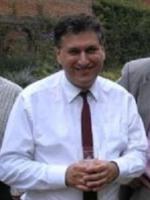
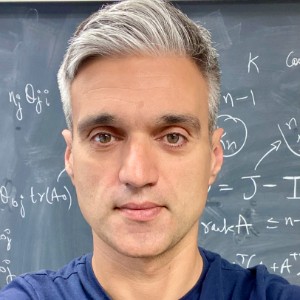
Yang P. Liu is an Assistant Professor at Carnegie Mellon University 's Department of Computer Science . He received his PhD from Stanford University under the supervision of Aaron Sidford and previously studied at MIT . Fields of Interest : Graph Algorithms, Optimization, High-Dimensional Geometry, Additive Combinatorics, Theoretical Computer Science. His research focuses on algorithmic design and analysis for graph problems, optimization, and combinatorics, with applications in machine learning and complexity theory. Recent work includes advancements in parallel repetition games , combinatorial lines , and dynamic graph algorithms . In 2024, his research spanned FOCS , STOC , and RANDOM conferences, addressing problems in k-CSPs , min-cost flow , and hypergraph sparsification . Earlier contributions (2023) included deterministic flow algorithms and spectral hypergraph techniques. Scientific Awards : NDSEG Fellowship (2018-2021), Google PhD Fellowship (2022-2023), FOCS Best Paper (2022), STOC Best Student Paper (2022), FOCS Best Student Paper (2021). He teaches CS 15-759 , a graduate course on convex optimization theory and applications, covering gradient descent, interior point methods, and algorithmic sparsification techniques.
Jacob Fox is a Professor at Stanford University, specializing in Combinatorics and Probability. His research focuses on extremal combinatorics, Ramsey theory, graph theory, and additive combinatorics. He advises students like Maya Sankar. His work explores structural and enumerative aspects of graphs, hypergraphs, and combinatorial configurations. Recent studies include advancements in Ramsey numbers, sumset theory, and probabilistic methods in discrete mathematics. Key research areas include Ramsey numbers for sparse structures, hypergraph properties, and applications of combinatorial geometry. His publications often bridge theoretical insights with algorithmic applications. No scientific awards are listed in the provided text. His advising includes Maya Sankar, with research aligned to combinatorial problems. Collaborative projects involve extremal graph theory and probabilistic combinatorics. No labs or dedicated research groups are explicitly mentioned.
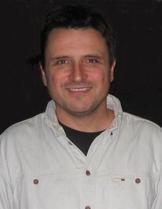
Professor Imre Leader is a distinguished mathematician at the University of Cambridge, where he serves as Professor of Pure Mathematics in the Department of Pure Mathematics and Mathematical Statistics (DPMMS), which is part of the Faculty of Mathematics. His office is located in room C2.02 at the DPMMS building. Professor Leader's research primarily focuses on Extremal Combinatorics and Ramsey Theory , two fundamental areas of discrete mathematics. His work explores deep connections between combinatorial structures, set theory, and algebraic properties. He has made significant contributions to understanding partition regularity, monochromatic structures, extremal set theory, and combinatorial geometry. His research often bridges the gap between pure combinatorics and applications in computer science and theoretical mathematics. Over his prolific career, Professor Leader has published numerous influential papers in top mathematical journals, collaborating with leading mathematicians worldwide. His work spans various aspects of combinatorics including hypergraph theory, geometric combinatorics, additive number theory, and combinatorial game theory. He has been particularly active in advancing our understanding of Ramsey-type phenomena in infinite structures and developing new techniques in extremal combinatorics. Research Group: Combinatorics Email: I.Leader@dpmms.cam.ac.uk Telephone: 01223 765902 Personal homepage: https://www.dpmms.cam.ac.uk/~ibl10
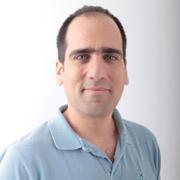
Asaf Ferber is Associate Professor in Mathematics at University of California, Irvine, School of Physical Sciences. His research spans discrete mathematics including combinatorial games, random graphs, extremal hypergraph theory, and quantum computation. Research explores Hamiltonian cycles in random graphs, structural properties of pseudorandom graphs, and quantum algorithms for combinatorial problems. Recent work develops quantum approaches to graph learning and sparse recovery in random matrices. Awards: NSF CAREER Award Sloan Fellowship Distinguished Early Career Faculty Award for Research Air Force Research Grant NSF-BSF Grant Organizes conferences including SoCalDM Symposium and Desert Discrete Math Workshop, mentoring graduate students through UCI's Probability and Combinatorics Seminar.
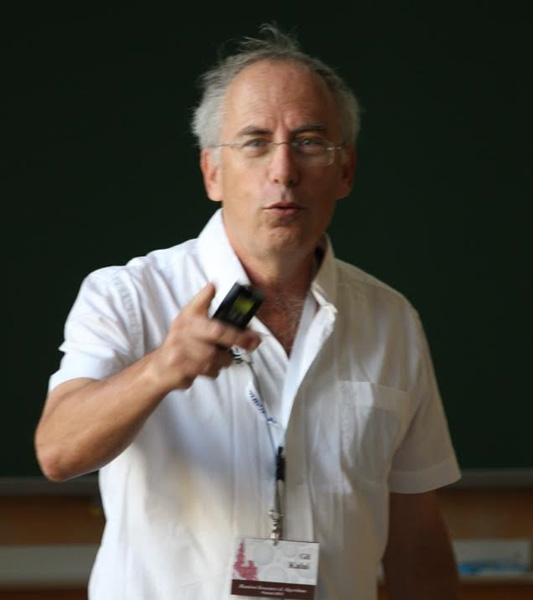
Gil Kalai is a Professor of Mathematics at the Hebrew University of Jerusalem since 1992, where he holds the Henry and Manya Noskwith Chair. He also serves as an Adjunct Professor of Mathematics and Computer Science at Yale University since 2004 in a long-term part-time visiting position. His academic career includes visiting positions at prestigious institutions including MIT, Cornell, IAS Princeton, Berkeley, Bell-labs, IBM, and Microsoft. Professor Kalai's research spans multiple areas within mathematics and theoretical computer science. His work in combinatorics encompasses geometric, probabilistic, and topological approaches. He has made significant contributions to the study of convex sets and polytopes, linear programming, and theoretical computer science. His influential 1988 paper with Kahn and Linial on Boolean functions pioneered applications of Fourier analysis in theoretical computer science. Kalai's research has evolved to include the application of Fourier analysis to thresholds, influences, symmetries, noise, percolation, and social choice. He has developed theories in algebraic shifting and studied face-numbers and other combinatorial invariants of polytopes. His work on the diameter of polytopes and randomized simplex algorithms has been influential in optimization theory. In 1993, his collaboration with Kahn produced a groundbreaking counterexample to Borsuk's Conjecture in 1325 dimensions. Professor Kalai's publications reveal a consistent focus on the intersection of combinatorics, geometry, and theoretical computer science. His work shows a progression from foundational combinatorial geometry to increasingly sophisticated applications of harmonic analysis in discrete mathematics. The recurring themes across his 30+ year career include Boolean functions, polytope theory, and probabilistic methods in combinatorics, demonstrating remarkable coherence in his research trajectory. 2016 European congress of Mathematics, plenary speaker 2013 ERC advanced grant 2012 Rothschild Prize 1994 International Congress of Mathematicians invited section talk, Zurich 1994 Fulkerson Prize 1993 Erdos Prize 1992 Polya Prize Though specific details of his advising are not provided in the source material, Kalai has written over 70 scientific papers and maintains an active research blog entitled "Combinatorics and More." His 2013 ERC advanced grant indicates significant research funding for his work. His extensive collaborations with researchers across multiple institutions suggest a robust research program with numerous PhD students and postdoctoral researchers, though specific names are not mentioned in the provided texts. Professor Kalai maintains active research connections across multiple institutions including Hebrew University, Yale, and various research centers worldwide. His work bridges pure mathematics and theoretical computer science, creating a unique interdisciplinary research environment that influences both fields.
Venkatesan Guruswami is a Chancellor's Professor in the Department of EECS and a Senior Scientist at the Simons Institute for the Theory of Computing at UC Berkeley . He also holds a Professor position in the Department of Mathematics . His academic journey began with a B.Tech in Computer Science from the Indian Institute of Technology, Madras (1997) , followed by a Ph.D. in Computer Science from the Massachusetts Institute of Technology (2001) . After a Miller Research Fellowship at UC Berkeley (2001–02), he held faculty roles at the University of Washington and Carnegie Mellon University before returning to UC Berkeley in January 2022. Education : B.Tech, IIT Madras (1997) Ph.D., MIT (2001) Professional Affiliations : Chancellor's Professor, UC Berkeley (EECS) Senior Scientist & Interim Director, Simons Institute Professor, UC Berkeley (Mathematics) Guruswami's research spans multiple domains within Theoretical Computer Science , focusing on Error-Correcting Codes , Approximation Algorithms , Randomness in Computing , Probabilistically Checkable Proofs , and Computational Complexity . His groundbreaking work in List Decoding has enabled codes with minimal redundancy for correcting worst-case errors, while recent advancements include Polar Codes , Deletion-Correcting Codes , and Constraint Satisfaction Problems . He has also contributed to Quantum Coding Theory , Locally Recoverable Codes , and Approximation Hardness in various computational contexts. His publications reflect a deep engagement with interdisciplinary topics. Key trends include: Quantum Information Theory : Quantum LDPC codes, transversal gates, and quantum storage. Algebraic Coding : Reed-Solomon codes, AG codes, and polynomial-based constructions. Computational Complexity : Hardness of approximation, CSPs, and parameterized intractability. Data Transmission : Polar codes, deletion channels, and feedback mechanisms. Algorithmic Techniques : Spectral methods, semirandom models, and Lasserre hierarchy applications. Guruswami has received numerous accolades, including the Simons Investigator Award , Presburger Award , Packard Fellowship , Sloan Research Fellowship , ACM Doctoral Dissertation Award , and the IEEE Information Theory Society Paper Award . He is an ACM Fellow (2017) and IEEE Fellow (2019) , with recent honors like the Guggenheim Fellowship (2023) and AMS Fellow (2023) . As an advisor, he has mentored over 25 PhD and postdoctoral researchers , including Atri Rudra , Prasad Raghavendra , and Peter Manohar , whose work has won awards like the Edmund M. Clarke Doctoral Dissertation Award and CRA Outstanding Undergraduate Researcher Award . His research is supported by grants from the National Science Foundation , Packard Foundation , and Sloan Foundation . He also serves as Editor-in-Chief of the Journal of the ACM and holds leadership roles in IEEE and arXiv moderation. Guruswami is actively involved in Simons Institute programs and co-organized workshops on Coded Computation and Information Theory . His work bridges theoretical advancements with practical applications in Cloud Storage , Quantum Computing , and Group Testing , including pandemic-era contributions like AC-DC: Amplification Curve Diagnostics for SARS-CoV-2 .
Prof. Tobias Müller is a Professor at the Bernoulli Institute for Mathematics, Computer Science and Artificial Intelligence at the University of Groningen. His academic journey includes previous positions at Utrecht University, CWI (Centrum Wiskunde & Informatica), Tel Aviv University, and Eindhoven University of Technology, with a doctorate from the University of Oxford under Colin McDiarmid. His research focuses on combinatorics, probability theory, random graphs, percolation, discrete and stochastic geometry, and combinatorial game theory. He has contributed extensively to understanding complex networks, hyperbolic models, and geometric random structures. Research Interests: Random Graphs and Percolation Theory Discrete and Stochastic Geometry Hyperbolic Network Models Probabilistic Combinatorics Geometric Probability Graph Algorithms and Connectivity Notable Contributions: Analysis of Voronoi and Poisson-Voronoi percolation in hyperbolic planes. Studies on Mallows random permutations and their cycle structures. Research on component games and logical limit laws in graph theory. Investigations into the geometry and properties of random geometric graphs. Grants & Collaborations: Active in organizing workshops and conferences on random graphs and geometric networks, including the BIRS Workshop on Random Geometric Graphs and the STAR Workshops series. Labs/Teams: Member of the Bernoulli Institute’s research groups, focusing on stochastic studies, combinatorics, and algorithmic methods.
Daniel Horsley is an Associate Professor and ARC Future Fellow at the School of Mathematical Sciences, Monash University. His research focuses on combinatorial designs and edge decomposition of graphs, with notable contributions to extremal graph theory, Zarankiewicz problems, and graph decomposition theorems. Current Role: ARC Future Fellow, Associate Professor Affiliation: School of Mathematical Sciences, Monash University Active Projects: 'The Zarankiewicz problem through linear hypergraphs and designs' (2022–2025), 'Edge decomposition of dense graphs' (2017–2022), and more Research interests span combinatorial designs, graph decomposition, and extremal combinatorics. His work emphasizes theoretical advancements in design theory, with applications in discrete mathematics and optimization. Recent articles address semi-inducibility, Zarankiewicz numbers, and embedding partial designs, reflecting his expertise in structural and extremal combinatorics. Key awards include the ARC Future Fellowship. His research outputs include over 57 publications in journals like Journal of Graph Theory , SIAM Journal on Discrete Mathematics , and European Journal of Combinatorics . Grant projects include collaborations with ARC, University of Queensland, and University of Melbourne, focusing on Steiner systems, compressed sensing, and combinatorial structure analysis. Advising PhD students and mentoring researchers in discrete mathematics and combinatorial design theory.
Prof. Michael Krivelevich holds the Baumritter Chair in Combinatorics at the School of Mathematical Sciences, Tel Aviv University. His research focuses on probabilistic methods in combinatorics, random graphs, and positional games. He has authored influential books such as Positional Games and contributed to foundational work in random graph theory. Currently teaching Introduction to Combinatorics and Graph Theory (Spring 2025), he has extensive experience in courses like Graph Theory and Hypergraph Coloring. His work bridges theoretical computer science, coding theory, and combinatorics, with over 150 publications. Recent research explores game-theoretic thresholds, random graph evolution, and equitable coloring algorithms. Education: Ph.D. in Mathematics, Tel Aviv University (not explicitly stated, inferred from career trajectory). Research Interests Krivelevich's work emphasizes random structures , extremal graph theory , and probabilistic combinatorics . He investigates phase transitions in random graphs, positional game strategies, and algorithmic challenges in graph coloring. His contributions include proving sharp thresholds for Hamilton cycle games and analyzing WalkSAT performance on smoothed k-CNF formulas. Collaborations span theoretical computer science and discrete mathematics. Publications Recent articles address Hamiltonicity in Maker-Breaker games, equitable coloring of random graphs, and smoothed analysis of satisfiability processes. His work often combines rigorous proofs with algorithmic insights. Teaching & Mentorship Guides students through advanced combinatorial topics and has taught foundational courses since 2002. No explicit student listings available in provided texts.
Professor Asaf Shapira is a faculty member in the Department of Theoretical Mathematics at Tel Aviv University's School of Mathematical Sciences. He has been actively contributing to combinatorics and graph theory research for over a decade, with numerous publications in top journals including Journal of the ACM, Advances in Mathematics, and Geometric and Functional Analysis. Professor Shapira's research focuses on extremal combinatorics, graph theory, and property testing. His work explores fundamental questions in Ramsey theory, hypergraph theory, and probabilistic methods in combinatorics. He has made significant contributions to the study of graph regularity, removal lemmas, and extremal problems in dense and sparse graphs. His recent publications demonstrate a consistent focus on theoretical aspects of combinatorics with connections to theoretical computer science. A notable trend is his work on developing polynomial bounds for various combinatorial theorems and exploring connections between combinatorial structures and computational complexity. His research often bridges pure mathematics with theoretical computer science applications. Professor Shapira teaches advanced courses at Tel Aviv University including Extremal Graph Theory, Basic Combinatorics, and seminars on specialized topics in combinatorics. His teaching spans undergraduate and graduate levels, reflecting his commitment to educating the next generation of mathematicians.
Tibor Szabó is a Professor in the Combinatorics and Graph Theory group at the Department of Mathematics, Freie Universität Berlin. He holds a PhD from The Ohio State University, advised by Ákos Seress. Prior to his current position, he held roles at McGill University, ETH Zürich, the Institute for Advanced Study (Princeton), and the University of Illinois (UIUC) as a J.L. Doob Research Assistant Professor. Research Interests: His work focuses on combinatorics and combinatorial optimization, including extremal problems, random structures and algorithms, pseudorandom graphs, positional games, and the combinatorics of linear programming. He explores tools from algebra, probability theory, and topology applied to combinatorics. Teaching: He teaches courses such as Algorithmic Combinatorics, Extremal Combinatorics, and runs the Combinatorics Seminar. His lecture notes include works on positional games and explicit constructions in extremal combinatorics. Students & Postdocs: Notable PhD advisees include Yamaan Attwa, Silas Rathke, Simona Boyadzhiyska, and Patrick Morris. Postdoctoral fellows include Olaf Parczyk and Anurag Bishnoi. His research has involved collaborations with over 50 co-authors. Funding & Grants: Supported by grants from the Swiss National Science Foundation (SNF) and German Research Foundation (DFG), focusing on topics like positional games and extremal graph theory.
Sebastian Cioaba is a Professor in the Department of Mathematical Sciences at the University of Delaware (UD), part of the College of Arts & Sciences. His research focuses on spectral graph theory, algebraic combinatorics, and their applications. He earned his Ph.D. from Queen’s University (2005) and joined UD in 2009 after postdoctoral work at UC San Diego and the University of Toronto. Cioaba has advised 8 Ph.D., 4 M.Sc., and numerous undergraduate researchers, with current advisees including John Byrne and Isabel Byrne. His work is supported by NSF, NSA, and international grants. Education - B.Sc. Mathematics & Computer Science, University of Bucharest (Undergraduate) - Ph.D. Mathematics, Queen’s University (2005) Research & Awards - 2024 College of Arts & Sciences Award - Co-editor of Discrete Mathematics and Linear Algebra and its Applications - Over 70 publications and two books: A Bridge to Advanced Mathematics (2023) and A First Course in Graph Theory and Combinatorics (2022, 2nd ed.) Teaching & Service - Organized conferences in discrete mathematics - Supervised over 25 undergraduate and high school students in research projects Advising - Current Ph.D. students: John Byrne, Isabel Byrne, Colby Sherwood - Notable past advisees include Vishal Gupta (Ph.D. 2025, Rochester) and Dheer Noal (Ph.D. 2022, Memphis postdoc)
Yulia Gel is a Professor in the Department of Statistics at Virginia Tech and serves as a Part-Time Program Director-Expert at the National Science Foundation (NSF). She holds a MSc (summa cum laude) and PhD in Mathematics from Saint Petersburg State University (Russia) and completed a postdoc in Statistics at the University of Washington. Her research focuses on uncertainty quantification in AI, statistical foundations of data science, spatio-temporal processes, and applications in climate science, healthcare, and blockchain analytics. She has received prestigious awards including the NSF Director’s Award (2023), ASA Distinguished Achievement Medal (2018), and TIES Abdel El-Shaarawi Award (2014). Gel has led grants on wildfire prediction, climate informatics, and blockchain data science. She serves on editorial boards of Statistica Sinica, Electronic Journal of Statistics, and Technometrics, and organizes workshops on AI for climate sustainability and fragile Earth systems. Her research group develops topological and geometric methods for graph neural networks, with applications to digital twins, environmental justice, and public health. Education: MSc (1997), PhD (2000) in Mathematics from Saint Petersburg State University; Postdoc in Statistics at University of Washington (2001–2003). Past roles include Professor at University of Texas at Dallas (2015–2024) and Associate Professor at University of Waterloo (2004–2014). Selected visiting positions include NASA Jet Propulsion Lab (2016–2017) and Isaac Newton Institute (2016–2017). She has pioneered statistical software packages like snowboot and funtimes for network inference and time-series analysis. Awards highlight her contributions to environmetrics and statistical methodologies. Current projects include NSF-funded research on AI-driven wildfire prediction and blockchain analytics for climate resilience. Her lab’s recent work emphasizes topological methods (e.g., zigzag persistence) for graph-based forecasting and adversarial robustness.
Benny Sudakov is a Professor of Mathematics at ETH Zurich, where he conducts research in combinatorics. He has previously held positions at UCLA, Princeton University, and the Institute for Advanced Study. His work is supported by the SNSF grant 200021_196965. Research Interests: His primary research areas include Extremal Graph and Hypergraph Theory, Ramsey Theory, Random Structures, and the application of Algebraic and Probabilistic Methods in Combinatorics, with strong connections to Theoretical Computer Science. He investigates fundamental structural properties of discrete systems, such as the existence of regular subgraphs, extremal configurations, and the behavior of random combinatorial objects. The recent popular science articles on his work highlight a consistent trend of solving long-standing open problems in extremal combinatorics using sophisticated probabilistic and algebraic techniques. His research spans topics like equiangular lines, graph decompositions, and the emergence of cycles in sparse graphs, demonstrating a deep focus on the interplay between structure and randomness. Scientific Awards: No specific awards are mentioned in the provided text. Advising and Grants: He has advised numerous Ph.D. students, many of whom have gone on to become professors at top universities (e.g., Oxford, Stanford, CMU, ETH, Princeton). His research is currently funded by the Swiss National Science Foundation (SNSF). He has organized workshops and seminars, such as the Theory of Combinatorial Algorithms Mittagsseminar at ETH and a workshop at UCLA on Extremal and Probabilistic Combinatorics. Labs and Teams: He is a key member of the combinatorics group at ETH Zurich and co-organizes the Theory of Combinatorial Algorithms Mittagsseminar, a central forum for research discussions in discrete mathematics at the institution.
Professor Stefan Glock is an Assistant Professor of Discrete Mathematics at the University of Passau's Faculty of Computer Science and Mathematics, a position he has held since September 2022. Prior to this appointment, he spent three years as a Junior Fellow at the Institute for Theoretical Studies at ETH Zurich, following the completion of his doctorate at the University of Birmingham. Stefan Glock received his mathematics education at Technische Universität Ilmenau from 2009 to 2014, then pursued his PhD at the University of Birmingham, which he completed in 2018. His doctoral dissertation, "Decompositions of Graphs and Hypergraphs," was the runner-up for the Richard-Rado-Preis 2018. Professor Glock's research focuses on discrete mathematical structures, with particular emphasis on their asymptotic properties. His work spans several interconnected fields of combinatorics: Extremal Combinatorics : Investigating the maximum or minimum possible size of mathematical structures satisfying certain properties Probabilistic Combinatorics : Applying probability theory to solve combinatorial problems Graph Theory : Studying properties of graphs and networks Ramsey Theory : Examining conditions under which order must appear in large structures Design Theory : Creating arrangements of elements satisfying specific balance properties Discrete Geometry : Analyzing geometric problems with discrete structures Analysis of Professor Glock's recent publications reveals a consistent focus on solving long-standing open problems in combinatorics using innovative methods that combine probabilistic techniques with structural insights. His work often bridges theoretical mathematics with applications in theoretical computer science, particularly in the analysis of algorithms and network structures. A significant portion of his research addresses fundamental questions about graph and hypergraph decompositions, which have implications for coding theory, cryptography, and network design. Professor Glock has received notable recognition for his contributions to mathematics: Runner-up for the Richard-Rado-Preis 2018 for his dissertation "Decompositions of Graphs and Hypergraphs" Awarded funding through the prestigious DFG Emmy Noether Programme in 2024 for his research group on "the interplay of structure and randomness in mathematics" As a faculty member at the University of Passau, Professor Glock leads the Discrete Mathematics research group and actively collaborates with mathematicians worldwide. He has established a strong research program that has attracted funding for academic visitors and supports multiple research projects. His approach to mathematical problems emphasizes developing new methods that have far-reaching implications beyond the specific problems being solved. Professor Glock's research group at the University of Passau focuses on the interplay between structure and randomness in discrete mathematics. The group maintains active collaborations with leading institutions including ETH Zurich, University of Birmingham, and various research centers across Europe. Through the DFG Emmy Noether Programme funding, his group is expanding its research on combinatorial structures and their applications.