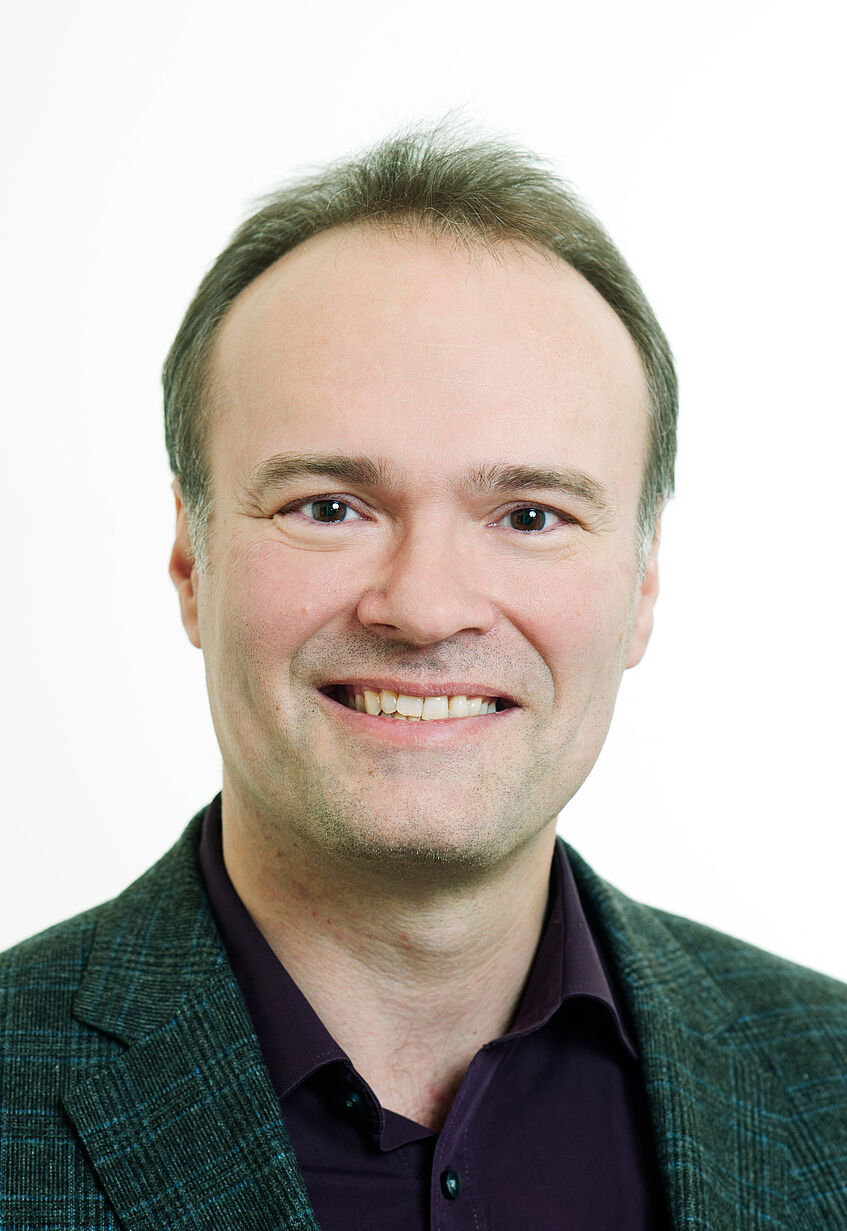
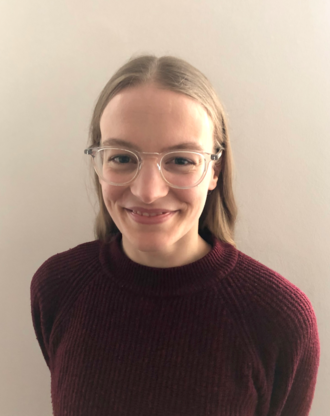
Alexis de Colnet is a PostDoc Researcher at the Vienna University of Technology , affiliated with the Faculty of Informatics and the Algorithms and Complexity department. Their work focuses on overcoming intractability in knowledge compilation, computational complexity, and model counting. Research Interests: Knowledge Compilation Computational Complexity Artificial Intelligence Model Counting Answer Set Programming Theoretical Computer Science Recent Publications explore trends in proof systems, compilation efficiency, and translations between machine learning models for explainability. These works are deeply rooted in theoretical computer science and AI, addressing challenges in knowledge representation and computational hardness. Projects: Overcoming Intractability in the Knowledge Compilation Map (2022–2025) QBFPC (2022–2025) Funded by the Austrian Science Fund (FWF).
Thomas Neubauer is a researcher affiliated with TU Wien's Department of E-Commerce, part of the Faculty of Informatics. He holds the title of Researcher and is actively involved in projects such as the 'Digitisation and Innovation Laboratory in Agricultural Sciences,' serving as Principle Investigator. His work focuses on applying artificial intelligence, digital twins, and machine learning to address challenges in sustainable agriculture and environmental systems. Neubauer has contributed to over 97 publications, emphasizing topics like precision farming, energy-efficient agrivoltaic systems, and predictive modeling in complex agricultural data. Education details aren't explicitly listed, but his academic titles include Dipl.-Ing. (Master of Engineering), Mag. (Magister), and Dr.techn. (Doctor of Technical Sciences). His research interests span digital agriculture, AI-driven crop management, and the integration of chaos theory with machine learning. Notable projects include exploring digital twin applications for grassland management and photovoltaic integration in farming systems. Neubauer has advised students such as Sebastian Raubitzek, Anja Klipic, and Enri Miho on theses related to digital twins and AI in agriculture. His work frequently intersects with sustainability goals, including reducing environmental impacts through technological innovation. He collaborates on interdisciplinary teams focused on energy resilience and precision livestock farming, leveraging explainable AI techniques to enhance decision-making in agricultural contexts.
Stefan Haeussler is an Associate Professor at the Department of Information Systems, Production and Logistics Management within the University of Innsbruck , Austria. His academic career spans since 2009, starting as a University assistant while completing his PhD in Management. He holds dual diplomas in Business Administration (2009) and Political Science (2010) from the same university. Specializing in production and logistics management, Häussler combines optimization techniques with machine learning approaches to address complex manufacturing challenges. His research focuses on Workload control systems Order release mechanisms Lead time management Reinforcement learning applications Semiconductor manufacturing optimization Behavioral operations in supply chains Recent publications highlight his work on integrated production planning , explainable AI for powertrain control , and dynamic workload allocation . He actively presents at major conferences like Winter Simulation Conference, EURO, and International Working Seminar on Production Economics. Häussler also teaches master's level courses and supervises thesis work in production economics, while serving as a guest lecturer on topics at the intersection of AI and manufacturing.
Sareh Aghaei serves as a Research Fellow at the Institute of Management Sciences within the Faculty of Mechanical Engineering and Industrial Management at Vienna University of Technology (TU Wien), focusing on knowledge-driven solutions for industrial maintenance and healthcare systems. Her academic credentials include: Ph.D. in Computer Science from the University of Innsbruck (2023) M.Sc. in Computer Science from the University of Isfahan Dr. Aghaei's research integrates knowledge graphs with natural language processing and machine learning to develop explainable AI systems. Her work spans industrial maintenance optimization, clinical decision support, and tourism information systems, emphasizing ontology engineering and question-answering frameworks that transform unstructured data into actionable knowledge. Analysis of her 2021-2025 publications reveals a strategic shift toward domain-specific knowledge graph applications, particularly in maintenance management (2022-2025) and health informatics (2023-2024). This evolution demonstrates increasing specialization in medical knowledge representation while maintaining foundational contributions to semantic web technologies established in earlier works like her 2011 Web services architecture research. Her scholarly recognition includes: netidee Grant Call 17: Austria's award for most innovative doctoral theses Dr. Aghaei's doctoral research was funded through the netidee scholarship. Current documentation indicates no active student supervision or major grant leadership beyond her postdoctoral position at TU Wien. Within TU Wien's Institute of Management Sciences, she contributes to research bridging production engineering and artificial intelligence, developing knowledge-based systems for predictive maintenance and industrial process optimization through interdisciplinary collaboration.
Alan Said is an Associate Professor in the Department of Applied IT at the University of Gothenburg, where he also serves as Head of Education. His research focuses on recommender systems, user modeling, personalization, and the human-centered evaluation of AI technologies. He is actively engaged in promoting responsible, fair, and sustainable AI through interdisciplinary research and community leadership. Research Interests: User Modeling and Personalization Recommender Systems (RecSys) Human-Computer Interaction (HCI) and Human-Centered AI (HCAI) Explainable and Responsible AI Green AI and Environmental Impact of Recommender Systems Reproducibility and Evaluation Methodologies His recent publications reflect a strong trend toward ethical, sustainable, and socially conscious AI, with a focus on fairness in healthcare, environmental cost measurement, and interdisciplinary approaches to recommendation. He contributes extensively to top-tier venues such as ACM RecSys and UMAP. Scientific Awards: ACM Distinguished Speaker Advising and Grants: Alan Said advises students on topics ranging from fairness in AI to human-centered explanations and sustainable recommender systems. He has been involved in organizing workshops and special issues that promote critical reflection and interdisciplinary collaboration in the RecSys community. He has participated in funded research projects, including international collaborations supported by agencies like Vinnova. Labs and Teams: He is a key organizer of the Human-centered AI (HCAI) podcast and has co-organized influential workshops such as BEYOND and INTROSPECTIVES at RecSys, fostering dialogue on the societal and ethical dimensions of AI. His work bridges computer science, psychology, design, and ethics, emphasizing collaboration across disciplines.
Marta Moscati works at the Institute of Computational Perception at Johannes Kepler University Linz , focusing on advanced recommendation systems and multimodal learning. Her research spans emotion-based music recommendation, privacy-preserving machine learning, and graph neural networks. Recent work includes: Developing multimodal single-branch architectures for cold-start scenarios Creating preference obfuscation techniques in implicit feedback systems Advancing music emotion recognition with semi-supervised graph networks Contributing to the FAME Challenge for multilingual face-voice association She has published extensively in top AI venues while maintaining technical expertise in both deep learning and theoretical physics , with early work on lepton universality violation. At JKU, she contributes to: Recommendation algorithms development Multimodal representation learning research Musical affective computing applications Privacy-preserving AI frameworks
Djordje Slijepčević serves as Deputy Research Group Leader of the Media Computing Research Group at the Institute for Creative Media/Technologies, St. Pölten University of Applied Sciences. He is affiliated with the Department of Media and Digital Technologies and holds a position involving both research leadership and academic instruction. His work bridges computer science, biomedical engineering, and clinical applications. Dr. Slijepčević's research focuses on the intersection of machine learning, computer vision, and biomechanics, with particular emphasis on clinical gait analysis. His work develops explainable AI systems that can interpret human movement patterns, particularly for rehabilitation applications and medical diagnostics. His research spans from fundamental machine learning methodologies to practical clinical implementations, with special attention to transparency and interpretability of AI systems in medical contexts. His work has significant implications for personalized rehabilitation, movement disorder diagnosis, and assistive technologies. His publication record demonstrates a clear trajectory toward increasingly sophisticated applications of machine learning in biomechanics, with a growing emphasis on explainability and clinical applicability. The research shows progression from basic gait analysis techniques to sophisticated AI-driven diagnostic tools that maintain transparency in medical decision-making processes. His work increasingly focuses on individualized approaches to movement analysis, recognizing the importance of personal gait signatures in rehabilitation contexts. Dr. Slijepčević actively contributes to multiple research projects including MODEL-CP, TrustAI, EyeQTrack, FAIRAI, deepForce, and IntelliGait 3D, which collectively aim to advance AI applications in healthcare, particularly in movement analysis and rehabilitation. His collaborative approach is evident through numerous co-authored publications with researchers from diverse disciplines including medicine, computer science, and biomechanics.
Gerhard Ecker is a Professor of Pharmacoinformatics and Head of the Pharmacoinformatics Research Group at the Division of Pharmaceutical Chemistry, Department of Pharmaceutical Sciences, Faculty of Life Sciences, University of Vienna. He serves as Director of Corporate Program and has held significant leadership roles including Dean of the Faculty of Life Sciences (2018-2022) and Vice-Dean (2014-2018). His educational background includes Pharmacy studies at the University of Vienna (1981-1986), Ph.D. in Medicinal Chemistry (1986-1991), a post-doctoral stay at the Research Center in Borstel, Germany (1995), and Habilitation for Pharmaceutical Chemistry at the University of Vienna (1998). He was appointed as full professor for Pharmacoinformatics at the University of Vienna in October 2009. Professor Ecker's research focuses on computational drug design with special emphasis on drug-transporter interactions and in silico safety assessment. His work spans ligand- and structure-based drug design , particularly focused on transmembrane transport proteins , prediction of on- and off-kinetics , and semantic data integration . His group employs advanced computational techniques including machine learning, neural networks, protein homology modeling, and molecular dynamics simulations to address challenges in pharmacology and toxicology. An analysis of his recent publications reveals a strong focus on solute carrier (SLC) transporters, with numerous studies on SLC6 family members and their role in disease. His work increasingly integrates machine learning approaches with structural biology to predict mutation pathogenicity, transporter inhibition, and drug safety profiles. The research demonstrates a clear trajectory toward more sophisticated computational models that combine chemical and biological fingerprints for improved prediction accuracy. Fellow of the Royal Society of Chemistry (2013) Professor Ecker has coordinated or participated in numerous significant research projects including the Open PHACTS project (semantic integration of public databases), and serves as Speaker of the FWF doctoral programme "Molecular Drug Targets." He has been involved in multiple EU-funded initiatives such as eTOX, K4DD, eTRANSAFE, TransQST, ReSOLUTE, and Risk-Hunt3r, as well as FWF projects like InSilify DrugTox and Vienna Business Agency's AI4HEALTH. He leads the Pharmacoinformatics Research Group at the University of Vienna, which focuses on developing computational methods for drug design and safety assessment. The group is actively involved in several major collaborative projects including RISK-HUNT3R (focusing on chemical risk assessment) and ReSOLUTE (research on solute carriers for drug discovery). Their work bridges computational approaches with experimental validation to address key challenges in pharmaceutical sciences.
Yuxi Xia is a researcher affiliated with the Faculty of Computer Science, specializing in data mining and machine learning. Current research activities focus on artificial intelligence validation, surrogate modeling for railway systems, and multimodal question-answering frameworks. BSc, MSc in Computer Science Active in AI Review publications (2024) Research interests span large language model calibration , digital twin technologies , and model ensembling . Recent articles address overfitting, multimodal fusion, and ethical implications of machine-generated text detection. Key publication trends include industrial AI applications for railway systems, federated learning security, and explainability in black-box models. Collaborations extend to interdisciplinary AI validation studies.
Katharina Hoedt is a University Researcher and Assistant at the Institute of Computational Perception at Johannes Kepler University Linz (JKU), with a Vienna-based research presence. She holds a PhD in Computer Science from JKU (2020) and has been involved in research roles since 2016, including at the Austrian Research Institute for Artificial Intelligence (OFAI). Her work focuses on adversarial machine learning, model interpretability, and neural network robustness, particularly within music information retrieval domains. Education: PhD in Computer Science (2019–2020), DI (Diploma) in Computer Science (2013–2016), Bachelor of Science in Informatics (JKU Linz). She has taught courses on Machine Learning and Pattern Classification, and Artificial Intelligence at JKU. Research Interests: Adversarial examples and robustness, interpretable machine learning, neural network inner workings, and applications in music classification. Her publications explore adversarial attacks, explanation validity, and model defense strategies in audio and music contexts. Labs/Teams: Active member of the Institute of Computational Perception, collaborating on interdisciplinary projects combining AI with musicology and signal processing.
Peter Filzmoser is a Professor at the Institute for Statistics and Mathematical Economics (E105) of Vienna University of Technology, leading the Computational Statistics Research Area (E105-06) and affiliated with the Network Lab. His research focuses on: Compositional Data Analysis Robust Statistics Outlier Detection Machine Learning for High-Dimensional Data with applications in geochemistry, mobility data, tribology, and sustainable development. Recent publications (2023) demonstrate significant advances in explainable outlier detection using Shapley values, robust techniques for compositional data analysis, and applications in forecasting heterogeneous time series. His work extends compositional data analysis through graph signal processing and develops novel robust methodologies for real-world problems. Professor Filzmoser has advised over 15 Master's and PhD students from 2021-2023. Key research projects he leads include: Automotive Intelligence for/at Connected Shared Mobility CSTAT: Blind Source Separation Generalized relative data and Robustness in Bayes spaces
Sebastian Ordyniak is an Associate Professor in the Department of Algorithms and Complexity at TU Wien. His research focuses on parameterized complexity, algorithms, computational complexity, and applications in artificial intelligence and graph theory. He holds a PhD and the prestigious START Prize (2014–2022), a renowned Austrian award for outstanding researchers. Key projects include the ERC-funded 'Parameterized Complexity of Local Search' (2010–2014) and ongoing initiatives like 'Parameterized Analysis in Artificial Intelligence' (2021–2026). His work bridges theoretical foundations with practical applications, such as algorithmic fairness, machine learning interpretability, and graph drawing. Research highlights include contributions to SAT solving, backdoor analysis, and clustering algorithms. He has advised at least one student, Hossein Maleki, on practical algorithms for deletion to small components. His interdisciplinary approach integrates logic, computational geometry, and multi-agent systems.
Alexander Pluska is a PreDoc Researcher at TU Wien's Faculty of Informatics, affiliated with the Department of Formal Methods in Systems Engineering. He holds an MSc and is engaged in research at the intersection of formal methods, logic, and machine learning. His work includes projects like StruDL (2023–2027) and NanoX (2024–2028), focusing on logic embeddings, graph neural networks, and knowledge representation. He teaches courses such as Formal Methods in Computer Science (UE/VU), Program and System Verification (VU), and a project on Trends in Cloud Computing (PR). His research interests emphasize automated deduction, intuitionistic logic, and applying formal methods to AI systems. Recent work includes logical distillation of GNNs and embedding intuitionistic logic into classical frameworks. Alexander contributes to academic events like the ICML 2024 Workshop on Mechanistic Interpretability and the International Conference on Principles of Knowledge Representation and Reasoning (KR 2024).
Maximilian Thiessen is a PhD student in machine learning at Technische Universität Wien , supervised by Thomas Gärtner. He is affiliated with the machine learning research unit and collaborates with the Laila lab in Milan. Research Interests : Learning with graphs Active learning frameworks Convexity theory in ML Computational learning theory Recent Research Trends include: (1) Expressive GNN architectures for outerplanar graphs (2025), (2) Generalized boosting theory through game frameworks (2024), (3) Efficient monophonic halfspace learning (2024), (4) Abstention mechanisms in contextual bandits (2024), (5) Global feature extensions in GNNs (2023), and (6) Expectation-complete graph representations (2023). Scientific Awards : 2024: DOC Fellowship from Austrian Academy of Sciences 2023: Best Poster Award at G-Research's ICML Poster Party Community Contributions : Organizer of Mining and Learning with Graphs (MLG) workshops at ECMLPKDD 2022-2024, co-organizer of Graph Learning on Wednesdays (GLOW) reading group, and session chair at ECMLPKDD'23.
Prof. Gerald Steinbauer-Wagner is an Associate Professor at TU Graz's Institute of Software Engineering and Artificial Intelligence. He specializes in autonomous intelligent systems, focusing on decision-making architectures for robots in uncertain environments. His research integrates software engineering, AI, and robotics to develop reliable systems for applications in disaster response, planetary exploration, and industrial automation. Research Interests: Steinbauer-Wagner's work addresses challenges such as robot navigation in unstructured terrains, human-robot collaboration, and trustworthiness in autonomous systems. Key areas include explainable AI, fault diagnosis, and multi-robot coordination. His team explores solutions for off-road robotics, collective perception, and certification of autonomous systems. Recent Projects: Current initiatives include developing autonomous systems for subterranean rescue missions (ROBO-MOLE), optimizing robot localization using machine learning, and creating educational frameworks for AI literacy in schools. His group also contributes to the RoboCup Logistics League and planetary exploration cascades through analog missions like AMADEE-20. Awards & Recognition: No specific awards listed, but his work has been recognized through extensive publications in top venues like IEEE/RSJ IROS, ICRA, and RoboCup symposiums. Lab & Teams: Leads the Autonomous Intelligent Systems (AIS) research group at TU Graz, collaborating with industry partners like the Smart Factory. His team develops integrated robot systems for production, logistics, and disaster response scenarios.