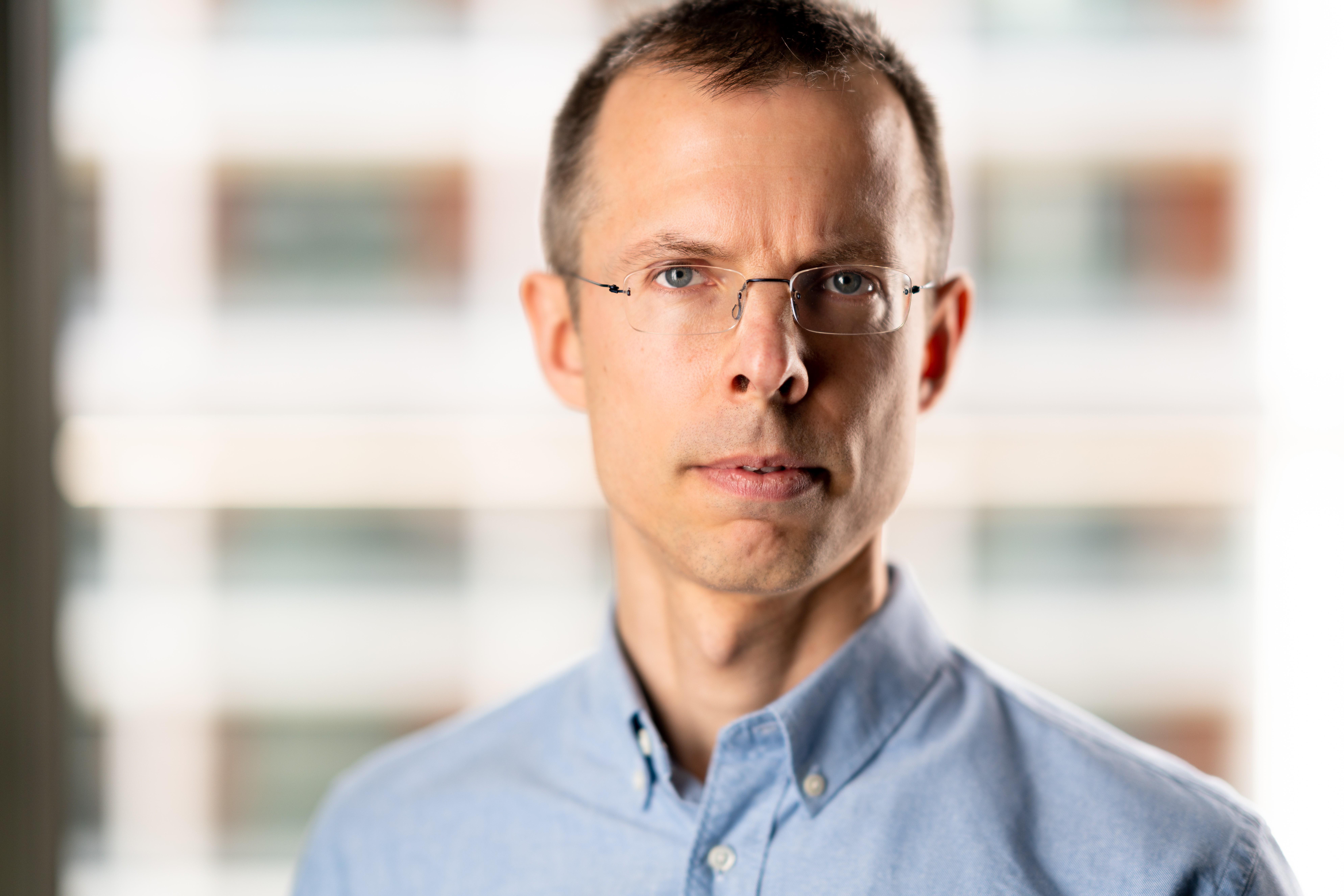
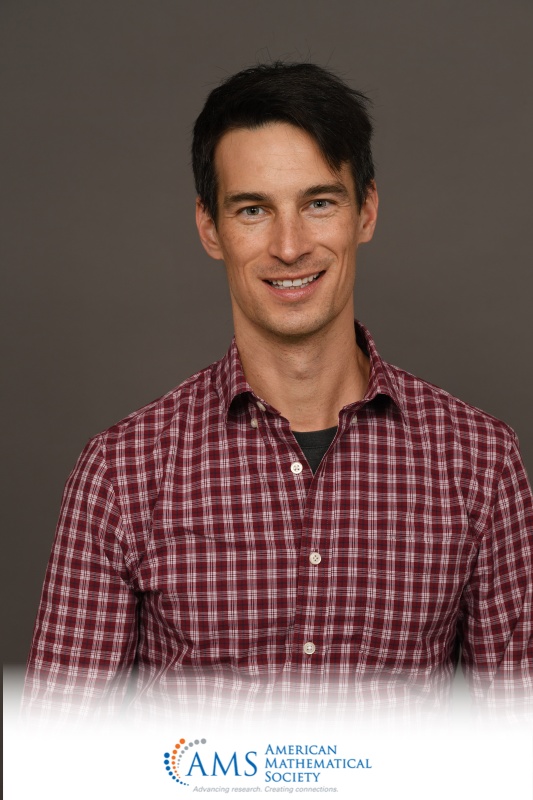
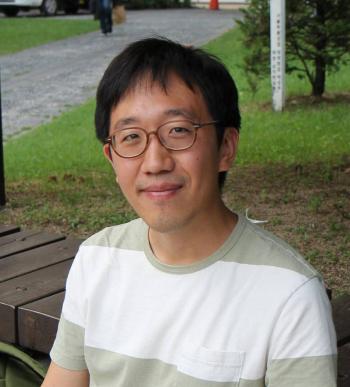
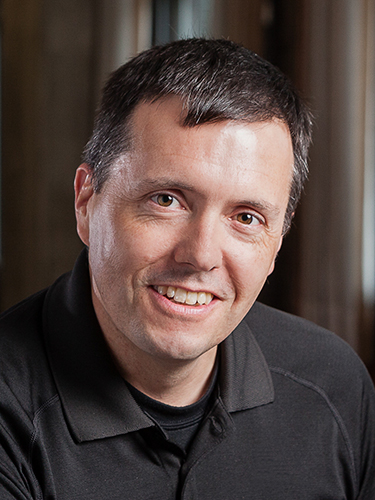
Nathan Reading is a Professor in the Department of Mathematics at North Carolina State University (NCSU). He holds a Ph.D. in Mathematics from the University of Minnesota (2002) and a B.S. in Physics from Stanford University (1995). His research focuses on algebraic and geometric combinatorics, particularly in Coxeter groups, cluster algebras, and lattice-theoretic approaches. He has been actively involved in organizing the Triangle Lectures in Combinatorics, a biannual research conference. His research interests include noncrossing partitions, cluster scattering diagrams, and the lattice theory of torsion classes. Recent work explores connections between Coxeter groups and combinatorial structures on surfaces. Reading has authored numerous papers on topics such as semidistributive lattices, scattering diagrams, and Cambrian frameworks. He teaches advanced combinatorics courses (e.g., MA 724: Combinatorics II) and has advised graduate students. His work has been supported by grants from the National Science Foundation (NSF), including DMS-1500949. Reading maintains an active presence in the mathematics community through publications, conference organization, and pedagogical contributions.
Zvezdelina Stankova is a Teaching Professor of Mathematics and Director and Founder of the Berkeley Math Circle at the University of California, Berkeley . Her contact details include an office in 713 Evans Hall and the email stankova@math.berkeley.edu . Research Interests: • Algebraic Geometry • Representation Theory • Combinatorics • Olympiad Problem-Solving • Mathematics Education Publications and Research Trends: Her work bridges Combinatorics and Algebraic Geometry , with a focus on permutation patterns, avoidance, and moduli spaces of curves. She has also contributed significantly to Mathematics Education through her leadership in the Berkeley Math Circle, emphasizing problem-solving techniques and outreach programs for students. Teaching and Outreach: Stankova has taught various courses at UC Berkeley, including MATH 52 Calculus II (2025), MATH 110 Linear Algebra , and MATH 74 Transition to Proofs . She actively engages with the Berkeley Math Circle, providing resources for mathematical competitions and advanced training for students.
Maxim Kontsevich is a permanent professor at the Institut des Hautes Études Scientifiques (IHÉS), holding the AXA Chair for Mathematics since 1995 and a visiting chair at Rutgers University (one month annually since 1997). Born in 1964 in Khimki, USSR, he earned his PhD from Bonn University in 1992. His career includes visiting positions at Harvard, the Institute for Advanced Study, and Berkeley, where he was a professor from 1993 to 1995. His research spans mathematical physics, algebraic geometry, and non-commutative geometry. Notable contributions include deformation quantization, mirror symmetry, and motivic integration. His work bridges algebraic structures with geometric and physical concepts, influencing areas like topological field theories, string theory, and integrable systems. Awardees of Fields Medal (1998), Crafoord Prize (2008), and Breakthrough Prize (2014), he also holds editorial roles at Compositio Mathematica and Publications Mathématiques IHÉS. His over 50 publications explore advanced topics such as quantum cohomology, Hodge theory, and categorical structures in geometry.
Kristin Shaw is a Professor in the Department of Mathematics at the University of Oslo, specializing in Algebra, Geometry and Topology. She leads the research group on Algebraic and Topological Cycles in Tropical and Complex Geometries, funded by the BFS. Her office is located in room 1114 of Niels Henrik Abels hus, with contact information including email krisshaw@math.uio.no and phone +47 22855940. Shaw's research focuses on the connections between combinatorics and algebraic geometry over the real and complex numbers, with particular emphasis on tropical geometry. Her work bridges abstract mathematical theory with concrete geometric structures, exploring how combinatorial methods can illuminate deep properties of algebraic varieties. She has made significant contributions to understanding matroids, real algebraic curves, and the topology of hypersurfaces through tropical techniques. Her research demonstrates how combinatorial structures can reveal fundamental insights about algebraic varieties and their topological properties. Analysis of Professor Shaw's recent publications reveals a consistent focus on tropical geometry and its applications to classical algebraic geometry problems. Her work frequently examines the interplay between real and complex geometries, with particular attention to combinatorial structures underlying algebraic varieties. Key themes include matroid theory, enumerative geometry, and the topology of algebraic varieties, demonstrating how tropical methods can provide new insights into longstanding problems in algebraic geometry. Her research shows remarkable depth across multiple subfields while maintaining a coherent theoretical framework that connects combinatorial and geometric approaches. Professor Shaw leads the research group on Algebraic and Topological Cycles in Tropical and Complex Geometries, which is funded by the BFS. Prior to her position at the University of Oslo, she held postdoctoral positions at the Max Planck Institute Leipzig, the Technical University of Berlin, the University of Toronto, and participated in the Fields' Institute semester in Combinatorial Algebraic Geometry. Her collaborative work spans multiple international institutions, reflecting her active engagement in the global mathematical research community.
Zsolt Patakfalvi is an Associate Professor at École Polytechnique Fédérale de Lausanne (EPFL), holding positions in the School of Basic Sciences (SB) within the Department of Mathematics (MATH). He is affiliated with the Chair of Algebraic Geometry (CAG) and the Section of Mathematics for Engineers (SMA-ENS). Additionally, he serves as Director of SMA-GE and holds roles in academic governance bodies like the Conference of Section Directors (CDS) and SB Faculty Management. His research focuses on Algebraic Geometry, particularly in birational geometry, positive characteristic methods, moduli theory, and mixed characteristic algebra. He explores topics such as Hodge theory, singularities, and applications to arithmetic geometry. Notable contributions include work on the minimal model program, test ideals, and counterexamples to classical conjectures in positive characteristics. He supervises doctoral students in areas like algebraic geometry and commutative algebra, including Jefferson Baudin, Léo Navarro Chafloque, and Linus Rösler. His past advisees include Emelie Arvidsson and Quentin Posva. Patakfalvi’s publications frequently address foundational questions in geometry, with recent work extending into perfectoid spaces and globally-regular varieties. He coordinates courses such as 'Algebra III - Rings and Fields' and 'Perfectoid spaces' at EPFL, reflecting his commitment to both research and education. His academic service includes managing educational programs within SB-SMA and contributing to institutional decision-making through CDS membership.
Professor Dhruv Ranganathan is affiliated with the Department of Pure Mathematics and Mathematical Statistics at the University of Cambridge, working within the Algebraic Geometry research group. His research spans foundational and applied aspects of algebraic geometry, focusing on enumerative geometry, Gromov-Witten theory, moduli spaces, tropical geometry, logarithmic structures, and classical geometry of curves. Research Focus Enumerative geometry and Gromov-Witten theory, particularly in toric varieties and tropical settings. Moduli spaces of curves and stable maps, with expansions and logarithmic structures. Applications of tropical geometry to classical problems in algebraic geometry. Brill-Noether theory and its combinatorial analogues for graphs and finite structures. Recent Publications The articles reflect a strong emphasis on logarithmic and tropical geometry, with connections to moduli spaces, enumerative invariants, and combinatorial algebraic structures. Topics include Donaldson–Thomas theory, double ramification cycles, chip firing on graphs, and motivic zeta functions. Contact Email: dr508@dpmms.cam.ac.uk Room: E1.01, Telephone: 01223 337990 Personal Homepage
Tom Coates is a Professor of Pure Mathematics in the Department of Mathematics at Imperial College London's Faculty of Natural Sciences. He holds affiliations with the Artificial Intelligence Network, the CNRS-Imperial Abraham de Moivre UMI, and the Pure Mathematics research group. His office is located in the Huxley Building (662) on the South Kensington Campus, London SW7 2AZ, and he can be contacted via email at t.coates@imperial.ac.uk or phone at +44 (0)207 594 3607. Professor Coates' research spans pure mathematics with emphasis on algebraic geometry, mirror symmetry, and Gromov-Witten theory. He investigates quantum cohomology and Fano variety classification to construct a 'Periodic Table for shapes' through computational algebra, data mining, and machine learning. His work integrates geometric methods with cluster-scale computing to identify structural patterns in algebraic varieties, focusing on quantum periods, toric degenerations, and Laurent polynomial applications. His recent publications (2021-2024) demonstrate a strong trend toward computational classification of Fano varieties and polytopes, leveraging machine learning for dimension prediction and database construction. Key themes include mirror symmetry via Laurent inversion, toric geometry applications, and connections between Gromov-Witten invariants and modular forms. These works often utilize custom tools like PCAS and Fanosearch for large-scale algebraic computations. While specific student names are not listed, Professor Coates mentors PhD and Master's students in algebraic geometry and computational mathematics. His research is supported by the Simons Foundation, member institutions, and contributors, enabling international collaborations through networks like the CNRS-Imperial Abraham de Moivre UMI. He leads a research team developing the Periodic Table for shapes framework, utilizing high-performance computing resources. The team maintains open-source tools including PCAS (Periodic Table for Algebraic Shapes) and Fanosearch for Fano variety exploration, with code repositories hosted on Bitbucket and quantum period databases published in Scientific Data.
Sheldon Katz is a Professor of Mathematics at the University of Illinois at Urbana-Champaign (UIUC), with a joint appointment in the Department of Physics. He holds a Ph.D. in Mathematics from Princeton University (1980) and a B.S. from MIT (1976). Previously, he was a Regents Professor of Mathematics at Oklahoma State University before joining UIUC in 2001. Katz's research focuses on algebraic geometry and mathematical physics, particularly string theory and supersymmetric quantum field theories. His work bridges geometry and physics, exploring topics like Gromov-Witten theory, toric varieties, and F-theory. He co-authored the influential book Mirror Symmetry and Algebraic Geometry (1999), a cornerstone in the field. His recent research includes studies on BPS invariants, Calabi-Yau manifolds, and topological string theory. Key contributions include analyses of F-theory, mirror symmetry, and geometric dualities in string compactifications. He teaches advanced courses in algebraic geometry and mathematical physics at UIUC. While no explicit awards are listed, his extensive publication record and academic leadership reflect significant contributions to the field. Katz’s work continues to explore the interplay between algebraic geometry and fundamental physics.
Nathan Kaplan is a Professor in the Department of Mathematics at the University of California, Irvine, where he conducts research in number theory, algebraic geometry, and combinatorics. His work spans rational points on varieties over finite fields, arithmetic statistics, coding theory, and the study of numerical semigroups. He is actively involved in the mathematical community, organizing seminars and conferences including the UC Irvine Number Theory Seminar and the Southern California Number Theory Day. Dr. Kaplan received his PhD from Harvard University in 2013 under the direction of Noam Elkies. Following his doctorate, he was a postdoctoral researcher at Yale University from 2013-2015 before joining the faculty at UC Irvine. His research interests focus on the intersection of number theory and algebraic geometry, with particular attention to problems involving rational points on varieties over finite fields, arithmetic statistics, and coding theory. He has made significant contributions to the study of numerical semigroups, cokernels of random p-adic and integer matrices, and quadratic forms and lattices. His work often bridges theoretical mathematics with applications in coding theory and cryptography. Analysis of his recent publications shows a strong trend toward combinatorial aspects of number theory, particularly in the study of numerical semigroups and their properties. He frequently collaborates with researchers across institutions, with recent work spanning algebraic geometry, combinatorics, and coding theory. His publications demonstrate expertise in both theoretical developments and computational aspects of number theory. Dr. Kaplan is deeply committed to undergraduate research and mentoring. He has experience as a mentor for undergraduate research projects through programs including SUMRY (a research program for Yale undergraduates), the University of Minnesota-Duluth REU program, and the Trinity University REU program. He actively encourages undergraduates to apply for summer research opportunities and has organized numerous outreach activities. He is an organizer of the UC Irvine Number Theory Seminar and the Southern California Number Theory Day conference series. In 2018, he co-organized the Conference on Open Questions in Cryptography and Number Theory in honor of Alice Silverberg's 60th Birthday. Dr. Kaplan has given numerous talks at mathematical venues including the Museum of Mathematics' Math Encounters series, where he presented "Error-Correcting Codes: The Mathematics of Communication" in July 2022. He has also spoken at the Yale Undergraduate Math Society, the UCI Math Circle, and various other outreach events.
Lauren K. Williams is the Dwight Parker Robinson Professor of Mathematics at Harvard University and the Sally Starling Seaver Professor at the Radcliffe Institute. Her research focuses on algebraic combinatorics, cluster algebras, and mathematical physics, with notable contributions to the study of the positive Grassmannian, amplituhedron geometry, and integrable systems. She holds affiliations with Harvard’s Department of Mathematics and the Radcliffe Institute for Advanced Study. Her work bridges combinatorics, algebraic geometry, and physics, particularly in understanding geometric structures like the amplituhedron, which encode scattering amplitudes in quantum field theory. Key areas include cluster algebras, Schubert varieties, and applications of combinatorial methods to stochastic processes such as the asymmetric exclusion process (ASEP). Recent activities include organizing conferences on combinatorics, mathematical physics, and the legacy of mathematicians like Richard P. Stanley. Her research often explores connections between discrete structures and continuous systems, with a focus on positivity and geometric positivity principles. Awards and grants are not explicitly listed in the provided texts, but her contributions have been recognized through invitations to major international conferences and leadership in the field. She actively mentors students and postdocs in combinatorics and algebraic geometry.
Qile Chen is an Associate Professor in the Department of Mathematics at Boston College . His research focuses on Algebraic Geometry , particularly in Logarithmic Geometry , Moduli Spaces , and Gromov-Witten Theory . He has made significant contributions to understanding A^1-connectedness , Stable Log Maps , and Virtual Cycles in geometric contexts. His publications include collaborations with leading mathematicians such as Dan Abramovich , Felix Janda , Yi Zhu , and Dawei Chen . Key topics span Logarithmic GLSM , Multi-scale Differentials , and Spin/Hyperelliptic Structures . Recent Articles : Punctured logarithmic maps (2025), Gorenstein contractions (2024), Campana rational connectedness (2024) Co-advised Student : Zijian Han (Ph.D. in progress at Boston College)
June Huh is a Mathematics Professor at Princeton University's Department of Mathematics. His research focuses on the interplay between algebraic geometry, combinatorics, and matroid theory, with notable contributions to Hodge theory, tropical geometry, and log-concavity phenomena. He is actively involved in collaborative projects such as the FRG initiative on matroids, graphs, and algebraic geometry. Key research interests include matroid polytopes, Chow rings, Lagrangian geometry, and combinatorial applications of Hodge-Riemann relations. His work bridges discrete and continuous mathematics, with implications for enumerative geometry and geometric combinatorics. Recent publications explore topics like volume polynomials, Bergman fans, and singular Hodge theory in combinatorial geometries. He has received funding for interdisciplinary research through grants like the FRG Collaborative Research program. His contributions highlight innovative methods in geometric and algebraic combinatorics.
Gregory G. Smith is a Professor in the Department of Mathematics and Statistics at Queen's University, affiliated with the Faculty of Arts and Science. His research focuses on algebraic geometry, commutative algebra, and symbolic computation, with a particular interest in the interplay between positivity, convexity, and combinatorial structures. He holds a B.ScH from Queen's University, an MA from Brandeis University, and a PhD from the University of California, Berkeley. His research contributions include work on Hilbert schemes, toric varieties, and computational algebra, with publications in top-tier journals such as the Journal of the American Mathematical Society and Compositio Mathematica . He has received prestigious awards, including the Coxeter-James Prize (2012) and the André-Aisenstadt Prize (2007). Smith is also an editor of the Journal of Software for Algebra and Geometry . He has advised multiple graduate students, including Sasha Zotine (PhD 2024) and Benjamin Hersey (PhD 2021). His teaching spans undergraduate and graduate courses in algebra, geometry, and combinatorics, emphasizing rigorous mathematical reasoning and computational tools.
Michael J. Schlosser is a faculty member at the Faculty of Mathematics , University of Vienna. His research focuses on combinatorics, number theory, and special functions, with a particular emphasis on hypergeometric and q-series, elliptic extensions, and rook theory. He has authored numerous publications in collaboration with prominent mathematicians such as Victor Guo, Meesue Yoo, and Christian Krattenthaler. Research Interests : Combinatorics and hypergeometric series Elliptic functions and their applications Partition theory and supercongruences Matrix inversions and determinant evaluations Students : Josef Küstner (Ph.D., 2022) Christian Stump (Ph.D., 2008) Editorial Roles : Associate Editor, Journal of Mathematical Analysis and Applications Editorial Board Member, The Ramanujan Journal Editorial Board Member, Journal of Algebraic Combinatorics
Tim Browning is a Professor of Number Theory at the Institute of Science and Technology Austria (IST Austria). He leads the Browning Group, focusing on analytic number theory and its interfaces with algebraic geometry. His research addresses Diophantine equations, rational points on algebraic varieties, and the distribution of arithmetic objects. He organizes the Algebraic Geometry & Number Theory Seminar and the Women in Math Day. Previously, he held roles at the University of Bristol and University of Oxford. He has authored over 100 publications and received accolades including the Ferran Sunyer i Balaguer Prize and an ERC Starting Grant. His group includes PhD students and postdocs working on topics like rational points, sieve methods, and arithmetic statistics. Education: PhD in Mathematics, University of Oxford (2002) Postdoctoral Fellowships at University of Oxford and Université de Paris-Sud Research Interests: Analytic and arithmetic methods in number theory, Diophantine geometry, rational points on varieties, circle method, sieve theory, and arithmetic statistics. His work often combines geometric and analytic techniques, such as the circle method and algebraic geometry to solve problems like Manin's conjecture and the distribution of solutions to polynomial equations. Grants & Leadership: ERC Starting Grant (2012) Serves on editorial boards of journals like Compositio Mathematica and Commentarii Mathematici Helvetici Organizes international conferences and workshops Labs/Teams: Leads the Browning Group at IST Austria, which includes postdocs and PhD students working on number theory and algebraic geometry. Collaborates with researchers globally on topics like the arithmetic of Fano varieties and rational curves.

.jpg)