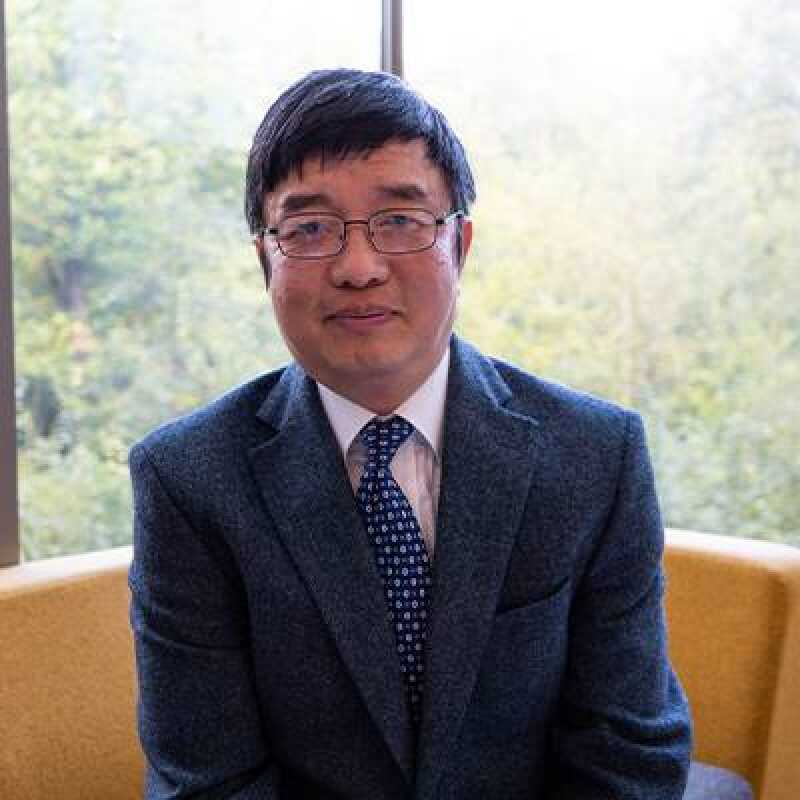
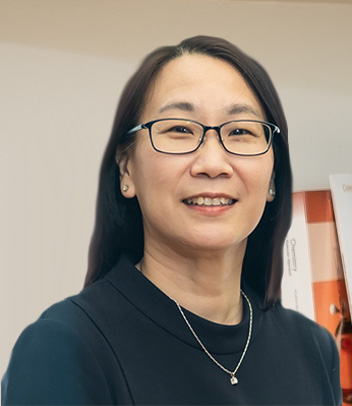
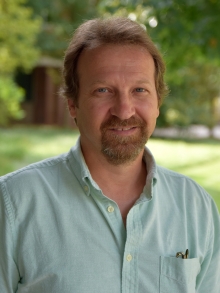
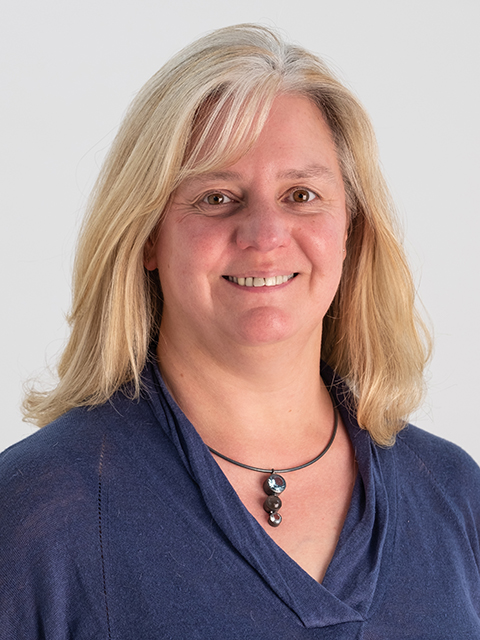
Jun Liu is an Assistant Professor in the Department of Mechanical and Aerospace Engineering at the School of Engineering and Applied Sciences, University at Buffalo. His research focuses on advanced energy materials, nano/micro-mechanics, and self-powered systems, with applications in triboelectric energy harvesting and scanning probe microscopy. Education: PhD, Materials Engineering, University of Alberta (2018) MS, Materials Science, Shanghai University (2015) BE, Materials Science and Engineering, Nanchang University (2012) Research Interests: Development of tribovoltaic and triboelectric systems for self-powered electronics Mechanical energy harvesting via dynamic heterojunctions and Schottky contacts 3D-printed hydrogel structures for energy absorption and flexible electronics Nanoscale characterization using atomic force microscopy Design of nanocomposite sensors and catalytic materials Publication Trends: His work emphasizes triboelectricity, nanoscale energy conversion, and sustainable materials. Recent articles explore bionic tactile sensing, tunable hydrogels, and quantum dynamics in sliding interfaces. Awards: SONY Faculty Innovation Award (2021) Nature Springer MINE Young Scientist Award (2020) International Contest of Applications in Nano/Micro Technology Prize (2013) Laboratory: Advanced Energy Materials and Nanomechanics Lab at University at Buffalo.
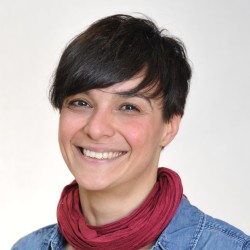
Isabella Guido is a Senior Lecturer in Experimental Soft Matter Physics at the University of Surrey's School of Mathematics and Physics. She holds a PhD from TU Berlin (2010) and has conducted postdoctoral research at Peking University and the Max Planck Institute for Dynamics and Self-Organization. Her research focuses on synthetic biology, active bioinspired systems, and microtubule-motor protein dynamics. Guido's work bridges active matter physics and synthetic biology, aiming to develop minimal systems mimicking natural cellular structures. Key projects include synthetic beating structures resembling cilia, 3D active nematics, and investigations into cellular symmetry breaking via biomimetic systems. Her education includes a PhD on dielectrophoretic effects in mammalian cells, followed by postdoctoral studies on cell mechanics, microfluidics, and electroporation. Guido's interdisciplinary approach combines experimental biophysics with synthetic biology to uncover principles governing living matter. She leads the Synthetic Active Systems group and collaborates internationally on projects such as light-powered artificial cells and motor-driven microtubule networks. Her work addresses sustainable development goals through bio-inspired material design and active matter applications. Publications highlight contributions to electrotaxis mechanisms, live-cell imaging techniques (e.g., MIET), and microtubule network dynamics under depletion forces. Guido's research has advanced understanding of ciliary beating patterns, synthetic axoneme models, and biopolymer self-organization under mechanical stress.
Dr. Igor V. Pivkin is a Full Professor at the Institute of Computing within the Faculty of Informatics at the Università della Svizzera italiana (USI) in Lugano, Switzerland. His academic journey includes degrees from Novosibirsk State University (B.Sc./M.Sc. Mathematics), Brown University (M.Sc. Computer Science and Ph.D. Applied Mathematics), and postdoctoral research at MIT's Department of Materials Science and Engineering. His research focuses on multiscale/multiphysics modeling , numerical methods , and large-scale simulations of biological and physical systems. Key areas include biophysics, cellular/molecular biomechanics, stochastic modeling, and coarse-grained molecular simulations. He leverages high-performance computing (HPC) and particle-based methods to address complex biological phenomena. His work spans diverse applications, from understanding cellular mechanosensitivity and biofilm engineering to modeling cancer cell behavior and red blood cell dynamics in the spleen. His contributions bridge computational science, biotechnology, and biomedical research. He has published extensively in top-tier journals, with recent work advancing automated biofilm analysis, deep learning for microbial classification, and systems biology approaches to metal bioleaching. His lab collaborates on interdisciplinary projects, emphasizing computational innovation for real-world biological challenges.
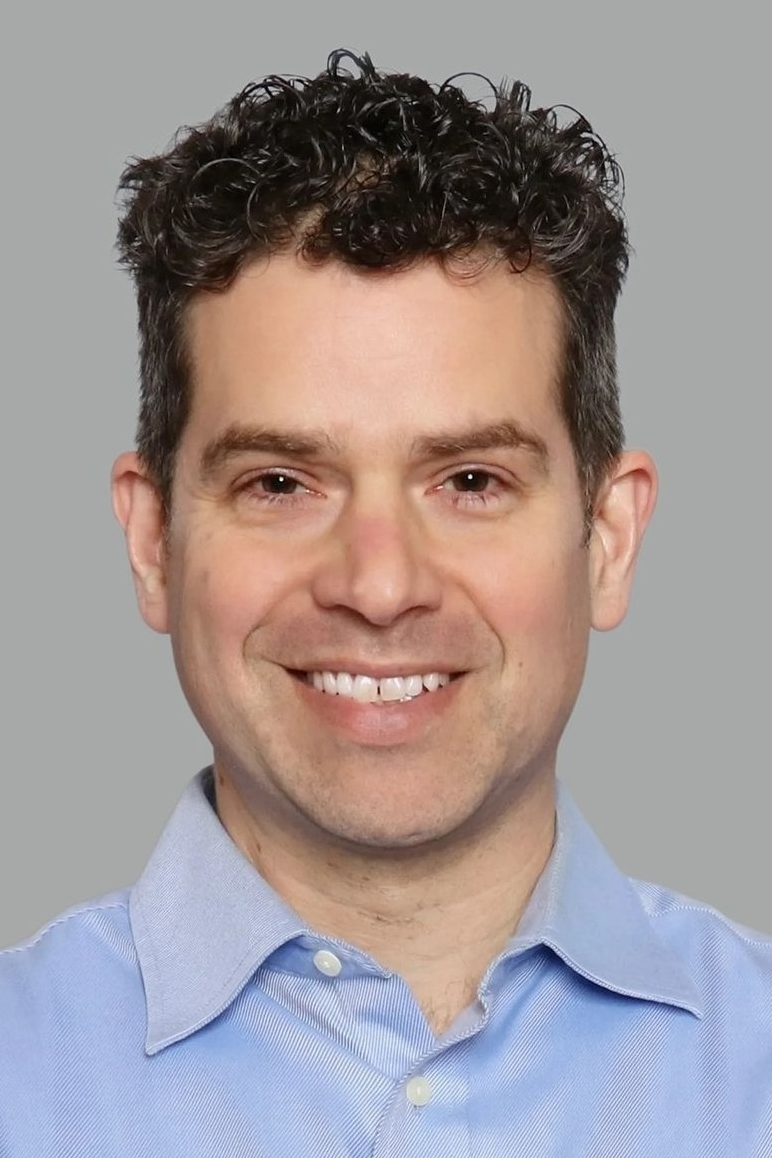
David Sivak is a Professor and Canada Research Chair Tier 2 in the Department of Physics at Simon Fraser University (SFU). His research focuses on theoretical and computational biophysics, exploring the physical limits of energy and information transduction in molecular machines. He investigates how biological systems operate efficiently under fluctuating conditions, with emphasis on molecular motors, free-energy transduction, and nonequilibrium thermodynamics. Education: Ph.D. in Biophysics, University of California, Berkeley B.A. in Philosophy, Politics & Economics, University of Oxford A.B. with Honors in Applied Mathematics, Harvard University Research Interests: Sivak's work integrates statistical mechanics, information theory, and molecular biophysics to understand how microscopic systems achieve functional efficiency. Key areas include: Optimal control strategies for nonequilibrium systems Energy-information trade-offs in molecular machines Stochastic thermodynamics of biochemical processes Design principles of ATP synthase and similar rotary motors Publications & Awards: Sivak has authored over 60 peer-reviewed articles, including foundational work on nonequilibrium fluctuation theorems and optimal control in stochastic systems. His awards include the Canada Research Chair and the Young Investigator Award from the Biophysical Society of Canada. Grants & Collaborations: He leads projects funded by the Simons Foundation and collaborates with experimental groups globally. His lab actively mentors graduate students and postdocs, emphasizing interdisciplinary approaches to biophysical problems. Labs & Teams: The Sivak Group at SFU develops theoretical models and numerical simulations to analyze molecular-scale processes. Current projects explore information engines, microbiome dynamics, and the thermodynamics of cellular processes.
Prof Aaron Thean is the Deputy President (Academic Affairs) and Provost at the National University of Singapore (NUS). Formerly, he served as Dean of the College of Design and Engineering at NUS and held senior roles at IMEC (Belgium) as Vice President of Logic Technologies and Director of Logic Devices Research. His expertise spans advanced semiconductor device technologies, including FinFETs, nanowire FETs, III-V/Ge channels, and emerging beyond-CMOS architectures. He holds degrees from the University of Illinois Urbana-Champaign (B.Sc., M.Sc., Ph.D. in Electrical Engineering) and has published over 300 papers with 50+ patents. His awards include the Gregory Stillman Award (2001) and Compound Semiconductor Innovation Award (2014). Research interests focus on semiconductor innovation, device-process co-optimization (DTCO), and monolithic 3D integration. Notable contributions include industry-first Gate-First HKMG technologies, advanced strained silicon platforms, and neuromorphic computing hardware. His work bridges academia and industry through collaborations with Qualcomm, IBM, and foundry partners. Current initiatives emphasize energy-efficient computing and wearable sensor systems. Prof Thean’s leadership spans NUS-wide academic strategy and global research partnerships. His technical legacy includes foundational advancements in transistor scaling, low-power CMOS design, and AI-driven failure analysis methodologies.
Karyn Moffatt is an Associate Professor in the School of Information Studies at McGill University and holds the Canada Research Chair in Inclusive Social Computing. As Graduate Program Director for the PhD program, she leads the Accessible Computing Technologies Research Group (ACT Lab), focusing on designing inclusive computing applications that support social engagement across diverse lifespans and abilities. Her work bridges human-computer interaction, accessibility research, and real-world community impact. Educational background: PhD in Computer Science, University of British Columbia MSc in Computer Science, University of British Columbia BASc in Computer Engineering, University of British Columbia Research Interests: Dr. Moffatt's work centers on inclusive social computing with emphases on aging populations , disability access , and intergenerational communication . She investigates how technology can overcome barriers to social participation through co-design methodologies, particularly for older adults and individuals with cognitive or physical disabilities. Current projects explore AI-enhanced aging support, dementia-friendly social platforms, accessible financial technology, and respite care coordination systems. Her approach integrates participatory design with rigorous usability testing to create solutions that address real-world challenges in healthcare, finance, and community engagement. Publication Trends: Analysis of her 15 most recent publications reveals consistent focus on aging and accessibility (60% of works), with growing emphasis on AI ethics (2025), dementia support systems (30% of 2023-2024 works), and accessible financial technology (2024). Methodologically, 75% employ co-design or participatory approaches, while 40% involve longitudinal field studies. Key venues include CHI (33%), ASSETS (20%), and ACM Transactions on Accessible Computing (27%), demonstrating leadership in top-tier HCI and accessibility forums. Scientific Awards: Multiple Best Paper Awards from ASSETS, CHI, and CSCW conferences Canada Research Chair in Inclusive Social Computing Advising and Grants: Dr. Moffatt currently supervises PhD candidates Chong Hu and Muhe Yang, having graduated four students since 2022 including Maurício Fontana De Vargas (2023) and Carrie Dai (2023). Her active grants include: NSERC Discovery Grant (2024-2029) as PI: Ethical AI for active aging Canada Research Chair renewal (2022-2027) as PI McGill Nursing Collaborative grant (2023-2025) as Co-I: iRespite mHealth app for palliative care Labs and Teams: She directs the ACT Lab, which partners with healthcare providers, public libraries, and community organizations to develop and deploy inclusive technologies. Current initiatives include the QuickPic AAC system for speech therapy, dementia-focused social programs with Montreal libraries, and Quebec-wide respite care coordination tools, all developed through interdisciplinary collaboration with clinicians, caregivers, and end-users.
Dr. Kanchana Thilakarathna is a Senior Lecturer in Distributed Computing at the University of Sydney's School of Computer Science, and a member of the Centre for Distributed and High Performance Computing. They hold a PhD from the University of New South Wales (UNSW) and a B.Sc. Eng (Hons) from the University of Moratuwa, Sri Lanka. Prior to academia, they worked as a Research Scientist at CSIRO/Data61 and had industry experience as a Mobile Radio Network Engineer. Research Interests : Dr. Thilakarathna focuses on cybersecurity, privacy in mobile and IoT systems, mixed reality privacy, and distributed computing platforms. Their work emphasizes user-centric solutions like the Yalut social media app, which enables decentralized data sharing. Key themes include privacy-preserving techniques, edge computing, and secure federated learning frameworks. Recent Work : Recent articles (2023–2025) explore machine unlearning for large language models, federated learning security, and IoT network slicing using P4 programmability. Their work on synthetic video traffic generation (VideoTrain++) and drone detection (DronePrint) demonstrates cross-disciplinary innovation. Awards : Malcolm Chaikin Prize (2015), Meta Research Awards (2020/2022), and Heidelberg Laureate Fellowship (2019). Grants : ARC Research Hub for Future Digital Manufacturing (2024), NSW Defence Innovation Network Projects (2024/2021), and Facebook Research Awards (2022/2020). Students : Advising 4 current PhD students on topics like wireless trust establishment and machine unlearning. Labs/Teams : Part of the Centre for Distributed and High Performance Computing and Sydney Nano Institute.
Leonardo Chamorro is a Professor in the Department of Mechanical Science and Engineering at the University of Illinois at Urbana-Champaign (UIUC), with affiliations in Earth Science and Environmental Change, Aerospace Engineering, and Civil and Environmental Engineering. His research focuses on fluid dynamics, renewable energy systems, and turbulence modeling. He holds a Ph.D. in Civil Engineering from the University of Minnesota (2010) and has held academic positions at UIUC since 2013, advancing to Full Professor in 2024. Chamorro's work spans experimental and theoretical investigations of wind and hydrokinetic energy, geophysical flows, and particle dynamics. His research group, the Renewable Energy & Turbulent Environment Group (RE-TE-G), explores topics like tidal flow multifractality, vortex dynamics, and bio-inspired robotics. Key achievements include Nature and Lab on a Chip cover articles, and contributions to turbulence modeling for tidal energy systems. He has received awards such as the Best Paper Award in Energies (2018) and recognition for pandemic-related research (2021). His editorial roles include associate editorships at journals like Journal of Renewable and Sustainable Energy and Frontiers in Energy Research . Chamorro has supervised numerous graduate students and postdocs, contributing to over 150 peer-reviewed publications since 2009.
Dr. Bimlesh Wadhwa is an Associate Professor in the Department of Computer Science at the National University of Singapore (NUS) and serves as Assistant Dean for Student Life at Tembusu College. She holds dual affiliations as a Residential Fellow at Tembusu College and an active member of the School of Computing's academic community. Her work bridges software engineering, human-computer interaction (HCI), and computing education. Dr. Wadhwa's research focuses on gender issues in HCI, software design quality, and digital well-being. She has pioneered initiatives like the Code for Community program to bring computing education to underserved groups. Her pedagogical contributions include developing courses on object-oriented design, software engineering principles, and interaction design. She actively engages with professional communities through roles such as Faculty Representative at the Singapore Computer Society Student Chapter and advisor to the Computing Club at NUS. Her recent work addresses pressing societal challenges like technology-facilitated sexual violence and integrates AI into educational contexts. She has organized major competitions including CodeXtreme and the Singapore Science and Engineering Fair, fostering innovation among students. Her interdisciplinary collaborations span healthcare applications, smart city technologies, and educational equity initiatives. Dr. Wadhwa’s scholarly contributions include over 80 publications in top venues such as FSE, CHI, and IEEE conferences. She has co-edited book chapters for Springer and Wiley on HCI and informatics, reflecting her commitment to advancing both technical and societal dimensions of computing. In addition to her academic roles, she leads MakerLab initiatives and contributes to national educational policies on computational thinking. Her work emphasizes bridging academia-industry gaps through projects like the GEAR mobile game-assisted rehabilitation system and cloud service brokerage frameworks.
Ana Damjanovic is an Assistant Research Professor in the Thomas C. Jenkins Department of Biophysics at Johns Hopkins University (JHU), affiliated with the Zanvyl Krieger School of Arts & Sciences. Her research focuses on ion channels, protein and membrane electrostatics, and computational biophysics. She holds a Ph.D. in Physics from the University of Illinois at Urbana-Champaign, where she studied quantum physics of photosynthetic light harvesting under Prof. Klaus Schulten. Subsequent postdoctoral research included work on photosynthesis with Prof. Graham Fleming at UC Berkeley, and molecular dynamics studies of protein ionization at JHU. Her current lab investigates ion channel mechanisms, protonation dynamics, and electrostatic effects in biological systems using advanced computational tools. Group members include graduate student Nauman Sultan (co-supervised with NIH's Bernard Brooks) and undergraduates Marianne Ri and Vivek Booshan. Past advisees include Ada Chen (now a NIH postdoc) and Maggie Li. Key research contributions include developing pH replica exchange methods, protein pKa prediction using machine learning, and structural-functional studies of voltage-gated sodium channels. Her work has been published in high-impact journals like Proceedings of the National Academy of Sciences and Biophysical Journal . Lab affiliations include the Computational Biophysics Group at JHU, with access to cutting-edge simulation techniques and experimental validation platforms. Ongoing projects explore ion channel selectivity, membrane protein dynamics, and computational modeling of protonation-dependent phenomena.
Professor Shaomin Wu is a faculty member at the University of Kent's Kent Business School, where he holds the academic rank of Professor of Business/Applied Statistics. He earned an MSc and PhD in applied statistics and has extensive industry experience, including a five-and-a-half-year stint at a global manufacturer in Shanghai before moving to the UK in 2001. He has held roles as a postdoctoral researcher and lecturer before joining Cranfield University and later the University of Kent. His research focuses on recurrent event data analysis, machine learning, and reliability mathematics, with funding from the EPSRC and ESRC. His research projects include managing risk in warranty servicing policies, smart data analytics for local government, and sustainable supply chain demand forecasting. He teaches modules such as risk analysis, reliability engineering, and machine learning. Currently supervising PhD students in time series forecasting, explainable AI, and recurrent event data analysis, he also serves as a co-chair of international conferences, editorial board member, and external examiner for doctoral degrees. Notably, he ranks among the top 2% of global scientists by Stanford University. His work integrates machine learning with business analytics, resilience engineering, and environmental sustainability. Key contributions include IoT-driven resilience methodologies for smart grids and unmanned systems, as well as frameworks for corporate carbon disclosure and maintenance optimization under uncertainty.
Ali Mani is an Associate Professor of Mechanical Engineering at Stanford University and a faculty affiliate at the Institute for Computational and Mathematical Engineering. He earned his PhD in Mechanical Engineering from Stanford in 2009, following an M.S. (2004) and B.S. (2002) from Stanford and Sharif University of Technology, respectively. His research focuses on fluid mechanics, turbulence, and numerical simulations, with applications in multiphase flows, electrokinetic systems, and applied mathematics. His group develops high-fidelity simulation tools and reduced-order models to understand transport processes in turbulent and chaotic systems. Research interests include turbulence modeling, two-phase flow dynamics, and electrochemical transport. Recent work explores eddy viscosity operators, nonlocal transport phenomena, and computational methods for multiphase systems. The group's studies often bridge experimental validation and numerical analysis to improve predictive engineering models. Key contributions span electrokinetic transport in porous media, superhydrophobic surface slip effects, and phase field modeling. His lab’s work is supported by grants focusing on fluid dynamics, renewable energy systems, and advanced simulation frameworks.
CHUA Lay-Lay is an Associate Professor in the Department of Chemistry at the National University of Singapore (NUS). She holds a joint professorship with the University of Cambridge and leads research in organic semiconductor materials. Her work focuses on polymer-based electronic materials and hybrid systems with graphene/SWCNTs for applications in LEDs, solar cells, and sensors. She has pioneered breakthroughs in multivalent anion-based electron donor materials and solution-processable organic electronics. Education: Ph.D., University of Cambridge (2007); B.Sc. Computational Chemistry, NUS (1995). Prior roles include Research Fellowships at NUS and Cavendish Lab, and industry experience at Bell Labs and Chartered Semiconductor. Research highlights include the 2019 Nature paper demonstrating multivalent anion electron donors, enabling air-stable low-work-function materials. Her group explores energy-level engineering and morphology-property relationships in organic electronics. Editorial roles: Associate editor of Journal of Materials Chemistry C . Awards include the NUS-Cambridge Dual Professorship (2008). Teaching: CM4254 Chemistry of Semiconductors (AY2022/2023). Laboratory affiliations: Organic Nano Device Laboratory (ONDL) focusing on plastic electronics innovation.
Dr. Rodney Weber is a Professor in the School of Earth & Atmospheric Sciences at Georgia Institute of Technology, part of the College of Sciences. His research focuses on atmospheric aerosols, urban air quality, and particle formation mechanisms. He holds a Ph.D. (1995) and M.S. (1991) in Mechanical Engineering from the University of Minnesota, and a B.S. (1987) from the University of Waterloo. Key research interests include atmospheric aerosol sources and processing, new particle formation via homogeneous nucleation, and aerosol growth processes. He develops novel instrumentation, such as the Particle Into Liquid Sampler (PILS), and leads field studies like the ALPACA project in Fairbanks, Alaska. His work bridges laboratory experiments and real-world atmospheric measurements. Dr. Weber has received awards including the Cullen-Peck Faculty Fellow Award (2007), Whitby Award (2005), and NASA Global Change Fellowship. His recent publications (2024–2025) address biomass burning plumes, urban pollution dynamics, and aerosol chemistry in cold climates. He collaborates on global initiatives like the NASA Atmospheric Tomography (ATom) mission and FIREX-AQ campaigns. His lab (ES&T 2107/2115) focuses on aerosol optical properties, reactive oxygen species in particulate matter, and the health effects of pollution. Research highlights include quantifying sulfur chemistry in Fairbanks and assessing oxidative potential of PM2.5 in urban environments.
Professor Joanna Bullard is a leading academic in Physical Geography at Loughborough University, specializing in aeolian processes, climate-landscape interactions, and dust dynamics. She holds adjunct roles at Griffith University, Australia, and has served in key leadership positions including Associate Dean (Teaching) and President of the International Society for Aeolian Research. Her work integrates field observations, remote sensing, and experimental methods to study dust emissions, microplastic transport, and environmental change in polar and arid regions. Bullard has received prestigious awards such as the EGU Ralph Alger Bagnold Medal (2021) and the Philip Leverhulme Prize (2004). Education: PhD from University of Sheffield Her research focuses on Arctic ecosystems, high-latitude dust pathways, and the geomorphic impacts of climate change. Recent work explores microplastic degradation via wind abrasion and the biogeochemical role of dust in Greenland’s lakes. Bullard’s teaching innovations include augmented reality tools for geomorphology education and crowd-sourced meteorological data projects. Awards: EGU Bagnold Medal, British Society for Geomorphology Fellowship, HEA Principal Fellowship Publications emphasize dust-climate feedbacks, aeolian sediment dynamics, and interdisciplinary methodologies. She leads international collaborations on dust cycle modeling and Arctic environmental monitoring.