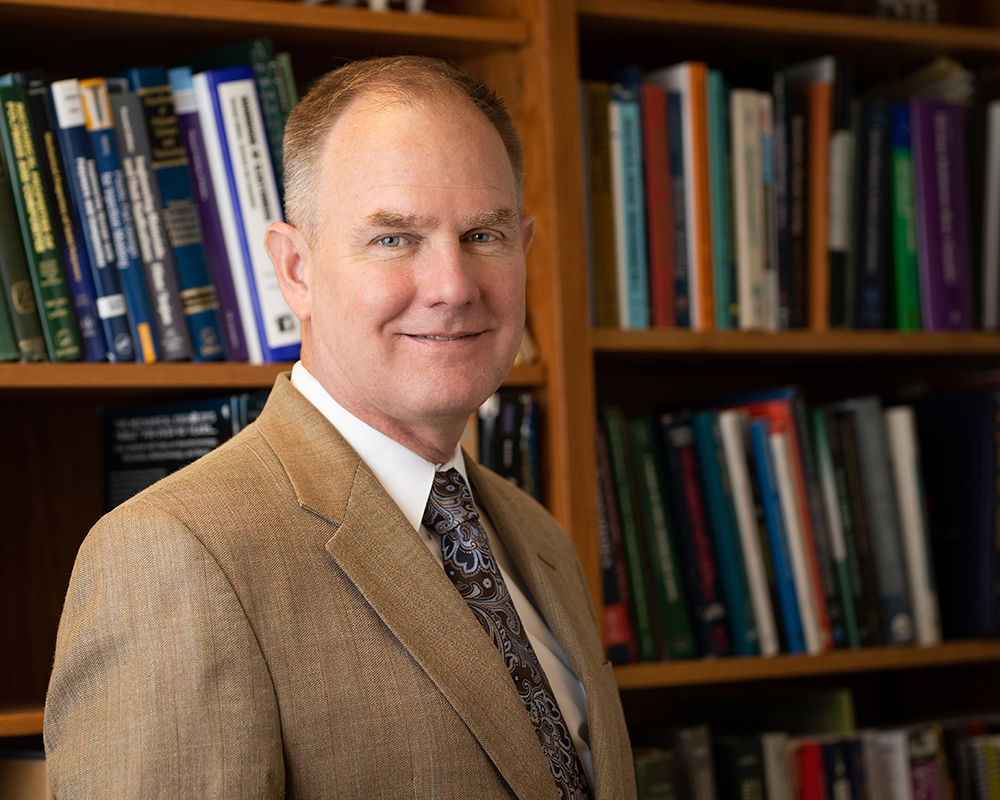
Prof. Dr. Heinz Bernhardt is a Full Professor at the Chair of Agricultural Systems Engineering at Technische Universität München (TUM), part of the TUM School of Life Sciences. His research focuses on technology integration in agricultural sciences, emphasizing precision agriculture, energy management, agricultural logistics, robotics, and sustainable farming systems. He holds a diploma in agricultural sciences from Justus Liebig University Giessen, a doctorate on bulk material transport in agricultural enterprises, and a habilitation on regulatory challenges in grain production. His career includes roles as Senior Lecturer at JLU Giessen and teaching positions at Kiel University before joining TUM in 2008. He leads research in smart farming, renewable energy integration, and IoT applications in agriculture. Notable projects include the CowEnergy energy management system and agrivoltaic systems for sustainable land use. Prof. Bernhardt’s publications highlight innovations in precision agriculture, livestock monitoring via AI, and sustainable energy solutions for farms. He is actively involved in industry collaborations and policy initiatives to advance agricultural technology through memberships in organizations like the Max Eyth Society and ASABE.
Yuanchang Xie serves as Professor in Civil and Environmental Engineering at UMass Lowell's Francis College of Engineering, where he leads research in the Center for Smart Cyber-Physical Systems. His work integrates computational methods with transportation infrastructure analysis, focusing on safety-critical applications through federal partnerships. Dr. Xie earned his Ph.D. in Civil Engineering from Texas A&M University (2007), preceded by M.S. and B.S. degrees in Transportation Engineering from Southeast University, China (2003, 2000). His academic foundation supports interdisciplinary research bridging civil engineering and cyber-physical systems. Research centers on traffic safety, intelligent transportation systems, and logistics optimization. He pioneers AI-driven approaches for crash prediction, connected vehicle operations, and infrastructure monitoring, emphasizing real-world implementation through partnerships with USDOT and state agencies. Current work explores multimodal data fusion for safety analytics in mixed-autonomy environments. Recent publications (2024-2025) reveal accelerating focus on deep learning applications: crosswalk detection via drone imagery, trajectory prediction in mixed traffic, and real-time work zone safety monitoring. This evolution demonstrates strategic alignment with emerging transportation technologies while maintaining core safety objectives. No scientific awards were explicitly documented in source materials. Dr. Xie has secured continuous funding as Principal Investigator through NSF, USDOT, DOE, and USDA programs. Key projects include Connected Vehicles: Toward the Understanding of "Firm Science" (NSF), Center of Multi-Scale Sensing Technologies (USDOT), and nuclear evacuation modeling for rural communities (USDA). His grants consistently address infrastructure resilience through cyber-physical integration. He directs research activities within UMass Lowell's Center for Smart Cyber-Physical Systems, which develops sensor networks and computational models for transportation infrastructure monitoring. The center's work on drone-based inspection systems and emergency response logistics demonstrates practical applications of his theoretical frameworks.
Dr. Tingjun Lei is an Assistant Professor at the University of North Dakota's School of Electrical Engineering and Computer Science (SEECS). With a Ph.D. in Electrical and Computer Engineering from Mississippi State University (2023), his research focuses on bio-inspired artificial intelligence , robotics and autonomous systems , and human-autonomy teaming (HAT) . Research Interests : Bio-inspired AI for robot cognition Multi-robot coordination and control Graph-based path planning algorithms Human-autonomy collaborative systems Intelligent transportation frameworks Recent Article Trends span robotics , bio-inspired computation , and machine learning , with specific focus areas in swarm intelligence , cognitive mapping , multi-agent safety , and adaptive navigation systems . Scientific Awards : 2025 Honorable Mentions (IJCNN 2025) 2025 Early Career Scholars Award (UND) 2024 Best Paper Awards (Biomimetic Intelligence & Robotics, ASEE ECE Division) 2022-2023 ECE Best Graduate Researcher (Mississippi State) Students : Ashwin Mukunda Devanga (Ph.D.), Samuel Steen (Ph.D.), and Justin London (Ph.D.)
Bradley Denby is an Assistant Professor in the Department of Aerospace & Ocean Engineering at Virginia Tech, holding the Marty and Anna Irvine AOE Faculty Fellow position. He specializes in cyber-physical systems, computational nanosatellite constellations, and machine learning for autonomy, with a focus on orbital edge computing. Denby leads the Starbelt Lab, focusing on advanced air mobility and satellite systems research. Education: PhD in Electrical and Computer Engineering, Carnegie Mellon University (20XX) MS in Computer Engineering, Air Force Institute of Technology (AFIT) BS in Physics, Southern Illinois University Research Interests: Denby’s work bridges computer science and aerospace engineering, addressing challenges in computational satellite systems, edge computing in space, and autonomous decision-making. His projects include batteryless satellites (Tartan Artibeus) and high-coverage nanosatellite constellations (EagleEye). He explores orbital edge computing frameworks to enable real-time data processing directly on satellites. Recent Research Trends: His publications emphasize scalable nanosatellite constellations, overcoming computational bottlenecks in space, and integrating machine learning for on-orbit inference. Themes include energy-efficient systems, inter-satellite communication, and mission-critical autonomy. Awards: Marty and Anna Irvine AOE Faculty Fellow (Virginia Tech) Teaching & Labs: Instructs courses on space engineering, satellite design, and advanced air mobility. Runs the Starbelt Lab (website/GitHub linked).
Dr. Fernando Vanegas Alvarez is a Lecturer at the School of Electrical Engineering and Robotics at Queensland University of Technology (QUT). He holds a M.Sc. in Electrical Engineering from Halmstad University and a PhD in Aerial Robotics from QUT. His research focuses on Drone Autonomy, UAV navigation in GNSS-denied environments, and AI-assisted remote sensing. Education: M.Sc. in Electrical Engineering, Halmstad University PhD in Aerial Robotics, QUT Research Interests: Dr. Vanegas' work emphasizes motion planning for UAV exploration , POMDP , SLAM , Visual Odometry , and AI-driven remote sensing applications . His projects include UAV frameworks for planetary exploration, invasive species mapping, and multi-UAV coordination in challenging environments. Scientific Awards: Advanced Queensland Industry Research Fellowship Grant (2024) Supervision & Grants: Dr. Vanegas has supervised three postgraduate students, including topics like planetary exploration UAV systems and multi-agent UAV search algorithms. He actively accepts new students for Honours, Masters, and PhD programs. His research is supported by grants and collaborations with the QUT Centre for Robotics. Teams & Affiliations: He is a core member of the QUT Centre for Robotics and contributes to the School of Electrical Engineering & Robotics. His work bridges robotics, AI, and environmental science.
Professor Jennifer Palmer is a leading academic in Aerospace Engineering at RMIT University, serving as Head of Department and Associate Dean. Her research focuses on autonomous systems, UAV propulsion, and urban environment operations. She previously led the Trusted Autonomous Systems (TAS) Defence CRC and held roles at the Defence Science and Technology Group (DSTG), emphasizing industry collaboration. Her career spans over 15 years in aerial autonomy and defense-related R&D, with expertise in hybrid power systems for UAVs and flapping flight mechanics. She has published extensively in top-tier journals across Aerospace, Mechanical, and Computer Science disciplines. Current projects include optimizing multimodal transport logistics and exploring fuel types for advanced propulsion systems. Professor Palmer’s work integrates academic research with practical defense and civilian applications, fostering innovation in autonomous technologies and robotic teaming strategies. She is open to supervising PhD and Masters students in aerospace engineering and related fields.
Dr. Avideh Zakhor is a Professor and Qualcomm Chair at the Department of Electrical Engineering and Computer Sciences (EECS) at the University of California, Berkeley. She is affiliated with several research centers including the Berkeley Artificial Intelligence Research Lab (BAIR), Berkeley Deep Drive Initiative, Video and Image Processing Lab, and Berkeley Center for New Media (BCNM). Her career spans over three decades with significant contributions to signal processing, 3D computer vision, robotics, and deep learning. 1983 B.Sc. in Electrical Engineering from Caltech 1985 S.M. in Electrical Engineering and Computer Science from MIT 1987 Ph.D. in Electrical Engineering and Computer Science from MIT Dr. Zakhor's research interests focus on 3D computer vision, autonomous systems and robotics, deep learning, and signal/image processing. Her work spans diverse areas including drone navigation, medical imaging analysis, indoor positioning, and building energy audits. She has led projects on drone-based 3D building reconstruction, legged robot locomotion, and melanoma detection using AI. The 15 most recent publications highlight her work in several key areas: person search pre-training techniques, drone-based indoor navigation and 3D modeling, medical image segmentation for melanoma detection, hexapod robot locomotion, and proximity detection for public health. These publications demonstrate her expertise at the intersection of computer vision, robotics, and AI applications. Dr. Zakhor has received numerous prestigious awards throughout her career: 2022 Winner of Phases 1 and 2, Department of Energy E-Robot Competition 2018 Electronic Imaging Scientist of the Year by SPIE 2004 Okawa Research Grant 2002 IEEE Fellow 1992 Office of Naval Research Young Investigator Award 1990 Presidential Young Investigator (PYI) Award from President George H.W. Bush 1990 Junior Faculty Development Award 1984-1988 Hertz Fellowship 1983 Henry Ford Engineering Award 1982-1983 General Motors Scholarship Dr. Zakhor has advised numerous research projects and has been involved in significant research grants. She has founded successful companies including Indoor Reality, which develops technologies for rapid 3D mapping and visualization of buildings and assets. She leads research initiatives in various cutting-edge technologies: Unmanned Aerial Vehicles (UAV) with focus on autonomy and obstacle avoidance, perception, path planning and control Deep learning applications in legged locomotion, unsupervised learning for multimodal sensors, misinformation detection, and learning-based image compression Wi-Fi proximity detection methods for contact tracing of diseases Temporal graphical neural networks for disease prediction Detection of small objects in ultra-high resolution images 3D reconstruction and recognition
Jane Cleland-Huang serves as the Frank M. Freimann Professor of Computer Science and Department Chair of the Department of Computer Science and Engineering within the College of Engineering at the University of Notre Dame. Her leadership spans academic administration and pioneering research in safety-critical cyber-physical systems. Her educational foundation includes a Ph.D. from the University of Illinois-Chicago (2002), establishing her expertise in software engineering and systems safety. This background directly informs her current research trajectory. Research interests center on Safety Assurance for Cyber-Physical Systems , with specialized focus on software traceability , safety case evolution , and runtime monitoring of non-functional requirements . Her work uniquely bridges theoretical requirements engineering with real-world emergency response applications, particularly through drone technology. Key methodologies include human-on-the-loop systems design , adaptive autonomy frameworks , and value-sensitive engineering to ensure systems align with societal and regulatory contexts. Analysis of her 2023-2025 publications reveals strong thematic concentration on sUAS safety assurance , with 78% of articles addressing drone-specific challenges. Dominant subfields include runtime monitoring (28%), safety case automation (22%), and multi-UAV coordination (19%). Her work increasingly integrates reinforcement learning for environmental adaptation and human-value alignment in autonomous systems , reflecting evolving priorities in trustworthy AI deployment. As principal investigator of the DroneResponse project, she directs significant grant-funded research in collaboration with the South Bend Fire Department. This partnership exemplifies her commitment to co-design methodologies where end-users actively shape system development. Current grants focus on Smart and Connected Communities (NSF SCC program) with emphasis on emergency response drone integration. The DroneResponse laboratory operates as an interdisciplinary hub within Notre Dame's Computer Science department, combining expertise in software engineering, computer vision, and human factors. Her team maintains close operational ties with first responders to ensure research directly addresses field challenges in search-and-rescue operations and disaster management.
Dr. Julie A. Adams is Professor of Computer Science in the School of Electrical Engineering and Computer Science and courtesy Professor of Mechanical Engineering and Industrial Engineering at Oregon State University, serving as Associate Director of Research in the Collaborative Robotics and Intelligent Systems Institute. She founded the Human-Machine Teaming Laboratory (HMTLab) at Vanderbilt University before relocating it to Oregon State, where she has led research in human-machine teaming for nearly thirty years. Dr. Adams received her M.S. and Ph.D. in Computer and Information Sciences from the University of Pennsylvania and her B.S. in Computer Science and B.B.E. in Accounting from Siena College. Her industry experience includes work on manned civilian/military aircraft at Honeywell, Inc. and commercial systems at Eastman Kodak Company. Her research focuses on distributed artificial intelligence, swarms, and human-machine teaming across domains including first response, archaeology, oceanography, national airspace, and military applications. The HMTLab develops capabilities for humans working with complex systems through two core research elements: human interaction with systems and distributed artificial intelligence for unmanned vehicles. Dr. Adams' work has been featured in National Geographic, Scientific American Podcast, Der Spiegel, and BBC online. She has received the NSF CAREER Award and served on the DARPA Computer Science Study Panel, while contributing to significant national reports on UUVs and UAV countermeasures. NSF CAREER Award recipient DARPA Computer Science Study Panel selection National Academies report contributor Army BAST report contributor FAA ASSURE Center of Excellence PI Dr. Adams has advised numerous doctoral and master's students across Vanderbilt and Oregon State, currently supervising multiple Ph.D. candidates. Her laboratory supports ten major research initiatives including swarm infrastructure development, resilient teaming systems, biologically inspired algorithms, and unmanned aerial/marine vehicle autonomy with applications in disaster response and military operations.
Maurice Fallon is a Professor of Engineering Science at the University of Oxford and a Royal Society University Research Fellow, leading the Dynamic Robot Systems Group (Perception) at the Oxford Robotics Institute. His research focuses on robust probabilistic methods for localization and mapping in challenging environments through advanced sensor fusion. Education: Electronic Engineering, University College Dublin PhD in Acoustic Source Tracking, University of Cambridge Research Interests: Dr. Fallon specializes in probabilistic state estimation , legged robot navigation , and dynamic motion planning for autonomous systems operating in vision-denied or complex natural environments. His work emphasizes robustness through multi-sensor integration , with applications spanning disaster response, forestry, and industrial inspection. Key innovations include terrain-aware locomotion and long-term autonomy frameworks. Publication Trends: Recent work (2024-2025) demonstrates a strategic shift toward forest robotics and long-term industrial inspection , leveraging legged and aerial platforms. There is strong emphasis on vision foundation models for place recognition, scalable 3D reconstruction using neural radiance fields, and open-vocabulary scene understanding . The research consistently addresses real-world challenges like lighting variations, sensor dropout, and environmental dynamics. Scientific Awards: Royal Society University Research Fellowship 4x Best Paper Awards at ICRA Nominations at Intelligent Vehicles, AAAI, and Humanoids conferences Advising and Grants: Dr. Fallon has secured major funding as PI/Co-I for EU/UK projects including ORCA, RAIN, THING, MEMMO, and the DARPA SubT-winning CERBERUS team. Current initiatives include the Horizon Europe DigiForest project and UKAEA collaborations. He mentors PhD students and postdocs in robotics systems development, though specific advisees aren't listed in source materials. Labs and Teams: He directs the Dynamic Robot Systems Group, which achieved global recognition through DARPA Robotics Challenge participation and SubT Challenge victory. The team operates specialized facilities for legged robot testing and maintains partnerships with nuclear energy and forestry sectors for field deployment.
Alex Thomasson is a professor and head of the Department of Agricultural and Biological Engineering at Mississippi State University (MSU), jointly administered by the College of Agriculture and Life Sciences and the Bagley College of Engineering. As the William and Sherry Berry Endowed Chair, he pioneered precision agriculture, remote sensing, and robotics, founding the nation’s first Agricultural Autonomy Institute. His work spans UAV-based phenotyping, robotic harvesting, and AI-driven nutrient management systems. Research Interests: Precision agriculture with emphasis on UAV-based monitoring Robotic systems for cotton harvesting and field automation Machine learning applications in crop stress detection Integration of air-ground sensing networks Scientific Awards: Elected member of the International Academy of Agricultural and Biosystems Engineering (IAABE) Held the William and Sherry Berry Endowed Chair Thomasson has mentored over 40 graduate and postdoctoral students, fostering global academic leadership in agricultural technology. His research drives sustainable yield optimization and production efficiency through advanced sensing and autonomous systems.
Dr. Sivakumar Rathinam is a Professor in the Department of Mechanical Engineering at Texas A&M University, affiliated with the College of Engineering and the Computer Science & Engineering department. He holds certifications as a Fellow of ASME (2021) and Senior Member of IEEE (2019). His research focuses on motion planning for autonomous vehicles, collaborative decision-making, combinatorial optimization, and vision-based control systems. He leads the Autonomy Lab, addressing challenges in multi-agent systems, path planning, and rural autonomous vehicle accessibility. Education: Ph.D., Civil Systems Engineering, University of California, Berkeley (2007) M.S., Electrical Engineering & Computer Science, UC Berkeley (2006) M.S., Mechanical Engineering, Texas A&M University (2001) B.Tech., Mechanical Engineering, Indian Institute of Technology Madras (1999) Research Highlights: Dr. Rathinam's work spans autonomous vehicle navigation, UAV coordination, and sensor fusion for adverse conditions. His lab develops algorithms for multi-agent pathfinding and persistent monitoring missions. Recent efforts include rural road detection datasets (R2D2) and thermal/LIDAR sensor fusion for safety in challenging environments. Awards: Outstanding Faculty Contribution Award (2021) Best Paper Runner-Up, ICAPS (2021) Teaching Excellence Award (2012) Labs & Teams: Directs the Autonomy Lab, collaborating with industry partners through the Mechanical Engineering Industry Advisory Council. Active in NSF-funded projects on equitable rural autonomy and multi-UAV recharging frameworks.
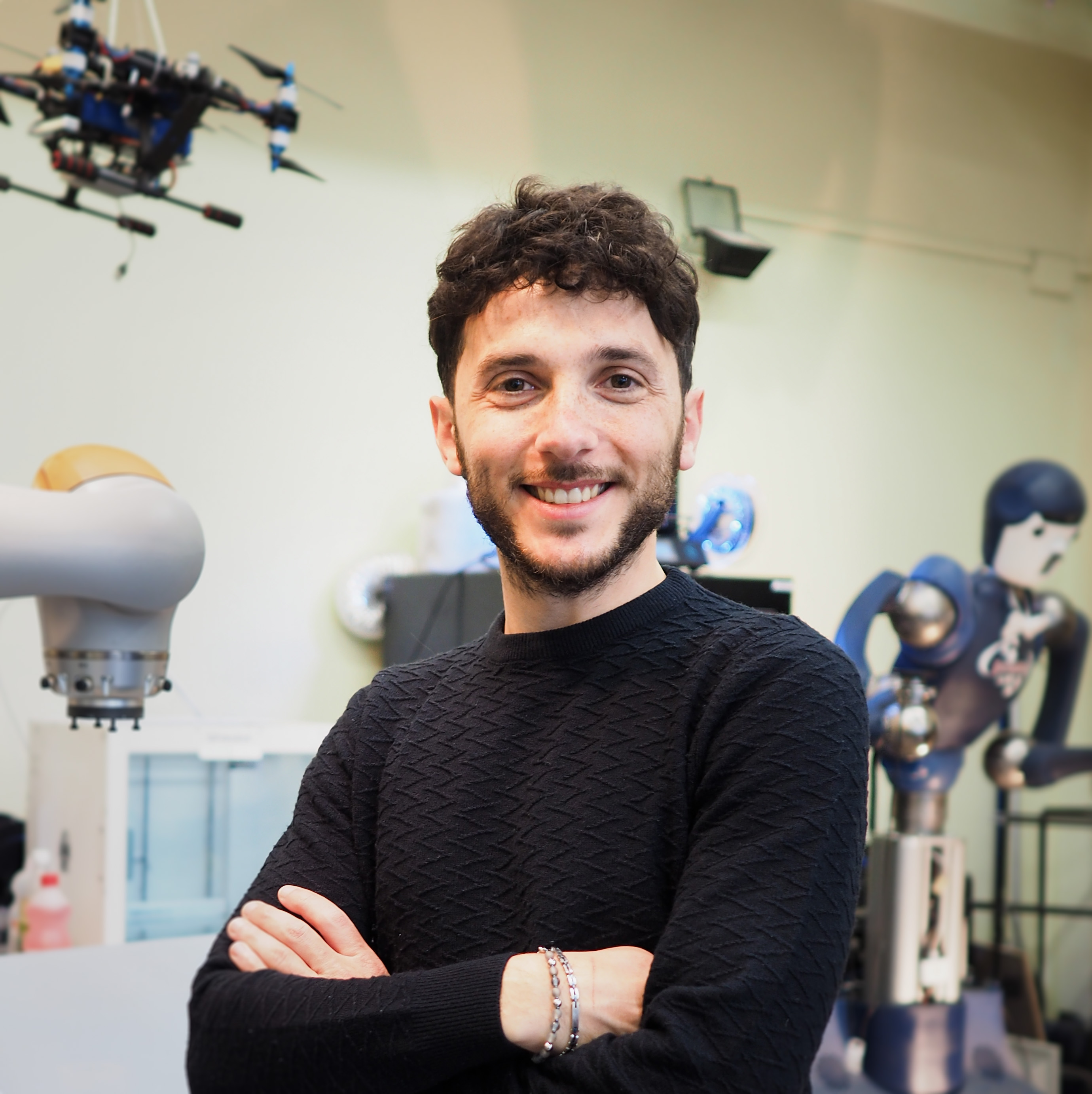
Mario Selvaggio is an Assistant Professor at the Department of Electrical Engineering and Information Technology, University of Naples Federico II. He actively contributes to robotics research through his involvement with PRISMA Lab and ICAROS , while co-founding spinoff companies BeyondShape and Herobots . His academic background includes a Ph.D. in Information Technology and Electrical Engineering (2020) under Prof. Bruno Siciliano, with previous degrees in Mechanical Engineering (2013, 2015). Ph.D. in Information Technology and Electrical Engineering (2020) Bachelor's and Master's in Mechanical Engineering (2013, 2015) His research interests focus on shared control/autonomy, robot teleoperation, passivity-based control, soft robotics, and robotic surgery. He has developed innovative solutions including: Shared-control teleoperation for soft growing robots Non-prehensile object transportation frameworks Advanced modeling of cable-suspended dual-arm systems Medical robotics with force-sensor equipped tools Virtual reality-based teleoperation architectures Recent publications (2021-2025) span topics from semi-autonomous aerial manipulation to cyber-physical measurement systems, with emphasis on human-robot interaction and industrial applications. He serves as Associate Editor for several IEEE conferences and journals. Scientific Awards IEEE RAS Technical Committee on Haptics grant ($2500, 2018) Second prize at Bioengineering Congress (2018) Finalist for 'Fabrizio Flacco' Best Paper Award (2020) Prof. Selvaggio teaches the Master's Course in Automation Engineering and Robotics (2024/2025) using Robot Operating System (ROS) curriculum. He actively collaborates with international research groups at IRISA/INRIA Rennes , Rainbow team , and University of California Santa Barbara (mechanical engineering department). His research combines theoretical advancements with practical implementations, demonstrated through extensive validation in simulated environments and real robotic platforms including KUKA LWR IIWA manipulators, dVRK systems, and humanoid platforms.
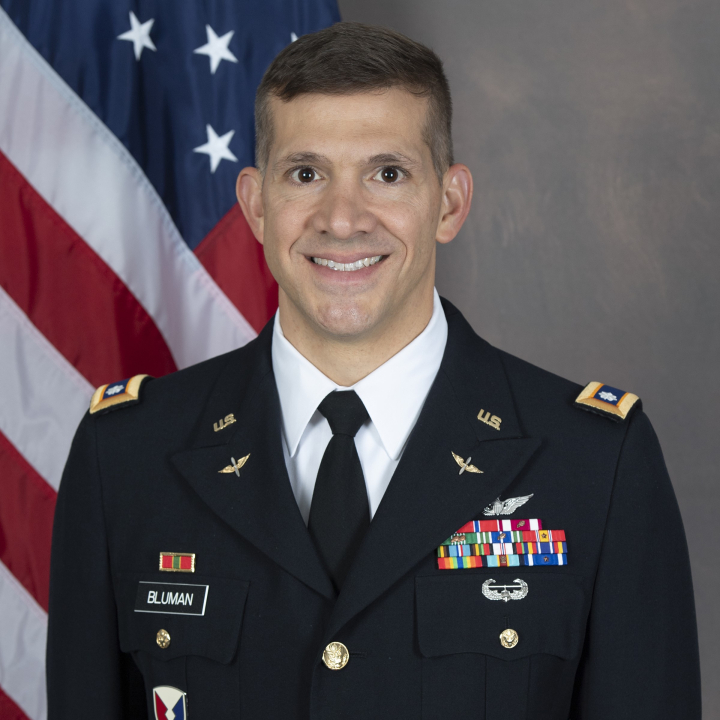
Colonel James E. Bluman, PhD, PE , serves as the Research Program Director for the Department of Mathematical Sciences at the United States Military Academy at West Point. Previously, he directed the Center for Innovation and Engineering and held an associate professorship in Civil and Mechanical Engineering at West Point. His Army career included operational roles as an Aviation Officer, Acquisition Corps officer with Level III DAWIA certification, and Assistant Product Manager for the Armed Scout Helicopter Project Office. Ph.D. in Mechanical Engineering - University of Alabama in Huntsville M.S. in Aerospace Engineering - Penn State B.S. in Mechanical Engineering - U.S. Military Academy His research focuses on robotics, military applications of small unmanned aerial systems (UAS), flapping wing micro-air vehicles, insect flight dynamics, drone autonomy, image classification, automated target recognition , and generative AI in undergraduate research . His recent publications emphasize algorithmic advancements for aerial search patterns, including Lissajous curves and deterministic flight planning. Scientific recognition includes the American Society of Mechanical Engineering’s Donald N. Zwiep Award for Innovation in Education and the USMA’s 2024 Dean’s Mid-Career Award for Scholarship Excellence .
Dr. Aditya Shrikhande is a Researcher at the University of Sheffield's School of Electrical and Electronic Engineering. His role focuses on enhancing the autonomy of swarms of UAVs through computer vision technologies. He is affiliated with the Amy Johnson Building in Sheffield, S1 3JD. Research interests center on advanced robotics, swarm coordination, and computer vision applications in autonomous systems. Despite no explicitly listed publications or awards, his work contributes to cutting-edge developments in UAV autonomy and swarm intelligence. No grants, advising details, or lab affiliations are detailed in the provided text.