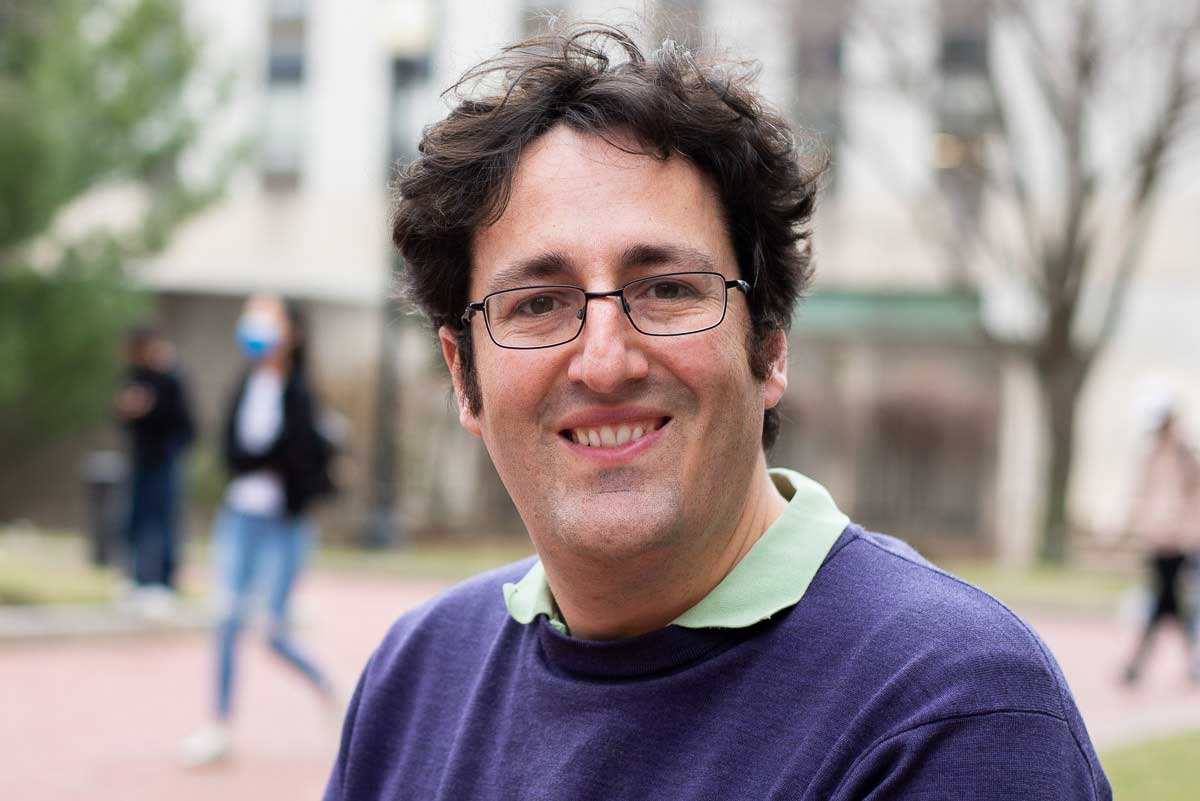
Dr. Haoran Ren is a Research Fellow at Macquarie University and currently serves as an ARC DECRA Fellow at Monash University . His research focuses on Nanophotonics , with expertise in metasurfaces, orbital angular momentum, and holography. Education : PhD in Optics from Swinburne University of Technology (2013-2017). Dr. Ren's work explores advanced optical materials and nanotechnology for fundamental light-matter interactions and photonic applications. His research outputs include breakthroughs in orbital angular momentum holography, metasurface design, and chip-scale light manipulation. Scientific Awards include the Chinese Government Prize (2016), OSA Foundation Travel Grant (2015), Victoria Fellowship (2018), Humboldt Fellowship (2019), and major fellowships from Macquarie University and ARC . Dr. Ren has secured significant grants, including the ARC DP ($350k), ARC DECRA ($434k), and Macquarie Research Infrastructure Schemes . He is an Associate Investigator for the ARC Centre of Excellence for Transformative Meta-Optical Systems (TMOS) and actively contributes to scientific communities as an editor, reviewer, and seminar organizer.
Xavier BULTEL is a Lecturer at INSA Centre Val de Loire, affiliated with the Computer Science Department. His research focuses on cryptography, data privacy, and secure communication protocols. Email: xavier.bultel@insa-cvl.fr Research Interests: Xavier specializes in cryptographic protocols for anonymity, zero-knowledge proofs, and secure multi-party computation. His work addresses privacy-preserving mechanisms in mobile networks, trick-taking games, and physical ring signatures. Recent Contributions: His publications from 2021-2024 highlight advancements in sanitizable signatures, plaintext equality proofs, and cryptographic games. Key keywords include Cryptography, Cybersecurity, and Secure Communication.
Sona Alex serves as a Postdoctoral fellow within the Department of Information Security and Communication Technology at the Norwegian University of Science and Technology (NTNU), focusing on advanced cryptographic research and security protocol development. Her research portfolio centers on: Structural vulnerabilities in encryption systems Matrix-based randomization techniques for data protection Algorithmic modifications to enhance cryptographic resilience Security evaluation of novel encryption frameworks Current work exemplifies her expertise through critical analysis of the v-MORE scheme, where she identifies theoretical weaknesses and implements practical countermeasures to strengthen encryption integrity. This research directly addresses evolving threats in secure communications infrastructure. While no student supervision or grant activities are documented in available materials, her presentation at DBSec 2025 demonstrates active engagement with the international cybersecurity research community. Laboratory affiliations and collaborative teams remain unspecified in current public records.
Stig Frode Mjølsnes serves as a Professor in the Department of Information Security and Communication Technology within the Faculty of Information Technology and Electrical Engineering at the Norwegian University of Science and Technology (NTNU). His research spans mobile network security, cryptographic protocols, and privacy engineering, with particular focus on vulnerabilities in LTE/4G systems and subscriber identification mechanisms. His office is located at Elektro B, B219, Gløshaugen, OS Bragstads plass 2, and he maintains active research collaborations internationally. Professor Mjølsnes' research interests center on mobile network security with emphasis on privacy exposure in cellular systems, cryptographic protocol design, and security education. His work has systematically exposed critical vulnerabilities in LTE paging mechanisms that enable IMSI catchers and subscriber tracking, while developing practical countermeasures through privacy-preserving identification protocols. He bridges theoretical cryptography with real-world implementation challenges, particularly in wireless communication systems where security flaws have immediate practical consequences. His research methodology combines formal protocol analysis with experimental network security testing. His publication record demonstrates consistent focus on mobile network privacy vulnerabilities, particularly in LTE systems, where his team has documented low-cost attack methodologies accessible even to non-programmers. The research trajectory shows evolution from foundational cryptographic work toward applied security testing frameworks that have influenced both academic understanding and practical security implementations in mobile networks. His contributions include developing educational tools for security experimentation and analyzing cryptographic weaknesses in voting systems. Professor Mjølsnes actively contributes to the academic community through conference organization, particularly the Norwegian ICT Conference for Research and Education (NISK), where he has served as program chair. His editorial work includes prefaces for major security conference proceedings published by Springer in the Lecture Notes in Computer Science series. He has also contributed to security standardization discussions through technical reports and government consultations. His teaching philosophy emphasizes hands-on security education, as evidenced by publications on security laboratory didactics and mobile network security experimentation frameworks. He has developed practical educational approaches for teaching information security through software laboratories and web security exercises, focusing on bridging theoretical knowledge with practical implementation skills.
Kazys Kazlauskas is an Affiliated Scientist at the Image and Signal Analysis Group of the Vilnius University Institute of Data Science and Digital Technologies . His research focuses on Digital Signal Processing , Cryptography , and System Identification , with significant contributions to spectrum estimation , deadzone compensation , and key-dependent S-box generation in encryption systems. Research Trends : His work spans Wiener systems , nonlinear modeling , frequency analysis , and noise reduction , particularly in block cipher systems and adaptive control . Collaborations : Frequent collaborator with Rimantas Pupeikis , Gytis Vaicekauskas , and Robert Smalius , especially in cryptography and signal processing applications. Grants & Projects : No explicit grants are listed, but his involvement in publications suggests participation in institutional research initiatives at Vilnius University.
Morten Øygarden is a Postdoctoral Fellow in the Department of Cryptography at Simula UiB, a joint research initiative between Simula Research Laboratory and the University of Bergen. His work bridges theoretical cryptography and practical security analysis within Norway's premier cryptographic research environment. His educational background culminates in a 2021 PhD from the University of Bergen with the thesis "Algebraic Cryptanalysis of Cryptographic Schemes with Extension Field Structure", establishing his expertise in algebraic methods for cryptanalysis. Øygarden's research focuses on Algebraic Cryptanalysis , Post-Quantum Cryptography , and Symmetric Cryptography , specializing in vulnerabilities of multivariate systems, code-based schemes, and ring-based primitives. He develops novel Gröbner basis techniques to break cryptographic assumptions underlying quantum-resistant candidates, with direct implications for NIST standardization processes. Analysis of his 2020-2024 publications reveals consistent innovation in algebraic attack methodologies, particularly against arithmetization-oriented primitives for zero-knowledge proofs and MPC-friendly ciphers. His work demonstrates exceptional depth in exploiting mathematical structures of symmetric primitives while advancing post-quantum security evaluations of multivariate and code-based systems. His publication record in top venues including CRYPTO, EUROCRYPT, and the Journal of Cryptology reflects significant contributions to cryptographic science, though specific awards or grant details are not documented in available sources.
Håvard Raddum serves as Chief Research Scientist in the Department of Cryptography at Simula UiB, a joint research entity of Simula Research Laboratory and the University of Bergen. His primary focus involves advancing cryptographic security through algorithm analysis, Fully Homomorphic Encryption applications, and hardware-level attack mitigation. Raddum's research spans cryptography with specialization in security analysis of cryptographic algorithms, practical deployment of Fully Homomorphic Encryption, and physical attacks on hardware implementations. His work addresses vulnerabilities in symmetric ciphers, multivariate schemes, and lattice-based systems through algebraic cryptanalysis, side-channel techniques, and theoretical security proofs. Analysis of his 2019-2025 publications reveals concentrated expertise in cryptanalysis across diverse primitives. Key trends include algebraic attacks on arithmetization-oriented cryptography, side-channel analysis of lightweight ciphers, error detection in lattice computations, and security evaluations of Fully Homomorphic Encryption. His research consistently bridges theoretical frameworks with practical implementation vulnerabilities.
Dr. Matluba Khodjaeva is an Associate Professor in the Department of Mathematics and Computer Science at John Jay College of Criminal Justice, City University of New York (CUNY). She is also a Graduate Faculty member in the Digital Forensics and Cyber Security program at John Jay and a Doctoral Faculty member in Computer Science at the CUNY Graduate Center. Her academic career is dedicated to advancing research in cryptography and training the next generation of cybersecurity professionals. Her educational background includes: Ph.D. in Computer Science / Cryptography from The Graduate Center, CUNY (2017) M.Phil. in Computer Science from The Graduate Center, CUNY (2017) M.S. in Computer Science from City College of New York, CUNY (2017) M.A. in Mathematics from Hunter College, CUNY (2011) B.A. in Mathematics from Hunter College, CUNY (2011) Dr. Khodjaeva's research focuses on cryptography, particularly secure outsourcing of computations to the cloud and the design of efficient cryptographic protocols for resource-constrained devices like RFID tags and embedded systems. Her work bridges theoretical security with practical applications, ensuring sensitive data protection in environments with limited computational power. She has made significant contributions to delegated computation, enabling secure and efficient offloading of cryptographic operations to cloud servers. Her recent publications (2018-2024) demonstrate a consistent focus on delegated computation, with an emphasis on pairing-based cryptography, RSA operations, and lattice-based schemes for post-quantum security. The research trends show increasing attention to practical implementations for IoT and cloud environments, with a strong emphasis on efficiency and security against malicious servers. Dr. Khodjaeva has received notable recognition for her scholarly work: Best Paper Award in Journal of Mobile Multimedia (2020) Second-Best Paper Award at the 4th Workshop on CPS&IoT Security and Privacy (2022) As an active researcher, Dr. Khodjaeva has secured multiple competitive grants to support her work. She has been the Principal Investigator (PI) for eight consecutive PSC-CUNY research grants from 2019 to 2026, totaling over $48,000, and served as Co-PI on a $299,993 NSF SaTC grant. Her grant portfolio reflects a sustained research program in secure delegated computation. In addition to her research, she is deeply committed to student mentorship through undergraduate and graduate courses, independent studies, and research projects in cryptography and cybersecurity. Although Dr. Khodjaeva does not lead a named research laboratory, she collaborates extensively with researchers including G. Di Crescenzo, D. Kahrobaei, and V. Shpilrain. Her research group consists of students and collaborators working on cutting-edge problems in cryptography, with opportunities for students to engage in funded projects and co-author publications.
Daniel Wichs is a tenured Professor at the Khoury College of Computer Sciences at Northeastern University in Boston. He is a prominent researcher in the field of cryptography and serves as a Senior Scientist at NTT Research. His academic journey includes a PhD from New York University under Yevgeniy Dodis, a postdoctoral fellowship at IBM Research T.J. Watson, and degrees from Stanford University. Current Position: Professor at Northeastern University Prior Positions: IBM Josef Raviv Memorial Postdoctoral Fellow (2011-2013) Education: PhD NYU (2011), BS/MS Stanford (2005) Professor Wichs specializes in cryptography with research interests spanning computing on encrypted data, program obfuscation, lattice-based cryptography, information-theoretic cryptography, and foundational aspects of cryptography. He also maintains broad interests in computer security, algorithms, complexity theory, coding theory, and information theory. His research group includes current PhD students Manu Kondapaneni, LaKyah Tyner, and Ethan Mook, along with numerous successful alumni who have become professors at institutions worldwide. His recent publications demonstrate a strong focus on advanced cryptographic primitives including homomorphic encryption, zero-knowledge proofs, private information retrieval, and functional encryption. These works frequently appear at top-tier conferences like STOC, FOCS, CRYPTO, and EUROCRYPT, with several receiving best paper awards. His research often bridges theoretical foundations with practical applications in privacy-preserving computation. Best Paper at STOC 2023 Alfred P. Sloan Research Fellowship (2018) NSF CAREER Award (2018) J.P. Morgan Faculty Research Award (2022) IBM Postdoctoral Fellowship (2011-2013) Professor Wichs actively contributes to the academic community through service as Area Chair for CRYPTO 2025 and EUROCRYPT 2024, Program Chair for ITC 2020, General Chair for STOC 2016, and membership on numerous program committees. He teaches advanced courses including Foundations of Cryptography (CS 7810) and Theory of Computation (CS 3800), and has organized events like the Charles River Crypto Day and the Simons Summer Program in Cryptography 2025. His research group operates at the forefront of cryptographic theory, addressing fundamental questions about secure computation on encrypted data while developing practical cryptographic tools for real-world applications.
Dr. Sandjai Bhulai is a Researcher at Centrum Wiskunde & Informatica (CWI) in Amsterdam, The Netherlands, and affiliated with Vrije Universiteit Amsterdam. He works in the Stochastics department within the Faculty of Science, focusing on applying machine learning and optimization techniques to solve complex real-world problems across diverse domains including telecommunications, mental health crisis intervention, and operations research. His research spans multiple critical areas of applied mathematics and computer science: Development of novel machine learning evaluation frameworks (Dutch Draw, Dutch Scaler) Optimization algorithms for facility location and supply chain problems Telecommunications signal processing using deep learning Mental health applications, particularly suicide prevention helpline analysis Natural language processing for conversation analysis in crisis intervention Dr. Bhulai's recent work demonstrates exceptional interdisciplinary impact. His Dutch Draw framework provides a universal baseline for binary classification problems that has been adopted across multiple research communities. His mental health research has directly influenced suicide prevention practices through machine learning analysis of helpline conversations, identifying specific counselor interventions that improve outcomes. In telecommunications, he's developed neural network approaches that simultaneously handle multiple modulation schemes, improving efficiency in wireless communications. His scientific contributions appear in leading venues including: Computers and Operations Research Journal of Classification IEEE Open Journal of the Communications Society JMIR Mental Health Journal of Applied Probability Dr. Bhulai maintains strong collaborative relationships with researchers across institutions, particularly with Rob van der Mei at CWI. He has secured funding for impactful projects including the collaboration between Stichting 113 Suicide Prevention and CWI, which applies machine learning to improve crisis intervention services. His work exemplifies how theoretical advances in machine learning can address critical societal challenges.
Christoph Baxa is an Associate Professor in the Department of Mathematics at the University of Vienna, where he has been a faculty member since 2000. His academic career at the University of Vienna began in 1990 as an Assistant Professor in the Department of Statistics, then moved to the Department of Mathematics in 1992, where he was promoted to Associate Professor in 2000. He maintains an active research profile and teaching load, with courses scheduled through 2025. Dr. Baxa completed his academic training at the University of Vienna, earning his M.A. in 1990 with a thesis on prime representing functions and Hilbert's Tenth Problem, his Ph.D. in 1994 on the discrepancy of sequences (nα), and his Habilitation in 2000 on estimates for discrepancies of special uniformly distributed sequences. His research focuses on Number Theory, particularly Uniform Distribution Theory, Discrepancy Theory, Continued Fractions, and Diophantine Approximation. His work often connects number theory with mathematical logic, as evidenced by his early research on Diophantine representations. His recent scholarly activity is dominated by book reviews for Monatsh. Math., covering diverse areas including algebraic geometry, number theory, history of mathematics, and mathematical education. Dr. Baxa has received several prestigious awards including the Ph.D. sub auspiciis Praesidentis rei publicae, the Würdigungspreis from the Austrian Ministry of Science and Research, the Jubiläums-Studienpreis from the Austrian Mathematical Society, and the Edmund und Rosa Hlawka Preis from the Austrian Academy of Sciences. He has held research grants from the Austrian Science Fund and was an Erwin Schrödinger Fellow at the University of Colorado at Boulder from 2001-2003. As a professional service, he has been a regular reviewer for Mathematical Reviews since 1996 and reviews books for Monatsh. Math. He is a member of numerous mathematical societies including the AMS, DMV, EMS, LMS, ÖMG, and SMF.