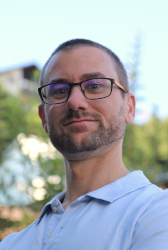
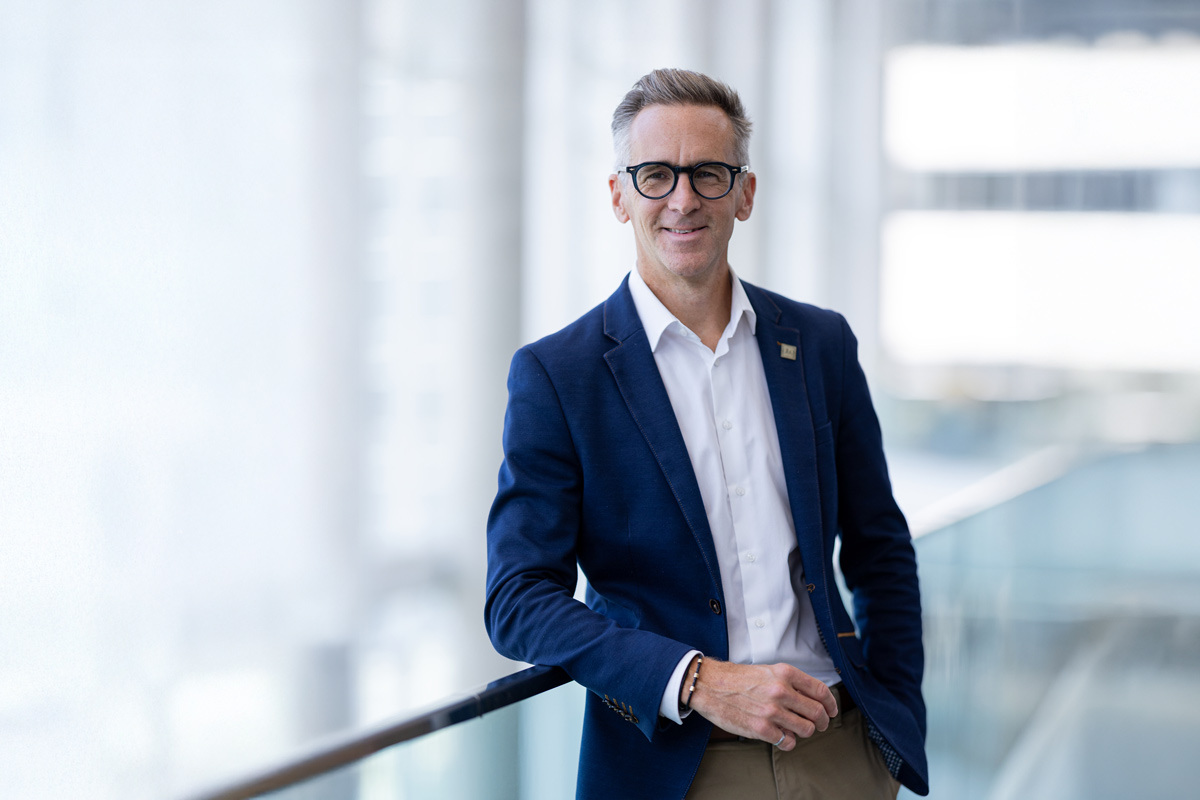
Reto Achermann is an Assistant Professor in the Department of Computer Science at the University of British Columbia (UBC), affiliated with the Systopia Lab. His research focuses on resilient and efficient systems at the intersection of operating systems, applied formal methods, and hardware models. He holds a PhD from ETH Zurich and previously served as a Postdoctoral Research Fellow at UBC under Prof. Margo Seltzer. Education: PhD in Computer Science from ETH Zurich (advised by Prof. Timothy Roscoe), MSc in Computer Science from ETH Zurich. Research interests include memory and storage systems, formal verification, device drivers, and software synthesis. He contributed to the Barrelfish OS project, particularly in memory management and hardware abstractions. Key achievements: Won distinguished artifact awards at ASPLOS'25 and SOSP'24 for 'Velosiraptor' and 'Verus'. Received UBC's Faculty of Science Excellence in Service Award for educational contributions. Served on program committees for ASPLOS, PLDI, EuroSys, and USENIX ATC. Current roles: Actively supervises graduate students in thesis-based MSc/PhD programs. Engages in interdisciplinary research and collaborates on grants. Previously advised undergraduate research projects and directed studies.
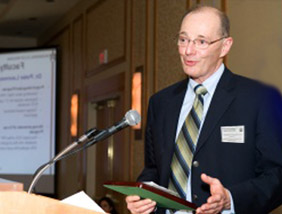
Professor Peter D. Lawrence holds a faculty position at the University of British Columbia (UBC) within the Department of Electrical & Computer Engineering, part of the Faculty of Applied Science. He has been a Professor since 1974 and has held visiting research roles at Chalmers University of Technology (1970-1972) and MIT (1972-1974). His educational background includes a B.A.Sc. from the University of Toronto (1965), M.Sc. from the University of Saskatchewan (1967), and Ph.D. from Case Western Reserve University (1970). He is a Professional Engineer (P.Eng.) and Fellow of the Canadian Academy of Engineering (FCAE). Research interests focus on improving human-machine interfaces, sensor technologies for control systems, and medical robotics. Key areas include teleoperation of heavy machinery, vision-based control, EEG-based brain interfaces, and functional approximation methods for complex systems. Collaborations span multiple disciplines at UBC, including Mechanical Engineering, Computer Science, Mining Engineering, and Forestry, with funding from NSERC and PRECARN/IRIS. Medical Robotics: Brain-computer interfaces and ultrasound-guided surgery. Autonomous Systems: Path planning and vision-based tracking for excavators and haul trucks. Sensing Technologies: Eye-tracking, joint-angle sensors, and slip detection for mobile robots. His teaching contributions include coordinating the Project Integrated Program (PIP) for ECE students and co-developing the interdisciplinary New Venture Design course with the Sauder School of Business. He leads the RCL Lab and has authored books on real-time microcomputer systems and contributed to IEEE publications. Awards include recognition as a Fellow of the Canadian Academy of Engineering.
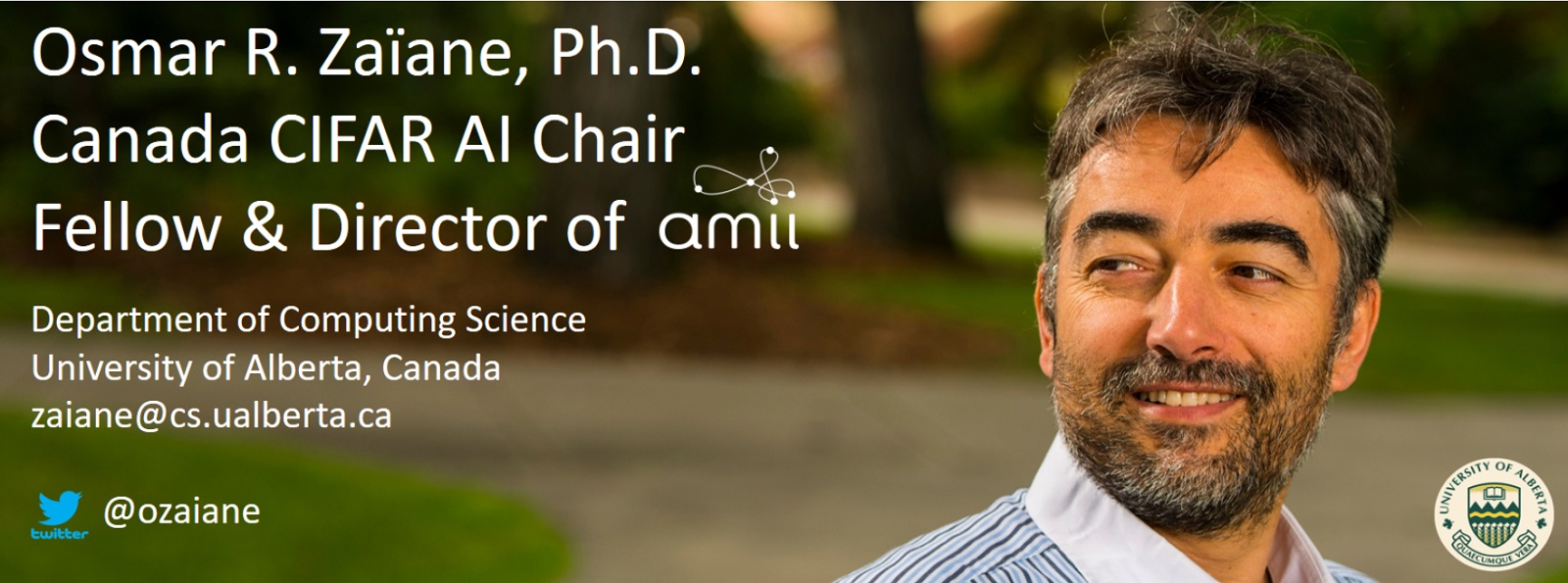
Osmar Zaiane is a Professor in the Department of Computing Science at the University of Alberta's Faculty of Science. With over 20 years of service at the university, he has established himself as a leading researcher in data mining and machine learning with applications across multiple domains. His educational background includes a Ph.D. in Computer Science from Simon Fraser University (1999), a Master's in Computer Science from Laval University (1992), a Master's in Electronics from Institut National des Sciences et Techniques Nucléaires and Paris XI University (1989), and a Bachelor's in Computing Science from Institut Supérieur de Gestion, Université de Tunis (1988). Zaiane's research focuses on discovering patterns in large complex datasets with practical applications. His primary research interests include data mining, machine learning, social network analysis (particularly community mining and link prediction), and precision health applications. He has made significant contributions to associative classifiers, class imbalance learning, explainable AI, and educational data mining. His work spans multiple application domains including healthcare (particularly for Alzheimer's disease prediction, diabetic retinopathy grading, and lung cancer detection), social media analysis, and natural language processing. His publication record shows a strong focus on medical AI applications, with numerous recent papers on medical image segmentation, brain network analysis, and diagnostic systems. His work increasingly integrates large language models and transformer architectures with traditional machine learning approaches. Best Paper Award at IEEE/ACM Int. Conf. on Advances in Social Network Analysis and Mining (2023) Best Paper Award at International Symposium on Foundations and Applications of Big Data Analytics (2022) Best Paper Award at International AAAI Conference on Web and Social Media (2019) Best Paper Award at 29th International Conference on Database and Expert Systems Applications (DEXA) (2018) Zaiane has supervised over 80 graduate students during his career at the University of Alberta. His research has been supported by numerous grants, particularly in the areas of precision health and educational data mining. He maintains an active research lab focusing on applied machine learning with strong industry and healthcare partnerships. His current work explores the intersection of traditional machine learning techniques with emerging large language models and vision-language models for healthcare applications.
Dr. Laurie Sykes Tottenham serves as Professor of Psychology and Assistant Dean at the University of Regina, Canada. With over two decades of academic experience since her 2003 debut publication, she maintains active research leadership while fulfilling significant administrative responsibilities within the Faculty of Arts. Her educational foundation includes: BA (Honours) in Psychology, University of Regina PhD in Psychology, University of Saskatchewan Dr. Sykes Tottenham's research program uniquely bridges neuropsychology and women's health. Early work established her expertise in laterality and pseudoneglect, examining spatial cognition through line bisection tasks and collision biases. Since 2016, her focus has intensified on reproductive endocrinology, particularly investigating how menopausal transitions and menstrual cycles impact cognition, mood, and health behaviors. This evolution reflects both scientific maturation and growing recognition of sex-specific health research imperatives. Her methodology integrates laboratory experiments with longitudinal hormone tracking, often collaborating with Dr. Gordon's team. Analysis of her 15 most recent publications reveals a dominant trajectory toward women's health research, with 80% of 2019-2023 work centered on menopause transition neurocognition. This represents a strategic pivot from her foundational spatial cognition work while maintaining core neuropsychological frameworks. Her research demonstrates increasing clinical relevance, particularly in understanding hormonal contributions to depressive symptoms and cognitive changes during aging. While no specific awards are documented in available sources, her sustained publication record in high-impact journals (Maturitas, Biology of Sex Differences, Psychology Medicine) indicates peer recognition. As Assistant Dean, she oversees academic operations while maintaining an active lab. Current supervision likely includes graduate students working on hormone-cognition projects, though specific trainee names aren't published. Her research group appears embedded within the Department of Psychology without a separately branded laboratory. Dr. Sykes Tottenham's work provides critical evidence for clinical management of menopausal cognitive symptoms and informs road safety interventions through pseudoneglect research. Future directions likely involve expanding mechanistic studies of hormone-brain interactions and developing targeted interventions for women's cognitive health during transitional life stages.
Yves Audet is an Associate Professor in the Department of Electrical Engineering at Polytechnique Montréal, affiliated with three centers of excellence: Industry of the Future and Digital Society (primary), Energy, Water and Resources , and Transport and Sustainable Infrastructure . He holds a B.Sc. and M.Sc. from Sherbrooke University and a Ph.D. from Simon Fraser University. His research bridges integrated circuit design , energy systems , and microsensor technology , with focus areas including: Ultra-low power CMOS circuits for energy harvesting High-speed isolated data communication (capacitive/inductive) Spectral imaging sensors and Hall-effect isolators Radiation-hardened avionics systems Photovoltaic and RF power conversion Analysis of his 62 publications reveals strong emphasis on: Optimizing power-delay tradeoffs in communication systems (7 recent papers on isolators) Advancing start-up circuits for sub-50mV energy harvesters Developing miniaturized sensor interfaces for IoT/industrial applications Improving fault tolerance in FPGAs and avionics He has supervised 19 graduate students (6 PhD, 13 Master's) working on projects spanning CMOS spectrometers, UAV wireless charging, and radiation-hardened circuits. No awards are documented, but he holds 2 patents in CMOS photodetection technology.
Sean Kauffman is an Assistant Professor in the Department of Electrical and Computer Engineering at Queen's University, Faculty of Engineering and Applied Science. He holds his office in Walter Light Hall, Room 611, and can be reached at sean.k@queensu.ca or by phone at 613-533-6000 ext. 77360. Dr. Kauffman earned his Ph.D. in Electrical and Computer Engineering from the University of Waterloo before completing a two-year postdoctoral position at Aalborg University in Denmark. Notably, he returned to academia after accumulating over a decade of industry experience as a software engineer, with his final industry role being Principal Software Engineer at Oracle. His research expertise spans several critical areas in computer science and software engineering, with a particular focus on safety-critical software systems. His work significantly contributes to the fields of Formal Methods, Runtime Verification, Anomaly Detection, and Explainable AI. Dr. Kauffman has established productive research collaborations with prestigious organizations including NASA's Jet Propulsion Laboratory, the Embedded Systems Institute, QNX, and Pratt and Whitney Canada. Dr. Kauffman's research output demonstrates a consistent focus on event stream analysis, formal verification techniques, and the development of practical tools for system monitoring. His most notable contribution is the nfer language and toolset, which has become influential in the runtime verification community for its ability to abstract event streams into meaningful temporal hierarchies. His publications reveal a progression from theoretical foundations to practical implementations, with applications spanning spacecraft telemetry, autonomous vehicles, and embedded systems. Among his scientific contributions, Dr. Kauffman has received recognition for his work on the complexity analysis of nfer evaluation, developing methods for annotating control-flow graphs for formalized test coverage criteria, and creating frameworks for anomaly detection in embedded systems. His research has been published in top-tier venues including Science of Computer Programming, International Journal on Software Tools for Technology Transfer, and proceedings of major conferences like Runtime Verification and NASA Formal Methods. As an educator, Dr. Kauffman employs active learning techniques, productive failure approaches, and peer instruction to foster student engagement. His industry background informs his teaching approach, providing students with practical insights into real-world software engineering challenges, particularly in safety-critical domains. Dr. Kauffman leads the CritLab research group at Queen's University, which focuses on critical systems research. The lab develops tools and techniques for analyzing and verifying systems where failures could have severe consequences, with applications in aerospace, automotive, and other safety-critical domains. His work on the nfer language has spawned related projects including nvis for visualizing temporal interval hierarchies.
Xiaotian Zhou is affiliated with the University of Alberta as a Research Fellow in the Faculty of Engineering , specifically within the Department of Electrical and Computer Engineering . Research Interests: Electrical Engineering Computer Engineering Signal Processing Control Systems Computer Architecture Embedded Systems Scientific Awards: Graduate Research Assistant Fellowship
Jean-François Boland is a Professor in the Department of Electrical Engineering at École de technologie supérieure (ÉTS), where he leads research in aerospace systems and embedded technologies through the LASSENA Laboratory. His expertise spans avionics, autonomous systems, digital design methodologies, and functional verification. Research Interests: Aeronautics & Aerospace : Flight control systems, radiation-hardened avionics, integrated modular architectures Intelligent Systems : Bipedal robot control, adaptive algorithms, autonomous navigation Digital Design : RTL verification, fault modeling, high-level synthesis His recent publications emphasize fault-tolerant aerospace systems , with 60% focused on radiation effects mitigation, 25% on autonomous robotics, and 15% on design methodologies. Key trends include AI-enhanced verification (2019), SEU-resistant flight controls (2013–2016), and bipedal locomotion control (2021–2022). Awards and Honors: Ambassadeur Honoraire (ÉTS, 2020) CNESST Safety Award & GREPCI Finalist (2017) CRIAQ Project Excellence Award (2012) Two ÉTS Teaching Excellence Awards (2011, 2013) He actively advises graduate students, with 16+ supervisees working on projects like fault-tolerant avionics and quadcopter control systems. Laboratory work at LASSENA emphasizes resilient embedded systems and aerospace-grade validation platforms.