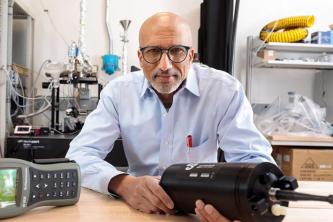
Gert Cauwenberghs is a Professor of Bioengineering at the University of California San Diego (UCSD), affiliated with the Jacobs School of Engineering. He co-directs the Institute for Neural Computation and holds a visiting professorship at MIT. His research focuses on neuromorphic engineering, energy-efficient neural interfaces, and wearable biosensors. Key contributions include silicon-based adaptive neural circuits, implantable neural recording systems, and in-ear biosensing devices. Education: M.Eng. in Applied Physics (University of Brussels, 1988), M.S. and Ph.D. in Electrical Engineering (Caltech, 1989–1994). Prior roles include Professorships at Johns Hopkins University and Visiting Professor at MIT. Research Interests: Biomedical integrated circuits, neuromorphic computing, brain-machine interfaces, and energy-efficient neural systems. His work bridges neuroengineering and clinical applications, emphasizing adaptive intelligence and low-power designs. Recent Work: Development of femtojoule-efficient neural chips, high-density neural interfaces, and closed-loop wearable systems. Projects include neurobench benchmarking frameworks and RRAM-based neuromorphic hardware. Awards: NSF Career Award (1997), ONR Young Investigator (1999), PECASE (2000), IEEE Distinguished Lecturer (2003–2004). Grants & Labs: Active in NIH and DoD-funded projects, co-directs the UCSD Institute for Neural Computation. Collaborates with industry on neural interface technologies. Labs/Teams: Cauwenberghs Lab at UCSD focuses on integrated neuroengineering systems, including neural recording systems and neuromorphic computing architectures.
Dr. Michael Mühlebach is a Lecturer at the Department of Information Technology and Electrical Engineering, ETH Zurich, and affiliated with the Max Planck Institute for Intelligent Systems in Tübingen, Germany. He holds a Bachelor's (2010) and Master's (2013) from ETH Zurich, recognized with awards for academic excellence in Robotics, Systems, and Control. His research focuses on multibody dynamics, nonlinear system control, and model predictive control, with applications in robotics and aerospace systems. His work spans theoretical advancements in variational integrators and practical implementations in systems like the Cubli (a reaction wheel-based 3D inverted pendulum) and flying platforms for ducted fan actuation. Publications highlight contributions to model predictive control schemes with stability guarantees, nonlinear analysis, and distributed event-based state estimation. Key awards include the Outstanding D-MAVT Bachelor Award and Willi-Studer Prize. His research integrates control theory with real-world applications, emphasizing both foundational mathematics and engineering implementations. No grants or lab affiliations are explicitly listed in the provided text.
Goran Strbac is a Professor of Energy Systems at Imperial College London's Faculty of Engineering, holding the Chair in Electrical Energy Systems. He leads the Department of Electrical and Electronic Engineering and directs the joint Imperial-Tsinghua Research Centre on Intelligent Power and Energy Systems. His roles include IPCC WG 3 Leading Author, OFGEM RIIO-2 Challenging Group Member, and member of multiple EU energy platforms. Strbac's research focuses on multi-energy systems integration, energy market design, renewable integration, distributed energy resources, and grid resilience. Notable contributions include whole-energy system modeling across operation and investment scales, market mechanisms for flexibility services, and security assessments for low-carbon infrastructure. His work emphasizes resilience and decarbonization, with over 500 publications and 4 co-authored books. He advises governments and regulatory bodies on energy policy, including contributions to UK Smart System Forum and European Technology and Innovation Platforms. His recent articles explore AI-driven grid optimization, hydrogen integration, and transactive energy systems. Strbac leads major initiatives like the UK Centre for Grid Scale Energy Storage and chairs resilience-focused research clusters. His research bridges academia and industry, informing policy through rigorous systems analysis and innovative modeling frameworks.
Mark Crowley is an Associate Professor in the Department of Electrical and Computer Engineering at the University of Waterloo, with a cross-appointment in the Cheriton School of Computer Science. He is a member of the Waterloo Artificial Intelligence Institute (WAII) and the Waterloo Institute for Complexity and Innovation (WICI), and serves as National Secretary of the Canadian Artificial Intelligence Association (CAIAC). His educational background includes a Ph.D. and M.Sc. in Computer Science from the University of British Columbia, where he worked in the Laboratory for Computational Intelligence, and a B.A. in Computer Science from York University. He completed a postdoctoral fellowship at Oregon State University working with Tom Dietterich's machine learning group. Crowley's research focuses on developing dependable and transparent algorithms to augment human decision-making in complex domains with multiple agents, spatial structure, or uncertainty. His work spans Reinforcement Learning , Deep Learning , Ensemble Methods , and Manifold Learning . He frequently collaborates with researchers in applied fields including Computational Sustainability, Sustainable Forest Management, Autonomous Driving, Medical Imaging, and Material Design. His research is motivated by both theoretical opportunities and real-world challenges such as forest fire management, automotive applications, and medical imaging. His recent publications demonstrate a strong focus on addressing challenges in reinforcement learning, particularly around observation costs, multi-agent systems, and causal representation learning. His work on ChemGymRL provides a significant contribution to digital chemistry and material design through reinforcement learning frameworks. The textbook Elements of Dimensionality Reduction and Manifold Learning represents a major contribution to the theoretical foundations of machine learning. Crowley actively supervises graduate students, with recent thesis completions including Shayan Shirahmadi Gale Bagi (PhD, Feb 2025) and Oleksandra Nahorna (MASc, Dec 2024). His lab, UWECEML (Waterloo ECE Machine Learning Lab), focuses on developing new algorithms at the intersection of Machine Learning, Optimization, and Probabilistic Modeling. He teaches courses including ECE 457C (Reinforcement Learning), ECE 657A (Data & Knowledge Modelling & Analysis), and ECE 457B (Fundamentals of Computational Intelligence). His blog Computationally Thinking explores AI, machine learning, and the societal impact of these technologies.
Gauri Joshi is an Associate Professor in the Electrical and Computer Engineering (ECE) department at Carnegie Mellon University, with affiliate appointments in the Machine Learning Department and Robotics Institute. Her work focuses on system-aware algorithms for distributed machine learning, combining optimization, probability, and coding theory to address communication and computational constraints in edge networks. MIT Ph.D. in EECS (2016) IIT Bombay B.Tech/M.Tech in Electrical Engineering (2010) Research themes include federated learning with communication efficiency, erasure coding for non-linear computations, and reinforcement learning for heterogeneous queueing systems. She leads the Optimization, Probability and Learning (OPAL) lab , affiliated with the Parallel Data Lab (PDL), CyLab, and FLAME Center. Recent publications highlight advances in: federated fine-tuning with low-rank adaptation, robust PCA for model aggregation, privacy-preserving prediction mechanisms, and adaptive reinforcement learning for job dispatching systems. Her group has received 15+ paper awards across SIGMETRICS, MobiHoc, and NeurIPS workshops. Scientific recognition includes: IEEE Goldsmith Lecturer (2025), MIT Technology Review '35 Innovators Under 35' (2022), ONR Young Investigator Award (2023), NSF CAREER (2021), and ACM SIGMETRICS Best Paper (2020). She has advised 20+ graduate students, many now at tech giants like Google, Apple, and Meta. Service contributions span program co-chair roles (MLSys 2025), associate editorships (IEEE/ACM Transactions on Networking), and workshop organization (ICML, NeurIPS). Her NSF AI-EDGE Institute leadership (2021-present) drives next-generation intelligent edge networks for robotics and aerospace applications.
Wei Xiang is an Assistant Professor of Economics at the University of Michigan's Department of Economics, housed within the College of Literature, Science, and the Arts. He earned his Ph.D. in Economics from Yale University in 2024, focusing on international trade, macroeconomics, and environmental economics. His research bridges economic theory with applied analyses, addressing global trade dynamics, macroeconomic policies, and environmental sustainability. Education: Ph.D. in Economics, Yale University (2024). Research Interests: His work explores the intersection of international trade policies, macroeconomic stability, and environmental regulations. He examines how trade agreements influence economic growth and environmental outcomes, with a focus on empirical methodologies to assess policy impacts. Additionally, he investigates macroeconomic models to understand global economic fluctuations and their implications for sustainable development. Publications: His recent articles highlight contributions to vehicle communication systems, signal processing, and wireless technologies, reflecting interdisciplinary engagement with engineering applications. These include real-time prediction models for GPS errors and beamforming optimization in vehicular networks. Labs/Teams: Not explicitly stated, but his research collaborations likely involve interdisciplinary teams in economics, engineering, and environmental science.
I-Hong Hou is a Professor in the Department of Electrical and Computer Engineering at Texas A&M University, part of the College of Engineering. He holds a B.S. in Electrical Engineering from National Taiwan University (2004), and M.S./Ph.D. in Computer Science from the University of Illinois, Urbana-Champaign (2008/2011). His research focuses on wireless networks, cloud/edge computing, and machine learning with notable contributions to real-time systems and network optimization. Education : B.S., Electrical Engineering, National Taiwan University, 2004 M.S., Computer Science, University of Illinois at Urbana-Champaign, 2008 Ph.D., Computer Science, University of Illinois at Urbana-Champaign, 2011 Research Highlights : Hou’s work emphasizes Age of Information (AoI) , distributed learning, and scheduling algorithms for edge computing. He has pioneered frameworks integrating machine learning with network protocols, such as deep reinforcement learning for restless bandits and second-order optimization for wireless systems. His methods address real-time communication challenges in multi-hop networks and dynamic environments. Awards : Best Paper Awards at ACM MobiHoc (2017, 2020) Best Student Paper, WiOpt 2017 C.W. Gear Outstanding Graduate Student Award, UIUC Advising & Grants : Advised PhD student Siqi Fan (graduated 2024). His research has been supported by grants exploring edge-cloud reconfiguration, real-time video delivery, and neural Whittle index networks. Recent work includes optimizing freshness of information in multi-user systems and developing threshold-optimal policies for complex decision-making. Labs/Teams : Leads the Computer Engineering and Systems Group (CESG) at Texas A&M, collaborating on projects blending networking, machine learning, and distributed systems.
Dr. Liang Cheng is the Department Chair and Professor in the Department of Electrical Engineering and Computer Science at the University of Toledo. He leads a department with ~700 students across CS, CSE, and EE programs. His research focuses on Cyber-Physical Systems (CPS), IoT, AI/ML, and intelligent infrastructure, supported by over $30M in funding from NSF, DOE, DOT, and industry. Notable projects include CPS Breakthrough initiatives and underground sensing systems. He co-edited a multidisciplinary book on Underground Sensing and contributed to smart grid cybersecurity. Dr. Cheng has held leadership roles at Lehigh University, shaping faculty governance and equity policies. His 100+ publications span networking, real-time systems, and sensor networks. He advises on funded projects totaling $30M+ and has pioneered pedagogical approaches in computer science education. Research Interests: Cyber-Physical Systems (CPS): Focuses on autonomous drones, energy systems, and real-time infrastructure Networking: Expertise in TSN, DTN, and wireless protocols Cybersecurity: SCADA systems, PLC attack detection, and blockchain energy modeling Underground Sensing: Geo-sensing via wireless signals and subsurface tomography Grants & Projects: Over 20 sponsored projects including NSF CPS Breakthrough (2018-2023), ABB smart grid projects, and DARPA-funded EDIFY systems. Key contributions include reconfigurable wireless architectures and network calculus tools for real-time systems. Teaching: Courses span senior design, compiler design, parallel computing, and wireless sensor networks. Developed pedagogical patterns for non-CS programming education. Awards: Recognized for leadership in academic governance and interdisciplinary research collaboration.
Supratik Guha is a Professor at the Pritzker School of Molecular Engineering and Senior Advisor to Argonne National Laboratory's Physical Sciences and Engineering directorate. His work bridges industrial R&D with academic and national lab research, focusing on quantum computing , semiconductor materials , and sensor networks for water and soil monitoring. Guha leads Argonne’s quantum information science strategy and serves as Faculty Director for the University of Chicago Center in Delhi. Education: PhD in Materials Science (USC, 1991), BTech in Engineering Physics (IIT Kharagpur, 1985) Research interests span multiple domains: Quantum technologies focusing on erbium-doped oxides for quantum memory and quantum interconnects Sensor networks for soil and water quality monitoring using cyberphysical systems Nanofabrication techniques including controlled spalling for heterogeneous material integration Advanced memory technologies exploring ferroelectric and optically addressable memory at atomic scales Scientific awards include: Election to National Academy of Engineering (2015) APS Prize for Industrial Applications of Physics (2015) Vannevar Bush Faculty Fellow (2018) Fellow of Materials Research Society and American Physical Society IBM Corporate Award (2013) Advising notable students like Manish Kumar Singh (co-founder memQ ), Cheng Ji (now at Intel), and Vamsi Nittala (now at Micron Technology). His group contributes to major DOE , NSF , and USDA funded projects including: Q-NEXT - DOE National Quantum Information Center AIFARMS - NSF/USDA AI for Agriculture Institute Thoreau Project - Geospatial sensor networks Labs and teams operate across University of Chicago and Argonne National Lab , with facilities for molecular beam epitaxy , nanofabrication , and optical/electrical characterization . The group has spawned startups like memQ (quantum networking) and K1 Semiconductors (wide-bandgap material transfer).
Michael McAlpine is a Professor in the Mechanical Engineering department at the University of Minnesota . He also holds affiliations with the Biomedical Engineering and Electrical and Computer Engineering departments. His research focuses on 3D printing functional materials & devices , Nanoscale inks , Biomedical devices , Bioelectronics , and Flexible Microsystems . Research Interests : 3D Printing, Biomedical Engineering, Nanotechnology, Flexible Electronics, Microfluidics Labs : ME 361/363 Contact : mcalpine@umn.edu , (612) 626-3303, ME 117 Recent Research Trends include 3D Printed Biomedical Devices , Flexible Electronics , and Bioprinting Applications . His work spans from Spinal Organoid Formation to Programmable Drug Release Capsules . Scientific Award : Circulation Research 2020 Best Manuscript Award
Colin Jones is an Associate Professor at the École Polytechnique Fédérale de Lausanne (EPFL) in the Automatic Control Laboratory, School of Engineering. He earned his BASc and MASc in Electrical Engineering and Mathematics from the University of British Columbia (1994-2002) and a PhD in Control Theory from the University of Cambridge (2002-2005). Prior to EPFL, he was an assistant professor there and a senior researcher at ETH Zürich. Current role: Director of the Robotics, Control, and Intelligent Systems Doctoral Program at EPFL Research focus: Optimization-based and model predictive control (MPC) for renewable energy systems, green energy management, and data-driven control methods His recent work (2023-2025) spans high-speed predictive control , smart grid optimization , and physically consistent neural networks , with applications to buildings, hovercrafts, and power systems. He has secured an ERC Starting Grant for his research on optimal control of building networks. Publications include over 200 papers in journals like Automatica , IEEE Transactions , and Energy and Buildings . Notable article trends include distributed optimization , data privacy in energy systems , and nonlinear MPC for autonomous vehicles . Scientific Awards : ERC Starting Grant for optimal control of building networks Advising : Supervises 10 current PhD students and has advised 19 past PhD students, including Alessandretti Andrea and Diwale Sanket Sanjay. Grants and projects emphasize smart energy systems , predictive demand response , and nonlinear control .
Qi Alfred Chen is an Assistant Professor in the Department of Computer Science at the University of California, Irvine (UCI), within the Donald Bren School of Information and Computer Sciences. He also holds affiliations with the Department of Electrical Engineering and Computer Science (EECS), the Institute of Transportation Studies at UC Irvine (ITS-Irvine), the Center for Embedded and Cyber-physical Systems (CECS), the Institute for Software Research (ISR), and the UC Irvine Cybersecurity Policy & Research Institute (CPRI). His research focuses on network and systems security, with particular emphasis on autonomous vehicle and IoT security. Dr. Chen received his Ph.D. from the University of Michigan in 2018. His educational background has prepared him for his current research in security of critical computer systems. His work bridges theoretical security principles with practical implementations in real-world systems. Chen's research interests center on network and systems security , with a major focus on smart systems and IoT security , particularly in transportation and autonomous vehicle systems . His work addresses security challenges through systematic problem analysis and mitigation, discovering and mitigating security problems in next-generation transportation systems, smartphone OSes, network protocols, DNS, GUI systems, and access control systems. His research has high impact in both academic and industry contexts, with over 10 top-tier conference papers, a DHS US-CERT alert, multiple CVEs, and coverage in major news media like Fortune and BBC News. His publication record shows a clear evolution from foundational work on network protocols and smartphone security toward increasingly sophisticated security analyses of autonomous vehicle systems and AI-powered transportation technologies. The research trajectory demonstrates growing technical sophistication and real-world impact, with recent work focusing on physical-world adversarial attacks against autonomous driving perception systems, LiDAR spoofing, and security of multi-sensor fusion in autonomous vehicles. NSF CAREER Award (2022) on securing the AI stack in emerging autonomous and connected CPSs Chancellor's Award for Excellence in Undergraduate Research Mentorship, UC Irvine (2021) 5th place nation-wide at National CCDC competition (2021, as faculty advisor) 1st place (Gold Medal) at CCDC Western Regional competition (2021) ProQuest Distinguished Dissertation Award, University of Michigan (2019) Dr. Chen has mentored numerous successful students, including PhD candidates and undergraduates who have gone on to positions at major tech companies like Meta, Uber, Amazon, and Intel. His research group has secured significant funding, including an NSF CAREER award, and has made substantial contributions to the field through high-impact publications and vulnerability disclosures. He is also the co-founder of the ISOC VehicleSec Symposium and has organized the AutoDriving CTF contest at DEF CON. Chen leads the AV & IoAT Security Research Group at UCI, focusing on security challenges in autonomous vehicles and the broader Internet of Autonomous Things. His team has developed numerous attack demonstrations and security analyses that have received significant media attention and influenced industry practices. The group maintains an active YouTube channel showcasing their security research.
Michele Zorzi is a Professor of Telecommunications at the School of Engineering, University of Padova, Italy, where he has held a faculty position since 2003. He leads the SIGNET (Signal processing and Networking) Research Group, focusing on cutting-edge wireless networking challenges including mmWave communications and underwater networks. His extensive publication record exceeds 600 papers in top-tier journals and conferences, reflecting significant contributions to the field through both theoretical and experimental work. He received his Laurea Degree (1990) and Ph.D. (1994) in Electrical Engineering from the University of Padova. Prior academic appointments include Politecnico di Milano (1993-1996), University of California San Diego (1995-1998), and University of Ferrara (1998-2003), where he progressed from Associate Professor to full Professor. His educational trajectory demonstrates deep roots in Italian academia with international exposure. Professor Zorzi's research spans wireless communications and networking, with current emphases on mmWave networking for vehicular systems, underwater acoustic/optical communications, non-terrestrial networks, and AI-driven networking solutions. His group conducts experimental validations including at-sea trials for underwater systems and testbeds for vehicular networks. Key projects include PRATA for predictive QoS in autonomous driving and IoT-based environmental monitoring of the Venice Lagoon, demonstrating practical applications of theoretical work. Analysis of his 2022-2025 publications reveals strong trends in applying artificial intelligence to networking challenges across diverse environments. There is significant emphasis on vehicular networks (predictive QoS, teleoperated driving), underwater systems (acoustic/optical communications, AUV swarms), and satellite networks (Starlink integration, NTN security). Experimental validation in real-world scenarios like the Venice Lagoon monitoring project and underwater sea trials characterizes his applied research approach. His scientific accolades include: IEEE Fellow (2007) IEEE Communications Society Best Tutorial Paper Award (2008, 2019) Stephen O. Rice Best Paper Award (2018) Multiple best paper awards at IEEE conferences (2005-2020) As principal investigator for numerous European and US research projects plus 20+ industry-funded initiatives, Professor Zorzi has mentored over 35 PhD students and post-docs. Graduates now hold prominent positions at institutions including Stanford, UCSD, CTTC, and Huawei. His SIGNET group maintains active international collaborations and contributes to open-source networking tools via GitHub, demonstrating commitment to community engagement. The SIGNET Research Group, housed within the Department of Information Engineering, operates specialized experimental facilities for mmWave and underwater communications. Current initiatives include AI-based predictive QoS frameworks for vehicular networks, underwater optical communication systems using ultraviolet light, and large-scale IoT deployments for environmental monitoring. The group's GitHub presence indicates strong open-science practices, while recent sea trials confirm hands-on experimental capabilities beyond theoretical work.
Michael Baldea is an Associate Professor in the Department of Chemical Engineering at the University of Texas at Austin . He holds a Ph.D. in Chemical Engineering from the University of Minnesota (2006), with prior degrees from 'Babeş-Bolyai' University in Romania (M.Sc. 2001, Diploma 2000). His research group develops theoretical and computational methods for Process and Energy Systems Engineering , focusing on integrated decision-making, performance optimization, and process intensification with industrial validation. Education: Ph.D., Chemical Engineering, University of Minnesota (2006) M.Sc., Interface Process Engineering, 'Babeş-Bolyai' University (2001) Diploma, Chemical Engineering, 'Babeş-Bolyai' University (2000) Research Thrusts: Integrated decision-making in chemical/energy supply chains Process performance monitoring and optimization Process integration and intensification Key applications include grid-responsive chemical plants, intensified distillation/column designs, and renewable energy integration for building systems. Scientific Awards: Frank A. Liddell, Jr. Fellowship NSF CAREER Award (2015-2020) Moncrief Grand Challenges Faculty Award (2014) AIChE Outstanding Young Researcher Award (2017) Implementation : His group has translated research into commercial tools through partnerships with industrial test beds and is working to integrate methods into commercial simulators. They explore predictive approaches for building energy management and strategic capital investment analysis in next-generation energy systems.
Ming-Syan Chen is a distinguished academic holding dual roles as a Distinguished Research Fellow and Director of the Research Center for Information Technology Innovation (CITI) at Academia Sinica, Taiwan, and a Distinguished Professor jointly appointed across multiple departments at National Taiwan University (NTU), including Electrical Engineering (EE), Computer Science and Information Engineering (CSIE), and the Graduate Institute of Communication Engineering (GICE). His career spans academia and industry, with prior roles as a research staff member at IBM Watson Research Center and leadership positions in Taiwan's technology sector. Education: He earned a B.S. in Electrical Engineering from National Taiwan University, followed by M.S. and Ph.D. degrees in Computer, Information, and Control Engineering from the University of Michigan, Ann Arbor. Research Interests: Chen's work focuses on databases, data mining, machine learning, multimedia networking, and cloud computing. He has authored over 350 papers and holds numerous patents, contributing to foundational advancements in query processing, data management, and networked systems. Award Highlights: Recipient of ACM and IEEE Fellowships, National Chair Professorship (lifetime honor), Teco Award, Pan Wen Yuan Distinguished Research Award, and IBM's Outstanding Innovation Award. His contributions span research, teaching, and technology commercialization. Leadership & Service: Former Dean of NTU's College of Electrical Engineering and Computer Science, CEO of Taiwan's Networked Communication Program, and Editor-in-Chief of the International Journal of Electrical Engineering. He has chaired international conferences and served on editorial boards of journals like IEEE TKDE and VLDB. Labs & Teams: Leads the Network Database Laboratory and collaborates on national initiatives in information and communication technologies. His research groups focus on data science, distributed systems, and social network analysis.