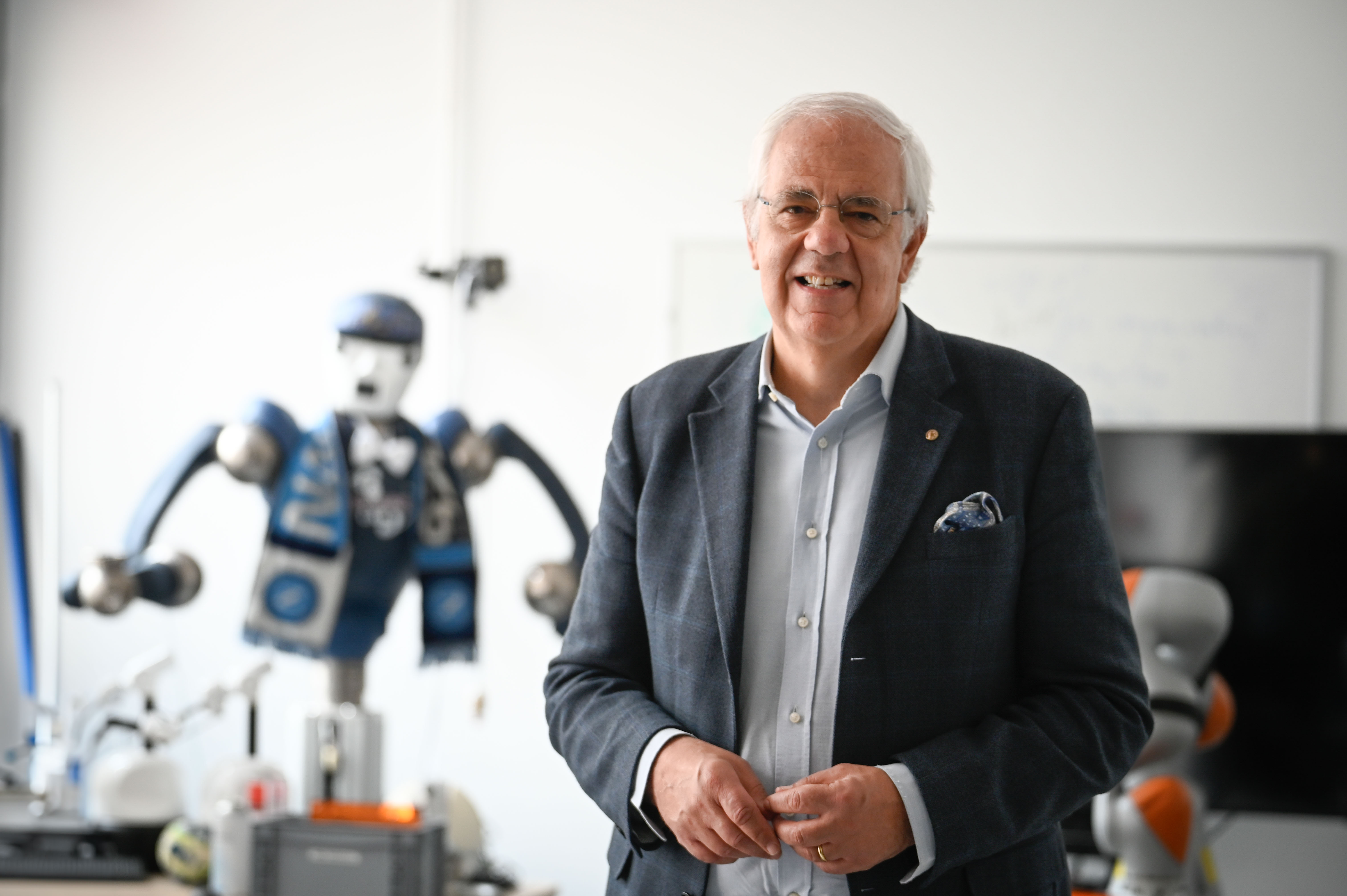
Nectarios Koziris is a Professor at the Department of Computer Science , National Technical University of Athens (NTUA) , and former Dean of the School of Electrical and Computer Engineering . His research focuses on Parallel and Distributed Systems , Computer Architecture , and Cloud Computing . Key Research Themes: Compiler-OS-Architecture Interaction, Datacenter Hyperconvergence, Sparse Matrix Optimization, Quantum Computing, FPGA Virtualization Leadership: Founder of ~okeanos (Europe's largest public Cloud IaaS), Co-founder of GFOSS , Member of IEEE Computer Society Greece, Advisor to Arrikto Inc. His work has led to over 180 publications with 5800+ citations (h-index 33) , including two Best Paper Awards (IPDPS 2001, CCGRID 2013) and Intel Recognition (2015). He has supervised 12 PhD students and participated in 15+ EU projects as coordinator or consortium partner. Scientific Leadership: Program Co-Chair for Europar 2012 , Organizer for IPDPS , ICPP , SC conferences, and active member in Cloud Computing Expert Groups for the European Commission.
Ralph Deters is a Professor in the Department of Computer Science at the University of Saskatchewan , where he co-leads the MADMUC (Multi-Agent Distributed Mobile and Ubiquitous Computing) Lab . He has taught courses including CMPT 298, CMPT 350, CMPT 436, CMPT 842, and CMPT 898, and served as co-coordinator for CMPT 400/CMPT 405. Education Ph.D. in Computer Science, Federal Armed Forces University Munich (1998) MS (Diploma) in Computer Science, Technical University Berlin (1992) BS in Computer Science, Technical University Berlin (1988) Research Interests focus on multi-agent systems , scalable distributed systems , mobile/ubiquitous computing , and privacy-preserving technologies . Current lab projects include: Middleware infrastructures for decentralized systems (cloud/fog/mobile) Social software for sustainable user collaboration Decentralized trust-based data storage Persuasive technologies for health, physical activity, and learning Ethical AI and dark patterns in UI design Blockchain applications in IoT and access control Publications highlight trends in digital twins , blockchain integration , synthetic data for privacy , and machine learning for social impact , with recent work spanning health analytics, agricultural AI, and smart city applications. Lab Impact : The MADMUC Lab, established in 2000 with a $895,687 CFI grant, has graduated 120 researchers (17 PhD, 103 MSc), including two Vanier Scholars. The lab emphasizes awards, scholarships, and interdisciplinary collaboration with 152 total alumni.
Antonio Corradi is a Full Professor of Computer Networks and Infrastructures supporting Cloud and Big Data at the University of Bologna's School of Engineering, within the Department of Computer Science - Science and Engineering. His roles include President of the regional CLUSTER RER for service innovation, President of the Alma Mater FAM Foundation, and Director of the UNIBO High Studies Center in Buenos Aires. He previously served as Director of the DISI department (2018–2021) and International Delegate for Latin America (2014–2018). His research focuses on distributed systems, middleware for pervasive computing, cloud solutions, mobile systems, smart cities, Industry 4.0/5.0, and 5G communication standards. Education: Laurea cum laude in Electrical Engineering (University of Bologna, 1979) and a Master's in Computer Engineering from Cornell University (1981, supported by a Fulbright-Hayes grant). He joined the University of Bologna as a Researcher in 1983 and became Full Professor in 2000. Research interests span distributed/parallel systems, middleware for mobile agent systems, cloud computing, smart city monitoring, and Industry 4.0 protocols. He emphasizes QoS-aware solutions, edge computing, and IoT integration. His work includes designing frameworks for big geospatial data and novel architectures for serverless and fog computing environments. Selected scientific awards include the 1980 'Cavalieri del Lavoro' prize for his thesis. He actively contributes to institutional duties, including the CCIB (Computer Services Centre of the Engineering School) and CINI Bologna University Section (Italian Interuniversity Consortium). In advising and grants: He coordinates PhD programs and has led projects funded by MIUR, CNR, and European initiatives. Notable collaborations include industry grants with Jakala, OTConsulting, ENAV-Sicta, and the Zefiro Consortium. His projects address challenges in energy efficiency, smart manufacturing, and healthcare management during crises. Labs/Teams: Developed platforms like SOMA and REDMAN middleware. Involved in initiatives such as ParticipAct (mobile crowdsensing), COLOMBO (vehicular traffic monitoring), and the Audit4Cloud platform for cloud performance auditing.
Saeed Ur Rehman serves as a Senior Lecturer in Cybersecurity and Networking within the College of Science and Engineering at Flinders University. He holds leadership positions as Course Leader for BIT and MIT (Networks and Cybersecurity) programs and Deputy Research Section Lead for Data and Information Sciences. His institutional affiliations include membership in the Centre for Defence Engineering Research and Training and the South Australia Cyber Security Innovation Node (SA Node) Advisory Board. Dr. Rehman's educational background includes: PhD in Electrical and Electronic Engineering from the University of Auckland (2015) Graduate Diploma in Higher Education from Unitec Institute of Technology (2016) Master of Engineering from the University of Auckland (2009) BSc Engineering from Pakistan (2004) His research spans cybersecurity, wireless communication, and network security with specific expertise in physical layer security, satellite communication, visible light communication, and fog computing. Dr. Rehman has developed innovative approaches in RF fingerprinting for device authentication and has contributed to vital sign monitoring technologies using radar systems. His work bridges theoretical security frameworks with practical applications in digital agriculture, vehicular networks, and energy harvesting systems. Analysis of his recent publications reveals a strong focus on emerging security challenges in next-generation networks, particularly addressing vulnerabilities in digital agriculture systems, privacy preservation in fog computing environments, and physical layer security enhancements for 6G networks. His research demonstrates consistent interdisciplinary collaboration across computer science, electrical engineering, and healthcare technology domains. Dr. Rehman has received significant recognition including: IEEE Senior Member status (2016) Fellowship from The Higher Education Academy, UK (2019) Cisco Networking Academy instructor certifications (2019, 2022) PhD Completion Award from University of Auckland (2014) As an active researcher and supervisor, he has secured substantial research funding including AUD$810,000 for the SmartSat CRC project (2020), AUD$150,000 from Defence Innovation Partnership (2023), and multiple grants from Flinders University and New Zealand institutions. He supervises PhD and Master's students in cybersecurity, with completed projects focusing on IoT security and privacy-preserving data aggregation, and current projects exploring intelligent reflective surfaces, RF emitter geolocation, and vehicular data communication frameworks. Dr. Rehman contributes extensively to the academic community as an IEEE Senior Member serving multiple societies, conference chair, journal editorial board member, and peer reviewer for numerous publications in his field.
Ramon Canal is a Professor at the Universitat Politècnica de Catalunya (UPC), affiliated with the Barcelona School of Informatics and the Computer Architecture Department. He has served as Vice Dean of postgraduate studies and leads the VirtuOS (Virtualization and Operating Systems) research group. His academic background includes BSc, MSc, and PhD from UPC, with thesis supervision by Antonio González (UPC) and James E. Smith (University of Wisconsin-Madison). He completed sabbaticals at Harvard University (2006-2007) and University of Cyprus (2019-2020). Education: PhD, MSc, BSc in Computer Engineering (UPC) Research focus: Microarchitecture security, reliability across circuit/system levels, cloud optimization Recent publications address privacy in IoT, secure hardware accelerators, and safety-critical systems. His work contributes to the DRAC project (2019-2022), Red-RISCV network, and Horizon's Vitamin-V project. Awards include HiPEAC Paper Awards, IEEE Senior Member status, Fulbright recognition, and multiple education excellence accolades. Scientific Honors HiPEAC Paper Award (ISCA-44, 2017) IEEE Senior Member (2016) Best Paper Nominee (ICCD-32, 2014) UPC Outstanding PhD Award supervision (2011) He advises current MSc students and has mentored multiple PhD graduates. Professional activities span academic leadership, research collaborations with Barcelona Supercomputing Center (BSC), and technical contributions to reliability analysis frameworks like RECIPE and FRACTAL.
Dragi Kimovski is a Habilitated Assistant Professor in Distributed Systems at Klagenfurt University, Austria, focusing on Edge Computing and AI. He previously held roles at the University of Innsbruck and the University of Information Science and Technology in Macedonia. His research spans Edge/Fog/Cloud computing, multi-objective optimization, and high-performance computing. He has coordinated major projects like 6GContinuum and KärtnerFog, and led initiatives such as DataCloud and ASPIDE. His teaching includes courses on Distributed Computing, Cloud Computing, and IoT. He is the co-creator of the Carinthian Computing Continuum and maintains a blog on Edge AI World. His work emphasizes sustainable and efficient computing solutions for emerging technologies. Education: Not explicitly listed in the provided text. Research Interests: Edge Computing, Fog Computing, Cloud Computing, Multi-objective Optimization, High-Performance Computing, AI in Distributed Systems. His work addresses challenges in resource management, latency reduction, and scalability across heterogeneous environments, with applications in healthcare, IoT, and 6G networks. Projects: 6GContinuum (Coordinator): Focuses on AI services over 6G networks. KärtnerFog (Scientific Coordinator): Develops adaptive Fog infrastructures over 5G. DataCloud (WP5 Leader): Manages Big Data pipelines on the Computing Continuum. ASPIDE (Scientific Coordinator): Advances exascale programming models for data processing. Teaching: Klagenfurt University: Courses include Distributed Computing, IoT, Cloud Computing, and Advanced Programming. University of Innsbruck: Taught Advanced Parallel and Distributed Systems. University of Information Science and Technology: Courses in High-Performance Computing and Network Architectures. Labs/Teams: Co-created the Carinthian Computing Continuum, an automated SDN testbed for Edge computing research. Active in interdisciplinary teams addressing extreme data processing and sustainable computing.
Dr. Khoa Phan is a Senior Lecturer in the Department of Computer Science and Information Technology at La Trobe University, Australia. He holds an ARC DECRA Senior Research Fellowship (2020-2023) and has held prior positions at UCLA, Monash University, and others. His academic background includes a B.Eng. (UNSW), two M.Sc. degrees (University of Alberta and Caltech), and a Ph.D. in Electrical Engineering from McGill University. Dr. Phan's research focuses on optimizing next-generation communication networks, particularly in wireless communications, IoT, satellite systems, and machine learning applications. He has secured significant grants, including ARC Discovery Projects and industry partnerships. His work emphasizes secure cyber-physical systems, federated learning, and edge computing. He has received prestigious awards such as the ARC DECRA and Atwood Fellowship. His research spans over 100 publications, with contributions to areas like OTFS modulation, secure satellite communications, and graph-based anomaly detection. He actively supervises PhD students and collaborates internationally, including initiatives to strengthen ties between La Trobe University and Vietnamese institutions. Grants include ARC Discovery Projects (totaling $1.3M+), CRC SmartSAT, and industry scholarships. His work addresses energy efficiency, secure resource allocation, and AI-driven solutions for 5G/6G networks and the metaverse.
Prof. Bruno Siciliano is a full Professor of Automatics and Robotics at the University of Naples Federico II's Department of Electrical Engineering and Information Technology (DIETI). He directs the PRISMA Lab and chairs the Scientific Council of the ICAROS Center. His research focuses on robotics, automation, and human-robot interaction, with notable contributions to medical robotics, deformable object manipulation, and AI integration. He has received prestigious awards such as the 2024 IEEE RAS Pioneer Award and is a Fellow of multiple international organizations. Affiliations: Director, PRISMA Lab Chair, ICAROS Center Scientific Council Member, ACN Technical-Scientific Committee Research Interests: His work spans robotics education, surgical robotics, non-prehensile manipulation, and AI-driven robotic systems. Notably, his projects include the ERC-funded EndoTheranostics initiative for robotic colonoscopy and RoDyMan for dynamic manipulation. His contributions bridge robotics with healthcare, automation, and cognitive systems. Awards & Honors: 2024 IEEE RAS Pioneer in Robotics and Automation Award Genio Award (2024) for pioneering Italian robotics Fellowships: IFAC, IEEE RAS, and international AI associations Grants & Leadership: ERC Synergy Grant (2023, 10M€) and Advanced Grant (2013) Leadership roles in IEEE RAS and international robotics initiatives Labs & Teams: PRISMA Lab focuses on robotics paradigms like design, knowledge, and human-robot interaction, with projects in medical robotics and autonomous systems.
Thomas Werner Pusztai is a Researcher at the Department of Distributed Systems, TU Wien. His work focuses on cloud-edge continuum systems, serverless computing, and service-level objective (SLO) management. He contributes to projects like RapidREC, TEADAL, and the EU-funded RAINBOW initiative. His research spans distributed scheduling algorithms, edge-cloud resource allocation, and SLO-aware middleware frameworks like Polaris and HyperDrive. Education: Completed a Diploma in Computer Science at TU Wien with a thesis on Model-based design and architecture of fog computing applications (2019). Active in academic conferences, presenting at IEEE/ACM Edge Computing, Cloud, and Fog/Edge events. Research interests include edge computing, cloud-native systems, IoT applications, and optimizing SLO compliance through novel scheduling techniques. His work emphasizes practical frameworks for real-world distributed systems challenges. Projects include developing HyperDrive for serverless function scheduling in 3D edge-cloud spaces, Polaris for SLO-aware microservices orchestration, and SLO Script for complex elasticity-driven SLO implementations.
Abdelhakim HAFID is a Full Professor at the University of Montreal , affiliated with the Faculty of Arts and Science and the Department of Computer Science and Operations Research . He leads the LRC — Laboratoire de recherche en réseaux de communication and is a member of several research centers including CIRRELT (interuniversity research center on enterprise networks, logistics, and transportation), the Cyberjustice Lab , and talents (AI for cybersecurity lab). His research focuses on Blockchain security , IoT , edge and fog computing , intelligent transport systems , and network resource management . He has supervised over 30 graduate students and led/co-led numerous research projects funded by agencies like NSERC , FRQNT , and MITACS . Notable projects include Blockchain Evolution: Quantum-Resistant Security (2025–2031) and Design and Management of Fog Networks (2019–2026). His work spans vehicular networks , mobile cloud computing , and machine learning for network optimization . He actively contributes to cybersecurity initiatives, including IoT authentication frameworks and AI-driven solutions for judicial systems (e.g., Cyberjustice ). Key Projects : Quantum-Resistant Blockchain Security (2025–2031) IoT Authentication via Blockchain and Intelligent SIM (2022–2026) Fog Network Design (2019–2026) Grants : NSERC Discovery Grants MITACS Acceleration Fellowships FRQNT Team Research Grants His lab collaborations include CIRRELT (logistics & transport) and Cyberjustice (digital law), reflecting interdisciplinary strengths in both technical and societal domains.
Ashkan Yousefpour is a Computer Scientist with a PhD from the University of Texas at Dallas , where he contributed to the FLOW project. He served as a Lecturer and research assistant at UT Dallas, while also working as a Visiting Researcher at UC Berkeley . His research spans Fog/Edge Computing , Federated Learning , Reinforcement Learning , and Distributed Systems . Current Role: AI Scientist at Meta Academic Affiliation: Department of Computer Science, University of Texas at Dallas Research Interests include: Minimizing IoT service delay through fog offloading Developing failure-resilient distributed neural networks (ResiliNet) Advancing privacy-preserving machine learning (Opacus, Papaya) Optimizing traffic flow with autonomous vehicles via reinforcement learning Advising : Supervised multiple graduate students including Ashish Patil , Harshavardhan Nalajala , and Brian Nguyen . Collaborated with researchers like Professor Alexandre Bayen (UC Berkeley) and Professor Cathy Wu (MIT) on traffic control frameworks such as Flow .
Tiago Manuel Ribeiro Gomes is an Assistant Professor at the Department of Industrial Electronics within the School of Engineering at the University of Minho, Portugal. He is also a Senior Researcher at Centro ALGORITMI and a member of both the IE R&D Group and the ESRG R&D Lab. Holding a Ph.D. in Electronics and Computers Engineering, his research focuses on embedded real-time systems, computer architectures, and hardware/software co-design for IoT devices. Academic Degree: Ph.D. in Electronics and Computers Engineering Current Position: Assistant Professor, School of Engineering, University of Minho Gomes has led extensive research in IoT systems over 15 years, particularly in hardware acceleration for automotive LiDAR sensors, secure embedded systems, and efficient OS frameworks for low-end devices. His work includes the EU-funded CROSSCON project and spans hardware-assisted security, dynamic binary translation, and wireless sensor networks. Recent publications highlight his expertise in automotive sensor technology, with articles like FOG-Zip for LiDAR compression, SecureQNN for TinyML security, and Hardware-Assisted Range Image Generation for LiDAR processing. His work bridges IoT, embedded systems, and cybersecurity, focusing on real-time performance and hardware-software co-design. Projects include the development of reliable/secure automotive sensor solutions and EU project CROSSCON. He contributes to open-source frameworks like UTango for IoT security and investigates heterogeneous fault tolerance architectures using Arm/RISC-V processors. Labs: IE R&D Group, ESRG R&D Lab Education: Ph.D. in Electronics and Computers Engineering, Master’s in Telecommunications Engineering (both from University of Minho)
Professor Athman Bouguettaya is a Professor and former Head of the School of Computer Science at The University of Sydney. He holds prestigious titles including IEEE Fellow and ACM Distinguished Scientist. His research focuses on service computing, IoT, and cloud computing, with notable contributions to energy crowdsourcing, drone delivery systems, and trust management in IoT environments. Education: PhD in Computer Science (University of Colorado, 1992) Previous roles: Head of School at RMIT University, Science Leader at CSIRO, and faculty member at Virginia Tech Research Interests: IoT Energy Crowdsourcing: Leveraging wireless energy sharing between devices Drone Delivery Systems: Optimizing aerial routes and swarm coordination Trust in Crowdsourced Services: Blockchain-based frameworks for IoT trust Awards and Honors: IEEE TCSVC Research Innovation Award (2019), ACM Distinguished Speaker (2012), and IEEE Fellow (2010). Grants and Funding: Multiple competitive grants from Australia, USA, EU, China, Qatar, and industry partnerships with HP and Sun Microsystems.
Mara Nikolaidou is a Professor in the Department of Informatics and Telematics at Harokopio University of Athens since 2007 and has served as the university's Rector since 2016. She represents Greek universities in the European University Association (EUA) for 2023-2024. Her research focuses on distributed systems, system modeling, and responsible computing, with a strong emphasis on IoT, cloud/edge computing, and cyber-physical systems. She leads projects funded by national, EU, and international agencies, exploring topics like autonomous systems, ethical requirements in design, and human-in-the-loop systems. Her educational background includes roles as a computer engineer and IT consultant before academia. She is a member of IEEE (SMC Society and Systems Council) and participates in the Object Management Group (OMG) working groups for SysML and responsible computing. She organizes international conferences in software and systems engineering. Research interests span distributed systems, IoT, and ethical computing. Recent work investigates cost analysis in cloud markets, human-AI collaboration, and smart city technologies. Over 200 publications highlight her contributions to model-based systems engineering, including SysML extensions for cost/QoS analysis and frameworks for autonomous fog nodes. Grants and projects include EU-funded initiatives on smart farming, cloud brokerage, and organizational interoperability. Her lab focuses on autonomous systems and context-aware middleware. She advises on e-Government compliance frameworks and collaborates with industry partners on IoT management platforms.
Rui Neto Marinheiro is an Associate Professor at the Department of Information Science and Technology, School of Technology and Architecture, Iscte - University Institute of Lisbon. He is also an Integrated Researcher at the Institute of Telecommunications - IUL, where he contributes to the Radio Systems Group. His academic leadership includes directing the Bachelor's Degree in Telecommunications and Computer Engineering and coordinating various institutional initiatives such as e-learning, audiovisual services, and international mobility programs. PhD in Electronics and Computer Science, University of Southampton (2001) Bachelor’s in Electrical and Computer Engineering, Faculty of Engineering, University of Porto (1995) His research focuses on advanced computer networking topics, including IoT communication architectures, software-defined networks, network security, mobility, and medium access control. His work bridges theoretical modeling with practical implementation in smart cities and distributed systems. He has led and participated in multiple national and international research projects funded by European and national agencies. The recent publications and projects reflect a strong trend in IoT-enabled smart environments, network resilience, and intelligent surveillance systems. His work integrates wireless technologies, data analytics, and autonomous systems, contributing to both academic knowledge and real-world applications in public safety, tourism, and telecommunications infrastructure. MoniCrowd – Adaptive system for crowding monitoring RESETTING – Digitalization of sustainable tourism ImpAr – Optical network impairment modeling SAAS – UAV surveillance via terrestrial networks LTE-Advanced Enhancements using Femtocells 3DVQM – 3D video quality monitoring E-NEXT – Networking technologies integration AGENTCITIES.RTD – Agent-based service networks Marinheiro actively supervises graduate students, with three doctoral theses and four master’s dissertations currently in progress, and has guided over twenty master’s students to completion. He has not received explicitly mentioned scientific awards in the provided text. His teaching responsibilities span network architecture, security, IoT, and digital communications across multiple undergraduate and institutional programs. He is affiliated with the Institute of Telecommunications - IUL (IT-Iscte), particularly within the Radio Systems Group, where he conducts research on wireless and optical networks. His academic management roles include laboratory coordination and promoting international student recruitment through Erasmus+.

.JPG)