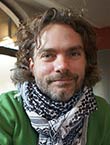
Thomas Arentzen is an Associate Professor (Reader) in Church History at Lund University, affiliated with the Centre for Theology and Religious Studies within the Faculty of Humanities and Theology. He received his PhD from Lund University in 2014 and became a Reader (docent) in Church History there in 2018. Arentzen has held research positions at the University of Oslo, Brown University (as a visiting scholar in spring 2016), and Dumbarton Oaks Research Library and Collection (as a Research Fellow in Byzantine Studies during 2018-2019). Currently, he leads the research project "Beyond the Garden: An Ecocritical Approach to Early Byzantine Christianity," funded by the Swedish Research Council. Dr. Arentzen's educational background includes: Doctor of Theology (PhD), Lund University, 2014 Cand.philol. (Master's equivalent), University of Oslo, 2005 Cand.mag. (Bachelor's equivalent), University of Oslo, 2001 Thomas Arentzen's research primarily focuses on Byzantine Christianity and ecology, exploring the intersection of religious traditions with environmental concerns. His work demonstrates how early Christian communities interacted with the natural world, challenging modern assumptions about Christianity's relationship with nature. Arentzen has made significant contributions to the study of Byzantine hymnography, particularly the works of Romanos the Melodist, and has examined representations of the Virgin Mary in late ancient poetry. His monograph "The Virgin in Song" (2017) represents a key contribution to this field. Arentzen also investigates popular piety and literary expressions of Christian faith across different historical periods and cultural contexts. The trajectory of Arentzen's recent publications reveals a growing emphasis on ecocritical approaches to early Christian studies. His works increasingly explore the relationship between religious traditions and ecological thinking, examining how trees, landscapes, and natural elements function within Byzantine religious texts and practices. This focus culminated in his co-authored book "Byzantine Tree Life" and his current research project "Beyond the Garden." While maintaining his expertise in traditional areas of Byzantine studies like hymnography and Mariology, Arentzen has expanded his research to include gender studies, particularly through his involvement in projects addressing "Orthodox Tradition and Human Sexuality" and "Gender and Sexuality in Orthodox Christianity." Dr. Arentzen has received notable recognition for his scholarly work, including: Vetenskapssocieteten i Lunds pris ur Insamlingsstiftelsen Näringslivets fond för humanistisk forskning (2015) Throughout his career, Arentzen has secured significant research funding from major institutions. He led the Norwegian Research Council-funded project "Bodies in Motion: Religion and Corporeality in Late Antiquity" (2015-2019) and received a fellowship from Dumbarton Oaks Research Library and Collection for "Reading between the Limbs: Holy Week and Byzantine Bodies" (2018-2019). Currently, he directs the Swedish Research Council-funded project "Beyond the Garden: An Ecocritical Approach to Early Byzantine Christianity" (2019-2023). Additionally, Arentzen has led international projects funded by the Norwegian Ministry of Foreign Affairs, including "New Directions in Orthodox Christian Thought and Practice: Gender and Sexuality in Orthodox Christianity" (2016-2018) and the follow-up project "Democracy and the Church in Orthodox Christianity." Thomas Arentzen is actively involved in several academic communities and research groups. He serves as praeses of Collegium Patristicum Lundense and is a council member of l'Association Internationale d'Études Patristiques (AIEP/IAPS). He also participates in the Society of Oriental Liturgy and serves as article-editor for Patristica Nordica Annuaria. Arentzen is a member of the Research Collegium at the Swedish Research Institute in Istanbul and contributes to the Oslo Coalition's International Expert Committee for the "New Directions in Orthodox Thought and Practice" project.