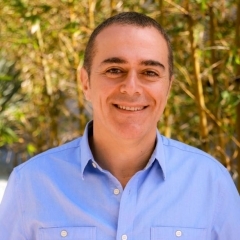
Nicola Dragoni is a Professor in Cybersecurity Engineering at the Department of Applied Mathematics and Computer Science, Technical University of Denmark (DTU). As Deputy Director and Head of Section, he leads research initiatives focused on securing emerging technologies. Key Research Areas : Internet of Things (IoT) security, machine learning for intrusion detection, cyber-deception techniques, fog computing, malware analysis, blockchain applications, and wireless sensor network security. Supervision : Actively supervising multiple PhD students in projects related to cyber-deception, moving target defense, and bio-inspired security mechanisms. Recent Publications : Contributions to IoT honeypots, drone identification via RF signals, passkey adoption challenges, and cyber range taxonomies.
Christophe Charrier is a Full Professor in Forensics and AI at Université de Caen Normandie, affiliated with GREYC UMR CNRS 6072 and IUT Grand Ouest Normandie's Multimedia and Internet Department (Dept. MMI). He obtained his PhD in Computer Science from Université Jean Monnet (Saint-Etienne) in 1998, followed by an HDR (Habilitation à Diriger des Recherches) in 2011 from Université de Caen Normandie. His academic journey includes roles as a Postdoctoral Researcher at Université Laval (1998-2001), Associate Professor at IUT Saint-Lô (2001), and Visiting Scholar/Professor positions at University of Texas at Austin (2008) and University of Sherbrooke (2009-2011). His research focuses on Digital Image and Video Forensics (e.g., deepfake detection), Image/Video Quality Assessment , Computational Vision , and Biometrics (fingerprint quality, template update, presentation attack detection). He leads the SAFE research group since 2016 and collaborates with the E-payment & Biometrics team at GREYC. His work integrates machine learning for quality metrics, biometric system evaluation, and forensic analysis. Recent publications highlight advancements in deepfake detection , 3D mesh quality assessment , and biometric security . Articles span journals like Intelligent Service Robotics (2024), IEEE Access (2024), and conferences such as CORESA (2024) and Cyberworlds (2023-2024). His studies on fingerprint systems, behavioral biometrics, and environmental impacts on data quality underscore his interdisciplinary approach. Scientific Awards : Best PhD Paper Award (ASONAM 2022) Best Full Paper Award (CW2022) He has mentored 14 PhD students since 2003, including notable alumni like Xinwei Liu (Zhejiang Wanli University) and Antoine Cabana (ALTEN, Toulouse). His projects span biometric certification, latent space manipulation, and 3D mesh evaluation, often in collaboration with institutions in Canada, Norway, and Morocco.
Yannis Kevrekidis is a Professor at Princeton University with a distinguished career in computational mathematics and chemical engineering. He is currently a Hans Fischer Senior Fellow at the Technical University of Munich (TUM-IAS) and has held visiting positions at institutions like the Zuse Institute Berlin and Caltech. Education : National Technical University of Athens (Chemical Engineering) University of Minnesota (PhD in dynamical systems) Research Interests : Equation-Free and Variable-Free Modeling Complex Systems Dynamics Multiscale Computation Integration of Machine Learning with Scientific Computing Pattern Formation & Instability Analysis Key Article Trends : Advanced data-driven modeling of dynamical systems Manifold learning for reaction coordinates Projective integration methods Coarse-grained modeling across disciplines Applications in epidemiology, neuroscience, and fluid dynamics Scientific Awards : Guggenheim Fellowship Humboldt Research Award Computing in Chemical Engineering Award (AIChE) Bodossaki Academic Award Allan P. Colburn Award Collaborations : Extensive international collaborations with institutions in Germany, Austria, and the UK Key role in the Complex Systems Modeling and Computation focus group at TUM-IAS
Juan Felipe Carrasquilla Álvarez is an Assistant Professor in the Department of Physics at the University of Toronto. His research focuses on the intersection of condensed matter physics, quantum computing, and machine learning, emphasizing quantum many-body systems, quantum device validation, and phase identification. He holds affiliations with the Acceleration Consortium and the Centre for Quantum Information and Quantum Control at the University of Toronto, and is a Perimeter Institute Visiting Fellow. Education: PhD in Physics from SISSA (Italy), followed by postdoctoral fellowships at Georgetown University (2011-2013), the Perimeter Institute (2013-2016), and a stint as a Research Scientist at D-Wave Systems Inc. Earlier, he completed the Abdus Salam ICTP Diploma Programme (2005-2006). Research interests span quantum Monte Carlo simulations, machine learning-driven analysis of quantum systems, and applications to quantum computing validation. His work bridges theoretical physics with computational methods, addressing challenges in both classical and quantum computing paradigms. Notable contributions include developing neural network architectures for quantum state reconstruction, error mitigation in quantum simulations, and optimal control strategies for quantum thermal machines. His publications explore topics like topological order detection, shadow tomography, and hybrid quantum-classical algorithms. Awards/Fellowships: Perimeter Institute Postdoctoral Fellowship (2013-2016), Georgetown University Postdoctoral Fellowship (2011-2013), SISSA PhD Fellowship (2006-2010), and Abdus Salam ICTP Diploma Programme Fellowship (2005-2006). Advising/Grants: No formal advisee list provided. Active in interdisciplinary collaborations through affiliations with major quantum research consortia and institutions. Lab/Teams: Part of the Acceleration Consortium and the Centre for Quantum Information and Quantum Control, contributing to cutting-edge quantum computing and machine learning research.
Eric Jessup is a Research Professor and Director of the Freight Policy Transportation Institute at Washington State University's School of Economic Sciences. He holds a Ph.D. in Agricultural Economics from WSU (1998), an M.S. and B.S. in Agricultural Economics from the University of Kentucky (1992, 1988). His career includes roles at Informa Economics, Albert-Ludwig-University (Germany), and American Express. His research focuses on transportation modeling, freight systems, applied econometrics, and geo-spatial analysis. Notable awards include the 2008 Transportation Research Forum Best Paper Award and recognition as an Eno Fellow (1994). Research interests emphasize optimizing freight logistics, transportation policy, and infrastructure investment. Recent work addresses pandemic impacts on global trade, truck parking safety, and rail rate dynamics. He has directed major freight policy initiatives, including the Freight Policy Transportation Institute and the PacTrans Workforce Development Institute. Over 80 publications span journals like Transportation Research Forum and Journal of the Transportation Research Forum , with a focus on GIS applications, supply chain resilience, and safety critical events. Education: Ph.D. Agricultural Economics, WSU, 1998 M.S. Agricultural Economics, University of Kentucky, 1992 B.S. Agricultural Economics, University of Kentucky, 1988 Awards: 2008 TRF Best Paper Award 2006 Best Paper Award (Italy) 1996 Northwest UTC Student of the Year 1994 Eno Transportation Fellowship Labs/Teams: Leads the Freight Policy Transportation Institute and collaborates with the Transportation Research Group at WSU. Engaged with national initiatives like PacTrans and the Idaho Statewide Freight Data Project. Grants and advising are central to his work, though specific student advisees are not listed. His research bridges academia and industry, addressing real-world challenges in freight logistics, environmental policy, and transportation safety.
Diane M. Styers is an Associate Professor in the Department of Geosciences and Natural Resources at Western Carolina University's College of Arts and Sciences. Her work integrates geospatial technologies with community engagement to address global climate resilience challenges through human-centered research approaches. Her educational qualifications include: Postdoctoral Research in Remote Sensing and Geospatial Analysis, University of Washington Ph.D. in Forest Ecology, Auburn University M.A. in Geography, Georgia State University B.S. in Human Development & Family Studies, University of North Carolina at Greensboro Dr. Styers specializes in public participatory GIS (PPGIS) to incorporate local landscape knowledge into climate adaptation strategies. Her technical expertise spans LiDAR data analysis, object-based image analysis (OBIA), MODIS/Landsat time series, multi-sensor integration, forest ecology, and dendroecology. She investigates how social-ecological processes drive landscape changes affecting Earth's resources, with particular focus on community resilience against climate-related risks. Her publication record reveals strong thematic trends in applying geospatial methods to socio-ecological systems, with increasing emphasis on rivercane conservation, forest community dynamics in Appalachia, biodiversity education using NEON data, and vector-borne disease mapping. Recent works demonstrate sophisticated integration of remote sensing with community-based adaptation frameworks. Dr. Styers actively mentors students through co-authored publications and teaches diverse courses including Introduction to Geospatial Analysis, Remote Sensing, GIS applications, and field-based programs like Sustainability in Costa Rica. Her instructional approach emphasizes authentic science engagement using big data resources.
Donato Romano serves as Associate Professor at The BioRobotics Institute of Scuola Superiore Sant'Anna, Italy, where he coordinates the Bio-Robotic Ecosystems Lab and co-founded the spin-off company HUBILIFE srl. His interdisciplinary work bridges robotics, biology, and AI to develop biohybrid systems for biodiversity preservation, sustainable environmental management, and life support in extreme scenarios including space exploration. With over 90 publications and an H-index of 27 (Scopus, March 2025), he has established significant academic leadership through editorial roles across 12+ international journals. Romano's educational foundation includes advanced degrees with honors: an M.Sc. in Agriculture Science and Technologies (2014) and a PhD in BioRobotics (2018), both from Scuola Superiore Sant'Anna. His academic journey includes visiting scholar positions at Khalifa University and substantial industry-academia collaboration through HUBILIFE srl, which commercializes bioinspired devices for human daily life improvement. His research program focuses on bioinspired and biomimetic robotics with particular emphasis on animal-robot interaction, biohybrid systems, and natural intelligence. Key projects address critical global challenges: SENSORBEES develops biohybrid environmental surveillance for ecological monitoring; REGOLIFE investigates lunar soil-terrestrial organism interactions for space agriculture; and OCEAN ROBOCTO explores marine ecosystem solutions. This work demonstrates a strategic progression from fundamental behavioral studies toward applied ecological and extraterrestrial systems. Analysis of his recent publications reveals strong trends in AI-driven behavioral analysis, with deep learning increasingly applied to entomological studies and pest management. The research spans agricultural applications (precision monitoring traps, larval detection systems), ecological conservation (biodiversity surveillance), and extreme-environment adaptation (lunar regolith studies). A distinctive feature is the consistent integration of biohybrid approaches where living organisms and robotic systems create synergistic capabilities exceeding either component alone. Romano's scientific recognition includes election as Junior Fellow of the Italian Academy of Engineering and Technology (2025), the Lucani fuori dal Comune award (2024), and multiple best-thesis prizes. His editorial leadership spans high-impact journals including IEEE Transactions on Medical Robotics and Bionics and Pest Management Science, where he serves as Associate Editor. As principal investigator, Romano coordinates major international projects totaling over €15M in funding: HORIZON-EIC's SENSORBEES (2024-2029), ASI's REGOLIFE (2024-2027), National Geographic's OCEAN ROBOCTO (2024-2026), and PRIN's COSMIC (2023-2025). His teaching portfolio includes PhD courses in Biosystems for Biorobotics and M.Sc. instruction in Bionics Engineering at Scuola Superiore Sant'Anna and University of Pisa. The Bio-Robotic Ecosystems Lab under Romano's direction pioneers biohybrid technologies where living organisms and robotic systems create integrated solutions. Current initiatives include SENSORBEES' environmental monitoring swarms, REGOLIFE's moonworm colonization systems, and HUBILIFE's commercial vector-control devices. The lab maintains active collaborations with space agencies, agricultural institutes, and conservation organizations, positioning biohybrid systems as next-generation tools for planetary-scale challenges.
Laura Innocenti is an Adjunct Professor at both the Università Europea di Roma and Università LUISS Guido Carli. She holds a PhD in Human Resource Management from King’s College London. Her primary teaching roles include Organisational Behaviour and Leadership at Università Europea di Roma, and Remuneration and Human Resource Management Systems at LUISS. She collaborates with People Management Lab srl and LUISS Business School’s People Management Competence Center & Lab. Her professional experience includes over a decade in Telecom Italia’s Human Resources Department and consultancy work on organisational climate analysis. Research interests focus on Human Resource Management (HRM), Diversity Management, organisational climate, employee engagement, and remuneration systems. Key areas include age diversity in the workplace, cross-generational workforce dynamics, and the impact of HR policies on employee commitment. Her work bridges academic research with practical HRM strategies for diverse organisational contexts. Her publications explore age diversity frameworks, reward system effectiveness, and organisational citizenship behaviours across industries. She contributes to projects involving Italian enterprises, banking sectors, and educational institutions, emphasizing actionable HRM solutions for contemporary challenges.
Andreas Rauber is an Associate Professor in the Department of Data Science at Technical University of Vienna. He serves as Curriculum Coordinator for Bachelor and Master programs in Business Informatics and Data Science, and chairs the Curriculum Commission for Business Informatics. His research focuses on Information Systems Engineering, Logic and Computation, and Visual Computing, addressing challenges in data management, digital preservation, and reproducibility in e-science. He leads projects like OS Trails and FAIR-AI, emphasizing FAIR principles and trustworthy research infrastructures. Rauber has contributed to over 150 publications, including works on data citation frameworks, adversarial ML defenses, and reproducibility in IR. His work bridges technical innovation with policy, exemplified through roles in the EOSC Support Office Austria and RDA Austria initiatives. Key projects include establishing FAIR data practices across universities and advancing digital preservation through repositories like DBRepo. He coordinates international collaborations, such as the EU-funded EOSC-Life and EGI Advanced Computing projects. His teaching spans courses in machine learning, information retrieval, and research methods, fostering next-generation data scientists.
Dr. Swati Chandna is a Senior Lecturer at the School of Computing and Mathematical Sciences, Birkbeck, University of London. She holds an honorary position as an Honorary Lecturer in Statistics at University College London (UCL) from January 2023 to January 2026. She earned her PhD in Statistics from Imperial College London in 2013. Her research focuses on statistical modeling, network analysis, and bioinformatics, with notable contributions to stochastic networks, single-cell genomic data analysis, and complex-valued signal processing. Teaching responsibilities include modules such as Bayesian Methods, Analysing Data, Statistical Analysis, and Project Applied Statistics. She serves as Admissions Tutor for Graduate Certificate and Diploma in Statistics for Data Science and as School Ethics Lead at Birkbeck. Her work bridges theoretical statistics with practical applications in genomics, environmental modeling, and biomedical research. Dr. Chandna’s recent research explores topics like covariate-driven network estimation, stochastic modeling of genomic data, and bootstrap techniques in source separation. Her publications reflect interdisciplinary collaboration across statistics, computer science, and life sciences.
Hojjat Adeli is an Academy Professor at The Ohio State University (OSU) with courtesy appointments in the Departments of Neurology, Neuroscience, and Biomedical Informatics. He has held the Abba G. Lichtenstein Professorship in Infrastructure Engineering (2003-2013) and served as Editor-in-Chief of Computer-Aided Civil and Infrastructure Engineering for 25 years. Academy Professor, OSU (2018–present) Professor of Neurology, Neuroscience, and Biomedical Informatics (by courtesy, since 2015-2002) His research interests span interdisciplinary domains at the intersection of engineering and neuroscience, focusing on: Computational neuroscience and neurocomputing Biomedical signal processing (particularly EEG-based diagnostics) Machine learning and computational intelligence applications Smart infrastructure systems and structural engineering Optimization algorithms in civil and biomedical contexts His research trends demonstrate a synergy between: Neural network development for medical diagnostics Wavelet and chaos theory in epilepsy detection Computational intelligence for structural engineering Hybrid models integrating fuzzy logic and genetic algorithms Scientific awards and honors include: Multiple IEEE Fellowships and AAAS Fellow Thomson Reuters Highly Cited Researcher in Engineering and Computer Science Hojjat Adeli Awards for Neural Systems and Innovation in Computing Elections to international academies in Poland, Lithuania, and Spain Scott Award for Engineering Education and Distinguished Member ASCE
Wenshe Liu is the Harry E. Bovay, Jr. Endowed Chair in Chemistry and Professor at Texas A&M University, affiliated with the Department of Biochemistry & Biophysics and the Institute of Biosciences & Technology. His research integrates chemical biology, organic chemistry, and molecular biology to develop novel therapeutics targeting cancer and viral pathogens like SARS-CoV-2. Key techniques include genetic code expansion (via pyrrolysyl-tRNA synthetase systems), phage display with noncanonical peptides, and epigenetic histone modification studies. Education: B.S. (Peking University, 2000), Ph.D. (UC Davis, 2005), Postdoc (Scripps Research Institute, 2007). Awards include the Presidential Impact Fellow, Gradipore Chair in Chemistry, and ACS Chemical Biology Most Prolific Author (2017). Research focuses on: (1) SARS-CoV-2 drug discovery targeting Spike protein, 3CLpro, and PLpro; (2) genetic code expansion for ncAA incorporation (over 80 ncAAs developed); (3) epigenetic histone modification studies using site-specific acylation/methylation; (4) phage-displayed cyclic peptide libraries for drug discovery. Current projects include PROTAC development for epigenetic regulators and chemo-genetic switches for CAR T-cell therapy safety. Publications highlight high-impact work in Nature , Journal of the American Chemical Society , and Nature Communications , with over 150 articles. The lab operates across Texas A&M campuses in College Station and Houston, emphasizing translational research in immunotherapy and antiviral strategies.
Bassam Bamieh is a Professor of Mechanical Engineering at the University of California, Santa Barbara (UCSB), with affiliate roles in Electrical and Computer Engineering and the Center for Control, Dynamical Systems and Computation (CCDC). His research focuses on control systems, dynamical systems, and their applications in fluid mechanics, quantum control, and network science. He holds fellowships from IEEE and IFAC and has received accolades such as the NSF Early Career Award and IEEE Distinguished Lecturer designation. Education: B.Sc. in Electrical Engineering and Physics from Valparaiso University (1983), M.Sc. and Ph.D. in Electrical and Computer Engineering from Rice University (1986, 1992). Formerly an Assistant Professor at the University of Illinois at Urbana-Champaign (1991–98). Research interests span robust and optimal control, distributed systems, shear flow turbulence, and thermoacoustic energy conversion. He has authored over 200 publications and pioneered work in spatially invariant systems and network controllability. His teaching includes courses on linear systems, vibrations, and control systems design. Awards include the IEEE Axelby Award (twice), Hugo Schuck Best Paper Award, and recognition for student research mentorship (e.g., Outstanding Student Paper Awards at CDC and IFAC NecSys22). His group collaborates across disciplines, integrating mathematical analysis with engineering applications.
Dr. Biswajit Ojha is a Research Fellow in the Department of Mathematics, Physics and Electrical Engineering at Northumbria University. He holds a PhD in Physics from the Indian Institute of Geomagnetism, where his dissertation focused on solar wind control of wave activity in the magnetosphere. His research expertise centers on space plasma physics, particularly electromagnetic phenomena in Earth's magnetosphere, solar wind interactions, and radiation belt dynamics. Ojha's research investigates fundamental plasma processes including wave-particle interactions, pitch angle scattering of relativistic electrons, and electromagnetic ion cyclotron (EMIC) wave emissions. His work utilizes spacecraft data from missions like THEMIS and ARTEMIS to analyze space weather phenomena and magnetospheric responses to solar activity. His publications demonstrate consistent focus on wave dynamics during geomagnetic disturbances, radiation belt electron behavior, and multi-point analysis of magnetospheric phenomena. Recent work advances understanding of coexisting wave modes and their role in energetic particle precipitation.
Adam Woźniak is a Professor and Vice-Rector for Development at Warsaw University of Technology (WUT), holding positions at the Faculty of Mechatronics and the Institute of Metrology and Biomedical Engineering. He earned a PhD in 2002, D.Sc. (habilitation) in 2011, and was promoted to full professor in 2017. His research focuses on advanced geometrical measurement techniques, coordinate metrology, quality engineering, and reliability of mechatronic systems. He has authored 2 books and over 130 scientific publications, including work on probing accuracy, X-ray CT applications, and dynamic error analysis in manufacturing systems. Notably, he served as Director of the Institute of Metrology and Biomedical Engineering (2012–2020) and later as Dean of the Faculty of Mechatronics (2020). He received the Polish Prime Minister’s Prize for Scientific Achievements (2012) and multiple scholarships from the Foundation for Polish Science. Education: PhD (2002), D.Sc. (2011), Warsaw University of Technology; Visiting Professor at École Polytechnique de Montréal (2005–2006). Research interests include coordinate measuring machine (CMM) performance, probing system accuracy, and industrial CT applications. His work addresses dynamic error identification, probe error compensation, and precision measurement techniques. Recent projects involve high-density point cloud correction, scanning probe validation, and pediatric growth measurement systems. His articles analyze topics like probe reliability, CNC machine tool errors, and X-ray CT threshold optimization. Awards also include recognition for leadership in standardization bodies, including roles in Poland’s Council for Metrology and Standardization. He has supervised 6 PhD students and numerous master’s candidates, contributing to over a dozen funded research projects. His lab, the Virtual Manufacturing Research Laboratory, integrates metrology, mechatronics, and biomedical engineering for advanced measurement solutions.