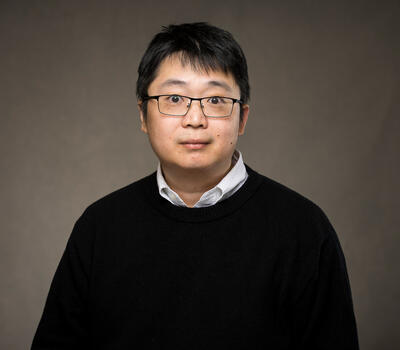
Aurélien Citrain is a researcher at INRIA's MAGIQUE 3D project, specializing in numerical analysis and scientific computing for elasto-acoustic problems. He earned his PhD in 2019 with a thesis on hybrid finite element methods for seismic wave simulation, advised by Hélène Barucq and Christian Gout. His work bridges computational mathematics and applied engineering. PhD defense: December 16, 2019 Advisors: Christian Gout (INSA Rouen), Hélène Barucq (INRIA) Project: Member of M2NUM (ERDF/Normandie Regional Council funding) Research focuses on: Developing hybrid numerical schemes combining Discontinuous Galerkin and Spectral Element methods Modeling seismic wave propagation and elasto-acoustic coupling Multi-scale simulations for engineering applications His publications highlight expertise in computational mechanics and geophysical simulations. He collaborates with institutions like INSA Rouen and BCAM Bilbao, with prior internships at INRIA Magique 3D and BCAM.
Pierre Borgnat is a CNRS Research Professor at École Normale Supérieure de Lyon, leading the Signals, Systems & Physics group. His research integrates signal processing, graph theory, and machine learning for complex data analysis. Key contributions include: Multiscale methods for graph signals and networks Time-frequency analysis of nonstationary data Applications in transportation, neuroscience, and climate science Graph-based learning with optimal transport He directs the 'Signals, Systems & Physics' group and serves as Area Editor for IEEE Transactions on Signal Processing. Recent projects include ACADEMICS (machine learning for complex models) and climate extremes forecasting.
Ingo Feinerer serves as an Associate Professor at Vienna University of Technology's Faculty of Informatics, specifically within the Institute of Information Systems Engineering (E192-02). His research bridges theoretical computer science and practical applications in database systems, artificial intelligence, and text mining, with significant contributions to configuration management and formal methods. His educational background includes: PhD Dissertation (2007): A formal treatment of UML class diagrams as an efficient method for configuration management Diploma Thesis (2005): Formal program verification: a comparison of selected tools and their theoretical foundations Feinerer's research focuses on database theory (particularly schema mapping and dependencies), AI-driven configuration systems using integer linear programming, and text mining infrastructure development in R. His work combines theoretical rigor with practical tool development, notably through the textcat and tm packages. The integration of formal methods in software engineering remains a consistent thread throughout his publications. Analysis of his 15 most recent publications reveals strong specialization in database constraints (40%), text mining applications (30%), and software configuration systems (30%), with increasing interdisciplinary work connecting computer science to digital humanities. His notable recognition includes: INiTS Award (2007) for technology commercialization potential Feinerer has supervised doctoral research including F. I. Chertes' work on schema mapping languages and diploma theses on UML semantics and probabilistic databases. He led major research projects HINT (2012-2017) and SEE (2012-2016) focusing on database technologies and information systems. His work demonstrates consistent funding through Austrian national research programs. As a core member of the Databases and Artificial Intelligence research group, he collaborates extensively on R package development for text analysis and contributes to international workshops on theoretical aspects of software engineering.
Professor Dominik Göddeke is a Full Professor of Computational Mathematics at the University of Stuttgart, leading the Institute of Applied Analysis and Numerical Simulation. He concurrently serves as Vice Dean for Mathematics and co-spokesperson of the MaRDI consortium under the National Research Data Initiative. His expertise spans numerical methods for partial differential equations, high-performance computing, and hardware-oriented algorithm design. Education: PhD in Mathematics (2010) and Diplom in Computer Science (2004) from TU Dortmund. He has held academic positions at TU Dortmund (2011–2015) and the University of Stuttgart since 2015. His research focuses on scalable parallel algorithms, fault-tolerant computing, and interdisciplinary applications in geophysics and biomedical engineering. Research interests include GPU computing, domain decomposition methods, and green computing. His work emphasizes practical implementation techniques and software frameworks for large-scale simulations. Recent projects include the OpenDiHu framework for neuromuscular systems and preconditioners for Stokes-Darcy problems. His awards reflect teaching excellence and research impact, including the 2020 Digital Teaching Award and multiple best paper accolades. He actively contributes to international conferences and serves on editorial boards for computational science journals. Labs/Teams: Director of the Institute of Applied Analysis and Numerical Simulation, affiliated with the Stuttgart Centre for Simulation Sciences and the Cluster of Excellence for Data-Integrated Simulation Science.
Ivan Bratko is a Full Professor at the Faculty of Computer and Information Science, University of Ljubljana, and has held leadership roles including Head of AI Lab (1986–present) and former Head of AI Department at Jožef Stefan Institute (1996–2004). His career spans over four decades, with research contributions in machine learning, qualitative modeling, and artificial intelligence applications. Developed the KARDIO expert system for cardiac arrhythmia diagnosis using deep qualitative knowledge Innovated ABML (Argument-Based Machine Learning) for faster, interpretable learning with expert annotations Created Q 2 learning methods that integrate qualitative constraints with quantitative prediction Contributed to minimax search analysis and decision tree pruning algorithms His work has earned prestigious awards, including the Zois award (2007) and Fellow of ECCAI (2000). He continues part-time research at Jožef Stefan Institute (since 1975) and authored influential textbooks like Prolog Programming for Artificial Intelligence .
Noël Hallemans is a Postdoctoral Research Assistant at the Control Group of the School of Engineering Science, University of Oxford . He earned his MEng (2019) from Vrije Universiteit Brussel and Université Libre de Bruxelles , followed by a PhD (2023) from Vrije Universiteit Brussel and University of Warwick , where he developed frequency domain data-driven modeling for electrochemical impedance spectroscopy in lithium-ion battery analysis. Research Focus: Electrochemical impedance spectroscopy for nonlinear/time-varying systems Battery modeling and real-time process control Nonlinear dynamics in electrochemical systems System identification and fractional order modeling Article Trends: His work spans Li-ion battery diagnostics , electroplating , and industrial process control , with a focus on operando techniques and nonlinear system identification across materials science , electrochemistry , and control theory . Scientific Awards: 2019: Best Master Thesis Prize (Vrije Universiteit Brussel and Université Libre de Bruxelles) Grants & Funding: His PhD research was supported by the Research Foundation Flanders (FWO-Vlaanderen, grant G.0052.18N) and the Flemish Government Methusalem Fund (METH1) . Current Projects: At Oxford, he investigates real-time battery impedance characterization and process control for battery manufacturing , collaborating with the Battery Intelligence Lab and researchers like Professor Stephen Duncan and Professor David Howey .
Ekaterina A Rapinchuk is an Assistant Professor in the Departments of Mathematics and Computational Mathematics, Science and Engineering (CMSE) at Michigan State University. Her research focuses on developing graph-based algorithms and spectral methods for machine learning applications, particularly in small data classification, molecular science, and hyperspectral imaging. She holds a joint appointment across two departments, reflecting her interdisciplinary work at the intersection of mathematics and computational science. Research Interests : Graph algorithms for data classification and clustering Spectral graph theory and Laplacian-based methods Machine learning for molecular and biomedical data Optimization in high-dimensional spaces Applications of topological data analysis Publications Trends : Recent work emphasizes addressing data scarcity through graph-based techniques, integrating transformer networks with spectral methods, and correcting labeling errors in training datasets. Her research bridges theoretical mathematics with practical applications in sensor data analysis, chemical informatics, and biomedical imaging. Grants & Advising : While specific grant details are not listed, her work aligns with NSF-funded research areas in computational mathematics and data science. No advising information is currently available.
Sebastian Schlecht is a Visiting Professor in the Department of Information and Communications Engineering at Aalto University, associated with the Virtual Acoustics research group. He holds a Doctoral degree in Engineering and Technology from Friedrich-Alexander-Universität Erlangen-Nürnberg (2017). His research focuses on acoustics, signal processing, and audio engineering, with a strong emphasis on reverberation, impulse response analysis, and feedback systems. Key research contributions include advancements in room impulse response completion, feedback delay networks, and audio processing libraries. His work has led to multiple awards, including the Best Paper Award at WASPAA 2019 and recognition at DAFx conferences. Schlecht leads the CExAM ARTS-ELEC project (2023–2027), exploring multi-objective optimization in digital signal processing. He has supervised five theses and contributed to datasets like the 'Sauna Impulse Responses' and 'Variable Acoustics Room Arni' collections. His research aligns with UN Sustainable Development Goals related to innovation and infrastructure.
Prasanth B. Nair is a Researcher at the University of Southampton affiliated with the Computational Engineering and Design Group. His work focuses on developing advanced computational methodologies for engineering and physical systems involving stochastic processes and uncertainty. His research spans Computational Engineering, Numerical Methods, Stochastic Partial Differential Equations, and Engineering Simulation. Key contributions include novel numerical schemes for solving stochastic differential equations and partial differential equations on random domains, with applications in physics, chemistry, and aerospace engineering. His methodologies emphasize robustness in modeling systems with inherent randomness. Nair's 2011 publications reveal a consistent focus on bridging theoretical mathematics with practical engineering challenges, particularly in uncertainty quantification for physical systems. His work demonstrates interdisciplinary connections between computational physics, chemical engineering, and numerical analysis. He participated in EPSRC-funded project EP/F006802/1 (now inactive), collaborating within the Computational Engineering and Design Group—a multidisciplinary unit integrating analytical, computational, and experimental techniques for engineering simulation. No information is available regarding student supervision or additional grants. Nair is embedded in the Computational Engineering and Design Group, which operates as a center for advanced engineering simulation combining high-fidelity computational models with experimental validation across physical domains.
Dr. Jonathan Schmidt is a Lecturer at the Department of Materials, ETH Zurich. His research focuses on computational materials science, integrating machine learning and high-throughput methods to predict material properties, design novel materials, and advance electronic structure theory. He specializes in quantum critical phenomena, superconductivity, and the development of open-source tools for materials discovery. Key research areas include symmetry-based material design, density functional theory corrections, and the OPTIMADE API for data exchange. His work bridges machine learning with traditional computational methods to address challenges in phase stability prediction, electronic band structure analysis, and high-throughput screening. Dr. Schmidt collaborates on interdisciplinary projects involving crystallography, thermodynamics, and advanced software frameworks like Atomate2. His contributions aim to accelerate materials innovation through automated workflows and data-driven approaches.
Anuj Srivastava is a Professor in the Department of Statistics at Florida State University. His research focuses on statistical shape analysis, computational geometry, and their applications in medical imaging, computer vision, and machine learning. He develops novel methods for analyzing complex shapes, trajectories, and functional data, with particular emphasis on elastic geometry and manifold-based techniques. Key research themes include shape analysis of 3D objects, brain subcortical structures, and tree-like anatomical networks. His work integrates statistical theory with computational tools to address challenges in biomedical imaging, motion tracking, and data-driven modeling. Notable contributions include frameworks for longitudinal elastic shape analysis (LESA), graph-based mobility modeling, and Bayesian emulation of human motion. Recent projects involve NSF-funded collaborations on stochastic shape processes, pandemic simulation (RAW-ALPS), and statistical analysis of chromosome conformations. His methods are applied to diverse domains such as neuroimaging, cell morphology analysis, and electrical load profiling. The research emphasizes interdisciplinary applications with clinical, environmental, and engineering relevance.
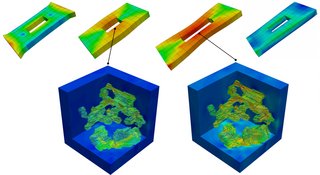
Martin Lanser is a Researcher at the University of Cologne's Department of Mathematics and Computer Science and a Core Scientist at the Center for Data and Simulation Science (CDS). His work focuses on developing efficient numerical methods for computational science and engineering problems, particularly targeting modern many-core architectures with million-way parallelism. His research spans Computational Science and Engineering, Numerical Methods, and Parallel Computing, with specialized expertise in Domain Decomposition Methods, Multigrid Approaches, and Computational Homogenization for heterogeneous solid mechanics. Lanser's theoretical work emphasizes nonlinear solvers for strongly heterogeneous materials, integrating algebraic multigrid techniques to enhance scalability in extreme-scale simulations. Analysis of his publication record reveals consistent innovation in scalable domain decomposition methods since 2014, with recent work targeting exascale computing through the FE2TI software framework. His research demonstrates strong interdisciplinary connections between computational mathematics, materials science, and high-performance computing, particularly in applications for dual-phase steel modeling. No scientific awards are documented in the provided information. Lanser's advising and grant activities are not specified in the source material, though his collaborative publications indicate extensive partnerships with researchers like Axel Klawonn and Oliver Rheinbach on projects including SCALEXA and High-Q club initiatives. As a core developer of the FE2TI software package—a computational homogenization implementation selected for the High-Q club—Lanser contributes to the CDS's research in quantitative modeling of complex physical systems. His work directly supports exascale computing projects focused on parallel domain decomposition methods and is integrated into the university's numerical analysis research infrastructure at numerik.uni-koeln.de.
Giancarlo Sangalli is a Professor in the Department of Mathematics at the University of Pavia. His research focuses on Scientific Computing, particularly Numerical Methods and Applications, with a strong emphasis on Isogeometric Analysis (IGA) for solving Partial Differential Equations (PDEs). He leads the Scientific Computing group and contributes to interdisciplinary fields such as computational mechanics, biomedical engineering, and environmental modeling. His work integrates advanced numerical techniques, including high-order finite element methods, space-time formulations, and matrix-free solvers, to address challenges in computational efficiency and accuracy. Key areas of application include cardiac electrophysiology, wave propagation, and groundwater flow modeling. Sangalli has pioneered low-rank solvers, Tucker tensor-based methods, and immersed boundary techniques to enhance computational scalability. He actively publishes in top journals and conferences, with a focus on advancing IGA theory and its applications to real-world problems. His research also explores uncertainty quantification, Bayesian calibration, and nonlinear dynamics. Despite no explicitly listed awards, his extensive publication record reflects recognition in computational mathematics and engineering. Sangalli collaborates internationally and maintains a research website at https://mate.unipv.it/sangalli . His group's work is supported by projects in computational electromagnetics, structural mechanics, and fluid-structure interaction, demonstrating a commitment to bridging theoretical advancements with practical engineering solutions.
Xiao Fu is an Associate Professor in the Department of Electrical Engineering and Computer Science at Oregon State University's College of Engineering. He holds a B.S. (2005) and M.S. (2010) in Communications and Information Engineering and Signal and Information Systems from the University of Electronic Science and Technology of China (UESTC), and a Ph.D. (2014) in Electronic Engineering from The Chinese University of Hong Kong (CUHK). His research focuses on machine learning, signal processing, and optimization, with applications in nonlinear factor analysis, unsupervised learning, and deep neural networks for signal processing tasks. He has received notable awards including the 2022 NSF CAREER Award and the 2024 OSU Promising Scholar Award. His work emphasizes developing robust algorithms for factor analysis (e.g., tensor and matrix factorization), large-scale optimization in data mining, and deep learning techniques for hyperspectral imaging, radio map estimation, and crowd-sourced label analysis. Key research groups affiliated with him include Data Science and Engineering, Artificial Intelligence and Robotics, and Communications and Signal Processing. His recent projects include advancing unsupervised machine learning to reduce reliance on labeled data in AI systems and exploring applications in environmental sensing and medical imaging. Xiao Fu's publications span topics like radio map estimation via latent-domain denoisers, noisy label learning with crowd wisdom, and identifiability in nonlinear mixture models. His research bridges theoretical advancements in optimization and practical applications in wireless communication, ecological networks, and biomedical imaging. Current efforts aim to enhance unsupervised deep representation learning and develop scalable algorithms for high-dimensional data analysis. Awards: NSF CAREER Award (2022), OSU Promising Scholar Award (2024) Grants: NSF-funded CAREER Award project on nonlinear factor analysis tools Labs/Teams: Affiliated with interdisciplinary teams in signal processing, AI, and ecological systems modeling
Dr. Ivo Dravins is a PostDoc at the Chair of Numerical Analysis within the Faculty of Mathematics at Ruhr-Universität Bochum, working in Prof. Katharina Kormann's research group. He focuses on preconditioning techniques for implicit time-stepping algorithms, particularly within the PDExa project. His research spans numerical linear algebra, implicit Runge-Kutta methods, and PDE-constrained optimization. Research Interests: Preconditioning of large-scale linear systems Implicit time-stepping algorithms for PDEs High-order numerical methods Optimal control problems with constraints Numerical linear algebra applications Key Research Trends: His work emphasizes scalable preconditioning strategies for parallel computing environments, with a focus on achieving high-order accuracy in time integration. Recent efforts have addressed stage-parallel Runge-Kutta implementations and spectral analysis of preconditioned matrices in PDE-constrained optimization contexts. Labs/Teams: Member of Prof. Kormann's Numerical Analysis group, contributing to the PDExa project. Associated with the Kormann Group within the Faculty's Numerics division.