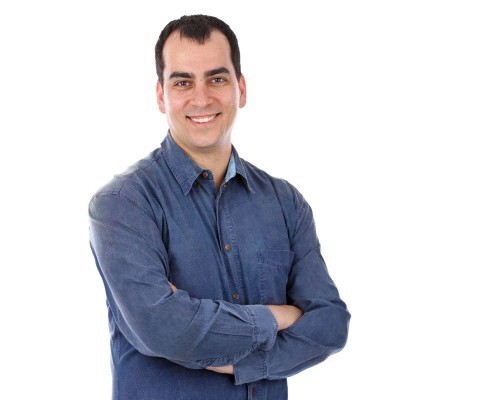
Prof. Yair Weiss is a faculty member at the School of Computer Science and Engineering, The Hebrew University of Jerusalem . He holds a PhD in Brain and Cognitive Sciences from MIT and an MSC in Applied Mathematics from Tel-Aviv University. Education: MSc in Applied Mathematics, Tel-Aviv University (1993) PhD in Brain and Cognitive Sciences, MIT (1998) His research focuses on Human and Machine Vision , Machine Learning , Bayesian Methods , and Neural Computation . Recent work explores adversarial examples, generative models, and robustness in neural networks. Recent publications highlight trends in: Understanding neural network representations Advancements in GANs and adversarial training Image restoration and translation techniques Perceptual distance modeling Bayesian approaches to computer vision Mathematical analysis of deep learning architectures
Shie Mannor is a Professor at the Technion - Israel Institute of Technology in the Department of Electrical Engineering. He also holds a visiting professorship at Cornell-Tech in New York City and is affiliated with the Technion Machine Learning Center and the Grand Technion Energy Program . Key Research Interests: Machine Learning: Theory, algorithms, and applications to high-dimensional data and dynamics modeling. Reinforcement Learning and Markov Decision Processes: Adaptive control in large stochastic systems. Learning and control under uncertainty: Robust/stochastic optimization frameworks. Game Theory: Stochastic, dynamic, and network games applied to power markets and resource allocation. Multi-agent systems: Online learning and designing economic systems with optimal equilibria. Power Grid: Data-driven reliability, pricing, and decision-making in smart grids (e.g., EU-funded GARPUR project). Applications: Communication network optimization, mobile health, LDPC codes, and large-scale optimization problems. He actively seeks postdocs, graduate, and undergraduate students with strong mathematical or programming skills for projects in mobile phone programming and complex system optimization. Contact: shie.mannor@ee.technion.ac.il | Phone: ++972-4-829-3284
Prof. Danny Dolev is a distinguished academic holding the Berthold Badler Chair in Computer Science at The Hebrew University of Jerusalem's Rachel and Selim Benin School of Computer Science and Engineering. He is an ACM Fellow and IEEE Fellow. His research focuses on distributed computing, fault-tolerant systems, algorithms, and secure protocols. He has held leadership roles, including Director of his school (1999–2002) and Chair of the Israeli National Committee for Information Technology (1994–1998). Education: B.Sc., The Hebrew University of Jerusalem, 1971 M.Sc., Weizmann Institute of Science, 1973 PhD., Weizmann Institute of Science, 1979 Research Interests: Danny Dolev's work spans distributed algorithms, Byzantine fault tolerance, consensus protocols, and hardware algorithms. His contributions include groundbreaking research on self-stabilizing systems, secure communication, and fault-tolerant clock synchronization. His HEX and Chronos protocols exemplify innovations in scalable synchronization and network security. Publications: His recent work emphasizes Byzantine agreement, asynchronous fault tolerance, and game-theoretic distributed systems. Key papers address optimal resilience in consensus algorithms and secure multi-party computation. Awards: ACM Fellow (2010) IEEE Fellow (2004) Grants & Leadership: Member of the Scientific Council, European Research Council (2010–2014) Chair of Israel's National Committee for Information Technology (1994–1998) Leadership roles at IBM Almaden Research Center (1987–1993) and Stanford University (1979–1981) Labs & Teams: His research group at Hebrew University focuses on distributed systems, with collaborations on projects like Steward (wide-area Byzantine replication) and Self-Stabilizing Circuits .
Omri Abend is an Associate Professor at The Hebrew University of Jerusalem, affiliated with the School of Computer Science and Engineering and serving as Chair of the Department of Cognitive and Brain Sciences. His research lies at the intersection of Computational Linguistics, Natural Language Processing, and Cognitive Science, with a focus on semantic representation and language acquisition modeling. His primary research interests include: Computational modeling of child language acquisition Semantic representation frameworks, particularly Universal Conceptual Cognitive Annotation (UCCA) Statistical learning and machine translation Unsupervised grammar learning and lexical relation induction Cross-lingual and cross-domain alignment in language models Evaluation methodologies for NLP systems His recent publications demonstrate a strong trend toward analyzing large language models (LLMs), exploring human-like patterns in AI, improving evaluation metrics, and applying NLP to humanitarian domains such as Holocaust testimony analysis. His work combines theoretical linguistic insights with practical machine learning applications. Scientific awards include: Outstanding Paper Award at ACL 2017 Area Chair Award for Best Paper in the Track at ACL 2023 He has supervised and collaborated with numerous researchers and students across projects in semantic parsing, machine translation, and cognitive modeling. His work has been supported by community-wide initiatives such as the MRP shared tasks, which he co-organized. He also leads research on ethical AI, open human feedback, and the computational analysis of historical narratives. Omri Abend leads several research teams focused on: The development and application of the UCCA framework for semantic annotation Cross-lingual and cross-domain knowledge representation in LLMs Computational modeling of language acquisition Evaluation and improvement of NLP systems Application of NLP to digital humanities and historical testimony analysis
Ari Shnidman is an Associate Professor in Mathematics at the Hebrew University of Jerusalem. For the 2024/25 academic year, he is a member of the Institute for Advanced Study in Princeton. His research focuses on number theory, particularly arithmetic geometry, special values of L-functions, and arithmetic statistics. Research Interests: Shnidman investigates deep connections between algebraic curves, abelian varieties, and L-functions. His work spans Tate-Shafarevich groups, Ceresa cycles, Heegner cycles, and rank distribution in elliptic curves. Key methodologies include algebraic geometry, representation theory, and computational number theory. Publications: Recent papers explore Ceresa cycles, torsion in Tate-Shafarevich groups, and arithmetic of curves like Picard curves. Collaborative work dominates his output, with frequent co-authorship on papers involving elliptic curves, L-functions, and geometric invariants. Theoretical frameworks are often complemented by computational experiments. Funding: European Research Council Israel Science Foundation Academic Leadership: Shnidman co-organizes the HUJI-BGU Workshop in Arithmetic and leads seminars including: Lunch Seminar on Transcendental Number Theory (Spring 2024) Seminar on Honda-Tate Theory (Spring 2023) Fundamental Lemmas and Fourier Transform Seminar (Spring 2021)
Ran Gelles is an Associate Professor at the Faculty of Engineering, Bar-Ilan University. He received his B.Sc. (Summa Cum Laude) and M.Sc. from the Technion–Israel Institute of Technology in 2003 and 2009, respectively, and his Ph.D. from UCLA in 2014. After a postdoctoral research associate position at Princeton University (2014–2016), he joined Bar-Ilan University in 2016. His research focuses on resilient communication protocols and distributed systems. Education B.Sc., M.Sc. – Technion–Israel Institute of Technology Ph.D. – University of California, Los Angeles (UCLA) Visiting Positions CWI, Amsterdam (2011) AT&T, New Jersey (2012) Princeton University (2013) Paderborn University (2022–2023) CISPA – Helmholtz Center for Information Security (2023) His recent work includes a 2024 publication in Interactive Coding with Unbounded Noise at RANDOM 2024, reflecting his expertise in noise-tolerant communication and distributed systems. He is also co-advising Ph.D. student Agajan Sahedov. Notable affiliations include sabbatical stays at Paderborn University, CISPA, and the Max Planck Institute for Informatics (2022–2023). In February 2025, he joined the editorial board of Scientific Reports (Springer-Nature).
Idit Keidar is currently the Dean of the Viterbi Faculty of Electrical and Computer Engineering at the Technion - Israel Institute of Technology, where she also holds the Lord Leonard Wolfson Academic Chair. She received her BSc, MSc, and PhD (all summa cum laude) from the Hebrew University of Jerusalem in 1992, 1994, and 1998 respectively, with Danny Dolev as her PhD advisor. She completed her postdoctoral studies at MIT with Nancy Lynch. Her academic lineage includes notable figures such as Copernicus, Leibniz, Jacob Bernoulli, Euler, Lagrange, Laplace, and Poisson. Keidar's research focuses on fault-tolerant distributed and concurrent algorithms and systems, with particular interest in distributed storage theory and systems, concurrent data structures and transactions, and scalable Byzantine fault-tolerance. She approaches her work with the goal of finding theoretical foundations that can help explain and improve practical implementations. Her research has significant implications for large-scale distributed systems, cloud computing, and multi-core architectures. Keidar has made substantial contributions to the field through her editorial work as editor of the ACM SIGACT News Distributed Computing Column from 2007-2013 (previously co-editing with Sergio Rajsbaum from 2000-2007). Her publications span theoretical foundations, practical applications, and educational aspects of distributed computing. The trends in her work show a consistent focus on bridging theory and practice in distributed systems, with increasing attention to large-scale systems, transactional memory, and Byzantine fault tolerance as these areas have gained practical importance. Scientific Awards and Recognition: Lord Leonard Wolfson Academic Chair Editor of ACM SIGACT News Distributed Computing Column (2000-2013) Keidar has held significant leadership positions in the distributed computing community, serving as PC Chair for PPoPP 2019 and PODC 2018, Organizing Committee Chair for DISC 2013 in Jerusalem, and PC Co-Chair for LADIS 2021. She has been actively involved with the Networked Software Systems Laboratory at the Technion. Beyond her technical work, Keidar is also a creative writer, with a short story winning 2nd place in the Shirat Ha'Mada creative writing contest for scientists.
Dr. Omri Finkel is an Assistant Professor and Principal Investigator at the Alexander Silberman Institute of Life Sciences, The Hebrew University of Jerusalem. His research focuses on terrestrial microbial ecology and plant-microbe interactions, with a particular emphasis on understanding microbiome assembly dynamics and their effects on plant health. He leads the Finkel Lab, which explores topics such as desert plant microbiomes and the ecological context shaping microbiome functionality. Dr. Finkel has been awarded an ERC Starting Grant 2022 for his project on molecular evolution of plant-microbiome interactions in drylands. His work combines experimental microcosms, synthetic communities, and genomic approaches to dissect microbiome-induced plant phenotypes and desert microbiome adaptations. The lab collaborates on projects involving drought-resistant crops, microbial community design, and functional genomics. Students and researchers in his lab include PhD candidates Tzila Vikiniansky and Zheniya Mogilevski, along with several MSc students. The lab is actively involved in analyzing root microbiome responses to environmental stressors, including drought tolerance and pathogen resistance.
Michael Elkin is a Professor in the Department of Computer Science at Ben-Gurion University of the Negev, Israel. His research focuses on Theoretical Computer Science, Discrete Mathematics, and Algorithms, with specializations in graph algorithms, distributed computing, and metric embeddings. He has held editorial roles, including Associate Editor of the Journal of Computer and System Sciences, and has contributed to numerous program committees for top conferences like FOCS and SODA. Elkin's research interests include low-distortion embeddings, streaming and dynamic graph algorithms, and approximation algorithms. His work bridges distributed and centralized algorithm design, with applications in network optimization and computational geometry. Recent trends in his publications emphasize efficient spanner constructions, symmetry-breaking in distributed systems, and algorithmic approaches to graph coloring and metric spaces. Elkin has advised multiple PhD and Master’s students, including Leonid Barenboim (winner of the 2015 Distributed Computing Doctoral Dissertation Award) and Shay Solomon. He has been awarded Best Paper and Best Student Paper awards at PODC conferences for groundbreaking contributions to distributed algorithms. Additionally, he leads a postdoctoral research group focusing on graph algorithms and metric embeddings, collaborating with Eden Chlamtac and Ofer Neiman. Teaching highlights include courses on Distributed Algorithms, Design of Algorithms, and Metric Graph Algorithms. His academic service includes organizing academic programs and mentoring early-career researchers in theoretical computer science.
Dr. Michael Kalyuzhny is a Senior Lecturer and Principal Investigator at the Hebrew University of Jerusalem's Department of Ecology, Evolution and Behavior. His research focuses on understanding ecological community dynamics, species coexistence mechanisms, and the application of data science to ecological systems. He won the prestigious Alon Fellowship in 2024. Education: BSc in Biology, Hebrew University MSc and PhD in Ecology, Evolution & Behavior, Hebrew University Postdoctoral research at the University of Michigan and University of Texas at Austin Research Interests: Exploring how ecological communities maintain high biodiversity, spatial and temporal dynamics of species, and the integration of theoretical models with large-scale datasets. Current projects include studying conspecific negative density dependence in tropical forests and the impact of environmental heterogeneity on biodiversity. Awards: Alon Fellowship (2024) Advising & Grants: Supervising MSc student Yuval Neumann, investigating disturbance effects on plant community diversity. Active in securing grants for theoretical ecology and field experiments. Labs & Teams: Leads the Kalyuzhny Lab, which combines theoretical ecology with empirical studies to address fundamental questions in community assembly and biodiversity maintenance.
Eran Yahav is a Professor in the Computer Science Department at the Technion, Israel Institute of Technology, and serves as CTO at Tabnine. His research bridges programming languages, software engineering, program analysis, and machine learning, focusing on program synthesis, verification, and code intelligence. Research Interests: His work spans program synthesis , abstract interpretation , verification of concurrent systems , binary analysis , and AI for code . He leads the PRIME project, which uses machine learning and static analysis to enable programming with millions of examples, improving code completion, search, and prediction. The recent publications reflect a strong trend toward integrating neural models with program analysis—using structured representations of code (e.g., AST paths) for property prediction, generating sequences from code (code2seq), learning distributed representations (code2vec), and interpreting neural networks via automata extraction. His work consistently appears in top-tier venues such as POPL, PLDI, ICSE, OOPSLA, and ICLR. Scientific Awards: Best paper award at ISSTA'07 Best paper award at ISSTA'06 Advising and Grants: He has advised numerous PhD and Master’s students, many of whom have published in premier conferences and now hold academic or industry positions. While specific grants are not mentioned, his sustained high-impact research and leadership in major projects (e.g., PRIME, Fender, SAFE) imply significant funding support. He has served on program committees for PLDI, POPL, CAV, OOPSLA, and VMCAI, reflecting his standing in the programming languages and verification communities. Labs and Teams: He leads a research group focused on program analysis and synthesis, with strong collaborations, particularly with Martin Vechev and others, on concurrency, synthesis, and machine learning for code. The group has developed influential tools such as PRIME, code2seq, code2vec, TRACY, and SAFE.
Zvi Lotker is a Lecturer in the Department of Communication Systems Engineering at Ben-Gurion University. His research focuses on computer networks, distributed systems, and mobile/wireless computing. Education: Ph.D. in Electrical Engineering (2003), Tel-Aviv University, Israel. Dissertation: Algorithms in Networks under Prof. Boaz Patt-Shamir. M.Sc. in Mathematics (1998), Tel Aviv University. Thesis: On the d distance between iid and Markov process under Prof. Meir Smordinsky. B.Sc. in Mathematics & Computer Science (1991), Ben-Gurion University. B.Sc. in Industrial Engineering (Information Systems track, 1991), Ben-Gurion University. No scientific awards, grants, or advised students are listed in the provided information.
Dr. Miri Adler is a Senior Lecturer (Assistant Professor) at the Alexander Silberman Institute of Life Sciences and the Faculty of Medicine at the Hebrew University of Jerusalem, and a visiting scientist at Yale University's Tananbaum Center. Her research focuses on uncovering universal principles of tissue organization and function, particularly in health and disease, with an emphasis on fibrosis, cell-cell communication circuits, and systems-level analysis of complex biological networks. She leads a multidisciplinary team combining theoretical models, computational methods, and experimental data to study tissue repair, homeostasis, and pathological processes like fibrosis. Education: Ph.D. in Physics (Weizmann Institute, 2019), M.Sc. in Physics (Weizmann Institute, 2013), B.Sc. in Physics (Technion, 2010). Previous positions include postdoctoral fellowships at the Broad Institute (MIT/Harvard) and Weizmann Institute, and a visiting scientist role at Yale. Research interests span network hyper-motifs, division of labor in tissues, fibrosis mechanisms, and fold-change detection in biological systems. Key contributions include identifying fibrosis subtypes (‘cold’ and ‘hot’) and developing theoretical frameworks to predict therapeutic targets. Her work integrates concepts from mathematics, computer science, and physics with biology. Scientific awards include the Alon Fellowship (2024), EMBO Excellence in Life Sciences Fellowship (2020), and the Lee A. Segel Prize in Theoretical Biology (2017). The lab actively seeks students and researchers in computational biology, systems biology, and mathematical modeling. Advising: Supervises graduate and undergraduate students in projects related to tissue dynamics, network analysis, and fibrosis modeling. Collaborates with experimental labs to validate theoretical predictions in heart, lung, and liver tissues. Current team includes postdocs, M.Sc. students, and undergraduate researchers. Labs & Teams: The Adler Lab at Hebrew University focuses on multidisciplinary approaches to tissue biology, with a particular emphasis on fibrosis and systems-level tissue organization. Collaborations span institutions including Yale University and the Broad Institute.
Professor George Weiss is a Professor of Control Engineering at the Department of Electrical Engineering - Systems, Faculty of Engineering, Tel Aviv University. He has been at Tel Aviv University since October 2007, following previous appointments at Imperial College London (1998-2007), Exeter University (1996-1998), Ben-Gurion University (1991-1996), and The Weizmann Institute (1991-1992). His research bridges theoretical foundations of control systems with practical applications in renewable energy integration and power electronics. Professor Weiss earned his PhD in Applied Mathematics from The Weizmann Institute of Science in Israel in 1989 and his MEng in Control and Computer Engineering from the Polytechnic Institute of Bucharest in 1981. His academic journey includes postdoctoral positions at Virginia Tech (1989-1991) and Brown University (1988-1989). His research focuses on distributed parameter systems, repetitive control, internal model based control, passive and conservative systems, control in power electronics, and grid integration of renewable energy. He is renowned for developing the concept of "synchronverters" with Qing-Chang Zhong, enabling grid integration of large renewable energy generators. His work spans theoretical mathematical control and practical industrial applications, with significant contributions to wave energy conversion and wind turbine vibration suppression. Analysis of his recent publications reveals a strong emphasis on renewable energy applications, particularly wind and wave energy systems, alongside fundamental theoretical work on well-posed systems and distributed parameter control. His research integrates mathematical rigor with practical engineering solutions for energy conversion systems. Professor Weiss has received substantial research funding including a 4M Euro "ConFlex" grant from the European Commission (as PI) and multiple grants from the Israel Science Foundation. His work has been supported by EPSRC, the Royal Society, and industry partners including MST, Coriolis, Solar Edge, Bioness, and Synvertec. He has supervised numerous PhD students who have gone on to prominent academic positions worldwide and serves as academic responsible for the Control Teaching Laboratory. His consulting work demonstrates the practical impact of his research across the renewable energy sector.
Michael London is an Associate Professor at The Hebrew University of Jerusalem's Edmond and Lily Safra Center for Brain Sciences. His research focuses on the interface between biophysical properties of neurons and information encoding, particularly nonlinear dendritic processes and neuronal noise effects. Key projects involve studying sensory systems (mouse barrel cortex) and self-generated activity (ultrasonic vocalization circuits). Techniques include patch-clamp, two-photon imaging, optogenetics, and computational modeling. Notable collaborations include work on cortical interneurons with Idan Segev and studies of adrenergic modulation with Inbal Goshen. His lab has published extensively on topics like neural coding dynamics, circuit function, and neuron-network interactions. He advises a team of ~9 PhD students and postdocs, focusing on experimental/theoretical integration. Laboratory location: Goodman Brain Sciences Building, Level 1, Room 2103. Active in neuroscience education through ELSC's PhD program and summer internships. Maintains an open-source lab website at www.mikilon.org with research tools and datasets.