Prof. Dr.-Ing. Clemens Westerkamp is a full-time professor in the Faculty of Engineering and Computer Science at Osnabrück University of Applied Sciences . With a Ph.D. in Electrical Engineering from Leibniz University Hannover (1996), his career spans academia and industry, including roles as R&D VP at Algovision Systems GmbH and development leader at Controlware GmbH. Research Focus: Applied research in intelligent distributed systems , Industry 4.0 , and IoT , particularly in agricultural contexts. Key projects include PACE (Ambient Communication Systems) and collaborations with Airbus, Stanford University, and agritech firms. Selected Scientific Contributions: Co-author of DIN SPEC 16593 for Industry 4.0 service architectures EU reviewer for Aeronautics and Innovative Training Networks Key member of Industrial Informatics (INDIN) research network Recent Publications analyze satellite networks for agriculture, friction modeling for autonomous systems, and energy-aware embedded software. His work bridges theoretical models with practical implementations in smart farming and remote engineering.
Dr. Paul von Bünau serves as Managing Director (CEO) of IDALab, a strategic advisory firm focused on artificial intelligence in healthcare and biotechnology. He concurrently holds an adjunct academic role at Europa-Universität Viadrina Frankfurt (Oder), where he teaches courses on AI strategy and regulatory compliance in healthcare. His educational background includes a PhD in Machine Learning (TU Berlin), M.Sc. in Pure Mathematics (University of St Andrews), and B.Sc. in Computer Science (University of Potsdam). **Professional Background**: Paul provides strategic AI guidance to multinational healthcare companies, biotech startups, and medical device manufacturers. Key engagements include building AI innovation units for a medtech company, accelerating drug discovery through AI-driven R&D, and developing AI tools for healthcare market access under EU regulations. His approach emphasizes aligning technical solutions with organizational needs and regulatory landscapes. **Research & Teaching**: At Viadrina, he delivers seminars on AI strategy (2024) and regulatory compliance in healthcare AI (2025). His research focuses on non-stationary data analysis, clinical data harmonization, and AI applications in neuroscience. Recent work includes a validated clinical data pipeline for scalable AI deployment (JMIR Medical Informatics, 2023) and algorithms for stationary subspace analysis (Physical Review Letters, 2009). **Key Takeaways from Projects**: Companies with strong engineering cultures often underestimate the cultural and structural changes required for AI integration. Rapid prototyping, talent alignment, and cross-disciplinary teams (e.g., AI + healthcare experts) are critical for success. His work highlights the transformative potential of AI in healthcare while emphasizing ethical and regulatory considerations.
Dr. Andreas Martin Lisewski is a Senior Lecturer of Science at the School of Science, Constructor University. His research focuses on computational life sciences and synthetic biology, particularly analyzing genomic information in infectious agents and exploring the biodigital convergence between molecular biology and digital communication theory. He investigates synthetic biology's societal impacts, including ethical implications and risks associated with bioengineering advancements. Dr. Lisewski holds an MSc from the University of Hamburg and a PhD from the Technical University of Munich. He has received prestigious awards such as the Sigma Xi (2025) and DAAD Rückgewinnung Stipendium (2015-2016). His teaching portfolio includes courses on synthetic biology, global health, and ethics in science and technology. His research outputs include groundbreaking studies on SARS-CoV-2 genomic analysis, vaccine effectiveness, and computational methods for protein function prediction. He serves as a Guest Editor for International Journal of Molecular Sciences and Academic Editor for Microbial Cell . Key research themes include: Decoding genomic information using digital signal processing principles Development of computational tools to distinguish synthetic from natural genomes Thermostability design in proteins for bioengineering applications Evaluation of synthetic biology's societal and environmental risks
Prof. Jürgen Schönwälder is a Professor of Computer Science at the School of Computer Science and Engineering, Constructor University Bremen gGmbH. His research focuses on computer networks, distributed systems, embedded systems, and computer security. He has held positions at TU Braunschweig, University of Twente, and Bell Labs. He leads the Computer Networks and Distributed Systems research group, which addresses challenges in robust network infrastructure and distributed systems resilience. Education: Doctoral Degree in Computer Science, Technical University Braunschweig (1996) Diploma in Computer Science, Technical University Braunschweig (1990) Research Interests: Design of scalable and resilient network services Security in distributed systems Measurement of network performance and behavior IoT and constrained device management Standardization of network protocols (e.g., NETCONF, YANG) Funded Projects: EU Horizon 2020 Concordia (2019-2023) EU FP7 Flamingo (2012-2016) Industry-funded projects in network management and security Key Contributions: Over 100 publications in top venues (IEEE/ACM Transactions, SIGCOMM) and co-chair roles in IETF working groups (NETMOD, ISMS). His work on network configuration (NETCONF), flow analysis, and IPv6 transition mechanisms has shaped modern network management practices.
Josef Viellehner is a Researcher at the German Sport University Cologne (DSHS), affiliated with the Institute of Biomechanics and Orthopaedics and the Institute for Outdoor Sports and Environmental Research. His work focuses on biomechanical analysis of sports activities, injury prevention, and equipment optimization. He has contributed to projects funded by third-party grants, including studies on cycling biomechanics, vibration effects, and sports injury risks. Viellehner holds a New Investigator Award from the International Society of Biomechanics in Sport (2019). Research interests span cycling biomechanics, musculoskeletal injury prevention, sensor calibration in sports equipment, and vibration analysis in sports performance. His projects include evaluating damping systems in cycling, saddle pressure optimization, and the biomechanical impact of treadmill running. Key collaborations involve analyzing joint moments during cycling and developing ergonomic sports equipment. Recent publications highlight advancements in dynamic calibration using machine learning, recovery patterns post-marathon, and vibration effects on neuromuscular performance. His work bridges biomechanical theory with practical applications in sports technology and injury mitigation. Awards: New Investigator Award (2019) Grants: 8 projects funded by third-party institutions, including studies on gravel-bike damping and triathlon equipment systems Labs/Teams: Collaborates with interdisciplinary teams focusing on biomechanics, sports engineering, and orthopaedic research at DSHS.
Elmar Schoch is a Lecturer at the Faculty of Informatics, Department of Distributed Systems at Ulm University. His research focuses on vehicular networks (V2X), ad hoc networks, and security mechanisms in mobile systems. He has been a contract lecturer since 2010, teaching courses like Security in IT Systems and Mobile Computing. His doctoral dissertation, 'Secure Communication in Inter-Vehicle Networks' (2009), explores security challenges in vehicular communication. He actively participates in projects like SEVECOM and has contributed to over 30 peer-reviewed publications in conferences such as ACM VANET, IEEE Globecom, and IEEE Wicomm. His work frequently addresses topics like secure geocast, VANET security, and privacy-preserving data aggregation. He has presented at workshops including KiVS and WMAN, and his research bridges theoretical modeling with practical implementation challenges in vehicular networks.
Hannes Mühleisen is a prominent database systems researcher affiliated with Centrum Wiskunde & Informatica (CWI) in Amsterdam, with a PhD from Free University of Berlin (2012) in distributed query processing. His research spans database architecture, embedded analytics, and query optimization, with significant contributions to the DuckDB open-source analytical database project. His primary research interests focus on embedded analytical database systems , query processing optimization , columnar storage , and database reliability . Mühleisen's work bridges theoretical database concepts with practical implementations, particularly in the context of analytical workloads. His research demonstrates how database systems can be optimized for modern hardware architectures including WebAssembly and tensor processing units. Mühleisen has published extensively in top database venues including VLDB, SIGMOD, ICDE, and SSDBM, with a consistent publication record from 2009 through 2025. His recent work shows increasing focus on robustness, reliability, and practical deployment of database technology in diverse environments from the web browser to scientific computing contexts. His collaborations reveal strong ties to the CWI database research group, with frequent co-authorship with Peter Boncz, Martin Kersten, and Mark Raasveldt. Mühleisen's work on DuckDB has made significant impact in the data science community as an embedded analytical database solution.
Tijs Slaats is an academic affiliated with the University of Copenhagen, Denmark. His work focuses on process mining, blockchain technology, and declarative process modeling. He has contributed to advancements in declarative frameworks like Dynamic Condition Response Graphs (DCRGs) and their applications in adaptive case management, smart contracts, and legal adjudication systems. His research bridges computer science, distributed systems, and business process management. Research interests include declarative process models, blockchain sharding protocols, formal verification of event-driven systems, and the integration of machine learning with legal processes. His work emphasizes practical applications in finance, healthcare, and public administration through collaborative projects like BRFkredit and the EcoKnow initiative. Recent articles highlight innovations in process discovery algorithms, smart contract security, and scalable blockchain solutions. His contributions span theoretical frameworks and real-world implementations, often involving interdisciplinary collaborations with institutions like Algorand and the Danish Refugee Council.
Shahram Ghandeharizadeh is a Professor at the University of Southern California (USC), known for pioneering work in database systems, distributed computing, and multimedia systems. He has authored over 178 publications and received the ACM Software System Award in 2008. His research focuses on caching strategies, data storage optimization, and distributed systems, with notable contributions to Cache Augmented SQL (CASQL) systems and flying light speck-based 3D displays. He collaborates extensively with industry and academia on projects like the BG social networking benchmark and the NOVA distributed database framework. His work bridges theoretical foundations with practical applications in cloud computing, real-time systems, and swarm robotics. Research interests include: - Cache optimization and write-back policies - Database architecture and consistency protocols - 3D visualization using flying light specks - Social networking benchmarking and scalability - Disaggregated cloud storage systems Key contributions include the Gamma Database Machine Project (1990), foundational work on continuous media servers (Mitra), and recent innovations in distributed systems like Gemini and Nova-LSM. He has advised on projects ranging from multimedia scheduling algorithms to fault-tolerant swarm-based displays. His work has been published in top venues including VLDB, SIGMOD, and ACM Multimedia, with a focus on practical implementations in cloud and edge computing environments.
Raimund Wegener is a researcher at the Fraunhofer Institute for Industrial Mathematics ITWM in Kaiserslautern. His work focuses on modeling fiber dynamics, kinetic theories, and industrial processes, particularly in the context of nonwoven materials and melt spinning. He specializes in developing numerical frameworks and stochastic models to simulate complex systems involving viscoelastic fluids, turbulent airflow interactions, and material behavior under various conditions. His research integrates applied mathematics, computational fluid dynamics, and mechanical engineering to address challenges in manufacturing processes like aerodynamic web forming, electrospinning, and nonwoven production optimization. Key contributions include advancements in predictive modeling for tensile strength inference, boundary condition formulations for viscoelastic fibers, and Pareto-optimized mass distribution strategies. Wegener’s methodologies bridge theoretical models with industrial applications, leveraging asymptotic analysis, finite volume methods, and regression-based approaches. His work is published in journals like the Journal of Computational Physics and Applied Mathematical Modeling, with a strong emphasis on interdisciplinary collaboration.
Klaus Paschek is a Ph.D. candidate in Astrophysics at the Max Planck Institute for Astronomy in Heidelberg, Germany, with affiliation to Heidelberg University. His research bridges planetary science and astrobiology, focusing on the chemical and physical processes that could lead to life's emergence. As an Executive Board member of the Origin of Life Early-career Network (OoLEN), he actively contributes to the international origins of life research community. Dr. Paschek's primary research interests center on prebiotic chemistry in extraterrestrial environments, particularly examining how carbonaceous chondrites could deliver life's building blocks to early Earth. His work investigates planetary habitability mechanisms including tidal heating effects and the synthesis pathways of critical biomolecules such as nucleobases, ribose, and vitamin B 3 within asteroid parent bodies. He combines sophisticated theoretical modeling with laboratory experimental validation to understand how prebiotic molecules form in space environments and survive delivery to planetary surfaces. His publication record demonstrates significant contributions to understanding how meteoritic material could have seeded Earth with prebiotic compounds essential for life's emergence. His research spans from specific molecule synthesis (nucleobases, ribose, vitamin B 3 ) to broader questions about early Earth conditions and the RNA world hypothesis. Through his work on tidal accelerations and cryovolcanism, he also explores energy sources that could maintain habitable conditions on other worlds. As a member of the Origin of Life Early-career Network executive board, Paschek helps organize and direct international research efforts in this interdisciplinary field, connecting chemistry, astronomy, geology, and biology to tackle one of science's most fundamental questions.
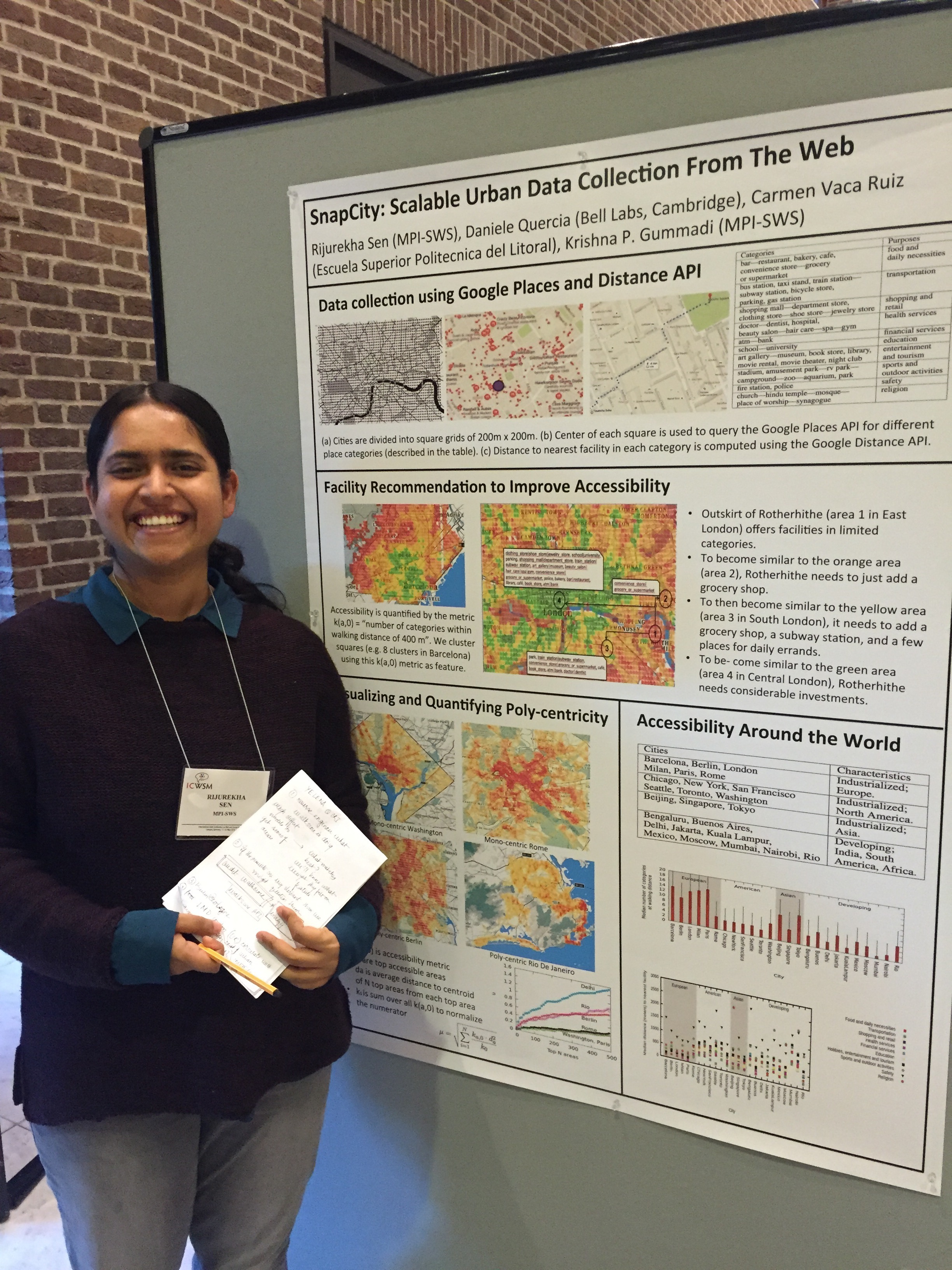
Rijurekha Sen is an Associate Professor in the Department of Computer Science and Engineering at IIT Delhi. Her research focuses on distributed, networked, and privacy-aware systems, with emphasis on societal applications such as road traffic monitoring in developing regions, human mobility measurements, and privacy-enhancing technologies for smart devices. She holds a PhD from IIT Bombay (2014), advised by Prof. Bhaskaran Raman. Education: PhD in Computer Science, Indian Institute of Technology Bombay, 2014 Research Interests: She explores interdisciplinary challenges in embedded systems, mobile computing, and cryptography. Her work balances technical trade-offs (e.g., performance vs. energy efficiency) and societal needs, such as privacy-preserving data transmission in resource-constrained environments. Recent projects include empirical audits of public policies and design of low-latency machine learning models for embedded platforms. Awards: Google India AI/ML Research Award 2018 Humboldt Post-Doctoral Fellowship (2015-2017) ACM India Doctoral Dissertation Award 2014 Multiple grants including Imprint-II (2019-2021) and Max Planck Mobility (2020-2023) Teaching: She teaches courses like COL216: Computer Architecture , COL788: Advanced Topics in Embedded Computing , and COP290: Design Practices in Computer Science . Recent courses include spring 2025 offerings. Collaborations: Engages with technical experts (e.g., cryptography, machine learning), domain stakeholders (e.g., traffic authorities, retail chains), and interdisciplinary teams to deploy prototypes. Her methodology emphasizes iterative design, in-situ testing, and long-term deployment evaluations.
Joël Ouaknine is Scientific Director at the Max Planck Institute for Software Systems (MPI-SWS) located at the Saarland Informatics Campus in Saarbrücken, Germany. He leads the Foundations of Algorithmic Verification research group and serves as an Associate Editor for the Journal of the ACM (JACM) since 2023 and previously for the Journal of Computer and System Sciences (JCSS) from 2014-2023. His research focuses on the Foundations of Algorithmic Verification and Theoretical Computer Science, particularly on decision, control, and synthesis problems for discrete and continuous linear dynamical systems using tools from number theory, Diophantine geometry, and algebraic geometry. His work also encompasses automated verification of real-time, probabilistic, and infinite-state systems, logic applications to verification, automated software analysis, and concurrency. His research integrates deep mathematical techniques with computer science theory to solve fundamental verification problems. Analysis of his recent publications reveals a strong trend toward solving decision problems in linear dynamical systems, with increasing emphasis on connections to number theory and algebraic geometry. His work bridges theoretical computer science with pure mathematics, particularly in addressing the Skolem Problem and related questions about linear recurrence sequences. Recent publications show growing interest in monadic second-order logic extensions and their applications to dynamical systems. Distinguished Paper Award at LICS 2024 for work on monadic second-order logic with arithmetic predicates ACM SIGBED Best Paper Award in 2024 for research on linear dynamical systems with continuous weight functions LICS Test-of-Time Award Winner in 2025 for a seminal 2007 paper on Metric Temporal Logic Dr. Ouaknine currently supervises PhD students Piotr Bacik, Joris Nieuwveld, and Mihir Vahanwala, and mentors postdocs Quentin Guilmant, Toghrul Karimov, and Isa Vialard. His research is supported by significant funding including an ERC Synergy Grant (2025-2031) as Coordinating Principal Investigator for the DynAMiCs project, and DFG Collaborative Research Centre 248 (2022-2026) as Principal Investigator for the Foundations of Perspicuous Software Systems. His previous ERC Consolidator Grant (2015-2021) supported work on Analysis, Verification, and Synthesis of Infinite-State Systems. He actively contributes to the academic community through service on numerous program committees including ICALP, LICS, CONCUR, and serves as organizer for workshops like Dynaverse and Bellairs. His research group at MPI-SWS collaborates extensively with mathematicians and computer scientists worldwide, creating a vibrant interdisciplinary environment focused on solving fundamental problems at the intersection of computer science and mathematics.
Ivan Gavran is a Researcher at the Max Planck Institute for Software Systems (MPI-SWS), focusing on foundational and applied aspects of computer science. His primary research interests include formal verification, reinforcement learning, multi-robot systems, and cyber-physical systems. He explores the intersection of formal methods with machine learning and robotics, aiming to create robust, provably correct systems. His work emphasizes practical applications such as smart contract verification, human-robot collaboration, and distributed task planning. He has developed tools like Lassie for interactive theorem proving and Antlab for multi-robot task coordination. Gavran’s contributions bridge theoretical computer science with real-world systems, addressing challenges in security, reliability, and scalability. While no formal awards are listed in the provided text, his publications reflect significant engagement with leading conferences in formal methods and robotics. His research often involves collaborative projects, leveraging MPI-SWS’s interdisciplinary environment to tackle complex problems in distributed systems and artificial intelligence.
Johnnatan Messias is a Research Scientist at the Max Planck Institute for Software Systems (MPI-SWS), specializing in blockchain governance, decentralized finance, and network transparency. He holds a Ph.D. in Computer Science from MPI-SWS in collaboration with Universität des Saarlandes, advised by Prof. Krishna P. Gummadi. His work focuses on improving fairness and accountability in decentralized systems through empirical analysis of blockchain transactions and governance mechanisms. Primary research areas include DeFi protocol vulnerabilities, blockchain scalability solutions (especially rollups), and transparency in transaction ordering. He develops measurement tools like Glasnost for detecting network differentiation and SatelliteLab for heterogeneous network testing. Recent work examines governance centralization in DeFi, arbitrage dynamics in layer-2 systems, and economic sustainability of token distribution mechanisms. Publications demonstrate consistent methodological innovation in analyzing blockchain data, combining network measurements, statistical modeling, and game-theoretic frameworks. Key contributions include revealing voting power concentration in DAOs, quantifying rollup performance during inscription surges, and detecting opaque transaction prioritization in Bitcoin and Ethereum. His empirical studies have exposed systemic issues like miner collusion in fee markets and arbitrage inefficiencies in AMMs. Dr. Messias has contributed to academic service as program committee member for FC, AFT, WWW, and other major conferences. He developed open-source tools including WhatsApp Monitor for tracking misinformation and public datasets for ZK-Rollup research. Current projects investigate the impact of inscriptions on EVM networks and design frameworks for decentralized insurance on blockchain infrastructures.