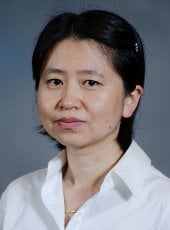
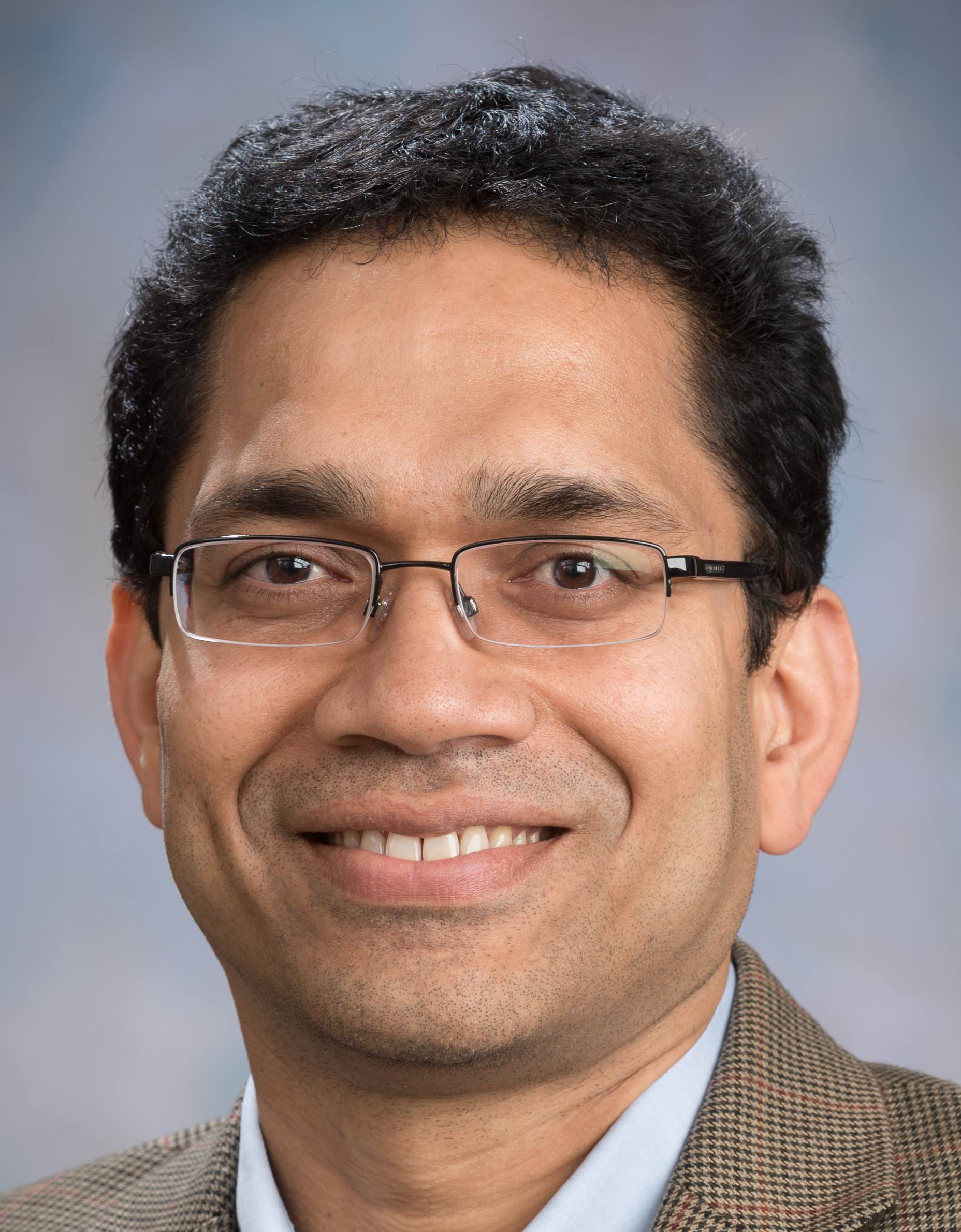
Yongmei M. Jin is a Professor in the Department of Materials Science and Engineering at Michigan Technological University (MTU), affiliated with the College of Engineering. She holds a PhD in Materials Science and Engineering from Rutgers University. Her research focuses on microstructure evolution in crystalline solids, solid-state phase transformations, magnetic domains, computational materials science, and single crystal diffraction techniques. Notable work includes studies on magnetic domain boundary dynamics in Fe-Ga alloys, electric field control of magnetism at material interfaces, and phase field modeling of microstructural evolution. Selected publications demonstrate expertise in modeling material behavior under external stimuli (e.g., electric fields, currents) and analyzing microstructural changes at atomic and macroscopic scales. Teaching responsibilities include courses on materials processing, mechanical behavior of materials, and transmission electron microscopy.
Heidi Samuelsen Nygård is an Associate Professor in Energy Physics at the Department of Physics, Faculty of Natural Sciences and Technology, Norwegian University of Science and Technology (NTNU). She holds a PhD (2014) from the Norwegian University of Life Sciences (NMBU) on thermochemical biomass conversion in molten salts and has conducted postdoctoral research on CO2 capture in molten salts. Her research focuses on: Sustainable power systems and renewable energy integration Smart grids and power flexibility Molten salt technology for CO2 capture and energy applications Convection dynamics in porous media Recent publications highlight advancements in: Electric vehicle grid integration and demand flexibility Battery energy storage optimization Molten salt-based carbon capture systems Renewable energy forecasting algorithms She supervises master’s and PhD students in topics spanning grid frequency prediction, EV scheduling, thermal energy storage, and molten salt chemical processes.
Prof. Cevdet Aykanat is a Professor of Computer Engineering at Bilkent University, Ankara, Turkey. He earned his BS/MS in Electrical Engineering from METU and PhD from Ohio State University as a Fulbright scholar. His research focuses on parallel computing, sparse matrix algorithms, graph partitioning, and high-performance computing for big data. He has been affiliated with Bilkent since 1989 and has held roles like Associate Provost. Education: BSc/MSc (METU Electrical Engineering), PhD (Ohio State University Electrical & Computer Engineering). Research interests include parallel scientific computing, combinatorial optimization, distributed systems, and large-scale data analysis. His work spans over 100 publications in top journals like IEEE Transactions and SIAM, with 5,500 citations and an H-index of 40. Awards: 1996 TUBITAK Investigator Award, 2007 METU Parlar Science Award. He led 6 TUBITAK projects and participated in EU-funded projects like PRACE-1IP to PRACE-6IP. Publications emphasize efficient parallel algorithms for sparse computations, graph partitioning, and distributed systems. His work addresses latency reduction, load balancing, and scalable data processing in HPC environments. Grants: Funded by TUBITAK, Intel SSD, and EU programs. Academic service includes editorial roles at IEEE Transactions on Parallel and Distributed Systems.
Wenbo Duan is a Senior Lecturer and MSc Programme Leader in Mechanical Engineering at the University of Hertfordshire. He holds a PhD from the University of Manchester (2010) and previously served at Brunel University London as a Research Fellow, Senior Research Fellow, and Technical Advisor. His research focuses on advanced non-destructive testing techniques, including ultrasonic and guided wave methods, finite/spectral element modeling, and acoustic communication in industrial pipelines. He specializes in numerical simulations of wave propagation in complex media, defect detection, and signal processing innovations. Education: PhD in Mechanical Engineering, University of Manchester (2010) MSc in Engineering BSc (Distinguished) in Engineering Research Interests: Ultrasonic Non-Destructive Testing (NDT) Guided Wave Defect Detection Piezoelectric-Structure Coupling Acoustic Communication in Pipes Multiphysics Spectral Element Modeling Fluid-Structure Interaction Analysis Key Projects (2021–2025): "Noise Cancelling for Powered Air Purifying Respirators" (PI) "Guided Wave Inspection in Fluid-Filled Wells" (PI) "Assessing the Impact of Strain on Temperature Readings" (Co-Investigator) Advisees & Grants: No specific advisees listed. Active in securing research funding for NDT and acoustics-related projects. Labs & Teams: Involved in the Centre for Engineering Research at the University of Hertfordshire, focusing on computational mechanics and industrial applications.
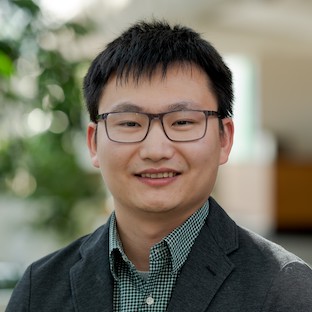
Dr. Tianqi Hong is an Assistant Professor at the University of Georgia, affiliated with the School of Electrical & Computer Engineering and the Department of Electrical and Computer Engineering. He holds a B.Sc. from Hohai University (2011), an M.Sc. from Southeast University and NYU (201?), and a Ph.D. from NYU (2016). Prior to his academic role, he served as a Principal Energy System Scientist at Argonne National Laboratory and a Senior Research Scientist at Unique Technical Services, LLC. His research focuses on power systems, power electronics, renewable energy integration, and AI-driven solutions for smart grids. Dr. Hong’s work emphasizes cybersecurity for power infrastructure, nonlinear dynamics in microgrids, and advanced control strategies. He actively contributes to IEEE Transactions across multiple journals and chairs the IEEE IAS Industrial Power Converters Committee. His recent publications address topics like AI-based photovoltaic inverter modeling, cyberattack mitigation in smart grids, and voltage regulation using distributed optimization. He has authored over 60 peer-reviewed articles, spanning from 2014 to 2025, with a focus on energy system stability, renewable integration challenges, and data-driven methodologies. His professional service includes editorial roles in top-tier journals and leadership in industry-research collaborations.
Dr. Michael L. Austin is a Senior Lecturer in Music and Sound at Edge Hill University, serving as Programme Leader in Music Production since January 2023. He previously held academic roles at Louisiana Tech University, Howard University, and others. His research focuses on sound and music in interactive media, including video games, social media, and smart devices. He is Executive Director of the Society for the Study of Sound and Music in Games and a Research Associate at the Library of Congress's Radio Preservation Task Force. Education: PhD in Humanities (Aesthetic Studies) from the University of Texas at Dallas (2011), MA in Music Theory from UT Austin (2007), and BA in Music Composition from UT San Antonio (2005). Research interests include ludomusicology, cultural representation in media, sound design for UX, and algorithmic bias in emerging technologies. His 2024 monograph Audiovisual Alterity explores identity representation in music videos, while earlier works like Music Video Games: Performance, Politics, and Play (2016) analyze music's role in digital games. Publications span video game music analysis, algorithmic bias, and sound art. His talks include topics like 'Sounding Drag Identities in Video Games' and 'Algorithmic Bias in Emerging Media.' As a sound artist, his work has been exhibited at the Smithsonian and Dallas Museum of Art.
Andrea Araldo is an Associate Professor at Telecom SudParis within the SAMOVAR research lab, specializing in NeSS (Networks, Systems, and Services). His work focuses on optimizing transportation systems, edge computing, and network resource allocation using advanced techniques like reinforcement learning and game theory. He has published extensively on topics including demand-responsive transit, vehicular cloud computing, and multi-tenant edge resource management. His research addresses challenges in urban mobility equity, infrastructure resilience, and energy-efficient network design. Research Interests: Transportation systems optimization Edge computing architectures Reinforcement learning applications Network resource allocation Urban accessibility equity Autonomous mobility systems Recent Trends in Publications: Recent work emphasizes adaptive transport network design during disruptions, equity-driven public transit planning, and vehicular cloud alternatives to traditional edge computing. He explores hybrid optimization methods combining reinforcement learning with classical algorithms for virtual network embedding and resource scheduling. Grants & Collaborations: Engages in multi-institutional projects involving institutions like Université Paris-Saclay and industry partnerships. Active in conferences such as TRB, IEEE ICC, and ACM SIGCOMM. Labs/Teams: Leads projects within SAMOVAR lab focusing on smart transportation and edge computing systems.
Mathieu BACOU is a Lecturer at Telecom SudParis, affiliated with the SAMOVAR research laboratory. His work focuses on cloud computing, distributed systems, and performance optimization, with particular emphasis on virtualization, data center management, and computer architecture challenges. He holds a PhD from the National Polytechnic Institute of Toulouse, where his thesis addressed resource management in multi-virtualized cloud environments. Education: PhD in Networks and Telecommunications, National Polytechnic Institute of Toulouse (2020) Research Interests: BACOU explores scalable systems, including function-as-a-service (FaaS), nested virtualization, and energy-efficient data center designs. Recent work addresses memory architecture limitations (e.g., 128-bit addressing) and containerization transparency. His projects often involve collaboration with industry partners to bridge academic research and practical deployment. Key Contributions: His work on Drowsy-DC introduced smartphone-inspired power management for data centers, while OFC caching systems improved FaaS efficiency. Recent papers like FaaSLoad and 128-bit address extensions highlight his focus on future computing challenges. Labs & Affiliations: Active member of SAMOVAR lab, Telecom SudParis, and collaborator with RISC-V Summit and EUROSYS conferences. Engaged in experimental practices bridging systems research and real-world infrastructure.
Ian Norheim is an Associate Professor in the Department of Electrical Energy at the Norwegian University of Science and Technology (NTNU), Gjøvik campus. His academic and professional journey spans research, industry, and academia, with a focus on electrical energy systems and renewable integration. Ph.D. in Electrical Engineering, NTNU (2002) M.Sc. in Electrical Engineering, NTNU (1997) His research interests lie in the domain of modern power systems, particularly renewable energy integration, microgrids, voltage stability, and distributed energy resources. His recent publications emphasize multi-energy systems and the technical challenges of integrating wind power into existing grids. The trend in his publications shows a consistent focus on electrical energy systems, starting with wind power integration and reserve assessment in 2008, moving to voltage optimization in distribution networks in 2018, and culminating in a comprehensive 2025 review on multi-energy microgrid design. These works reflect a deep engagement with sustainable energy transition, system modeling, and grid resilience. No scientific awards are mentioned in the available text. Ian Norheim has supervised bachelor's theses and teaches key courses in power electronics, electrical machines, high-voltage systems, and power system stability. While formal graduate advisees are not listed, his involvement in research and education suggests an active role in student mentorship. There is no mention of specific grants, but his publications indicate sustained research activity. He is affiliated with NTNU’s Department of Electrical Energy and conducts research in power system modeling and renewable integration. His work contributes to the development of resilient and sustainable energy infrastructure.
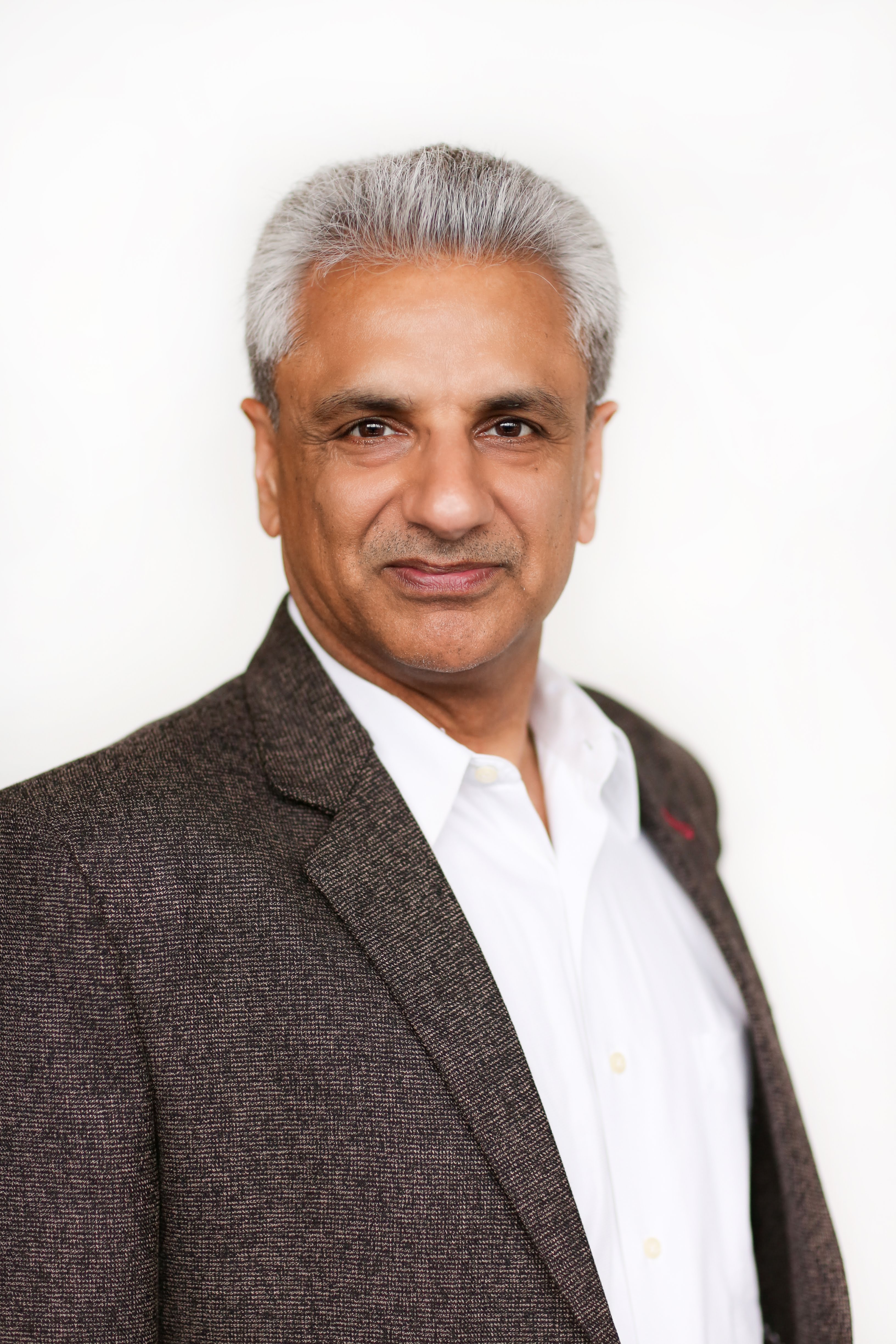
Pankaj Mehra is an Adjunct Professor in the Department of Computer Science and Engineering at the Jack Baskin School of Engineering, University of California, Santa Cruz (UCSC). He is affiliated with the Storage Systems Research Center (SSRC), now succeeded by the Center for Research in Storage Systems (CRSS). Alongside his academic role, he is the Founder and CEO of Elephance Memory, Inc., and serves as Workstream Lead for Computational x Programming (x = Memory or Storage) at the OpenCompute Project. Ph.D. in Computer Science, University of Illinois at Urbana-Champaign Former Faculty, IIT Delhi Adjunct Faculty, University of California, Wright State University Computer Scientist, NASA Ames Research Center Founder, HP Labs Russia Executive Roles: SVP & WW CTO at Fusion-io; VP at Samsung, SanDisk, Western Digital Pankaj Mehra's research centers on next-generation memory and storage systems. His work explores disaggregated memory architectures, computational storage, non-volatile memory (NVM), and data-centric operating systems. He investigates how to optimize data placement, improve system performance through intelligent caching, and restructure computing models around emerging memory technologies like CXL and persistent memory. His recent publications focus on far memory, tiered memory systems, and offloading computation to storage devices. His recent publications demonstrate a strong focus on memory disaggregation, computational storage, and non-volatile memory systems. Themes include rethinking data and pointer management in distributed memory environments, resource allocation in tiered systems, and designing operating systems that treat data as a first-class citizen. His work bridges academic research and industrial innovation, often involving collaboration with leading researchers at UCSC. Samsung R&D Award (2019) CES R&D Innovation Award (2021) Terabyte Sort Trophy by Jim Gray (1998) TPC-C Cluster Performance Records (1997) Pankaj Mehra has advised and collaborated with numerous researchers and engineers across academia and industry. His work has been supported by affiliations with HP Labs, Fusion-io, Samsung, and now Elephance Memory, Inc. He has led major research and development initiatives, including SmartSSD at Samsung and foundational work on persistent memory at HP. He has also contributed to standards efforts through the InfiniBand Trade Association. He has been a key contributor to the UCSC Storage Systems Research Center (SSRC/CRSS), collaborating with faculty and researchers including Ethan L. Miller, Heiner Litz, and Daniel Bittman. His industry leadership at Elephance Memory, Inc. and involvement in the OpenCompute Project further extend his influence in shaping future data infrastructure technologies.
Zhipeng Tan is an Assistant Professor at Huazhong University of Science and Technology, affiliated with the Data Storage and Application Lab. His work centers on innovative solutions in data storage technologies, particularly in active storage and replication mechanisms. His research interests lie in the domains of data storage systems, provenance management, and scalable storage architectures. He focuses on enhancing efficiency and scalability in large-scale storage environments, particularly through active storage frameworks and provenance data compression. The recent publications highlight a strong focus on provenance storage efficiency, active storage system design (e.g., Oasis), and scalable data management. Key themes include hybrid storage models, provenance graph compression, and compliance with T10 OSD standards, reflecting contributions to both theoretical and applied aspects of storage systems. Scientific Awards: No scientific awards mentioned in the text. Advising and Grants: There is no mention of student advising, research grants, or funding sources in the available information. Labs and Teams: Zhipeng Tan is associated with the Data Storage and Application Lab at Huazhong University of Science and Technology, a research group focused on advancing storage system technologies, including dynamic file systems and ultra-large scale data solutions.
Shrideep Pallickara is a Professor in the Department of Computer Science at Colorado State University, where he also directs the Center for eXascale Spatial Data Analytics and Computing (XSD) . His research is funded by the National Science Foundation, Department of Homeland Security, Environmental Protection Agency, Department of Agriculture, and the UK's e-Science program. Research Interests: His research lies at the intersection of machine learning and large-scale systems, focusing on: Spatiotemporal data management and analytics Extreme-scale storage systems Stream processing for IoT and cyber-physical systems Deep learning over petabyte-scale, high-dimensional datasets Model construction for forecasting natural and urban phenomena His work addresses challenges in computational tractability, resource utilization, and convergence in distributed environments. Systems developed in his lab are deployed in domains such as urban sustainability, agriculture, epidemiology, environmental monitoring, healthcare, and defense. Research Trends in Publications: His recent publications demonstrate a strong focus on scalable analytics for geospatial and environmental data. Key themes include deep learning for soil moisture and salinity prediction, efficient visualization of massive satellite datasets, spatiotemporal search and summarization, and model performance profiling across spatial domains. The work integrates scientific domain knowledge with machine learning and systems innovation. Scientific Awards: NSF CAREER Award Board of Governors Award for Excellence in Undergraduate Teaching OLIE Award N. Preston Davis Award Monfort Professorship Best Paper Award at IEEE/ACM CCGrid 2019 Best Paper Award at BDCAT 2023 Best Paper Award at IEEE Cluster 2012 Best Student Paper Award at IEEE CloudCom 2010 Shortlisted for ACM DEBS-2015 Grand Challenge Award One of the Six Best Papers at ACM/IEEE GRID 2005 Advising and Grants: He advises numerous graduate students, many of whom are co-authors on his publications. His research is supported by major grants from NSF, DHS, EPA, USDA, and UK e-Science, enabling the development of open-source systems such as Granules, NaradaBrokering, Galileo, Funnel, and Spindle. Labs and Teams: He leads the XSD Center, which develops and maintains large-scale open-source software systems involving over 2500 classes and a million lines of code. These systems are used in academic, commercial, and defense applications.
Dr. Andrea Patriarca is a Senior Lecturer in Mycology at Cranfield University’s Centre for Soil, Agrifood and Biosciences, where she leads research on fungal spoilage and mycotoxin contamination in food. She previously served as an Associate Professor and Head of the Food Mycology research group at the University of Buenos Aires and as an Independent Researcher with CONICET. She has been a visiting scientist at institutions in Denmark, Spain, and the UK, and is a member of the Joint FAO/WHO Expert Committee on Food Additives (2023–2027). Her research focuses on food mycology , particularly the genus Alternaria and Fusarium , their taxonomy, ecophysiology, and mycotoxin production. She investigates fungal contamination in cereals and vegetables, the impact of climate change on mycotoxin accumulation, and the development of rapid detection methods and eco-friendly control strategies. Her work spans from field to fork, integrating polyphasic approaches combining molecular, taxonomic, and metabolomic data. Dr. Patriarca’s recent publications highlight trends in mycotoxin detection , fungal taxonomy , food safety in plant-based products , and biological control methods . Her research has strong industrial relevance, with collaborations involving General Mills, Unilever, Tetra Laval, and other major food companies. Fundación Carolina & Ministry of Education, Science and Technology (Argentina) grant (2010) CONICET Young Researchers External Fellowships (2011) Thalmann Program, University of Buenos Aires (2013) Ministry of Science, Technology and Productive Innovation (Argentina) grant (2014) Joint FAO/WHO Expert Committee on Food Additives expert roster (2023–2027) She supervises PhD students and leads projects such as FunShield4Med and Seed Microbiome Engineering, focusing on sustainable agriculture and foresight in fungal threats. Her advisory work includes consultancy for food industries on fungal spoilage and mycotoxin mitigation. She has contributed to books with Elsevier, Springer, and CRC Press and maintains active research networks including MYTOX-SOUTH.
Styliana Avraamidou is an Assistant Professor in the Department of Chemical and Biological Engineering at the University of Wisconsin-Madison. She leads research in Process Systems Engineering, focusing on expanding Circular Economy supply chains through mathematical optimization and control. Education: PhD (2018, Imperial College), MEng (2014, Imperial College) Her research interests span Mathematical Optimization and Control , Circular Economy Systems Engineering , Energy Systems Engineering , and the Food-Energy-Water Nexus , with applications in sustainable industrial processes and smart manufacturing. Her recent publications highlight trends in bilevel optimization , distributed model predictive control , and circular economy frameworks for plastic recycling and energy systems. These works integrate data-driven models and multi-parametric programming to address industrial challenges. Scientific Awards: 2024 AIChE’s Institute for Sustainability Managing Board Member 2023 iSoGO Young Researcher Award 2022 Bluemke Assistant Professorship 2022 Faculty Sustainability Fellowship Multiple AIChE and Elsevier awards (2016–2020) Avraamidou teaches graduate courses in process optimization, including CBE 750 (Advanced Process Synthesis) and CBE 470 (Process Dynamics), while mentoring research on sustainable chemical systems.
Wenguang Chen is a researcher affiliated with Tsinghua University and Pengcheng Laboratory , specializing in computer science and high-performance computing . His work bridges theoretical advancements with practical applications in domain-specific languages , parallel programming , and machine learning . Research Interests include: Development of modular DSLs for numerical methods (e.g., Mat2Stencil) Performance optimization in distributed and parallel systems Compiler frameworks for privacy-preserving AI (e.g., FHE-based neural network inference) Graph algorithms scaling to trillion-edge datasets Applications of Rust in memory-safe pointer analysis Recent Publications span 2014–2025, focusing on: Parallelization strategies for supercomputing Compiler automation tools Extreme-scale data processing Performance variance diagnosis in production environments