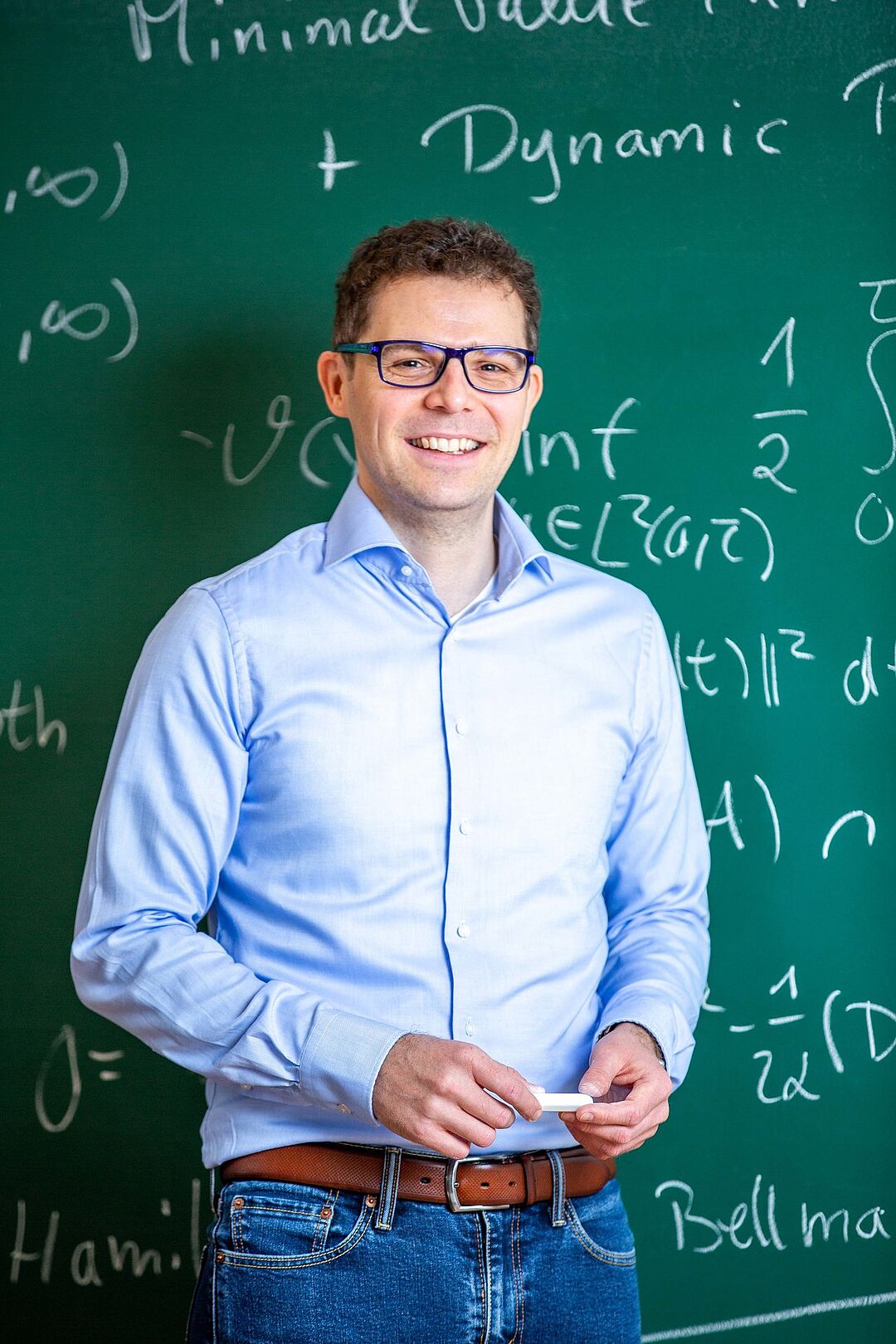
Prof. Dr. Tobias Breiten is a Professor of Mathematics at Technische Universität Berlin, affiliated with Faculty II - Mathematics and Natural Sciences and the Institute of Mathematics. His research focuses on model reduction, control theory, and numerical methods for complex systems. Education: Diploma in Technomathematik (2009, TU Kaiserslautern), PhD in Mathematics (2013, Otto-von-Guericke University Magdeburg), Habilitation (2018, University of Graz). Roles: Associate Professor (2019-2020, University of Graz), Junior Professor (2020-2022, TU Berlin), Full Professor since 2022. Research interests include structure-preserving model reduction, nonlinear observer design, and optimal control of port-Hamiltonian systems. He leads projects on topics like thermoacoustic spectra and nonlinear control perspectives. Notable publications include works on H2 optimal rational approximation, balanced truncation methods, and Mortensen observer theory. His work often bridges numerical analysis and systems theory.
Prof. Daniel Walter is a Junior Professor at the Institute of Mathematics, Humboldt University of Berlin, within the Faculty of Mathematics and Natural Sciences. His research focuses on non-smooth optimization, optimal control, and numerical analysis of partial differential equations (PDEs). He specializes in developing advanced methods for sensor placement in inverse problems and stabilizing control systems using computational techniques. His work integrates theoretical analysis with practical applications, addressing challenges in feedback stabilization, convergence of optimization algorithms, and data-driven approaches. Notable contributions include studies on extremal points in optimization norms, linear convergence rates of conditional gradient methods, and semiglobal stabilization using neural networks. Key Research Areas: Non-smooth optimization and sparse methods PDE-constrained optimization and control Inverse problems and sensor placement strategies Numerical methods for parabolic and elliptic equations Recent publications emphasize algorithmic advancements in optimization, with a focus on acceleration and convergence guarantees. His interdisciplinary approach bridges mathematical theory with engineering applications, particularly in stabilization and parameter estimation. Advising & Grants: While no specific grants or advisees are listed, his research indicates active involvement in training through cutting-edge projects in optimization and control.
Jürgen Kleinöder is the Chief Information Officer (CIO) of the Friedrich-Alexander-Universität Erlangen-Nürnberg (FAU) and serves as a Senior Academic Director at the Department of Computer Sciences 4 (Distributed Systems and Operating Systems Group). He is affiliated with the Faculty of Engineering and holds a prominent role in FAU's academic and administrative leadership. His research focuses on invasive computing, real-time systems, and operating systems, notably through projects like the invasive Runtime Support System (iRTSS) under the SFB/TRR 89 Invasive Computing initiative. He has taught courses such as System Programming 1, Distributed Systems, and System Programming 2. He is also involved in the GI/ITG Fachgruppe Betriebssyssteme (SIG Operating Systems of the Gesellschaft für Informatik and Informationstechnische Gesellschaft im VDE). Contact details include his email jk@cs.fau.de and office at Room 0.043-113 in Erlangen.
Peter Wägemann is a postdoctoral researcher leading the Embedded Systems Software group at the Chair of Computer Science 4 (System Software) at Friedrich-Alexander-Universität Erlangen-Nürnberg (FAU). His research focuses on real-time systems, energy-constrained systems, worst-case analysis, and fault tolerance in embedded systems. He has received multiple awards, including the Best Paper Award at ECRTS '24 and Outstanding Paper Awards at ECRTS '18 and RTAS '17. His work spans topics like clock reconfiguration, energy-neutral systems, and Byzantine fault tolerance. Wägemann's teaching includes courses such as System-Level Programming, Real-Time Systems, and Dependable Real-Time Systems. He has organized conferences like WCET and RTSS and serves on program committees for top venues. His funded projects include DFG grants for Byzantine Fault Tolerance (BFTeam), whole-system analysis (Watwa), and power-constrained systems (ResPECT). He also collaborates with industry partners like Schaeffler AG on safety-critical AI systems. Key contributions include the Platin WCET analysis tool, TinyBFT for resource-constrained systems, and energy-efficient frameworks like FusionClock. His work bridges theoretical analysis with practical implementations in embedded systems, emphasizing sustainability and real-time guarantees.
M. Sc. Dustin T. Nguyen is a Researcher at the Department of Computer Science 4 (Distributed Systems and Operating Systems) within the Faculty of Engineering at Friedrich-Alexander-Universität Erlangen-Nürnberg. His research focuses on kernel compilation, operating systems, and distributed systems design. He contributed to the Cocoon project, which explores custom-fitted kernel compilation techniques. Teaching activities include leading exercises for the course 'Systemprogrammierung 1 (SP1)' during the Summer Term 2019. His academic background includes a Master’s thesis titled 'Boot-time Target Optimization for Operating Systems based on LLVM for X86 Architecture,' supervised by Prof. Wolfgang Schröder-Preikschat and others. Contact details include his office room 0.045-113 at Martensstraße 1, Erlangen, and professional email nguyen@cs.fau.de. He is affiliated with the university’s Computer Science 4 group, specializing in distributed systems and operating systems research.
Tim Rheinfels is a Researcher in the Department of Computer Science 4 (Distributed Systems and Operating Systems) at Friedrich-Alexander-Universität Erlangen-Nürnberg. His work focuses on real-time systems, distributed systems, and operating systems, with applications in machine learning techniques for scheduling. Education & Background: Completed his diploma thesis titled Leveraging Machine-Learning Techniques for Quality-Aware Real-Time Scheduling under Prof. Wolfgang Schröder-Preikschat and Prof. Peter Ulbrich. No additional educational details provided. Research Interests: Specializes in real-time control systems, embedded systems, and scheduling algorithms. His research integrates machine learning to enhance quality-aware scheduling in real-time environments. Teaching: Taught Systemnahe Programmierung in C (SPiC) and seminars on system software topics across multiple semesters from 2019/2020 to 2021/2022. Lab & Teams: Works within the Department of Computer Science 4 but no specific lab/team name explicitly mentioned.
Klaus Stengel is a Researcher at the Department of Computer Science 4 (Distributed Systems and Operating Systems) at Friedrich-Alexander University Erlangen-Nuremberg. He focuses on distributed systems, sensor networks, cloud computing, and deterministic multithreading. His work includes stateful mobile modules for sensor networks and resilient in-network processing. Teaching activities from 2010–2015 included exercise sessions for Distributed Systems, Middleware/Cloud Computing, and seminars on operating systems and cloud computing concepts. Supervised thesis topics include deterministic parallel execution in virtual machines and stateful migration in Contiki-based sensor networks. Contact: +49.9131.85.27909 or email . Office: Room 0.041, Martensstr. 1, 91058 Erlangen.
Michael Stilkerich holds a doctoral degree from Friedrich-Alexander-University Erlangen-Nuremberg, where he was a member of the research staff in the Department of Computer Science 4 (Distributed Systems and Operating Systems Group) from 2006 to 2012. He later worked in operating system development at Elektrobit Automotive (2012–2017) before transitioning to his current role as a functional safety manager at Schaeffler. His research focuses on distributed systems, operating systems, and embedded systems, with contributions to automotive software and systems engineering. Key research groups and projects include KESO, CiAO, the ergoo group, and JOSEK. He has taught multiple courses in computer science, including lectures on systems programming (SP), operating systems (SOS), and embedded systems (EZS) during his academic tenure. No specific awards or grants are detailed in the provided information, though his work spans academic and industrial collaborations. Michael is affiliated with the Department of Computer Science 4 at FAU and remains connected to research groups like the Distributed Systems and Operating Systems team.
Frank Bellosa is a Professor and head of the Operating Systems Group at the Karlsruhe Institute of Technology (KIT). Previously, he held roles at the University of Erlangen, including Assistant Professor and researcher in the Operating Systems Department. He earned his PhD from the University of Erlangen in 1998, focusing on memory-conscious scheduling in multiprocessor systems. His research interests center on energy-aware systems, including OS-directed power management, thermal management in distributed systems, and flexible operating system architectures. Key projects include Event-Driven Clock Scaling (Process Cruise Control) and Energy-Aware Memory Management. He has advised numerous students on topics like temperature-aware scheduling and power management for embedded systems. Bellosa's publications span dynamic thermal management, cooperative I/O, and energy-efficient file systems. His work emphasizes reducing energy consumption while maintaining performance through innovative OS mechanisms. He has contributed to international conferences and workshops, including EuroSys and USENIX, and serves on program committees for major systems conferences. Current roles include leading the Operating Systems Group at KIT and contributing to initiatives like the Disruptive Memory Systems workshop. His research bridges hardware and software, addressing challenges in modern computing systems' efficiency and scalability.
Dr. Gunter Bolch was a Professor and former head of the Performance Modelling and Process Control research group at the Department of Computer Science 4 (Distributed Systems and Operating Systems) of Friedrich-Alexander-Universität Erlangen-Nürnberg. He held positions such as Akademischer Direktor and was a Visiting Professor at institutions like the Catholic University of Rio de Janeiro. His work focused on performance modeling using queueing networks, stochastic Petri nets, and Markov chains, with applications in telecommunications and operating systems. Education: Studied Telecommunication at Technical Universities of Karlsruhe and Berlin (Ph.D. 1973). Retired in 2006 but remained active in research and academia until his passing in 2008. Research interests spanned performance evaluation, process control, and analytical methods for computer systems. He authored/co-authored 7 books and over 130 publications, including influential works on queueing networks and MOSEL modeling language. Key contributions include the PEPSY and MOSEL tools for performance analysis. Collaborated internationally on conferences like ASMTA and ESS. His work integrated theoretical models with practical applications, impacting both academia and industry.
Anita Schöbel is a Professor in the Department of Mathematics at the Rheinland-Pfälzische Technische Universität Kaiserslautern-Landau (RPTU) and serves as the Director of the Fraunhofer Institute for Industrial and Financial Mathematics (ITWM) in Kaiserslautern. She is a leading figure in operations research and mathematical optimization, with a strong focus on public transportation systems, robust optimization, and multi-objective decision-making. Her dual roles bridge academic research and industrial application, particularly in logistics, healthcare, and energy systems. Her research interests include: Robust and integer optimization Public transport planning (timetabling, line planning, delay management) Facility and hub location problems Multi-objective optimization under uncertainty Algorithmic methods in transportation networks The analysis of her recent publications reveals a consistent focus on integrating robustness into transportation planning, using machine learning to enhance schedule reliability, and advancing theoretical frameworks for multi-objective optimization. Her work often combines mathematical rigor with real-world applicability, especially in public transit and pandemic modeling. She has contributed significantly to the development of optimization models for public health during the COVID-19 crisis. Her scientific awards include leadership roles in major professional societies: President of the European Association of Operational Research Societies (EURO), 2022–2023 President of the German Society for Operations Research (GOR), 2019–2020 Anita Schöbel has been actively involved in grant-funded research and collaborative projects, including the DFG Research Group FOR2083 on integrated transportation planning, the EU project EASIER, and the BMBF project SynphOnie. She is currently co-spokesperson of the DFG Graduate College 2982 on 'Mathematics of Interdisciplinary Multiobjective Optimization'. She also serves on advisory boards such as the steering committee of HLRS and the Fraunhofer Strategic Research Field on Next Generation Computing. She leads the research group 'Optimization' at RPTU and is associated with initiatives like LinTim (software for transport planning), QuanTUK (quantum computing applications), and GRK 2982. Her leadership extends to academic governance, including membership in the RPTU University Council and the Departmental Council of Mathematics.
Björn B. Brandenburg is a tenured faculty member at the Max Planck Institute for Software Systems (MPI-SWS), where he leads the Real-Time Systems Group. His role is equivalent to an associate professorship in the US system, and he is deeply engaged in both theoretical and practical aspects of real-time computing. Max Planck Institute for Software Systems (MPI-SWS), Kaiserslautern, Germany PhD, University of North Carolina at Chapel Hill (2006–2011) MSc, Technische Universität Berlin (TU Berlin, 2003–2006) His research centers on real-time systems , operating systems , and embedded systems , with a focus on combining formal analysis methods and systems building to create robust, analyzable, and efficient systems. He is particularly interested in work that bridges theory and practice, such as formally verified schedulability analysis and dynamic model extraction from real systems. The 15 most recent publications reflect a strong trend toward mechanized verification (especially using Coq/Rocq in the PROSA project) and real-world applicability (e.g., Linux, ROS 2). Key themes include response-time analysis, scheduling theory, model extraction, and formal foundations for real-time principles. The work spans from abstract theoretical frameworks to concrete tools like LiME and LITMUS-RT. His scientific recognition includes: ERC Starting Grant (TOROS, 2018) ACM SIGBED Early Career Award (2018, inaugural) Multiple Best/Outstanding Paper Awards at RTSS, RTAS, ECRTS, EMSOFT Fulbright and Klaus Murmann Fellowships ACM Future of Computing Academy (2017, inaugural class) Distinguished Dissertation Awards (EDAA, CGS/ProQuest, UNC) He has advised numerous PhD and master’s students, many of whom have secured academic positions or industry research roles. He has received significant research funding, including the ERC Starting Grant and bilateral ANR-DFG grants. His leadership extends to organizing major conferences (e.g., PC Chair of RTSS 2025, ECRTS 2021) and editorial roles (LITES, former associate editor for ACM TECS). He actively contributes to the open-source research ecosystem through tools like PROSA, LiME, LITMUS-RT, and SchedCAT. He leads the Real-Time Systems Group at MPI-SWS, which focuses on the PROSA and LiME projects. The group brings together systems hackers and formal provers to advance the state of the art in analyzable real-time systems. He collaborates with institutions such as INRIA, ONERA, and TU Braunschweig through funded projects.
Uwe Nestmann is a Professor of Computer Science at Technische Universität Berlin. His research focuses on concurrency theory, formal verification, and process calculi. He has contributed to foundational work in semantics of concurrent systems, distributed computing, and formal methods. His publications explore topics such as causality in event structures, failure detectors in distributed algorithms, and session types for network reliability. Nestmann has collaborated on verifying distributed algorithms and analyzing system architectures using operational semantics. His work bridges theoretical computer science with practical applications in distributed systems and security protocols. Education and Roles: Professor at TU Berlin (Computer Science Department) Research Interests: Concurrency Theory Formal Verification of Distributed Systems Process Calculi (e.g., π-calculus, ambient calculi) Semantics of Programming Languages System Security and Reliability Key Contributions: Nestmann’s work on encoding analysis for guarded choice and operational semantics for failure detectors has influenced theoretical models of concurrency. His recent research includes causality models in distributed systems and session type systems for handling link failures. Awards and Grants: No specific awards mentioned in the provided texts, though his extensive publication record indicates significant academic recognition. Labs/Teams: Not explicitly detailed in the texts, but his work suggests involvement in theoretical computer science and distributed systems research groups.
Dr. Michael Wagner is Head of Publishing at Schloss Dagstuhl - Leibniz Center for Informatics since January 2012. He holds a Ph.D. in Computer Science from the University of Kassel (2013), focusing on 'Context as a Service.' His role involves overseeing Dagstuhl's publishing initiatives, including the LIPIcs/OASIcs series, Open Access policies, and digital library operations. He is a key figure in advancing scientific communication infrastructure in computer science. Education: Ph.D. in Computer Science, University of Kassel (2013) Studies in Computer Science, University of Trier (2000-2007) Research Background: Previously a research assistant in the Distributed Systems group at the University of Kassel (2007-2011), Michael’s work spans distributed systems, context-aware computing, and academic publishing frameworks. His current focus includes technical and organizational aspects of large-scale conference proceedings and open-access initiatives. Publishing Leadership: Manages Dagstuhl’s publishing division, ensuring high-quality dissemination of scientific research through platforms like DROPS and dblp. Collaborates on ethical publishing standards and metadata integration. Labs/Teams: Integral to the Dagstuhl Publishing Team and the Leibniz Center’s Scientific Staff, driving innovation in computational informatics infrastructure.
Prof. Thomas Huckle is a Professor of Scientific Computing at the Technical University of Munich (TUM), affiliated with the TUM School of Computation, Information and Technology and the Department of Computer Science. His research focuses on numerical linear algebra, parallel computing, and their applications in physics and computer science. Key interests include solving linear problems on parallel architectures, image processing, multigrid methods, preconditioning, and tensor-based high-dimensional problem approximation. Education: Studied mathematics and physics at the University of Würzburg (diploma in mathematics, 1985 PhD, 1991 habilitation). Professional History: DFG-funded research at Stanford University (1993–1994), appointed to TUM in 1995, and member of the Mathematics Department since 1997. Research Interests: Prof. Huckle’s work spans numerical methods for large-scale systems, including structured matrices, regularization techniques, and quantum computing applications. He develops algorithms for parallel computing environments and contributes to software tools like ELPA for eigenvalue problems. Grants and Labs: Engaged in projects such as the ELPA-AEO eigensolver and ESSEX-II initiatives. Active in the SCCS (Scientific Computing and Computational Science) group at TUM, focusing on high-performance computing and numerical methods.