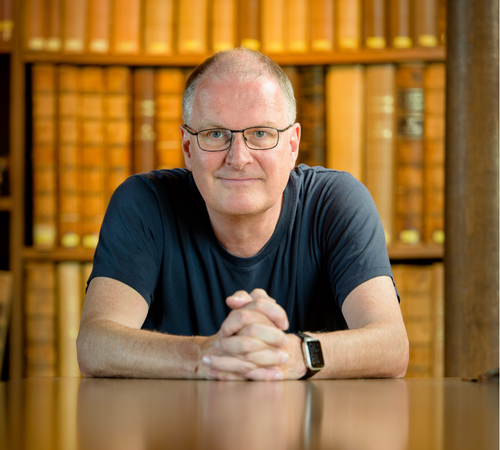
Michael Wooldridge holds the Ashall Professorship in the Foundations of Artificial Intelligence at the University of Oxford, where he is recognized as a world leader and founding figure in multiagent systems research. His scholarly focus centers on the theoretical underpinnings of artificial intelligence, particularly interactions between autonomous AI systems. This work has established critical frameworks for distributed intelligence and agent-based computing, influencing both academic research and industrial applications in AI coordination and negotiation protocols. Professor Wooldridge's contributions have been honored with: Fellowship of the Royal Academy of Engineering (FREng, 2025) Beyond academia, he actively shapes AI policy through governmental advisory roles, including specialist consultation for the UK House of Lords inquiry on large language models and the Scientific Advisory Group for Emergencies. His public engagement culminated in the 2023 Royal Institution Christmas Lectures series titled “The Truth about AI”, making complex AI concepts accessible to broad audiences.
Dr. Bingzhe Li is an Assistant Professor in Computer Science at UT Dallas' Erik Jonsson School of Engineering. His research at the Lab for Intelligent Storage and Computing (Lab4ISC) focuses on DNA storage systems, machine learning infrastructure, and energy-efficient computing architectures. Awarded the NSF CAREER Award (2025) and recognized for Best Paper nominations at leading conferences. Research spans DNA storage capacity optimization, reinforcement learning for hybrid SSDs, Kubernetes storage optimization, and stochastic computing architectures. Recent publications demonstrate innovations in out-of-core graph processing and blockchain storage systems. Leads multiple NSF/NASA-funded projects on DNA storage and convertible SSDs. Teaches Digital Logic and Computer Architecture courses. Supervises 8 PhD students and 3 master's candidates in storage systems and low-power computing research.
Piotr Gmytrasiewicz is an Associate Professor at the Department of Computer Science, University of Illinois at Chicago (UIC). He leads the Multiagent Systems Group within the Artificial Intelligence Laboratory at UIC. His research focuses on rationality in artificial agents , particularly in environments with multiple interacting agents. Key areas include Interactive Decision-Making Bayesian Modeling for Agent Communication Recursive Belief Frameworks Time Pressure and Computational Trade-offs Evolution of Agent Communication Languages Dynamic Resource Allocation His recent work examines the rationality of insincere communication and methods to discount potentially insincere information. Past projects include modeling emotions in agent design and developing decision-theoretic approaches to game theory. He has secured funding from prestigious institutions such as the National Science Foundation (NSF) , Office of Naval Research (ONR) , and DARPA . Current and past projects emphasize Automated Linguistic Competence Evolution Emergent Communication Protocols Scalable Multiagent Learning Strategic Coordination under Uncertainty He earned his Ph.D. from the University of Michigan, Ann Arbor (1992) and has previously collaborated with the Department of Computer Science and Engineering (CSE) at the University of Texas at Arlington on DARPA-funded research.
Dr. Mohamed Djemai is a Full Professor at École Nationale Supérieure de l'Électronique et de ses Applications (ENSEA), Cergy, and INSA Hauts-de-France. He is affiliated with the Quartz Laboratory (EA 7393) and LAMIH UMR CNRS 8201 at University Polytechnic Hauts-de-France. His research focuses on nonlinear control systems theory, with emphasis on hybrid and variable structure systems, sliding mode approaches, fault detection, and applications to power systems, robotics, and vehicle dynamics. IEEE Senior Member Associate Editor for Nonlinear Analysis: Hybrid Systems Co-Facilitator of National Working Group GT-SDH (2014–present) Member of IFAC-TC-1.3 (Discrete Event and Hybrid Systems) since 2001 Member of IFAC-TC-2.1 (Control Design) since 2005 His recent publications address fractional-order control of multiagent systems, stability analysis on time scales, fault-tolerant satellite attitude control, and robust consensus algorithms for nonlinear systems. Key methodologies include sliding mode control, event-triggered control, and observer-based fault detection. Current teaching activities encompass diagnostics, linear systems, signal processing, and sensor conditioning. The trend in Dr. Djemai's research since 2022 involves advanced control strategies for cyber-physical systems, distributed fault detection mechanisms, and time scale theory applications to intermittent communication problems. Notable collaborations include work with Michael Defoort, Stefano Di Gennaro, and international institutions like Kyungpook National University and University of Reims. Scientific contributions include: IEEE Senior Member recognition Development of robust exact filtering differentiators Innovations in fixed-time consensus protocols Leadership in IFAC technical committees Editorial role in hybrid systems analysis His laboratory work at Quartz and LAMIH supports applications in aerospace systems, renewable energy conversion, and industrial risk management architectures.
Dr. Asieh Salehi Fathabadi is a Lecturer (Assistant Professor) in the Cyber-Physical Systems (CPS) group at the University of Southampton, UK. She specializes in formal methods for software engineering, with a focus on Event-B methodology for designing safe and secure systems. Her research addresses challenges in autonomous systems, responsible AI, and human-AI trust dynamics. She leads the Verifiably Safe and Trusted Human-AI Systems (VESTAS) and HANA-HAIP projects as Principal Investigator and contributes to initiatives like HD-Sec and HICLASS . Her work integrates formal verification into critical system development, emphasizing security and safety. Recent publications explore exception handling in secure hardware (CHERI), socio-technical trust frameworks for defense systems, and human intervention in self-driving vehicles. She supervises two PhD students in Computer Science and actively participates in the Rodin formal methods community. Dr. Salehi Fathabadi has over 13 years of research experience, applying formal methods to aerospace systems, embedded software, and cybersecurity. Her interdisciplinary approach bridges theoretical rigor with practical engineering solutions for modern complex systems.
Franco ZAMBONELLI is a Full Professor in the Department of Engineering Sciences and Methods at the University of Modena and Reggio Emilia. He holds positions in both the Reggio Emilia and Modena campuses, offering courses such as Software Engineering and Distributed Artificial Intelligence. His research focuses on IoT, pervasive computing, multiagent systems, and self-organization in distributed systems, with applications in smart cities, healthcare, and mobility. He leads projects like FLUIDWARE (PRIN 2017) and CONNECARE (H2020), exploring adaptive IoT systems and integrated healthcare solutions. ZAMBONELLI is an IEEE Fellow, ACM Distinguished Scientist, and member of the Academia Europaea. His work bridges theory and practice, emphasizing software engineering methodologies for IoT and agent-based systems. Education: Not explicitly detailed in provided texts. Research Grants: FLUIDWARE (2019-2022), CONNECARE (2016-2019). His research interests include causal discovery in pervasive environments, reinforcement learning for cybersecurity, and digital twin technologies. He contributes to editorial boards of journals like ACM Transactions on Autonomous and Adaptive Systems and IEEE Technology and Society Magazine. His teaching spans software engineering, distributed AI, and IoT-oriented methodologies. The Agents and Pervasive Computing Lab (agentgroup.unimore.it) is a focal point for his experimental work. Professional memberships include IEEE, ACM, and the Italian Association for Artificial Intelligence. Recent achievements include successful final reviews for CONNECARE and advancements in fluidware programming paradigms.
Eric T. Matson is a Professor in the Department of Computer and Information Technology at Purdue University's Purdue Polytechnic Institute. He also holds a non-tenure-track Professorship at Dongguk University's Department of Computer Science and Engineering in Seoul, South Korea, and serves as an International Faculty Scholar at Kyung Hee University. His roles include directing the RICE Research Center and co-founding the M2M Lab. Education: PhD (Computer Science), University of Cincinnati (2008) MSE (Software Engineering), Kansas State University (2002) MBA (Operations Management), Ohio State University (1993) BS (Computer Science), Kansas State University (1988) Research Interests: Dr. Matson focuses on Multiagent Systems, Robotics, Software Engineering, and STEM Education. His work emphasizes organizational models for autonomous systems and outreach to underserved communities. Recent projects include sensor networks, cooperative robotics for search and rescue, and global academic collaborations through programs like the Korean Square Initiative. Publications: His research spans agent coordination, organizational transition algorithms, and robotics education, with notable contributions to journals like Autonomous Agents and Multiagent Systems and conferences such as AAMAS and SPIE. Awards: Ho Award for Outstanding Undergraduate Teaching (2010, 2011) 2024 Outstanding Leadership in Globalization Award Grants & Collaboration: Leads initiatives like the Purdue-Dongguk Korean Square Program and the POSTECH Graduate Degree Collaboration. Engages in global partnerships to advance AI and robotics education. Labs/Teams: Director of the RICE Research Center and co-founder of the M2M Lab, focusing on multiagent systems and robotic applications.
Vasilis Gkatzelis is an Associate Professor in the Department of Computer Science at the College of Computing & Informatics, Drexel University. He joined the faculty in 2016 and has since been actively contributing to theoretical computer science research with a focus on algorithmic game theory and optimization. His educational background includes a PhD and MSc in Computer Science from New York University's Courant Institute of Mathematical Sciences, and a Diploma in Computer Engineering and Informatics from the University of Patras. Gkatzelis' research lies at the intersection of algorithms and economics, particularly in designing efficient and fair mechanisms for resource allocation among self-interested agents. His work in approximation algorithms and multiagent systems has been supported by national recognition such as the NSF CAREER award. The trends in his research, though not detailed in specific publications here, center on foundational problems in algorithmic mechanism design, with implications for distributed computing, AI, and economic systems. NSF CAREER Award He has advised students and mentored researchers in theoretical computer science, though specific names are not listed. His prior experience includes significant research grants and collaborations through postdoctoral work at UC Berkeley (Department of EECS, International Computer Science Institute, and Simons Institute) and Stanford University, as well as industrial research roles at Microsoft Research, HP Labs, and Google, indicating a strong record of funded and applied research. Gkatzelis has been affiliated with elite research labs including the Simons Institute for the Theory of Computing and the International Computer Science Institute at UC Berkeley, contributing to collaborative, interdisciplinary efforts in theoretical computer science and AI.
Simina Brânzei is an Associate Professor in the Department of Computer Science at Purdue University. She joined Purdue in Spring 2018, after postdoctoral positions at Hebrew University of Jerusalem and the Simons Institute for the Theory of Computing at UC Berkeley. Her research spans theoretical computer science and artificial intelligence, focusing on algorithmic game theory, computational complexity, fair division, and the intersection of dynamical systems with optimization. PhD in Computer Science from Aarhus University (2015), advised by Peter Bro Miltersen Undergraduate and Master's degrees from University of Waterloo Research Interests : Her work addresses algorithmic game theory, fair division, market and auction design, learning dynamics, and computational complexity. She explores how strategic behavior, fairness, and dynamics interact in resource allocation problems, with applications to economics and multiagent systems. Publication Trends : Recent articles examine lower bounds for local search algorithms, fair division protocols, market equilibrium computation, and learning in competitive environments. Her work often bridges theoretical computer science with economic models, emphasizing mathematical rigor and interdisciplinary applications. Scientific Awards : NSF CAREER Award IBM Ph.D. Fellowship Google Anita Borg Memorial Scholarship Advising and Grants : She mentors graduate students in theoretical computer science and algorithmic game theory. Her research is supported by grants from NSF and prior funding from IBM and Google during her PhD.
Dr. Georgios Birmpas is a researcher specializing in algorithmic game theory, computational economics, and fair division. He currently serves as Module Co-ordinator for Algorithmic Game Theory (COMP559) and Computational Game Theory and Mechanism Design (COMP326) at an institution not explicitly named. His research focuses on fairness and efficiency in resource allocation problems, often intersecting computer science, economics, and multiagent systems. Key research areas: Algorithmic Fairness Submodular Optimization Strategic Agent Modeling Distortion in Voting Systems Recent contributions include: Fair multiobjective submodular function maximization Existence of approximate equilibria in resource allocation Two-query distortion analysis in matching problems Interdependent value models in fair division His work has appeared in venues such as the International Joint Conference on Autonomous Agents and Multiagent Systems (AAMAS) and journals like Mathematics of Operations Research and SIAM Journal on Discrete Mathematics . Collaborators include researchers from institutions across Europe, focusing on theoretical and applied aspects of algorithmic fairness.
Aleksandr Zagarskikh is an Associate Professor at the Game Development School of ITMO University, specializing in virtual reality, scientific visualization, and high-performance computing. He has led projects in quantum chemistry visualization, flight simulators, and urban simulation technologies. Developed real-time graphics systems for ultra-realistic image synthesis Created high-performance network protocols for distributed visualization Current research focuses on big data decision-making in finance and multiscale urban modeling His work spans predictive modeling, GPU optimization, and cloud-based infrastructure visualization, with publications in Procedia Computer Science. He teaches courses in game technologies, VR, and scientific computer graphics.
Junsoo Lee is an Assistant Professor in the Departments of Mechanical and Aerospace Engineering at the University of South Carolina's Molinaroli College of Engineering and Computing. His research centers on stability theory, stochastic systems, and distributed control of multiagent networks, with applications in aerospace systems and large-scale dynamical networks. Education credentials: Ph.D. in Aerospace Engineering, Georgia Institute of Technology (2022) M.S. in Mathematics, Georgia Institute of Technology (2021) M.S. in Aerospace Engineering, Seoul National University (2018) B.S. in Mechanical and Aerospace Engineering, Seoul National University (2016) Dr. Lee's research develops novel frameworks for finite-time and fixed-time stability in stochastic systems, creating control architectures based on thermodynamic principles. His publications demonstrate consistent focus on semistability, network consensus protocols, and optimal control of nonlinear discrete-time systems across deterministic and stochastic domains. Awards include multiple IEEE travel grants and the 2021 Faces of Inclusive Excellence honor. He serves as editorial reviewer for leading journals including IEEE Transactions on Automatic Control and Automatica, and participates in professional societies including IEEE, AIAA, and ASME.
Professor Jinjun Shan is a Full Professor of Space Engineering and former Department Chair (2018-2023) in the Department of Earth and Space Science and Engineering at York University's Lassonde School of Engineering. An internationally recognized expert in dynamics, control and navigation, he joined York University as an Assistant Professor in 2006, was promoted to Associate Professor in 2011, and became a Full Professor in 2016. Dr. Shan received his B.Eng., M.Eng., and Ph.D. degrees from Harbin Institute of Technology, China, in 1997, 1999, and 2002, respectively. Before joining York, he was a Post-Doctoral Fellow at the University of Toronto Institute for Aerospace Studies (2003-2006) and a Research Assistant at City University of Hong Kong (2002-2003). His research focuses on dynamics, control and navigation, autonomous systems, multi-agent systems, smart materials and structures, space instrumentation, active vibration control, and orbit dynamics. Dr. Shan has made significant contributions to national and international space missions including NEOSSat and has attracted over $5 million in research funding from governmental agencies and industry partners. His laboratory, the Spacecraft Dynamics Control and Navigation Laboratory (SDCNLab), which he founded in 2006, conducts cutting-edge research in space engineering. Dr. Shan's extensive publication record includes over 200 peer-reviewed journal and conference papers, with his most recent work focusing on multi-agent formation control, autonomous vehicle decision-making, quadrotor control systems, and smart material applications. His research shows a clear progression from fundamental dynamics and control theory toward increasingly complex multi-agent systems and real-world applications in autonomous vehicles and space engineering. Fellow of Canadian Academy of Engineering (CAE) Fellow of Engineering Institute of Canada (EIC) Fellow of American Astronautical Society (AAS) Associate Fellow of AIAA Alexander von Humboldt Research Fellowship JSPS Fellowship Lassonde Educator of the Year Award (2022) Named in Stanford's list of world's top 2% researchers Dr. Shan has successfully mentored numerous graduate students and post-doctoral fellows, with current advisees working on cutting-edge projects in multi-agent systems, UAV control, and smart materials. His research is supported by substantial funding from NSERC, CSA, and industry partners. As the founding director of SDCNLab, he has built a comprehensive research facility for spacecraft dynamics, control, and navigation, recently expanding to include autonomous unmanned vehicle research through a CFI JELF award. His laboratory continues to make significant contributions to both theoretical advancements and practical applications in space engineering and autonomous systems.
Martin Lackner is a Researcher at the Vienna University of Economics and Business (WU Wien) within the Institute for Data, Process and Knowledge Management. He previously held postdoctoral positions at the University of Oxford and TU Wien, and earned his doctoral degree (Dr. techn.) in computer science from TU Wien in 2014. His research focuses on artificial intelligence, computational social choice, and algorithm design, with a particular emphasis on multi-winner voting systems, approval-based methods, and fairness in decision-making processes. Education: PhD in Computer Science (TU Wien, 2014), Mathematics in Computer Science studies at TU Wien, and a semester at the University of Illinois at Urbana-Champaign (USA). Research interests include computational social choice topics such as multi-winner voting, approval-based committee rules, liquid democracy, and axiomatic analysis of voting systems. He has contributed to the development of the abcvoting Python library for implementing approval-based voting rules and co-authored the book Multi-Winner Voting with Approval Preferences (Springer, 2023). His work bridges theoretical computer science with practical applications in democratic processes and algorithmic fairness. Key contributions include studies on proportional representation mechanisms, participatory budgeting fairness, and long-term decision-making frameworks. Lackner's research frequently addresses the algorithmic aspects of collective decision-making, with publications in venues like Artificial Intelligence , Journal of Economic Theory , and top conferences such as AAAI and IJCAI. Grants and Projects: Principal investigator of the FWF-funded project Algorithms for Sustainable Group Decision Making (TU Wien, 2025–present), and co-developer of the abcvoting open-source software project.
Juan Bazerque Giusto is a Visiting Assistant Professor at the Department of Electrical and Computer Engineering, University of Pittsburgh, within the Swanson School of Engineering. He holds a B.Sc. in Electrical Engineering from Universidad de la República (Uruguay), and M.Sc. and Ph.D. degrees from the University of Minnesota. His research focuses on machine learning, stochastic optimization, and networked systems, with emphasis on reinforcement learning, swarm robotics, and power systems optimization. Education: B.Sc., Electrical Engineering, Universidad de la República, 2003 M.Sc., Electrical and Computer Engineering, University of Minnesota, 2010 Ph.D., Electrical and Computer Engineering, University of Minnesota, 2013 His work bridges theoretical advancements in optimization and signal processing with practical applications in robotics, energy systems, and wireless networks. Notable contributions include multiagent systems for mobile infrastructure, safe reinforcement learning algorithms, and sparse kernel-based methods for signal recovery. Publications: Over 15 peer-reviewed articles in IEEE Transactions and top conferences, emphasizing interdisciplinary research in reinforcement learning, distributed optimization, and cognitive networks. Recent work explores networked robotics and energy-efficient datacenter management. Awards: University of Minnesota Master Thesis Award (2009-2010) Best Paper Award at ICCRON 2007 Professional Experience: Previously served as Assistant Professor at Universidad de la República (Uruguay) before relocating to the U.S. in 2022.