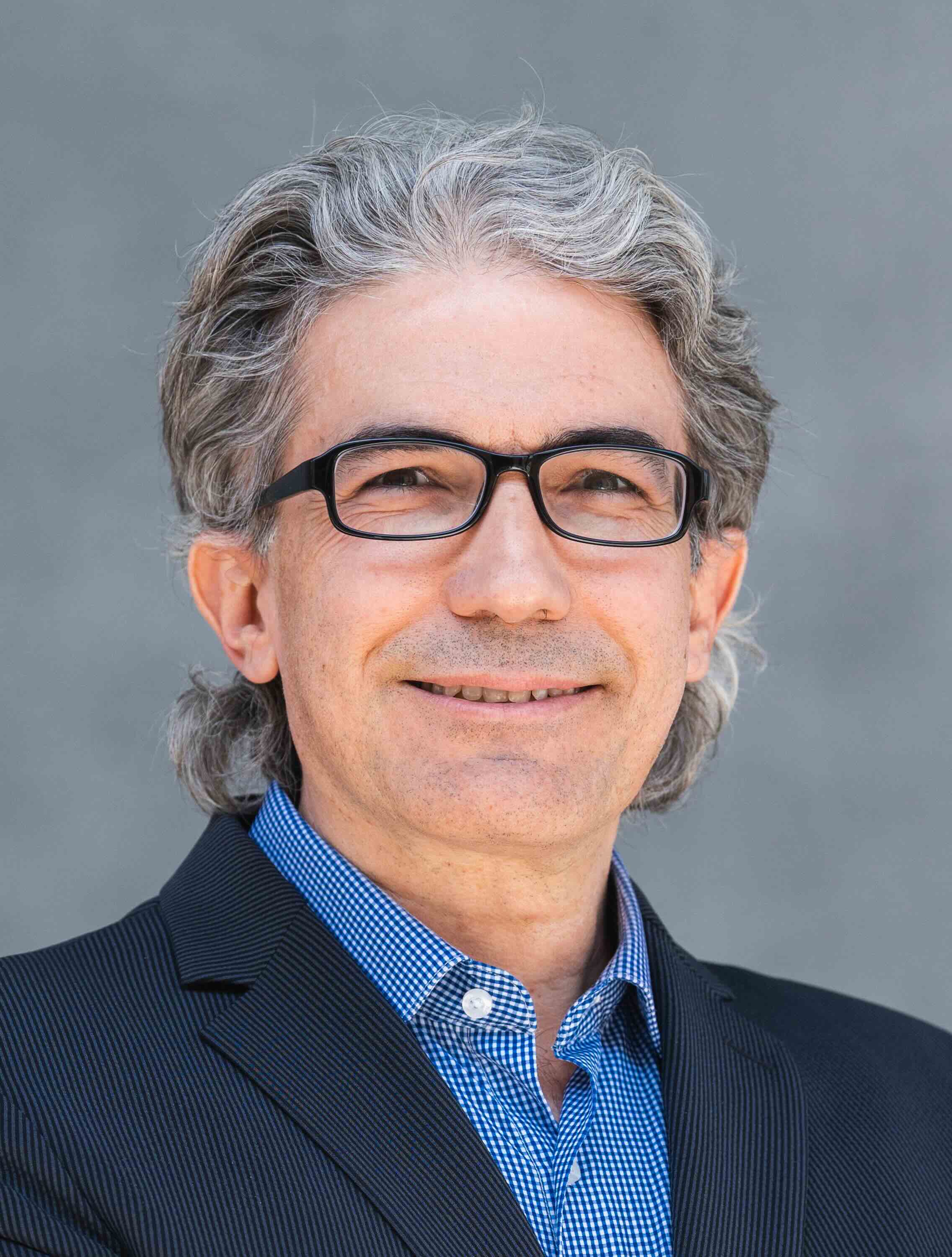
Francesco Bullo is a Distinguished Professor of Mechanical Engineering at the University of California, Santa Barbara (UCSB), affiliated with the College of Engineering. He holds joint appointments in Electrical and Computer Engineering, Computer Science, and the Center for Control, Dynamical Systems, and Computation. His research focuses on distributed control, network systems, and neural networks, with notable contributions to contraction theory and social dynamics analysis. Education: Laurea (1994, University of Padova), PhD (1998, Caltech). Leadership roles: Former IEEE CSS President, SIAG CST Chair. Research interests include biological/artificial neural networks, distributed control of robotic networks, and synchronization in power grids. He authored books like Lectures on Network Systems and Contraction Theory for Dynamical Systems . His work spans 300+ publications, including impactful articles on Hopfield networks, power grid stability, and optimization. Awards include IEEE Fellow, ASME Fellow, and SIAM Fellow. Advising and grants: Mentored over 30 PhD students and led major projects like the NSF MURI on team behavior modeling. Current research includes neural synchronization and AI-driven control. Labs/teams: Directs the UCSB Center for Control, Dynamical Systems, and Computation, and collaborates on interdisciplinary initiatives like the Network Science for Medicine white paper.
Rocco Servedio is a Professor in the Department of Computer Science at Columbia University, where he leads research in theoretical computer science with a focus on computational complexity theory, learning theory, and the role of randomness in computation. He previously served as Chair of the Computer Science Department from 2018 to 2021. He holds a Ph.D., MS, and AB in Mathematics from Harvard University. His research interests include property testing, computational learning theory, and algorithmic lower bounds. He has contributed to foundational work in areas like junta testing, trace reconstruction, and convexity testing. Servedio has held leadership roles in major conferences such as STOC, CCC, and COLT, and has mentored students through courses like Unconditional Lower Bounds and Derandomization . Education: Ph.D. in Computer Science, Harvard University MS in Computer Science, Harvard University AB in Mathematics, Harvard University His research bridges theoretical computer science and applied mathematics, with recent work exploring the intersection of Gaussian processes, convex geometry, and algorithmic efficiency. Servedio's contributions to the field are exemplified through his involvement in high-impact conferences and his leadership in advancing fundamental computational theories.
Maria Elena Cobas Cobiella is an Associate Professor in the Department of Civil Law at the Faculty of Law, University of Valencia. Her academic work is deeply rooted in civil and private law, with significant contributions to inheritance, family, mediation, and European private law. She is an active member of two research groups: the GPF Research Group on Person and Family and the GEDPED Study Group on European Private and Digital Law. Research Interests: Her research spans civil law, succession law, bio-law, legal mediation, reproductive rights, and legal education. She has explored the legal implications of posthumous reproduction, European succession instruments, Cuban property law, and innovative teaching methods such as concept mapping and cooperative learning in legal education. Her work often bridges doctrinal analysis with practical and ethical considerations. The trends in her scholarly publications from 2001 to 2017 reflect a sustained focus on succession law and legal modernization, with increasing attention to European harmonization, digital law, and interdisciplinary issues in bio-law. Her articles also reveal a strong commitment to pedagogical innovation and comparative legal analysis, particularly between Spanish and U.S. legal systems. Scientific Contributions: PhD from the University of Valencia (2001) on testamentary executorship. Active researcher in European private and digital law. Prolific author on mediation, inheritance, and legal education. Advising and Grants: While no specific grants are listed, she has supervised PhD research, as evidenced by her role as advisor to Dr. Lorenzo Prats Albentosa’s thesis. She actively contributes to academic discourse through publications and research group leadership. Her work in legal education suggests involvement in curriculum development and pedagogical projects. Labs and Teams: She collaborates with the GPF Research Group on Person and Family and the GEDPED Study Group on European Private and Digital Law, indicating active participation in team-based legal research focused on contemporary civil law challenges.
Andreas Holzinger is a Professor at Graz University of Technology, with additional affiliations at Medical University Graz and University of Natural Resources and Life Sciences Vienna in Austria. He is recognized as an IFIP Fellow (2021) for his significant contributions to information processing and computer science. His work spans multiple institutions across Europe, with notable collaborations extending to the University of Alberta in Canada. Professor Holzinger's research focuses on Human-Centered AI, Explainable AI (XAI), and their practical applications across diverse domains. His work bridges theoretical AI advancements with real-world implementations in healthcare, forestry, and human-robot interaction. He has pioneered approaches in counterfactual explanations, graph neural networks, and human-in-the-loop systems that emphasize transparency and trustworthiness in AI decision-making processes. His recent publications demonstrate a strong trend toward integrating large language models with traditional AI systems while maintaining explainability. Holzinger's work consistently emphasizes the human element in AI systems, ensuring that technological advancements serve human needs rather than obscuring decision processes. His research in medical AI, smart forestry, and agricultural applications shows a commitment to solving practical problems with human-centered technological solutions. Scientific Awards: IFIP Fellow (2021) Professor Holzinger has been instrumental in establishing design guidelines for explainable AI systems, particularly through his work on post-hoc versus ante-hoc explanations. His research on Kandinsky Patterns has provided valuable experimental frameworks for pattern analysis and machine intelligence. He has secured significant research funding for projects bridging AI with practical applications in healthcare and environmental monitoring. His leadership extends to the organization of major conferences and workshops, including the CD-MAKE conference series, where he has fostered interdisciplinary collaboration between AI researchers and domain experts. His work on the CLARUS platform demonstrates practical implementations of interactive explainable AI for medical applications.
Martin Rajman is a Senior Scientist at École Polytechnique Fédérale de Lausanne (EPFL) with multiple affiliations across the institution. He holds positions in the School of Computer and Communication Sciences (SIN - Teaching, SCI IC MR Group, SSC - Teaching) as well as in the Vice Presidency for Strategic Development (VPS Artificial Intelligence) and the Vice Presidency for Academic Affairs (SNAI Administration). He serves as the Executive Director of Nano-tera.ch, a large Swiss Research Program funding collaborative multi-disciplinary projects in Health and the Environment. Rajman's research spans the intersection of artificial intelligence, natural language processing, and information retrieval. His work demonstrates a consistent focus on developing practical applications of computational linguistics and machine learning techniques. Early in his career, he contributed significantly to syntactic parsing, stochastic language models, and vector space representations for text. More recently, his research has expanded into deep learning applications for 3D reconstruction, empathetic conversational agents, and distributed analytics systems. His publications reveal a trajectory from foundational NLP research toward increasingly applied and interdisciplinary work connecting AI with healthcare, environmental monitoring, and human-computer interaction. Analysis of his recent publications (2015-2024) shows a clear evolution toward more applied AI research with strong interdisciplinary connections. While maintaining his core expertise in natural language processing and information retrieval, his work has expanded into computer vision, healthcare applications, and sustainable computing. The publications demonstrate increasing collaboration across disciplines, with applications in medical imaging, mental health support systems, environmental monitoring, and human-centered AI. His leadership role in the Nano-tera.ch program reflects this interdisciplinary approach, connecting computing research with real-world challenges in health and environmental contexts. Rajman has mentored several PhD students including Ailomaa Marita, Eckard Emmanuel, Melichar Miroslav, and Veselý Martin. His research has been supported through the Nano-tera.ch program, which has funded more than 100 research projects with over 95 million CHF in public funding. He has also managed more than 20 European projects during his tenure as Director of the EPFL Global Computing Center. As Executive Director of Nano-tera.ch, Rajman leads a significant research initiative connecting EPFL with national and international partners. His work bridges academic research with industry applications, notably through collaborations with eBay on product ranking technology and with Elsevier on article recommendation systems. His leadership extends to managing large-scale research programs while maintaining an active research agenda and mentoring the next generation of computer scientists.
Philip Wadler is Professor of Theoretical Computer Science at the University of Edinburgh and Senior Research Fellow at IOHK. He is an ACM Fellow, Fellow of the Royal Society, and Fellow of the Royal Society of Edinburgh. His work spans programming language design, type systems, and formal verification, with significant contributions to Haskell, Java, and XQuery. He has held leadership roles in ACM SIGPLAN and served on editorial boards for major journals. Research Interests: Wadler's research focuses on the foundations of programming languages , including Gradual and session typing Language-integrated query Functional and logic programming XML data models Parametricity and free theorems Verification of smart contracts Publication Trends: Recent articles emphasize type safety, formal verification, and blockchain applications. Key themes include gradual typing (blame calculus), session types for concurrency, and logical foundations of programming. His 2015–2025 papers show sustained focus on type theory and language design . Awards & Recognition: POPL Most Influential Paper (2003 for 1993 work) SIGPLAN Distinguished Service Award Best Paper SBMF 2018 Royal Society-Wolfson Fellowship (2004–2009) ACM Fellow (2007) Fellow of Royal Society of Edinburgh (2005) Advising & Grants: He has supervised numerous PhD students in programs like the Centre for Doctoral Training in Pervasive Parallelism. His EPSRC Programme Grant "From Data Types to Session Types" (2013–2020) funded major advances in concurrency theory. Current work with IOHK explores blockchain verification using Haskell-based Plutus.
Diana Gratiela Berbecaru is an External Collaborator and External Lecturer at the Department of Control and Computer Science (DAUIN), Politecnico di Torino, where she contributes to teaching and research in cybersecurity and digital identity. She is affiliated with the TORSEC Security Group and actively participates in EU-funded research projects such as Q-FENCE, focusing on quantum-resistant cryptography. She teaches core courses including Security and Privacy for Digital Identity Frameworks and Information Systems Security , and has been recognized with the Italian national scientific habilitation as Associate Professor in 2025, affirming her academic standing. Full Name: Diana Gratiela Berbecaru University: Politecnico di Torino Department: Department of Control and Computer Science (DAUIN) Academic Rank: Associate Professor (habilitated) Teaching Status: Part-time External Lecturer Email: diana.berbecaru@polito.it Her research focuses on cybersecurity, identity management, and trusted computing, with specific interests in authentication, authorization, data privacy, network security, and trusted computing in distributed and IoT environments. She investigates practical implementations of digital identity systems using the eIDAS infrastructure, certificate validation, TLS security, and post-quantum cryptography. Her work bridges theoretical security models with real-world deployment challenges. Her recent publications (2022–2025) reflect a strong focus on TLS security, X.509 certificate analysis, anomaly detection using AI, remote attestation for IoT, and post-quantum migration strategies. These works are published in high-impact venues such as IEEE Access, IEEE ISCC, and ARES, indicating active and influential contributions to the cybersecurity research community. The research trend shows a consistent emphasis on practical tools and frameworks for enhancing trust and security in digital systems. Scientific Awards and Recognition: Italian National Scientific Habilitation as Associate Professor (Abilitazione Scientifica Nazionale, II fascia), 2025 She serves as an Associate Editor for IEEE Transactions on Network and Service Management and IEEE Access , and as a Guest Editor for Electronics and Computer Networks . She chairs and co-chairs international workshops such as TrustAICyberSec and IMTrustSec, and is a frequent member of program committees for major conferences including ARES, IDC, and ISCC. These roles demonstrate her active engagement in academic leadership and knowledge dissemination. Labs and Research Groups: TORSEC - Security Group (DAUIN): Core research group focusing on cybersecurity, trusted systems, and digital identity.
Falko Dressler is a Full Professor and Chair for Telecommunication Networks at the School of Electrical Engineering and Computer Science, Technische Universität Berlin. He holds a Ph.D. and M.Sc. in Computer Science from Friedrich-Alexander University of Erlangen-Nuremberg (1998-2003). His research focuses on next-generation wireless systems , distributed machine learning , edge computing , and applications in Internet of Things (IoT) , cyber-physical systems , and internet of bio-nano-things . Editorial roles: IEEE Trans. on Mobile Computing, Elsevier Computer Communications, IEEE/ACM Trans. on Networking Conference leadership: IEEE INFOCOM, ACM MobiSys, IEEE VNC Textbooks: Self-Organization in Sensor and Actor Networks (Wiley), Vehicular Networking (Cambridge) Recent publications highlight trends in Edge Computing Resilience and 6G Network Architecture , with a strong emphasis on Molecular Communication , Terahertz Band Synchronization , and Federated Learning in vehicular environments. Scientific contributions include multiple IEEE Fellow , ACM Fellow , and VDE ITG Prize 2023 recognitions. Advisory and professional activities include membership in the German National Academy of Science and Engineering (acatech), IEEE COMSOC Conference Council, and ACM SIGMOBILE Executive Committee. His work spans cooperative driving, ultra-low power sensor networks, and security in nano-communication systems.
Emel YILDIZ is an Assistant Professor in the Department of Business Administration at Trakya University's Faculty of Economics and Administrative Sciences . Since 2014, she has served as Deputy Head of Department and Cooperatives USA Presidency, focusing on economic development and policy analysis. Bachelor's, Master's, and PhD in Economics from Marmara and Trakya Universities Role: Academic leadership in Cooperative Economics and Development Economics Research spans macroeconomic policy, social capital, education economics, and sustainable development Her research integrates macroeconomic frameworks with socioeconomic outcomes. Key themes include: Econometric analysis of monetary and fiscal policies Education's role in human capital formation Cooperative models for sustainable energy Technology's impact on employment Publishing trends show emphasis on Turkey-Azerbaijan trade dynamics, G20 competitiveness, and vocational education integration into the information economy. Supervised theses address SMEs' strategic planning, fast food localization, and Turkey's cooperative energy policies.
Daniel Schiller is a Professor of Economic and Social Geography at the University of Greifswald, where he has been employed since April 2016. He currently serves as Vice Rector for Research and Transfer (since April 2025) and has held several significant administrative positions including Managing Director of the Institute of Geography and Geology (2020-2024) and Vice Dean of the Faculty of Mathematics and Natural Sciences (2020-2023). His academic affiliations include leadership roles at the Steinbeis Research Center for Regional Economics and membership in the Northeast Regional Working Group at the Academy for Spatial Development. Professor Schiller's research focuses on knowledge-based and sustainable regional development, transformation of regional economies, spatial justice, and futures of globalization, with regional expertise in Germany, the Baltic Sea region, and East and Southeast Asia. His work bridges theoretical economic geography with practical regional development challenges, particularly examining innovation systems, bioeconomy transitions, and the spatial dimensions of sustainability. His publications reveal a strong emphasis on how regions navigate economic transformation, with particular attention to the role of institutions, networks, and governance in shaping regional development trajectories. His recent publications demonstrate a clear trend toward examining sustainability transitions in regional contexts, with increasing focus on bioeconomy development, One Health approaches, and the spatial dimensions of innovation. The geographical scope of his work spans from local German regions to East Asian contexts, particularly China's innovation systems. Methodologically, his work combines qualitative case studies with spatial analysis and theoretical frameworks from economic geography and innovation studies. Scientific Prize 'Human Geography' of the Prof. Dr. Frithjof Voss Foundation for Geography (2013) Professor Schiller has secured substantial research funding from multiple sources including BMBF, DFG, EU, and regional programs, leading major projects such as Plant³ RIIS, RegioTransformOH, and ChiKUBIG. His research portfolio demonstrates strong international collaboration, particularly with Chinese institutions. As Chair of Examination Boards for M.Sc. programs in Regional Development and Tourism and Bioeconomy, he plays a significant role in academic program development and student education. His leadership extends to the WIR! innovation alliance Plant³, where he serves as spokesperson since 2019. Through his work at the Steinbeis Research Center for Regional Economics and various research projects, Professor Schiller leads teams examining regional innovation systems, economic transformation, and sustainable development pathways. His current research agenda focuses on the intersection of bioeconomy development, spatial justice, and regional transformation, with particular attention to how regions can navigate the complex challenges of sustainability transitions while addressing socio-spatial inequalities.
Lili Qiu is a Professor in the Department of Computer Science at The University of Texas at Austin, where she has been a faculty member since January 2005. She is an active member of the Wireless Networking and Communications Group (WNCG) and has made significant contributions to the field of networking research. Dr. Qiu previously spent 2001-2004 as a researcher at Microsoft Research in Redmond, WA, before joining UT Austin. Dr. Qiu's research spans Internet and wireless networking with a current focus on wireless network management and content distribution in mobile networks. Her work extends into diverse applications including acoustic imaging, metasurface applications, healthcare sensing technologies, and AI systems. She has pioneered research in areas such as acoustic motion tracking, passive RFID sensing, and wireless network optimization. Her research demonstrates a consistent pattern of innovation that bridges theoretical networking concepts with practical real-world applications, particularly in mobile and wireless systems. Her extensive publication record shows a clear evolution from fundamental networking research to increasingly interdisciplinary work that combines wireless systems with healthcare applications, AI, and novel sensing technologies. Recent publications demonstrate growing integration of machine learning techniques with traditional networking problems, as well as expansion into healthcare applications like Parkinson's disease modeling and non-invasive glucose monitoring. ACM Fellow IEEE Fellow National Academy of Inventors (NAI) Fellow ACM Distinguished Scientist NSF CAREER award Google Faculty Research Award Best paper award at ACM MobiSys'18 Best paper award at IEEE ICNP'17 Dr. Qiu has supervised numerous students, including a PhD dissertation that won the SIGMOBILE best dissertation award in 2020. She has served in significant leadership roles including chair of ACM SIGMOBILE, General co-chair for ACM MobiCom 2025, and various conference chair positions for IEEE ICNP, ACM CoNEXT, and other major networking conferences. Her research has been supported by substantial grants from NSF, Google, and other organizations, enabling her to lead cross-disciplinary research teams. As a member of the Wireless Networking and Communications Group at UT Austin, Dr. Qiu leads research efforts that combine networking expertise with innovations in sensing technologies, metasurfaces, and AI systems. Her lab has produced numerous influential results in mobile networking, wireless sensing, and network management, with applications spanning healthcare, consumer electronics, and communication infrastructure.
Arnab Nandi is a Professor of Computer Science and Engineering at The Ohio State University, with a courtesy appointment in Biomedical Informatics. He holds leadership roles including Steering Committee Member for the Human-in-the-Loop Data Analytics (HILDA) Workshop and has served as Workshops co-chair for SIGMOD 2025-26 and Demonstrations co-chair for SIGMOD 2024. His research focuses on bridging human interaction and data infrastructure, spanning database systems, human-in-the-loop data analytics, and next-generation query interfaces. Nandi's work emphasizes interactive data exploration through projects like DICE (Distributed Interactive Cube Exploration), GestureDB (Querying Beyond Keyboards), and Omni (Multimodal Data Exploration). His recent research explores integrating LLMs into database education, augmented reality interfaces for data analytics, and multimodal approaches to video querying. Nandi has received numerous honors including the NSF CAREER Award, Google Faculty Research Award, IEEE TCDE Early Career Award, and the University's Alumni Award for Distinguished Teaching. He was also named to Columbus Business First's '40 under 40' and became an ACM Distinguished Member in 2024. As an educator, he teaches courses including CSE 3241 (Introduction to Database Systems), CSE 5242 (Advanced Database Systems), and CSE 5251 (Introduction to Software Startups). His educational innovations include DBTutor, which integrates LLMs into database systems education. At Ohio State, Nandi co-founded the OHI/O Program, which fosters tech culture through hackathons, and The STEAM Factory, an interdisciplinary research collaboration network. Prior to academia, he was founder and CEO of Mobikit, a connected vehicles data analytics startup acquired by Azuga Inc. (a Bridgestone company). His research has been supported by the NSF and industry partnerships, with applications spanning precision agriculture (CropFusion), clinical data pipelines (ICARUS), and interactive visualization systems (Perceptvis).
James H. Anderson is the Kenan Distinguished Professor and Department Chair in the Department of Computer Science at the University of North Carolina at Chapel Hill, where he has been a faculty member since 1993. A leading researcher in real-time systems and distributed computing, he previously served at the University of Maryland (1990-1993). His educational background includes: B.S. in Computer Science from Michigan State University (1982) M.S. in Computer Science from Purdue University (1983) Ph.D. in Computer Sciences from the University of Texas at Austin (1990) Anderson's research focuses on real-time systems, distributed and concurrent algorithms, multicore computing, and operating systems. His work addresses fundamental challenges in scheduling, resource management, and reliability in time-critical environments, with recent emphasis on GPU acceleration for AI workloads and heterogeneous platforms. He investigates novel approaches to budget enforcement, processing graph scheduling, and timing predictability in complex systems. Analysis of his recent publications reveals a strong trend toward applying real-time scheduling principles to GPU and heterogeneous computing architectures. Key research thrusts include enabling predictable AI acceleration, managing timing uncertainties in autonomous systems, and developing composable resource partitioning techniques for safety-critical applications. His distinguished honors include: U.S. Army Research Office Young Investigator Award (1995) Alfred P. Sloan Research Fellowship (1996) Seven Computer Science Student Association Teaching Awards (1995-2019) Fellowships from IEEE (2012), ACM (2013), AAAS (2020), and AAIA (2022) IEEE TCRTS Outstanding Technical Achievement and Leadership Award (2018) Anderson actively mentors through the TOPICS Club, a reading group for undergraduate students that he co-leads with Cynthia Sturton and Danielle Szafir. His professional leadership includes chairing IEEE TCRTS (2016-2017) and ACM SIGBED (2019-2021), plus service as program/general chair for major conferences including RTSS, PODC, ECRTS, and RTAS. He directs ongoing research initiatives in real-time systems through collaborative projects and the TOPICS Club, which provides undergraduates with hands-on research experience in cutting-edge computer science topics.
Thomas S. Gruca serves as the George Daly Professor in Marketing and Director of the Iowa Electronic Markets at the University of Iowa's Tippie College of Business. His interdisciplinary work bridges marketing, finance, and healthcare through innovative prediction market applications. Education PhD in Decision and Information Sciences, University of Illinois Urbana-Champaign MBA in Management Information Systems, University of Illinois Urbana-Champaign BS in Mathematics and Computer Science, University of Illinois-Chicago His research centers on prediction markets for political and healthcare forecasting, with recent work analyzing geopolitical biases , anti-incumbency effects , and rural healthcare access disparities . This intersects with his expertise in marketing/finance interface phenomena like brand equity measurement and consumer behavior modeling in casino gaming. Analysis of his 15 most recent publications reveals three dominant research streams: (1) Election forecasting through Iowa Electronic Markets (35% of output), (2) Rural healthcare access modeling (27%), and (3) Marketing analytics including brand equity and consumer behavior (38%). His work consistently appears in top journals like Journal of Marketing , International Journal of Forecasting , and PS: Political Science & Politics . Scientific Awards 9-time recipient of MBA Marketing Professor of the Year (2006-2019) President & Provost Award for Teaching Excellence (2018) Iowa MBA Instructor of the Year - Core (2014) Gruca has secured significant external funding including an NSF grant ($300,000) for Active Learning in Undergraduate Education Using Iowa Electronic Markets (2000-2003) and a US Department of Education grant for Enhancing Economic Literacy (1997-2000). His leadership roles include Faculty Director of the MBA Marketing Career Academy (2008-2019) and PhD Program Director for Marketing (2008-2014). He directs the Iowa Electronic Markets (IEM), a real-money prediction market used globally for election and economic forecasting research, which serves as both a research platform and teaching tool for over 10,000 students annually.
Mikhaïl Xifaras serves as Professor of Public Law at Sciences Po's Law School since September 2008, holding a secondment position at New York University Abu Dhabi since 2021. His academic appointments include Visiting Professorships at Harvard Law School (since 2011) and Keio Law School in Japan (since 2012). His educational background spans multiple disciplines: Agrégation de l'enseignement supérieur in Public Law (2004), Agrégation in Philosophy (1993), and Doctorate in Philosophy from Besançon (2001). He graduated from the École Normale Supérieure of Fontenay-Saint Cloud in 1990. Xifaras specializes in the intersection of legal philosophy and political theory, with particular focus on property theory, critical legal studies, and the historical evolution of legal thought. His research examines how philosophical frameworks from Kant to contemporary critical theorists shape legal institutions, with recurring themes in global governance, democratic theory, and the critique of presidential systems. He explores property not merely as an economic institution but as a site of political struggle and emancipatory potential. His scholarly output demonstrates consistent engagement with structuralist and post-structuralist methodologies, particularly through Barthesian semiotics applied to legal doctrine. The articles reveal a trajectory moving from national legal theory toward global constitutionalism, with increasing focus on transnational commons and post-capitalist property models. Prix Ouverture Internationale of the Université Libre de Bruxelles (2003) Marie-Curie Grant from the European Commission (2003) Fulbright Scholarship at Harvard Law School (2000) Fondation Thiers Grant (1999) Junior Member of the Institut Universitaire de France (2006-2011) Xifaras has secured significant competitive research funding including European Commission grants and Fulbright support. His academic leadership includes directing doctoral programs and co-editing the journal Jurisprudence. His international collaborations span institutions in the United States, Japan, and across Europe, reflecting his transnational research focus. While specific lab affiliations aren't documented, his work with the Law School's Research Centre and participation in cooperative projects like Digilaw and Environmental Justice initiatives indicate active engagement with interdisciplinary research teams.