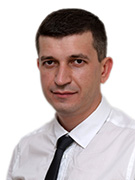
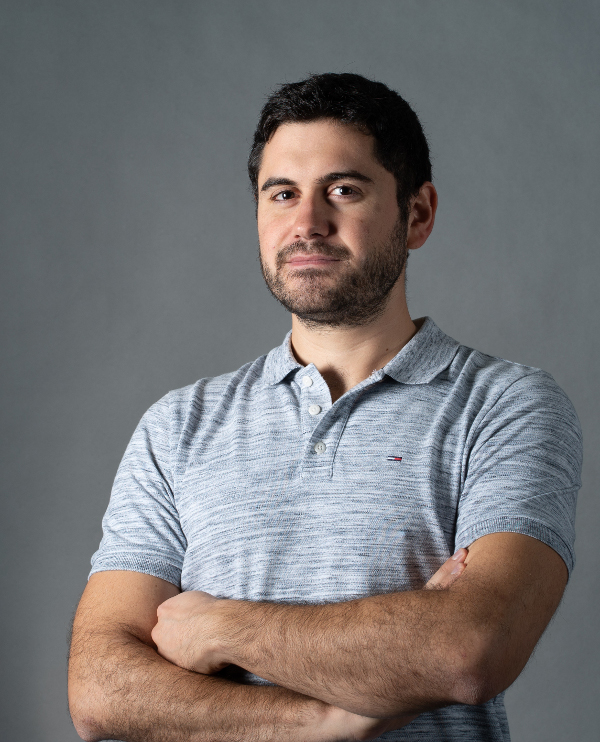
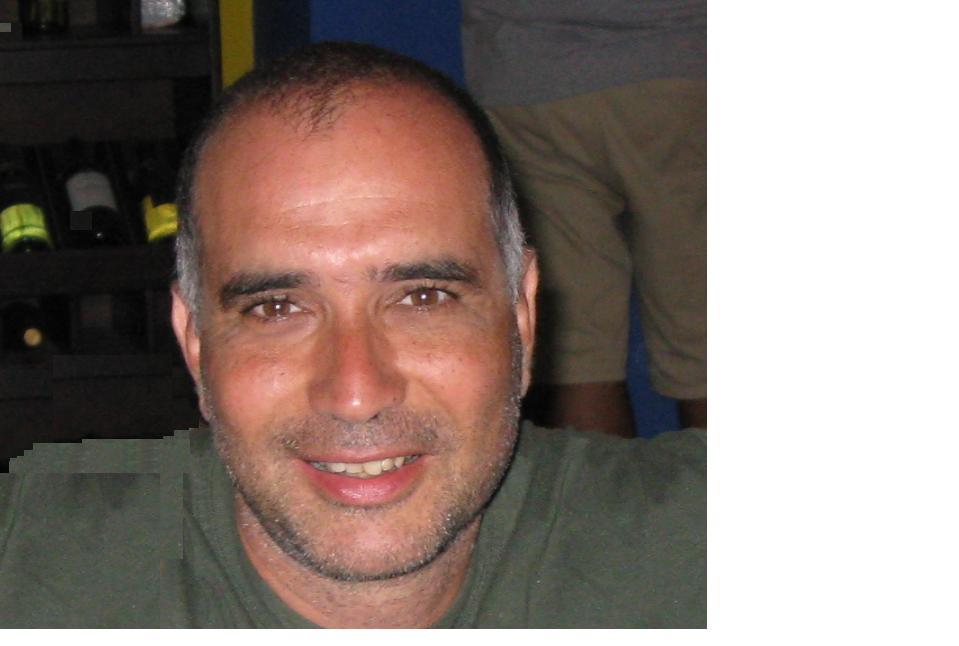
Dr. FÜLÖP Roland is an Associate Professor at the Department of Sanitary and Environmental Engineering, Faculty of Civil Engineering, Budapest University of Technology and Economics. His professional activities focus on urban water infrastructure management, with extensive experience in hydraulic modeling, pipeline failure analysis, and water distribution systems optimization. Current Courses: Dewatering (BMEEOVKMI53) Public water utility systems modelling (BMEEOVKMV63) Public Works I. (BMEEOVKAT42) Research Interests: His work addresses critical challenges in water infrastructure sustainability through advanced modeling techniques and data-driven decision-making. Key research areas include: Hydraulic model calibration for complex networks Probabilistic failure prediction in pipeline systems Optimization of water balance calculations Pressure management in distribution zones Long-term infrastructure rehabilitation planning Integration of mobile technologies for utility management
Dr. Ritu Shandilya is an Associate Professor of Computer and Data Science at Mount Mercy University since 2023. She holds a PhD from Iowa State University and has academic credentials from Shobhit University, U.P Technical University, and Kurukshetra University. Her research focuses on machine learning, recommender systems, and their applications in healthcare and legal domains, alongside expertise in big data, search engines, and data mining. Education: PhD, Iowa State University Master of Technology, Shobhit University Master in Computer Application, U.P Technical University Bachelors in Science, Kurukshetra University Her work includes eFeed-Hungers (sustainable feeding systems), MATURE (recommender systems), and eLegPredict (legal judgment prediction). She has collaborated with institutions in India and the U.S., served on editorial boards, and received a Teaching Excellence Award. Dr. Shandilya co-founded eFeed-Hungers.com and continues technical advisory work at eLegalls, LLC. Scientific Awards: Teaching Excellence Award, Iowa State University
Darius Bufnea is an Associate Professor at the Department of Computer Science, Faculty of Mathematics and Computer Science, Babeş-Bolyai University in Cluj-Napoca, Romania. His academic address is at No. 1 Mihail Kogalniceanu Street, RO-400084 Cluj-Napoca. He teaches various courses including Web Programming, Security Protocols in Communications, Web Security and Internet, Web Traffic Control, and Operating Systems for Parallel and Distributed Architectures. Dr. Bufnea's research spans multiple domains within computer science, with a strong focus on parallel and distributed computing systems. His work explores innovative frameworks like PowerList-based programming models and their implementation in Java. He has made significant contributions to web security research, particularly in detecting and measuring scraper sites and clickbait content. His research bridges theoretical computer science with practical applications in web technologies and parallel programming paradigms. His publication record shows a consistent trajectory of research in parallel computing frameworks, with recent work expanding into web security and content analysis. The trend indicates a progression from foundational parallel programming models toward applied research in web technologies, security, and educational approaches for teaching complex computing concepts. His work on measuring "scrappiness level" of websites represents an innovative approach to quantifying web spam and content duplication issues. Dr. Bufnea actively engages with students through undergraduate and dissertation thesis supervision, with specific research topics available through university channels. His teaching philosophy emphasizes hands-on learning, as evidenced by detailed laboratory assignments covering web technologies from HTML/CSS to advanced JavaScript and server-side programming.
Michaela Bednarova is a Full Professor in the Department of Financial Economics and Accounting at Pablo de Olavide University, Spain. Her academic career focuses on the intersection of financial reporting, corporate communication, and digital technologies, with particular expertise in sustainability reporting and social media communication practices of corporations. Dr. Bednarova earned her doctorate from the University of Huelva with a thesis titled Corporate social responsibility reporting practices of Eurozone companies (2014), supervised by Dr. Enrique Bonsón Ponte. Her educational background provides a strong foundation in economics and business administration, which she applies to contemporary issues in corporate reporting and digital communication. Professor Bednarova's research spans several interconnected areas within business and economics. She specializes in integrated and sustainability reporting practices, particularly examining how companies communicate non-financial information to stakeholders. Her work on social media platforms (YouTube, LinkedIn, Twitter) analyzes corporate communication strategies and stakeholder engagement in the digital age. More recently, her research has expanded to include emerging technologies like blockchain and artificial intelligence, focusing on their implications for corporate reporting, governance, and transparency. Her interdisciplinary approach bridges traditional accounting and finance with digital communication and emerging technologies. Analysis of Professor Bednarova's recent publications reveals a clear evolution in her research focus. While her early work centered on traditional corporate social responsibility (CSR) reporting practices, her research has progressively incorporated digital communication channels and emerging technologies. Her publications from 2020-2025 show increasing attention to artificial intelligence, blockchain, and ESG (Environmental, Social, and Governance) reporting. The interdisciplinary nature of her work connects accounting, finance, communication studies, and information systems, reflecting the growing integration of technology in corporate reporting practices. Her research consistently examines Western European companies, particularly those in the Eurozone, providing valuable insights into regional reporting practices and their evolution. Professor Bednarova supervises doctoral students in the Information Systems and Supply Chain Management program. Her academic guidance focuses on the intersection of technology, communication, and business reporting. While specific grant information isn't detailed in the provided materials, her extensive publication record suggests successful research funding to support her investigations into corporate reporting practices across multiple digital platforms and technologies.
Wenting Zheng is an Assistant Professor in the Computer Science Department at Carnegie Mellon University (CMU), with a courtesy appointment in the Electrical and Computer Engineering Department. She co-founded Opaque Systems and serves as a core faculty member at CyLab Security and Privacy Institute. Ph.D. in Electrical Engineering and Computer Science (EECS) from UC Berkeley M.Eng. and Bachelor’s degrees from MIT under Barbara Liskov Her research focuses on system security and applied cryptography , particularly systems enabling “sharing without showing.” Key areas include secure cloud computation, collaborative privacy-preserving analytics, and practical cryptographic frameworks for machine learning. Recent work emphasizes encrypted AI (e.g., Cinnamon), secure multi-party computation (e.g., Silph), and private information retrieval (e.g., PIANO). Notable scientific honors include the Berkeley Fellowship (2014-2016) , IBM Research Fellowship (2017-2018) , and the USENIX Security 2021 Distinguished Paper Award . She has advised numerous Ph.D. and Master’s students, including collaborators at CMU and UC Berkeley. Teaching: Distributed Systems, Secure Computer Systems, Cryptosystems: Theory and Practice Research grants from NSF, AWS, Cisco, Google, Samsung, and CMU CyLab Co-founder of DARE, a diversity-focused research mentorship program
Ladjel Bellatreche is a Full Professor at the National Engineering School for Mechanics and Aerotechnics (ISAE-ENSMA) in Poitiers, France, where he has been a faculty member since September 2010. He leads the Data and Model Engineering Team of the Laboratory of Computer Science and Automatic Control for Systems (LIAS). Prior to his current position, he spent eight years as Assistant and then Associate Professor at Poitiers University. His academic journey includes visiting positions at Université du Québec en Outaouais (Canada), Purdue University (USA), and Hong Kong University of Science and Technology (China). Professor Bellatreche's research interests span multiple domains in data management and engineering, with a focus on Semantic Data Integration, Ontology-based Database Design, Life Cycle of Extremely Large Database Design, Big Data & Cloud Computing, Green Computing, and Database Deployment. His work bridges theoretical foundations with practical applications in data-intensive systems. His publications reflect a strong trend toward addressing challenges in big data analytics, semantic data integration, and energy-efficient database systems. The research demonstrates a progression from traditional data warehousing techniques to more advanced approaches incorporating semantic web technologies, linked open data, and green computing principles. His work increasingly focuses on scalability, efficiency, and the integration of diverse data sources. Professor Bellatreche has received recognition through his service as an Editorial Board Member for the International Journal of Reasoning-based Intelligent Systems and as subject area editor of the Scalable Computing Journal. He has also served as a reviewer for prestigious journals including IEEE TKDE and Distributed and Parallel Database Journal. His leadership extends to organizing major international conferences such as DAWAK, DOLAP, MEDI, and WISE. With over forty program committee memberships, he plays a significant role in shaping research directions in data management. Additionally, he actively promotes research in Africa and Asia through student supervision and conference organization.
Juan Antonio Fernández del Pozo is an Associate Professor of Statistics and Operations Research at the School of Computer Science, Technical University of Madrid (UPM), and a member of the Computational Intelligence Group. With over 60 publications and participation in more than 30 national and international research projects, he is a leading researcher in decision analysis and intelligent systems. His educational background includes: Doctorate in Computer Science from the School of Computer Science, UPM (Thesis: "Listas KBM2L para la síntesis de conocimiento en sistemas de ayuda a la decisión") His research focuses on probabilistic graphical models (Bayesian networks/influence diagrams) for decision support, evolutionary algorithm optimization, and machine learning for data streams with concept drift. Key application domains span Social Network Analysis, Air Traffic Management, structural health monitoring, Industry 4.0, and social service quality modeling in collaboration with Spanish Foundations. His work emphasizes knowledge acquisition in large decision tables, explanation synthesis, and sensitivity analysis. Publication trends reveal two phases: foundational work (2000-2013) on Bayesian networks and medical decision systems (e.g., neonatal jaundice modeling), and recent applied research (2016-2018) addressing environmental restoration, transportation scheduling, and social innovation networks. Scientific awards: No scientific awards were mentioned in the provided text. Advising and grants: Supervised 12+ Master's Degree projects Supervised 50+ final degree projects Participated in 30+ research projects Served on 18+ doctoral thesis evaluation panels Labs and teams: Active member of the Computational Intelligence Group at UPM
Ling Ren is an Assistant Professor at the Siebel School of Computing and Data Science, University of Illinois at Urbana-Champaign. He earned his Ph.D. in Computer Science from MIT in 2018 and held a postdoctoral position at VMware Research Group before joining UIUC. His research bridges theoretical and practical aspects of applied cryptography and secure distributed algorithms. University: University of Illinois at Urbana-Champaign School: Siebel School of Computing and Data Science Department: Department of Computer Science Academic Rank: Assistant Professor Research Interests: Ling Ren focuses on designing algorithms that combine practical efficiency with provable security. His work spans threshold/distributed cryptography, fault-tolerant consensus (blockchain), and privacy-preserving protocols like Private Information Retrieval (PIR). Recent projects include Granular Synchrony for unified network timing models and Practical Asynchronous Distributed Key Generation for blockchain infrastructure. Selected Publications (2025-2023): Recent works cover verifiable secret sharing, BLS threshold signatures, batch PIR protocols, and asynchronous consensus algorithms. These publications address foundational challenges in cryptographic security and distributed systems, with applications to blockchain scalability and privacy. 2025: Verifiable Secret Sharing Simplified, Single-Server Client Preprocessing PIR 2024: S3PIR Protocol, Adaptively Secure BLS Threshold Signatures 2023: Threshold Signatures from Inner Product Argument Scientific Awards: NSF CAREER (2022) Google Research Scholar Award (2023) Chaincode Lab Bitcoin Research Prize (2023) Best Paper Runner-up at CCS (2021) Top Picks in Hardware and Embedded Security (2018) Teaching & Advising: Ling Ren teaches graduate courses such as CS 539 (Distributed Algorithms) and CS 461 (Computer Security I). He advises current students like Sourav Das and Ananya Appan, while past advisees include Zhuolun Xiang (PhD 2022) and Muhammad Haris Mughees (PhD 2024).
Professor Ian Gibson is a distinguished faculty member at the University of New South Wales with over 30 years of experience as a computer scientist and engineer at executive level R&D management. He has led the research, development and global commercialisation of new technology across a broad range of electrical engineering, computer science and digital imaging. His educational background includes: BE (Hons) Electrical Engineering / BSc, University of NSW (1986) PhD Electrical Engineering, University of NSW (1991) Professor Gibson's research spans multiple cutting-edge fields in computer science and engineering. His primary interests include Electronics, Sensors and Digital Hardware, Artificial Intelligence, Machine Learning, Computer Vision and Multimedia Computation, Software Engineering, and Distributed Computing and Systems Software . His work demonstrates a consistent focus on bridging theoretical concepts with practical applications, particularly in image processing and hardware design for specialized computational tasks. Analysis of Professor Gibson's publication record reveals a clear evolution from early foundational work in logic programming hardware (Prolog processors) to more recent innovations in image processing, computer vision, and data management systems. His research shows a strong emphasis on practical, commercially viable technologies with numerous patents and billion-unit scale deployments. While specific academic awards aren't listed in the available information, Professor Gibson's professional achievements are substantial: Technology shipped in over 1 billion units worldwide Secured over $200 million in research funding from various sources Generated hundreds of patents during his tenure at CiSRA Professor Gibson has held significant leadership positions that demonstrate his impact beyond pure research. As the founding CEO of Intersect Australia Ltd (2008-2015), he shaped research infrastructure services for the Australian academic community. Prior to this, as General Manager at CiSRA (Canon Inc's Australian R&D lab), he built research capability that delivered world-leading technology into Canon's major product groups.
Nikolaos E. Panagiotou is a Research Engineer at the Department of Informatics and Telecommunications, National and Kapodistrian University of Athens, where he has been working since March 2014. He is also a Ph.D. candidate in Real-time Data Analysis in Massive Streams and Social Media at the same institution under the supervision of Prof. D. Gunopulos. He is an active member of the KDDLAB research group at the University of Athens, participating in EU research projects including INSIGHT and VaVeL. His educational background includes: MSc. with Distinction in Artificial Intelligence, Learning from Data from the School of Informatics, University of Edinburgh (2012-2013) BSc. in Informatics and Telecommunications from the Department of Informatics and Telecommunications, University of Athens (2007-2011) Dr. Panagiotou's research focuses on real-time analysis of high-volume data streams with particular emphasis on text and sensor streams, including news and social media content. His current research interests include: Text Mining: event detection, first story detection, open information extraction IoT/Smart-Cities: sensor analysis, heterogeneous sensor aggregation, real-time visualization Spatio-temporal Analysis: congested road-segments, travel time estimation, OSM His work bridges theoretical research with practical applications in smart city technologies and real-time data processing systems. His publication record demonstrates a strong focus on smart city applications, real-time data processing, and information extraction from diverse data sources. The research shows progression from foundational work on stream mining and event detection to sophisticated applications in urban mobility and news monitoring systems. His most recent work continues to advance techniques for handling sparse data environments and real-time analytics, with particular emphasis on travel time estimation and hybrid analytical approaches. Dr. Panagiotou has been involved in significant EU-funded projects: INSIGHT project: Implementation of real-time analysis modules and visualization engine for the smart city of Dublin VaVeL project: Design of integration schemes and development of real-time analysis modules using spatio-temporal data He has developed multiple demonstration systems including the News Monitor for real-time news analysis and various smart city monitoring dashboards. His technical expertise spans real-time data processing, stream mining, spatio-temporal analysis, and visualization systems, with applications in urban mobility and news monitoring. His collaborative work with researchers across Europe demonstrates his integration into the international research community in data science and smart city applications.
Dr. Conny Junghans is a researcher in computer science with expertise in data mining, spatio-temporal analysis, and information security. She completed her diploma at Ilmenau University of Technology (2005) and earned her PhD at the University of California, Davis (2009). From 2009-2011, she worked at Ruprecht-Karls-University of Heidelberg in the Database Systems Research group under Prof. Dr. Michael Gertz. Education: Diploma in Computer Science, Ilmenau University of Technology (2005) PhD in Computer Science, University of California at Davis (2009) Her research focuses on data stream mining with adaptive resource management, spatial/sensor network anomaly detection, and data quality assurance. She has contributed to multilingual document similarity models and burst detection in stream engines. Recent publications highlight trends in quality-aware systems, obstacle handling in sensor networks, and adaptive spatio-temporal prediction. She has served on program committees for SSDBM and CIKM conferences and acted as an external reviewer for multiple journals and conferences.
Rizka Purwanto serves as an Adjunct Associate Lecturer at the University of New South Wales (UNSW) Canberra within the School of Engineering and Technology, and concurrently as an Assistant Professor for the Master of Cybersecurity program at Monash University, Indonesia. Previously, she held a postdoctoral researcher position at UNSW Canberra Space and accumulated industry experience as a software engineer across Australia and Indonesia. Her academic qualifications include: Bachelor's degree in Electrical Engineering from Institut Teknologi Bandung (ITB), Indonesia (2013) Master's degree from the University of New South Wales (UNSW) (2018), specializing in artificial intelligence and internetworking PhD from UNSW's School of Computer Science and Engineering (2022), funded by the University International Postgraduate Award (UIPA) and Cyber Security Cooperative Research Centre scholarships Rizka's research centers on artificial intelligence applications across critical domains. Her primary cybersecurity work develops AI-driven methods for phishing and scam detection to enhance public awareness, while her space systems research pioneers federated learning for miniaturized satellite constellations and deep learning-based space object characterization using lightcurve data. This dual focus bridges theoretical AI innovation with practical security and aerospace solutions. Her publication record (2020-2025) reveals consistent contributions to phishing detection algorithms (PhishSim, PhishZip), federated learning optimization, space mission analytics (M2 CubeSat), and affective computing. Key trends show increasing integration of machine learning with domain-specific challenges in Indonesian energy infrastructure, cybersecurity, and satellite operations. No major scientific awards are documented in the provided materials. While no current advisees are listed, her PhD research received significant funding through the University International Postgraduate Award (UIPA) and Cyber Security CRC scholarships. Her postdoctoral role at UNSW Canberra Space likely involved mission-specific project grants, and her current Monash University position suggests involvement in cybersecurity education partnerships. Rizka's technical work prominently features UNSW Canberra Space, where she contributed to the 'M2' Low Earth Orbit Formation Flying CubeSat Mission. This placed her within a multidisciplinary team developing change detection systems and formation flying protocols using optical imaging for space situational awareness.
Kemafor Anyanwu Ogan serves as Associate Professor in the Department of Computer Science at North Carolina State University's College of Engineering, where he directs the Semantic Computing Lab. His research bridges theoretical foundations with practical applications in data-intensive systems, supported by continuous funding from major agencies since 2012. His educational foundation includes: Ph.D. in Big Data and Knowledge Management, Semantic Web, and Internet of Things from the University of Georgia (2007) Dr. Ogan's research program centers on scalable semantic technologies, with evolving focus from foundational Semantic Web and knowledge graph processing (2014-2019) to blockchain-integrated systems (2021-2024). His work develops novel frameworks for RDF query optimization, knowledge graph analytics, and blockchain transaction primitives that address critical challenges in distributed data management. Current efforts emphasize agricultural supply chain transparency and smart manufacturing applications. Publication trends reveal strategic progression from MapReduce-based RDF processing to blockchain-enhanced architectures, reflecting adaptation to emerging computational paradigms while maintaining core expertise in semantic data management. Recent work demonstrates increasing industry relevance through manufacturing and agricultural applications. His scientific recognition includes: Three IBM Faculty Awards (2008, 2009, 2016) Best Paper Award at JIST 2012 Best Student Paper Award Nominee at ISWC 2014 Dr. Ogan has secured $2.3M+ in competitive funding across 10 major grants, with current projects focused on blockchain for agricultural resilience (USDA), declarative blockchain transactions (Cisco), and crop productivity analytics (GRIP4PSI). His Semantic Computing Lab actively collaborates with RENCI, IBM, and agricultural industry partners to translate research into real-world impact, particularly in food supply chain optimization and smart contract reliability. The Semantic Computing Lab drives innovation through NSF-funded projects like SmartChainDB and SERPENT, developing semantically-enhanced blockchain platforms that enable trustless smart marketplaces while addressing critical performance limitations in existing systems.
Arthur Boston serves in the University Libraries - Dean's Office at Murray State University, contributing significantly to scholarly communication research and library science. His work bridges academic publishing practices with innovative approaches to information access and equity. Dr. Boston's research interests focus on transformative agreements , open access models , scholarly infrastructure , and the intersection of popular culture with academic publishing . His publications demonstrate a consistent commitment to making scholarly communication more equitable and accessible, with particular emphasis on alternative economic models for academic publishing. His most notable contribution is the Read & Let Read model, which proposes a fundamentally different approach to library-publisher relationships that prioritizes equitable access over open access article flipping. This work has gained attention in scholarly communication circles as a potential alternative to traditional transformative agreements. Boston's interdisciplinary approach incorporates insights from the music industry, hip-hop culture, and digital media to inform scholarly communication practices, demonstrating creativity in addressing longstanding challenges in academic publishing.
Esteban Feuerstein is a faculty member at the Universidad de Buenos Aires , affiliated with the Faculty of Exact and Natural Sciences and the Department of Computer Science . A renowned Associate Professor, he has extensive experience in academic research and teaching. Education : Licenciado en Informática, ESLAI (1988) Doctor en Informática, Universidad de Roma 'La Sapienza' (1995) Research Focus : His work centers on Algorithms and Data Structures , with special emphasis on Online and Dynamic Algorithms , Parallel and Distributed Algorithms , and Computational Complexity . Additional interests include Knowledge Management , Information Retrieval , and Algorithmic Problems in Online Advertising . Academic Contributions : His 15 most recent publications (1993-2011) cover diverse subfields including Conflict-free Petri Nets , Stochastic Auction Mechanisms , Online Traveling Salesman Algorithms , and Distributed Inverted Files . These works span theoretical computer science, practical web search optimization, and algorithmic economic models. Professional Roles : Founder of Echagüe & Feuerstein Consultores (1999) Co-founder of umai (2001) Senior Consultant at Pragma Consultores (2001-) Yahoo! Research collaborator (2006) Editor-in-Chief of SADIO's Electronic Journal (1997-) Teaching : Currently teaches Algoritmos y Estructuras de Datos II at Universidad de Buenos Aires. Previously taught Algoritmos y Estructuras de Datos III (1995-2004).