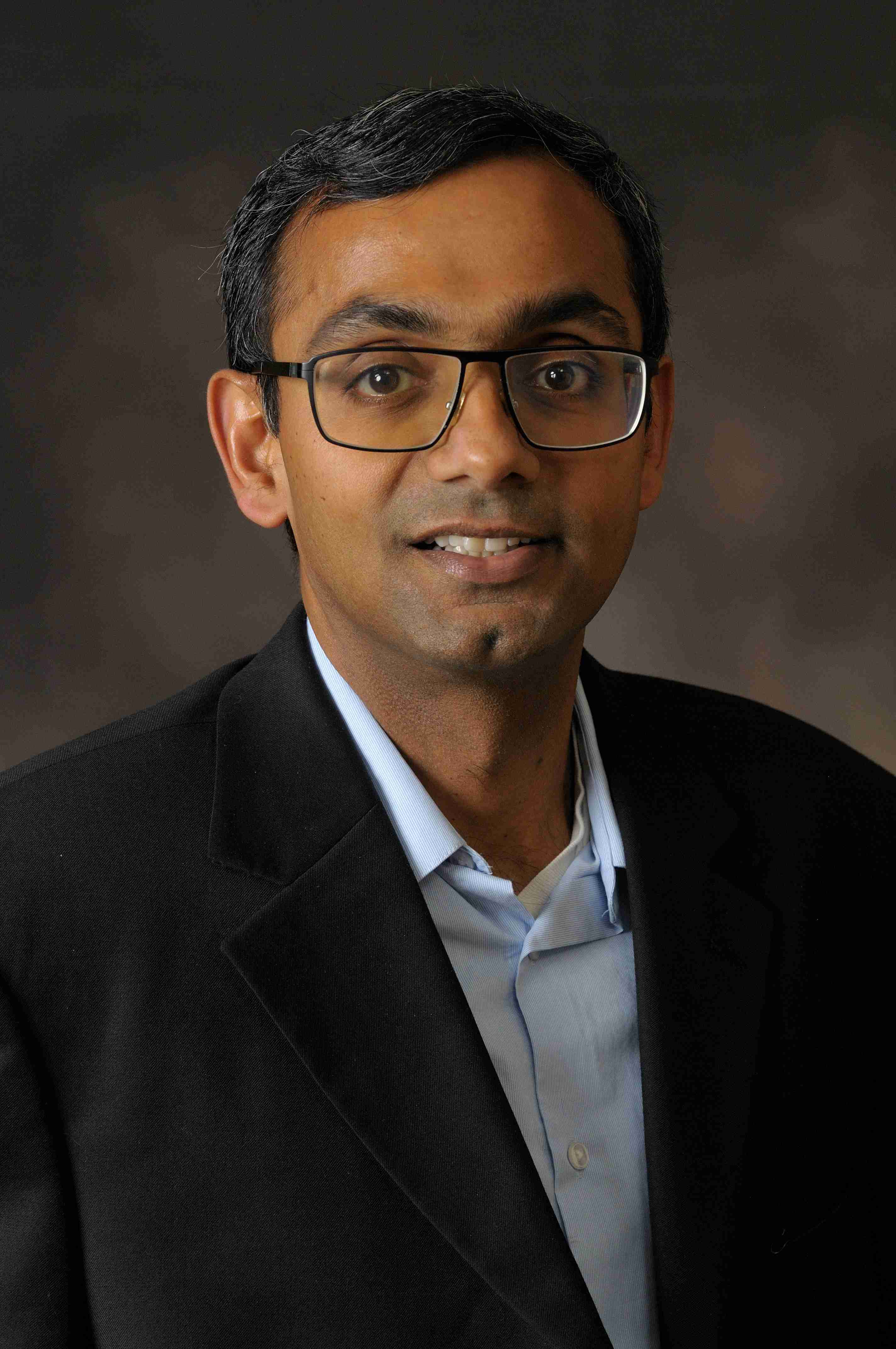
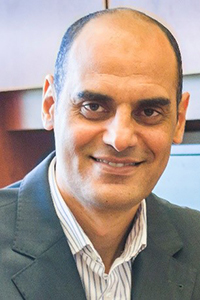
Jun Cai is a Professor in the Department of Electrical and Computer Engineering at Concordia University. He holds the PERFORM Research Chair and is a Senior Member of IEEE (SMIEEE). His work focuses on cutting-edge technologies in next-generation wireless networks and distributed learning paradigms. Ph.D. in Electrical and Computer Engineering from the University of Waterloo (2004) Dr. Cai's research spans multiple domains in modern telecommunications and computational systems: Digital twin modeling for human-centric applications Distributed machine learning architectures (federated/split learning) Network resource allocation economics Advanced wireless communication (5/6G, NOMA, MIMO) Edge/cloud computing integration IoT applications in healthcare (eHealth) He actively supervises graduate students in both Master's (MASc) and Doctoral (PhD) programs in Electrical and Computer Engineering, with current openings for candidates interested in digital twin technologies, distributed learning systems, and next-generation wireless networks. PERFORM Research Chair recipient Senior Member, Institute of Electrical and Electronics Engineers (IEEE)
Dr. Patrick Hung is a Professor (on Research Leave) in the Department of Information Security at Ontario Tech University's Faculty of Business and Information Technology. His research focuses on smart toys, robotic computing, services computing, workflow security, and privacy. He holds U.S. patents and has authored Springer books on toy computing. He chairs academic minitracks at the Hawaii International Conference on System Sciences (HICSS) and collaborates globally, including with Zayed University (UAE), the University of São Paulo (Brazil), and National Technological University (Argentina). He has held visiting roles at institutions worldwide, including National Taipei University of Technology (Taiwan) and Shizuoka University (Japan). His editorial roles include Associate Editor of IEEE Transactions on Services Computing and Coordinating Editor of Springer's Information Systems Frontiers. Dr. Hung has received the IEEE TCSVC Outstanding Service Award (2018) and contributed to NSF panels. His education includes a PhD in Computer Science from Hong Kong University of Science and Technology. Education: PhD (Computer Science), Hong Kong University of Science and Technology Master of Philosophy Science (Computer Science), Hong Kong University of Science and Technology Master of Applied Science (Management Sciences), University of Waterloo Bachelor of Science (Computer Science), University of New South Wales Research Interests: Dr. Hung explores how technology enhances smart toys and companion robots, with recent work on in-vehicle companion robots in Connected and Autonomous Vehicles (CAV). He investigates cybersecurity, IoT privacy, and blockchain applications in smart cities. His work bridges robotics, AI, and ethical design, emphasizing inclusivity for visually impaired users and privacy protection for children's devices. Publications: His recent work spans smart toy security, edge computing optimization, and AI-driven healthcare solutions. Key topics include privacy-preserving frameworks for IoT, federated learning for incomplete data, and fall risk detection using computer vision. Awards & Recognition: IEEE TCSVC Outstanding Service Award (2018) Founding member of IEEE's Technical Committee on Services Computing Grants & Collaboration: Collaborates with Boeing Research & Technology, CSIRO (Australia), and Zayed University. His projects address aviation services, smart city infrastructure, and ethical AI deployment. He has secured funding for research on blockchain-based academic record verification and privacy-aware smart metering systems. Labs & Teams: Active in cybersecurity research labs at Ontario Tech and collaborates globally on interdisciplinary teams addressing IoT security, robotics ethics, and accessible technologies.
Naser Ezzati-Jivan is an Associate Professor in the Department of Computer Science at Brock University, Canada. He holds a PhD in Computer Engineering from the University of Montreal. His research focuses on software performance engineering, software tracing, distributed systems, and energy efficiency in IoT and cloud environments. He leads a research team exploring adaptive tracing techniques, malware detection, and anomaly classification in IoT networks. He has secured grants from NSERC, Mitacs, and FedDev for projects on software energy efficiency and smart IoT devices. Dr. Ezzati-Jivan teaches courses such as Software Performance Engineering (COSC 5P07) and Software Engineering 1/2 (COSC 4P01/4P02), emphasizing Agile methodologies, AI integration, and tool usage (Git, Azure DevOps). His research team includes members like Morteza Noferesti and Madeline Janecek, and he actively mentors graduate students and postdocs. His recent work includes publications on execution trace reconstruction using diffusion models, CNN-BiLSTM anomaly detection, and kernel-level performance analysis. He collaborates with institutions like the University of Montreal’s DORSAL lab and has presented at conferences like MIDDLEWARE and TRUSTCOM. His research bridges system-level tracing with software engineering practices to enhance observability and robustness in modern distributed systems.
Ben DeVries is an Associate Professor in the Department of Geography, Environment & Geomatics at the University of Guelph's College of Social and Applied Human Sciences. His research focuses on satellite Earth observation, remote sensing of ecosystem dynamics, and land use/land cover change. He teaches courses such as Analysis in Geography, The Earth from Space, GIS and Spatial Analysis, and Applied Geomatics. His research interests span geospatial technologies, environmental monitoring, and ecosystem dynamics, with a strong emphasis on practical applications in conservation and land management. Dr. DeVries supervises multiple graduate students working on projects ranging from wetland classification using remote sensing to Arctic lake dynamics. His recent publications reflect a focus on global forest carbon patterns, erosion modeling, and advanced satellite data applications. Research trends show integration of machine learning, large-scale geospatial analysis, and climate impact assessments across diverse ecosystems. His work employs cutting-edge methodologies including cloud computing, time-series analysis of satellite imagery, and hybrid modeling approaches to address pressing environmental challenges.
Fatemeh Khoda Parast is an Assistant Professor in the Department of Computer Science at the University of New Brunswick (UNB). She previously served as an Assistant Professor at the University of Guelph from September 2023 to September 2024. Her PhD in Computer Science from UNB (2019–2023) focused on the security of large-scale distributed storage systems. She currently researches transforming cyber threat intelligence into rapid defense mechanisms. Education: PhD in Computer Science, University of New Brunswick (2019–2023) Her research interests span cybersecurity, cyber threat intelligence, digital forensics, and cloud storage security. She explores cryptographic solutions for distributed systems and AI-driven threat detection. Recent work includes CephArmor (secure Ceph storage interfaces) and neural network-based RSA cryptanalysis. Her publications address cutting-edge topics like AI in threat intelligence automation and privacy-preserving machine learning for distributed data. No scientific awards are explicitly mentioned. No advising or grant details are provided. Her work contributes to advancing secure cloud infrastructure and cryptographic protocols.
Parimala Thulasiraman is a Professor in the Department of Computer Science at the University of Manitoba, affiliated with the Faculty of Science. Her research focuses on high-performance computing, graph analytics, and network science, leveraging bio-inspired algorithms and machine learning. She leads the IDEAS (InterDisciplinary Evolving Algorithmic Science) Lab, which develops innovative optimization techniques for complex systems and scalable algorithms for multicore architectures. Her work spans applications in finance, genomics, and vehicular networks, supported by grants from NSERC, Research Manitoba, and MITACS. She holds senior membership in the ACM and IEEE and has been recognized with the University of Manitoba Teaching Recognition Award. Research interests emphasize evolutionary computation, parallel algorithms, and their real-world applications. Recent projects include GPU-accelerated multi-objective optimization, blockchain-based VANET security, and genomic data analysis using parallel suffix tree methods. Her publications explore cutting-edge topics like coevolutionary systems, ant brood clustering for portfolio management, and knowledge distillation in sentiment analysis. Grants & Awards: NSERC, Research Manitoba, MITACS ACCELERATE; Teaching Recognition Award Labs/Teams: IDEAS Lab (InterDisciplinary Evolving Algorithmic Sciences) Advising and grant activities involve interdisciplinary collaborations, with a focus on training the next generation of computational scientists. Current research trends include post-cloud computing models (dew-blockcloud systems), AI bot optimization, and blockchain applications in finance and transportation.
Prof. Jamal Bentahar is a Professor at the Concordia Institute for Information Systems Engineering (CIISE), part of Concordia University's Faculty of Engineering and Computer Science. His research focuses on intelligent agents, multi-agent systems, federated learning, reinforcement learning, cybersecurity, and their applications in healthcare, IoT, and autonomous systems. He leads research initiatives in AI-driven medical imaging, edge-cloud computing, and blockchain-empowered distributed systems. Key research areas include: Multi-Agent Systems: Formal verification of trust and commitments, group trust modeling, and distributed decision-making Federated Learning: On-demand client/model deployment, trust-aware optimization, and privacy-preserving frameworks Medical AI: Cardiac ultrasound analysis, CPR signal processing, and robotic telemedicine systems Edge/IoT Intelligence: UAV-enabled vehicular networks, energy-efficient LoRa gateways, and fog computing optimization His work bridges theoretical foundations (e.g., multi-valued model checking) with practical applications in healthcare robotics, smart city infrastructure, and autonomous vehicle safety. Recent publications highlight innovations in transformer-based reinforcement learning, spherical topic modeling, and explainable AI for cybersecurity. Prof. Bentahar's contributions include tools like MV-Checker for multi-valued verification and frameworks like CACTUS for cardiac ultrasound analysis. He actively publishes in top venues and serves as editor for special sections on federated learning and AI applications.
Zhen He is an Assistant Professor in the Department of Economics at McMaster University, where he focuses on retail economics, labor markets, and applied microeconomics. His interdisciplinary research bridges economic theory with advanced sensing technologies, particularly in human activity recognition and wearable devices. Key teaching areas: Intermediate Microeconomics, Public Sector Economics, Labour Economics Recent work explores sedentary behavior mapping in aging populations and acoustic sensing applications His scholarly output spans both traditional economic studies and cutting-edge technological implementations, suggesting a unique cross-disciplinary approach. While primarily affiliated with McMaster's Economics department, his research extends into domains like wireless sensing systems and edge computing analytics. Notable trends in his publications include: Acoustic sensing innovations on commodity hardware mmWave radar applications for health monitoring Behavioral pattern analysis in commercial environments
Omar Abdul Wahab is an Assistant Professor at the Department of Computer Engineering and Software Engineering, Polytechnique Montréal. He holds a PhD in Information Systems Engineering from Concordia University (2017) and completed postdoctoral research at École de technologie supérieure (2017-2018) in collaboration with Rogers and Ericsson. PhD: Concordia University, Montréal, Canada Master's: Lebanese American University, Beirut, Lebanon Bachelor's: Lebanese University, Tripoli, Lebanon His research focuses on Cybersecurity , Artificial Intelligence , and Internet of Things , with expertise in cloud computing security , federated learning , and game-theoretic security models . He has developed frameworks for threat intelligence coalitions , IoT intrusion detection , and trust-aware client selection in distributed systems. His recent publications emphasize federated learning security , IoT anomaly detection , and trust modeling in collaborative environments. Current supervised students include PhD candidates Sarhad Arisdakessian and Osama Wehbi, and Master's student Ranim Rahali.
Azzedine Boukerche is a Full Professor and holds a Canada Research Chair in Large-Scale Distributed Simulation Systems and Vehicular Networking (Tier 1) at the University of Ottawa. He is the Founding Director of the PARADISE Research Laboratory. Previously, he held faculty positions at the University of North Texas, McGill University, and Polytechnic of Montreal, and worked as a Senior Scientist at Metron Corporation. His research focuses on wireless communication, mobile ad hoc networks, sensor networks, distributed systems, and large-scale simulation. He has authored multiple books and numerous publications in top-tier conferences and journals. Research Interests: His work spans Wireless Communication , Mobile Ad Hoc Networks , Sensor Networks , Parallel and Distributed Simulation , and Security in IoT/Underwater Systems . His contributions address challenges in network protocols, privacy, and efficient resource management in dynamic environments. Awards: Ontario Distinguished Researcher Award, Canada Research Chair, G. S. Glinski Award, Best Paper Awards (PADS'97, Telecommunication Software 1999). Leadership: Co-founder of QShine Conference, served as General Chair/Program Chair for IEEE/ACM events, and editorial roles in journals like Wireless Networks and Journal of Parallel and Distributed Computing . Labs & Teams: He leads the PARADISE Lab, focusing on innovations in vehicular networks, underwater systems, and distributed simulation. His team collaborates on projects involving autonomous vehicles, smart cities, and secure communication protocols.
Dr. Gennady Pekhimenko is an Associate Professor in the Department of Computer Science and cross-appointed to the Electrical and Computer Engineering department at the University of Toronto. He leads the EcoSystem research group and serves as CEO/Co-Founder of CentML, with affiliations at CIFAR and Vector Institute. PhD in Computer Science from Carnegie Mellon University (2016) His research spans computer architecture, systems optimization, and applied machine learning, with a focus on memory hierarchy efficiency, hardware acceleration, and compiler design. Recent work emphasizes large language model training, GPU virtualization, and processing-in-memory systems. Key article trends include: 1) Memory optimization for transformers and sparse models (2024-2025), 2) GPU resource management (2022-2024), 3) Prompt programming languages (2025), and 4) Deep learning compilation frameworks (2021-2023). Major Awards: NVIDIA Graduate Fellowship, Microsoft Research PhD Fellowship, ISCA Hall of Fame, AWS/Google/VMware research grants Key Collaborations: Onur Mutlu (CMU), Todd Mowry (CMU), Vector Institute researchers
Wendy Osborn is an Associate Professor in the Department of Mathematics and Computer Science at the University of Lethbridge . She holds a Ph.D. (2005) from the University of Calgary, an M.Sc. (1998) from the University of Windsor, and a B.C.S.(Hons) (1996) from the University of Windsor. Research Interests: Dr. Osborn specializes in Databases , with a focus on Spatial , Distributed , and Multimedia systems. Her work also explores Mobile Information Systems , Recommender Systems , and Digital Libraries , emphasizing efficient querying and classification in dynamic environments. Publications: Her research addresses challenges in spatial data streams, mobile device processing, and distributed query optimization, reflecting collaborations with database indexing techniques like the mqr-tree and area code tree. Key trends include iterative classification, approximate querying, and energy-efficient system design.
Dr. Abdelhakim Senhaji Hafid is a Full Professor at the University of Montreal in the Department of Computer Science and Operations Research within the Faculty of Arts and Science. He serves as the founding director of both the Network Research Lab and the Montreal Blockchain Lab, and is a research fellow at CIRRELT (Centre interuniversitaire de recherche sur les réseaux d'entreprise, la logistique et les transports). Dr. Hafid's research focuses on Blockchain technology , Internet of Things (IoT) , Fog/edge computing , and intelligent transport systems . His work addresses critical challenges in distributed systems, particularly how to overcome the limitations of cloud computing for real-time IoT applications through edge computing solutions, and how to enhance the security and performance of blockchain platforms across various application domains. With over 240 published papers and three US patents to his name, Dr. Hafid has made significant contributions to his fields of expertise. His research is supported by multiple grants from NSERC, FRQNT, and other funding agencies, focusing on cutting-edge topics like quantum-resistant blockchain security, IoT authentication using blockchain, and fog network management. Research fellow at CIRRELT since 2015 Member of talents - Laboratoire d'Intelligence Artificielle pour la Cybersécurité Co-founded Tipot Technologies Inc. (R&D Platform for IoT) Extensive consulting experience with telecommunications companies and startups Dr. Hafid has supervised over 50 graduate and postgraduate students to completion, demonstrating his commitment to training the next generation of researchers. His teaching includes specialized courses on Blockchain Technology, which he has offered since 2019, along with foundational courses in networking protocols, e-commerce technologies, and web development. His industry experience at Bell Communications Research provides valuable context to his academic work, bridging theoretical research with practical applications.
Karthik Pattabiraman is a Professor and Associate Head (Graduate Affairs) in the Department of Electrical and Computer Engineering at the University of British Columbia (UBC), Canada. He holds a PhD in Computer Science from the University of Illinois at Urbana-Champaign (UIUC), an MS from UIUC, and a B.Tech from the University of Madras. His research focuses on dependable computer systems, computer security, cyber-physical systems, and software engineering. He has led the Dependable Systems Lab and other research groups like RADICAL and LERSSE. Education: PhD (UIUC, 2009), MS (UIUC, 2004), B.Tech (University of Madras, 2001). Postdoctoral research at Microsoft Research (2009). Research Interests: Dependable systems, security in cyber-physical systems, software reliability, and edge computing. His work includes fault injection frameworks (e.g., TensorFI, BinFI), resilience techniques for ML systems, and intrusion detection in robotic vehicles. Awards: Inaugural Rising Star in Dependability Award (2020), UBC Killam Research Prize (2018), IEEE/IFIP DSN Best Paper (2021), and recognition for contributions to dependability and security. Lab Activities: Dependable Systems Lab, Real-Time and Dependable Computing Lab (RADICAL), Secure Systems Engineering (LERSSE), and Software Analysis and Testing (SALT) Lab. Current sabbatical at Meta (2024-2025).
Dr. Khalid Elgazzar is an Associate Professor and Canada Research Chair in the Internet of Things (IoT) at Ontario Tech University's Faculty of Engineering and Applied Science. He holds a PhD in Computer Science from Queen's University and has expertise in IoT, AI, Big Data, distributed systems, and mobile computing. His research bridges physical infrastructure with technological innovations, with applications in healthcare, transportation, and smart cities. Education: PhD in Computer Science, Queen's University, 2013 MSc in Computer Engineering, Arab Academy for Science and Technology, 2007 BSc in Computer and Communication Engineering, Alexandria University, 1995 Research Interests: Dr. Elgazzar focuses on IoT architectures, real-time data analytics, and edge computing, with emphasis on cybersecurity, smart healthcare systems, and transportation safety. His work integrates AI techniques like deep learning and reinforcement learning to address challenges in distributed computing and sensor networks. Awards: Best Paper Award at IEEE/ACM International Conference on Utility and Cloud Computing (2013) Outstanding Achievement in Sponsored Research Award (2017) Queen's School of Computing Distinguished Research Award (2014) Grants & Labs: Recipient of a Canada Research Chair Tier II (2018-present). He leads the IoT Research Lab, advancing projects like real-time ECG monitoring systems and intelligent traffic prediction models. Collaborations include institutions like Carnegie Mellon University and IBM Canada. Teaching: Design and Analysis for IoT Software Systems (SOFE 4610U) Real-Time Data Analytics for IoT (ENGR 5785G) Introduction to Programming for Engineers (ENGR 1200U)



.png)