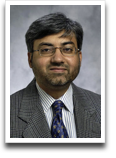
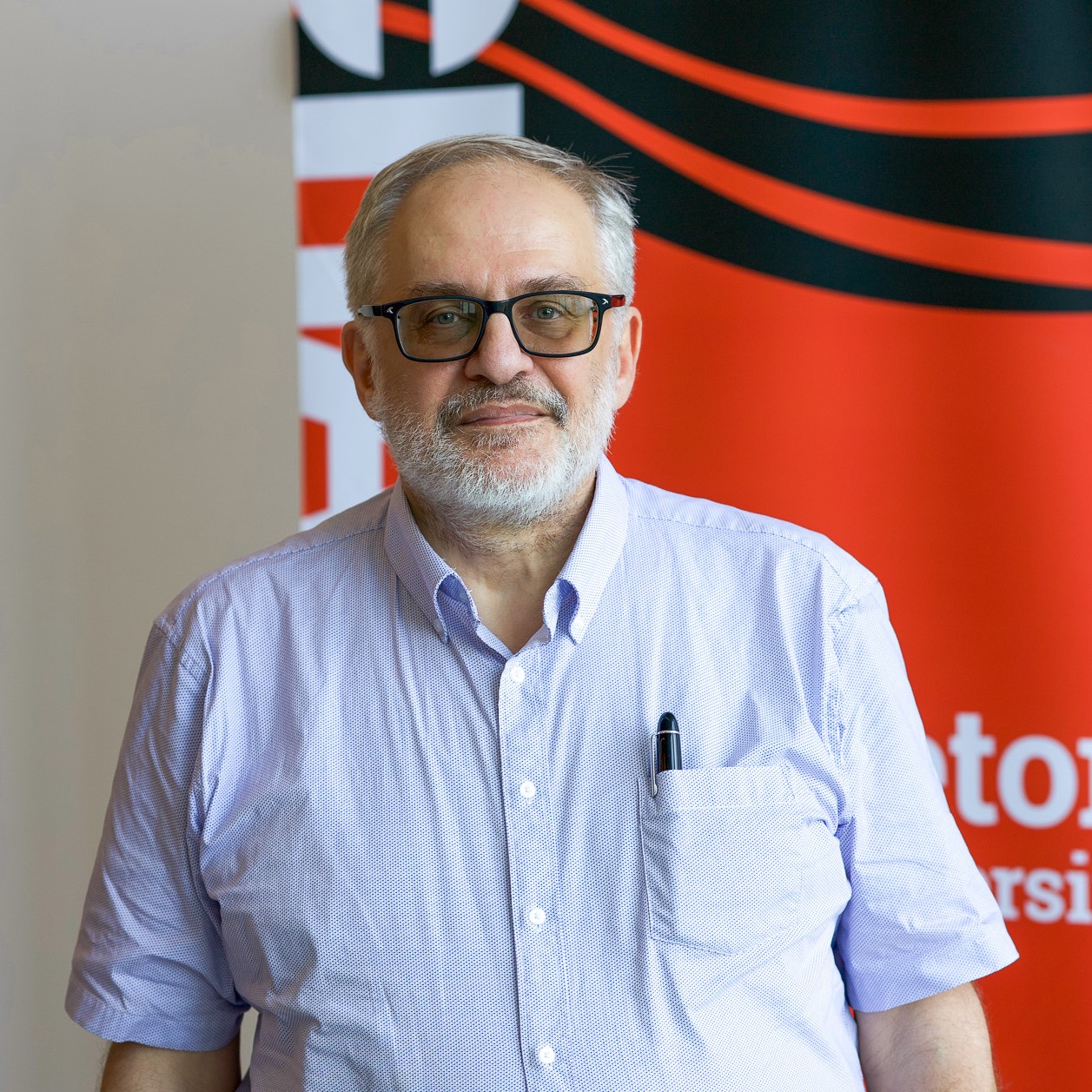
Muhammad Jaseemuddin is a Professor and Program Director of Computer Networks at Toronto Metropolitan University since 2002. He holds a Ph.D. from The University of Toronto (1997), an M.S. from The University of Texas at Arlington (1991), and a B.E. from N.E.D. University of Engineering & Technology, Karachi, Pakistan (1989). Research Interests: IP Networking Mobile Wireless Networks Network Automation Smart Grid Communication Internet of Things Mobile and Cloud Computing Publications Trends: His selected works (2010–2012) focus on wireless network protocols, directional antenna applications, and network performance optimization in ad hoc and mesh architectures. Academic Roles: He has contributed to network protocol design through collaborations with researchers like O. Bazan, A. Anpalagan, and others, while teaching courses in Software Systems and Computer Networks.
Ali José Mashtizadeh is an Associate Professor at the Cheriton School of Computer Science, University of Waterloo. His research focuses on operating systems, distributed systems, and storage, with expertise in system reliability, network optimization, and concurrent programming. Education: Ph.D., Computer Science, Stanford University (2017) M.S., Computer Science, Stanford University (2017) M.Eng., Electrical Engineering and Computer Science, MIT (2007) B.S., Electrical Engineering, MIT (2006) His research centers on designing scalable and reliable systems, with recent publications exploring TCP network frameworks, in-memory data persistence, and microsecond-scale scheduling. Key themes include optimizing tail latency, neutralization-based memory reclamation, and fault-tolerant distributed services. His articles consistently demonstrate innovations in low-latency networking, operating system architecture, and cloud infrastructure, with recent emphasis on serverless benchmarks and processor customization. No scientific awards or advising relationships are detailed in the provided materials.
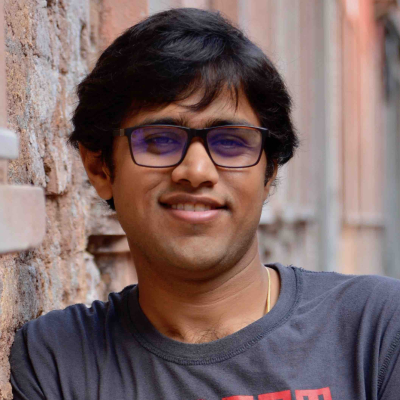
Arpan Gujarati is an Assistant Professor in the Department of Computer Science at the University of British Columbia (UBC), affiliated with the Systopia Lab. His research focuses on real-time systems, distributed systems, fault tolerance, and reliability analysis in cloud and cyber-physical systems domains. He holds a PhD from the Max Planck Institute for Software Systems (MPI-SWS) and has postdoctoral and research experience at MPI-SWS and UBC. Education: PhD in Real-Time Systems (MPI-SWS/TU Kaiserslautern, 2020), Postdoctoral Researcher at MPI-SWS (2020), Research Associate at UBC (2022–2023), B.Sc. from Birla Institute of Technology and Science (BITS Pilani, India). Research interests include distributed real-time systems, reliability analysis of cloud applications, fault-tolerant machine learning, and scheduling algorithms. His work bridges theory and practice, addressing challenges in ultra-reliable CPS and resilient distributed systems. Awards: Best Dissertation Award (SIGBED, 2020), Best Paper Awards (RTSS 2022, ECRTS 2018), Distinguished Artifact Award (OSDI 2020). Advising: Supervises PhD and undergraduate students in distributed systems and resilience engineering. Active in UBC’s Computer Science Graduate Program, teaching courses like CPSC 416 (Distributed Systems) and CPSC 538G (Topics in Computer Systems). Labs/Teams: Leads the Systopia Lab, collaborating with industry partners on projects like robotic arm datasets and self-driving lab tools (RABIT). Involved in research groups focused on machine learning resilience and real-time systems.
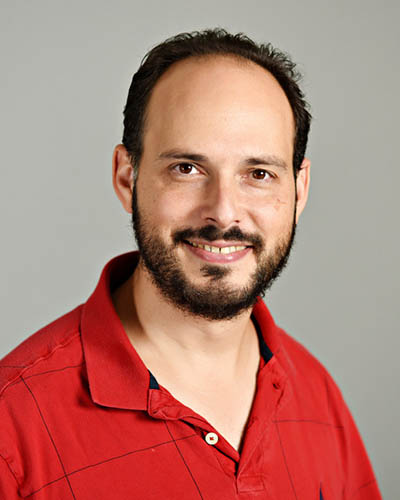
Eyal de Lara is a Professor and Chair of the Computer Systems and Networks Group at the University of Toronto's Department of Computer Science . He is cross-appointed in Computer Engineering and actively leads research in distributed systems, cloud, edge, and mobile computing. His office is located at BA5234, Bahen Centre for Information Technology . Research Interests: His work spans distributed systems , cloud computing , edge computing , and mobile computing . He leads the Computer Systems and Networks Group , focusing on scalable and efficient computing paradigms. Students: He has supervised numerous Ph.D. and M.Sc. students, including current advisees such as Kai Shen , Myles Thiessen , and Guy Khazma , as well as former students like Sahil Suneja and Jing Su .
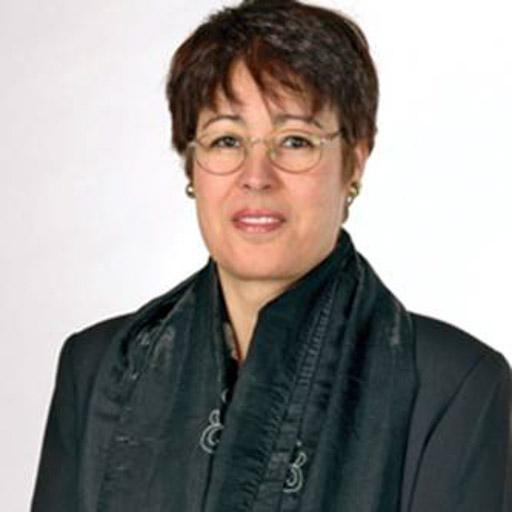
Rachida Dssouli is a Professor at the Concordia Institute for Information Systems Engineering (Concordia University). Her research focuses on advanced software engineering methodologies, quality assurance systems, and distributed computing frameworks. She specializes in model-based testing, federated learning optimization, and big data quality management. Her work integrates formal verification techniques with modern machine learning approaches to address challenges in edge computing, IoT, and safety-critical systems. Key research areas include: Development of hybrid swarm intelligence algorithms for optimizing large language model deployment in edge-cloud environments Design of reinforcement learning frameworks for robotics motion planning and IoT device scheduling Creation of interpretable machine learning tools for fault detection in software systems Establishment of holistic big data quality frameworks for continuous monitoring and unstructured data analysis Formal verification methods for avionics systems using multi-agent models Her recent work demonstrates trends toward AI-driven solutions for testing methodologies (e.g., SHAP-Driven fault detection) and edge-cloud integration (e.g., MIMO-based computation offloading optimization). The 2025 publications highlight advancements in federated learning and trust-aware IoT scheduling. Earlier works (2018-2020) emphasize foundational contributions to cloud trust models, big data quality metrics, and safety-critical system testing. Her research also addresses emerging technologies for developing countries through frameworks like neurodegenerative disease monitoring systems and mobile application requirements engineering. She has contributed to service-oriented architectures for healthcare systems and cloud-based resource orchestration strategies.
Ioannis Lambadaris is a Full Professor and Chancellor’s Professor at Carleton University's Department of Systems and Computer Engineering, Faculty of Engineering and Design. Holding a Ph.D. from the University of Maryland, he has contributed extensively to network performance analysis over 25+ years. Specializes in stochastic processes, cloud computing, and wireless edge systems Led Ericsson 5G Chair initiatives Supervised over 70 graduate students His research spans QoS control , VNF placement optimization , and IoT indoor localization , with over 170 publications. Recent work focuses on reinforcement learning and deep learning in network resource allocation. Scientific Recognition: Chancellor’s Professor Ericsson 5G Chair Contact: ioannis@sce.carleton.ca | Office: Mackenzie 4448, Ottawa, ON
Dr. Yong Deng is an Assistant Professor in the Software Engineering department at Lakehead University , Canada. He holds a Ph.D. in Electrical and Computer Engineering from Ontario Tech University and a Postdoctoral Fellowship from University of Toronto . His research focuses on Coded Caching, Distributed Computing, Wireless Networks, Algorithmic Mechanism Design, and Network Security . B.Eng., Wuhan University of Technology, China Ph.D., Electrical and Computer Engineering, Ontario Tech University, Canada Postdoc, University of Toronto, Canada Deng's recent work investigates memory-rate tradeoffs in caching systems, novel coded delivery strategies, and decentralized caching under nonuniform file popularity. His contributions span IEEE/ACM Transactions on Networking , IEEE Communication Letters , and IEEE Transactions on Information Theory , focusing on optimizing network efficiency and resource allocation. He actively recruits Master's students and has published extensively on caching algorithms, vehicular cloud security, and distributed computing challenges.
Marc St.-Hilaire is a Professor at the School of Information Technology and cross-appointed to the Department of Systems and Computer Engineering at Carleton University within the Faculty of Engineering and Design . He holds a Ph.D. from École Polytechnique de Montréal and serves as the NET Program Coordinator. He is a Senior Member of IEEE and has received multiple awards, including the Carleton Faculty Graduate Mentoring Award and the Teaching Achievement Award. Education: Ph.D., École Polytechnique de Montréal His research centers on telecommunication network planning, mobile computing, and network optimization , with strong emphasis on wireless and vehicular networks, fog/edge computing, blockchain integration, and AI-driven network protocols . His recent work applies reinforcement learning, genetic algorithms, and fuzzy logic to solve challenges in dynamic and distributed environments. The trend in his recent publications shows a strong focus on smart infrastructure , including Internet of Vehicles (IoV), smart grids, and cloud/edge resource management . He frequently collaborates with students and researchers on topics such as virtual network embedding, SLA-aware provisioning, and cooperative positioning , often leveraging emerging technologies like blockchain and deep learning. Scientific Awards and Honors: Senior Member, IEEE Best Industry Paper Award, WF-IoT 2024 Best Paper Award, ADHOCNETS 2019 Best Paper Award, iThings 2018 IEEE WIE Best Paper Award, CCECE 2018 Best Paper Award, ADHOCNETS 2017 Carleton Faculty Graduate Mentoring Award, 2014 Carleton Teaching Achievement Award, 2014–2015 Dr. St.-Hilaire actively supervises a large team of graduate students and has mentored over 40 Ph.D., Master’s, and postdoctoral researchers to completion. He has secured significant research funding through industry and government grants, enabling extensive experimental testbeds in SDN, fog computing, and vehicular networks. His work bridges theoretical optimization with practical implementation, often releasing tools and simulators (e.g., NetAnalyzer, DEVS fog simulator). He leads a vibrant research team focused on network intelligence, edge-based complex event processing, and sustainable computing . His lab collaborates with industry partners on projects involving 5G/6G integration, TSN in cloud environments, and smart city applications such as cloud-based waste management and smart grid simulation.
Dr. Cungang Yang is an Associate Professor in the Department of Electrical, Computer, and Biomedical Engineering at Ryerson University. Holding a PhD from the University of Regina (2003) and a Master's from Jilin University (1992), Yang specializes in security protocols for emerging technologies including robotics, IoT, and cloud computing. His research focuses on developing efficient authentication mechanisms to protect data in power systems, smart grids, and wireless networks. PhD in Computer Science, University of Regina (2003) MS in Computer Science, Jilin University (1992) Yang's work addresses critical security challenges in: Internet of Things (IoT) communication Cloud computing infrastructure Wireless sensor networks Smart grid technology His research team has published extensively on cryptographic key management and authentication protocols, with recent work appearing in IEEE Cloud and IEEE ICIOT conferences (2018). Yang teaches core courses in network security and software systems (COE 817, COE 318, EE 8213). Scientific Awards New Opportunities Fund, Canada Foundation for Innovation (CFI) Departmental Teaching Excellence Awards
Prof. Kui Wu is a Professor in the Department of Computer Science at the University of Victoria, affiliated with the Faculty of Engineering and Computer Science. His research focuses on computer networks, wireless and mobile networking, mobile computing, and network security. He is part of the Parallel, Networking and Distributed Computing (PANDA) research group. Key areas of expertise include distributed learning frameworks, autonomous systems, IoT anomaly detection, and edge computing architectures. His work integrates machine learning techniques with network optimization, addressing challenges in real-time systems, security, and resource allocation. Notable contributions include advancements in federated learning, privacy-preserving distributed systems, and UAV-based monitoring solutions. Prof. Wu's research also explores edge computing innovations, such as smart contract-aided IoT resource sharing and energy-efficient edge data centers. He has contributed to over 50 peer-reviewed publications, with recent work emphasizing AI-driven network design, anomaly detection in IoT, and reinforcement learning applications in autonomous driving safety. His research has practical implications for improving the reliability and efficiency of next-generation communication and computing infrastructures.
Yasaman Amannejad is an Associate Professor in the Department of Mathematics and Computing at Mount Royal University (MRU), Faculty of Science. She holds a PhD in Software Engineering from the University of Calgary (2017) and an MSc/BSc in Computer Information Technology from Amirkabir University of Technology (2011/2008). Her research focuses on applying machine learning to healthcare diagnostics, performance analysis of cloud and edge computing systems, and addressing social challenges like domestic violence and homelessness. Her work has been funded by NSERC, Petro-Canada, and the New Frontiers in Research Fund. Education: PhD in Software Engineering, University of Calgary (2017) MSc in Computer Information Technology, Amirkabir University of Technology (2011) BSc in Computer Information Technology, Amirkabir University of Technology (2008) Research Interests: Machine Learning for Healthcare (e.g., tropical disease diagnosis, Multiple Myeloma cancer) Performance Optimization in Cloud/Edge Systems Resource-Constrained Device Learning (wearables, IoT) Social Impact Technologies (domestic violence detection, homelessness solutions) Awards & Grants: NSERC Discovery Grant (2020) New Frontiers in Research Fund-Exploration (2020) Petro-Canada Young Innovator Award (2019) Multiple Teaching Awards (2015-2016) Teaching & Industry: Incorporates industry experience into courses, emphasizing real-world applications Outstanding Teaching Performance Award (2016) Over 5 years of industry experience in software engineering Labs/Teams: Part of interdisciplinary teams at MRU's Faculty of Science Collaborates on NSERC-funded projects
Martine Bellaïche is a Full Professor in the Department of Computer Engineering and Software Engineering at Polytechnique Montréal. With a B.Sc., M.Sc., and Ph.D. from Montreal, she has established herself as a leading researcher in network security and cybersecurity. She is affiliated with the Mobile Computing and Networking Research Laboratory (LARIM), where she contributes to cutting-edge research in communications systems, networks, and algorithms. Dr. Bellaïche's research spans multiple critical areas of modern cybersecurity, with particular focus on network security, prevention and detection of attacks, performance evaluation of defense systems, and defense against Denial of Service (DDoS) attacks. Her work extends to specialized domains including sensor network security, vehicular network security, cloud computing security, and Internet of Things security. Her research approach often combines theoretical foundations with practical applications, addressing real-world security challenges across various technological domains. Analysis of her recent publications reveals a strong trend toward AI-driven security solutions, particularly using deep learning and federated learning approaches for intrusion detection in IoT environments. Her work increasingly addresses emerging security challenges in blockchain technology, metaverse applications, and industrial IoT systems, demonstrating adaptability to evolving technological landscapes while maintaining focus on fundamental security principles. Supervised 5 PhD students to completion, including Alfalqi (2022), Alghamdi (2022), Abusitta (2018), Halabi (2018), and Benbrahim (2016) Mentored 6 Master's students, with research spanning DDoS detection, VANET security, and graph coloring algorithms Active participant in multiple research grants, including Discovery Grants from Polytechnique Montréal Dr. Bellaïche teaches several foundational computer science courses including procedural programming, object-oriented programming, microcomputer architecture, and data structures and algorithms, bridging theoretical knowledge with practical security applications in her teaching.
Aastha Mehta is a Tenure-Track Assistant Professor in the Computer Science Department at the University of British Columbia (UBC), affiliated with the Systopia Lab and the Security and Privacy Group. Her research focuses on systems security, data privacy, and distributed systems, particularly in cloud and edge platforms. She teaches courses such as CPSC 538M (Systems Security) and CPSC 317 (Introduction to Computer Networking). Research Interests: Her work spans systems security, network privacy, ICS security, and privacy-preserving technologies. Key projects include compliance tools for serverless applications (Growlithe), network side-channel mitigation (NetShaper), and epidemic risk mitigation systems leveraging Bluetooth beacons. Received NCC Funding for ICS security research (2024) Faculty Teaching Awards (UBC) Advising: Currently supervises PhD and MSc students like Yayu Wang, Angela DeMarco, and Satvik Vemuganti. Collaborates with researchers from MPI-SWS, UofT, and UBC ECE on security and privacy projects. Service: Serves on program committees for CCS 2025, ASPLOS 2025, and Oakland S&P. Organized mentoring programs at SOSP and OSI.
Henry P. Schriemer is a Professor in the School of Electrical Engineering and Computer Science at the University of Ottawa's Faculty of Engineering. His career bridges fundamental physics, photonics innovation, and applied renewable energy systems, with significant contributions to both academic research and industrial photonics development. His educational foundation includes a B.Sc. in Mathematics (1987) and Ph.D. in Physics (1997), both from the University of Manitoba. Early career milestones featured postdoctoral research at Queen's University and a prestigious FOM Postdoctoral Fellowship at Amsterdam's van der Waals-Zeeman Institute. Schriemer's research spans Nanophotonics, Optoelectronics, and Complex Systems, with current emphasis on Photovoltaics and Smart Grid technologies. His photovoltaic work integrates multiphysics simulation, spectral irradiance modeling, and system reliability testing, while his smart grid research pioneers blockchain-secured demand response and game-theoretic energy management. This dual focus addresses critical challenges in renewable energy integration and grid stability. Analysis of his 2020-2024 publications reveals a decisive shift toward solar energy systems and grid modernization. His team develops predictive spectral models incorporating weather dynamics, advanced demand response frameworks using Stackelberg game theory, and novel instrumentation like the CanSIM network for solar resource assessment. These works consistently bridge atmospheric science, power systems engineering, and cybersecurity. His scientific achievements include: FOM Postdoctoral Fellowship (1998) for nanophotonics research at van der Waals-Zeeman Institute NCIT Research Fellowship in Photonics (2003-2005) at University of Ottawa Industry recognition as innovator of strain-engineered planar lightwave circuits Schriemer has authored over 50 refereed publications in Science, Physical Review, and IEEE journals. His industrial contributions include foundational work in diffusive acoustic wave spectroscopy and optical scattering techniques, while his academic leadership manifests through the CanSIM network and IEEE 2030/2030.5 standard implementations. He maintains active collaborations across atmospheric science, power systems, and semiconductor physics domains. His laboratory operations focus on photovoltaic testbeds, solar spectral irradiance instrumentation, and smart grid simulation platforms. The CanSIM network provides critical northern-climate solar data, while his module-level power electronics research directly addresses rapid cloud-shading challenges in real-world PV deployments.
Shadi Khalifa is an Adjunct Assistant Professor with expertise in Big Data Analytics , Distributed Machine Learning , and Wireless Communication . His work bridges Cloud Computing and Data Mining with practical applications in MapReduce , Analytics-as-a-Service , and LTE Systems . Research Trends : Analysis of Shadi Khalifa’s publications reveals a focus on distributed computing and big data optimization . Key themes include inter-cell interference coordination in wireless networks, smart big data frameworks , and cloud-based analytics . His work emphasizes scalability, efficiency, and integration of machine learning with infrastructure.