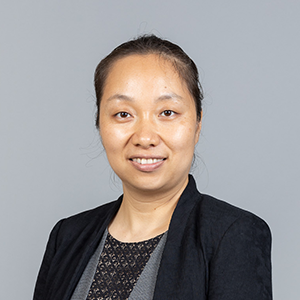
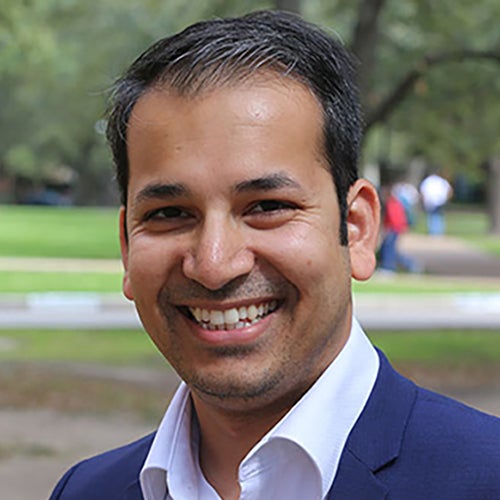
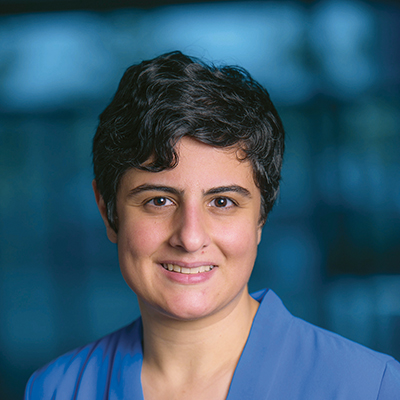
AI Xin is a Lecturer in the School of Computing at the National University of Singapore (NUS), specializing in Artificial Intelligence and Data Science. She teaches courses such as machine learning, deep learning, and data mining, including advanced modules like CS4225 and CS5425. Education: Ph.D. in Electrical and Computer Engineering from NUS; B.Eng. from Xidian University, China. Her research spans Game Theoretical Modelling , Optimization Methods , Algorithm Design , and Wireless Networks . She has contributed to multi-agent systems, algorithmic game theory, and wireless community networks, focusing on robust and distributed solutions. Her recent publications highlight trends in game theory for wireless networks , distributed coverage algorithms , and optimization for network efficiency , with a strong emphasis on theoretical and practical applications in AI and networking. Scientific Awards: Teaching Excellence Award (NUS, 2024). She has taught courses on Big Data Systems for Data Science and Computational Thinking , bridging academic rigor with industry relevance through her prior experience in risk management, supply chain, and sales at BHP Billiton Marketing Asia.
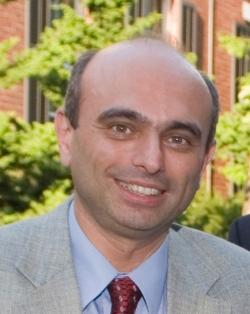
Roberto Tamassia is the James A. and Julie N. Brown Professor of Computer Science and Chair of the Computer Science Department at Brown University. He is also Director of Brown's Center for Geometric Computing. His research focuses on information security, cryptography, algorithms, graph drawing, and computational geometry. He has authored six textbooks and over 250 publications, and his work has been funded by ARO, DARPA, NATO, NSF, and industry sponsors. Education: PhD in Electrical and Computer Engineering from the University of Illinois at Urbana-Champaign. Research Interests: Cryptography and Secure Systems Algorithm Design and Optimization Graph Drawing and Geometric Computing Encrypted Database Security Awards and Honors: IEEE Fellow Technical Achievement Award from IEEE Computer Society Listed among the 360 most cited computer science authors by ISI Grants and Funding: His research has been supported by major agencies and organizations including ARO, DARPA, and NSF, as well as industry partnerships. Labs and Affiliations: Directs Brown's Center for Geometric Computing, a hub for interdisciplinary research in computational geometry and graph algorithms.
Ioannis Panageas is an Assistant Professor in Computer Science at UC Irvine's Donald Bren School, directing the GOALLab. His research develops theory for learning in multi-agent systems, game dynamics, and optimization. Funded by NSF and NRF, he focuses on last-iterate convergence guarantees in games, efficient equilibrium computation, and multi-agent reinforcement learning. Recent Work: Provides first exponential lower bounds for fictitious play in potential games (NeurIPS 2023), efficient Nash equilibrium computation methods (ICLR 2023), and semi-bandit learning dynamics with no-regret guarantees (ICML 2023). Teaching: Offers courses in Algorithmic Game Theory and Optimization for Machine Learning. Currently advising 3 PhD students and 2 MS students.
Jeanna Matthews is a Full Professor of Computer Science at Clarkson University and an affiliate at Data and Society. She holds a PhD from UC Berkeley (1999) and teaches courses ranging from operating systems to cybersecurity. Her research focuses on algorithmic transparency, AI ethics, and societal impacts of automated systems. Matthews is a prominent ACM leader, serving on multiple committees including the Technology Policy Subcommittee on AI Accountability. She has pioneered work on forensic software analysis in criminal justice systems and delivered DEF CON presentations on virtualization security and adversarial testing. Awards include ACM Distinguished Speaker and Fulbright Specialist roles. Her work emphasizes open-source tools and critical thinking in education, extending to global service learning programs in the Dominican Republic and Brazil. Education: PhD in Computer Science (UC Berkeley, 1999), B.S. in Math/Computer Science (Ohio State, 1994), B.A. in Spanish (SUNY Potsdam, 2016). Research Interests: Cybersecurity vulnerabilities, algorithmic accountability frameworks, automated decision systems in justice contexts, and ethical AI design. Recent projects include investigating bias in DNA forensic software through a Brown Institute grant and analyzing political polarization on social platforms. Awards & Recognition: ACM Distinguished Speaker (2018-present) Fulbright Specialist (2018-present) 2018-2019 Brown Institute Magic Grant ACM SIGOPS Chair (2011-2015) ACM Special Interest Group Governing Board Chair (2016-2018) Teaching & Outreach: Designed courses integrating open-source tools and critical inquiry, including abroad programs in Mexico, Brazil, and the Dominican Republic. Advocates for lifelong learning strategies and questioning underlying assumptions in computing systems. Key Projects: Forensic Software Accountability: Examining discrepancies in DNA analysis tools Algorithmic Transparency: Frameworks for auditing automated systems Cybersecurity Education: Adversarial testing methodologies for justice software
Minyi Huang is a Professor in the School of Mathematics and Statistics at Carleton University. His research focuses on Mean Field Stochastic Control, Stochastic Algorithms in Multi-Agent Systems, and Wireless Networks. He holds a Ph.D. from McGill University (2003) and has held postdoctoral positions at the University of Melbourne and the Australian National University. Dr. Huang is a Fellow of IEEE and a Member of SIAM. Education: Ph.D. in Electrical and Computer Engineering, McGill University (2003) M.Sc. in Systems and Control, Chinese Academy of Sciences (Beijing) B.Sc. in Mathematics, Shandong University (Jinan, China) Research Interests: Huang's work centers on stochastic control, mean field games, and multi-agent systems. His contributions include theoretical advancements in mean field social optimization, graphon-based control frameworks, and applications in wireless networks and economic models. He has organized workshops on Mathematical Cybernetics and Stochastic Processes, fostering interdisciplinary collaboration. Scientific Awards: Fellow of the IEEE Advising & Grants: Huang has advised numerous graduate students on topics in stochastic control and mean field theory. His grants include funding for international PhD students through Carleton's initiatives. He collaborates on projects involving mean field models for production output and social dynamics. Labs/Teams: Associated with the Ottawa-Carleton Institute for Mathematics and Statistics (OCIMS), contributing to collaborative research in control theory and applied mathematics.
Kaiyang Liu is an Assistant Professor at the Department of Computer Science, Memorial University of Newfoundland. He holds a Ph.D. from Central South University (2019) and was a Postdoctoral Fellow at the University of Victoria, Canada. His research focuses on distributed cloud/edge computing, data center networks, and distributed machine learning, emphasizing optimization for data-intensive services. He is an IEEE Senior Member and has received prestigious awards, including the NSERC Discovery Grants and IEEE TCCLD Outstanding Ph.D. Thesis Award. Education: Ph.D. in Information Science and Technology, Central South University (2014–2019) M.Sc. in Information Science and Technology, Central South University (2012–2014) B.Eng. in Information Science and Technology, Central South University (2008–2012) Research Assistant at the University of Victoria (2016–2018) Research Interests: Kaiyang’s work bridges AI and cloud computing, exploring optimization strategies for next-generation systems. Key areas include learning-based congestion control, energy-efficient resource management, and scalable distributed storage solutions. His research has been published in top-tier journals like IEEE Transactions on Parallel and Distributed Systems and conferences such as IEEE ICDCS. Awards & Grants: NSERC Discovery Grants & Discovery Launch Supplement (2024) IEEE TCCLD Outstanding Ph.D. Thesis Award (2020) CSC-UVic Fellowship (2016–2018) Teaching: He teaches courses on Computer Networks, Advanced Computer Networks, and Operating Systems at Memorial University and previously at the University of Victoria. Labs & Teams: His research group focuses on Space Edge Computing, leveraging LEO satellites for resilient, low-latency networks. Ongoing projects include optimizing distributed systems for AI workloads and satellite-based data centers.
Richard Nickl is a Professor of Mathematical Statistics at the University of Cambridge, affiliated with the Department of Pure Mathematics and Mathematical Statistics (DPMMS) and the Statistical Laboratory. His research focuses on high-dimensional inference, Bayesian nonparametrics, statistics for partial differential equations, and inverse problems. He has held significant grants, including an ERC Advanced Grant (2024–2029) and an EPSRC Programme Grant (2022–2027). His work bridges statistics, probability, and analysis, with contributions to theoretical foundations and computational methods in non-linear inverse problems. Key research interests include Bayesian posterior consistency, statistical inference for diffusions, and polynomial-time algorithms for high-dimensional posteriors. Notable publications include foundational monographs such as Mathematical foundations of infinite-dimensional statistical models (2016), which earned a PROSE Award, and recent advancements in Bayesian nonparametric inference for McKean-Vlasov models (2025). His group organizes workshops, such as the 2024 Statistical Aspects of Non-Linear Inverse Problems conference. Awards: 2017 PROSE Award in Mathematics. Grants: ERC Advanced Grant, EPSRC Programme Grant. Lab/Team: Research Group in Mathematical Statistics at DPMMS, focusing on inverse problems and Bayesian methodology.
Mathias Lécuyer is an Assistant Professor in the Computer Science Department at the University of British Columbia (UBC) , part of the Faculty of Science . His research focuses on trustworthy AI systems, with emphasis on privacy (differential privacy), adversarial robustness, and causal machine learning. He leads the Systopia Lab and collaborates with groups such as UBC S&P, TrustML, and CAIDA. Education: PhD in Computer Science from Columbia University (2019), MSc from Columbia University (2013) and École Polytechnique (2011). Research Interests: Ensuring rigorous guarantees for AI systems via differential privacy, robustness against adversarial attacks, and causal inference. His work spans theoretical foundations and practical implementations in areas like privacy-preserving systems, federated learning, and transparent machine learning. Awards: SOSP Distinguished Artifact Honorable Mention (2024), Google Research Award (2022), Bourse Carnot Fellowship (2011), and UBC’s top teaching evaluations (2021). Advising & Service: Supervised over 20 students (PhD, MSc, undergrad) across privacy and machine learning topics. Serves on PCs for top conferences (OSDI, S&P, NeurIPS) and organizes workshops like TrustML @ UBC. Actively mentors high school students in ML research through outreach programs. Labs/Teams: Leads the Systopia Lab at UBC, focusing on AI safety and privacy. Collaborates with MSR, Google, and industry partners on practical system implementations.
Michael Farber is a Professor of Mathematics at Queen Mary University of London's School of Mathematical Sciences. Previously, he held professorships at the Universities of Warwick, Durham, and Tel Aviv. His research focuses on applied and computational topology, topological robotics, stochastic topology, and their applications in distributed computing, genomics, and brain connectivity modeling. He has authored influential monographs such as Invitation to Topological Robotics and Topology of Closed One-Forms . Farber's current research includes projects funded by the Leverhulme Trust and EPSRC, addressing probabilistic and deterministic topology, automated motion planning, and topological robotics. He advises PhD students including Lewin Strauss, Gabriele Beltramo, and Lewis Mead. His work has been recognized with the Royal Society Wolfson Research Merit Award. Key research interests include parametrized topological complexity, sequential motion planning algorithms, and the intersection of topology with AI and robotics. His collaborations span interdisciplinary fields, such as using topological methods in cancer research and genomic analysis. Grants and funding include the Leverhulme Trust's 'Probabilistic and Deterministic Topology' and EPSRC's 'Topology of Automated Motion Planning.' Farber is affiliated with Queen Mary's Centre for Geometry, Analysis, and Gravitation, contributing to advancing topological methodologies in algorithmic and stochastic systems.
Xiaolei Fang is Associate Professor in the Edward P. Fitts Department of Industrial and Systems Engineering at North Carolina State University. His research develops advanced statistical learning, deep learning, and optimization methods for industrial applications involving high-dimensional data, with particular focus on condition monitoring, failure prognostics, and system performance optimization. He holds a PhD in Industrial Engineering and MS in Statistics from Georgia Tech. Professor Fang's research integrates machine learning with industrial engineering to solve complex problems in predictive maintenance, quality control, and energy systems. His methodological innovations include federated learning approaches for privacy-preserving prognostics, distributionally robust machine learning models, and tensor-based statistical methods for manufacturing quality diagnostics. He has received multiple prestigious awards including the ISE Outstanding Research Award (2024), Sigma Xi Best PhD Thesis Award (2019), and SAS Data Mining Best Paper Award (2016). His research has been funded by NSF, Cisco Systems, and the US Department of Energy. Professor Fang teaches courses in Quality Design & Control, Statistical Models for Systems Analytics, High-Dimensional Data Analytics, and Optimization Models. He has supervised 9 PhD students to completion and currently advises 7 graduate students working on projects spanning federated learning for prognostics, tensor-based quality control, and machine learning applications in manufacturing and energy systems.
Anshumali Shrivastava is an Associate Professor of Computer Science, Electrical and Computer Engineering, and Statistics at Rice University, affiliated with the George R. Brown School of Engineering. His research focuses on large-scale machine learning, randomized algorithms for big data, and graph mining. He holds a PhD from Cornell University (2015) and an MSc from the Indian Institute of Technology Kharagpur (2008). His research interests span scalable deep learning, efficient neural network inference, and probabilistic algorithms. He has pioneered techniques in compressed learning, hashing-based search, and distributed optimization for handling massive datasets. Notable contributions include methods for accelerating LLM inference, memory-efficient quantization, and graph processing algorithms. Teaching: Probabilistic Algorithms, Large-Scale ML, and Machine Learning Seminars Awards: Charles W. Duncan Jr. Achievement Award (2023), Young Faculty Research Award (2021), NSF CAREER Award (2017), and multiple best paper awards His work bridges algorithm design with practical applications in recommendation systems, genomics, and edge computing. Current efforts focus on sustainable AI, hardware-aware compression, and efficient training/inference pipelines for large models.
Shirin Saeedi Bidokhti is an Assistant Professor at the University of Pennsylvania's School of Engineering and Applied Science with primary appointment in Electrical and Systems Engineering and secondary appointment in Computer and Information Science. She is affiliated with the Warren Center for Network and Data Sciences. She holds M.Sc. and Ph.D. degrees from EPFL and completed postdoctoral work at Stanford and Technical University of Munich. Her research focuses on information theory, networking, data compression, and machine learning. Her recent publications demonstrate strong emphasis on neural compression algorithms, network optimization during the COVID-19 pandemic, and age-of-information theory. Awards include: 2023 IEEE Communications Society & Information Theory Society Joint Paper Award 2021 NSF CAREER Award 2019 NSF-CRII Award Swiss National Science Foundation Fellowships She advises PhD students including Xingran Chen. Current research involves developing data compression algorithms for IoT applications and network strategies for pandemic response.
Venkatesan Guruswami is a Chancellor's Professor in the Department of EECS and a Senior Scientist at the Simons Institute for the Theory of Computing at UC Berkeley . He also holds a Professor position in the Department of Mathematics . His academic journey began with a B.Tech in Computer Science from the Indian Institute of Technology, Madras (1997) , followed by a Ph.D. in Computer Science from the Massachusetts Institute of Technology (2001) . After a Miller Research Fellowship at UC Berkeley (2001–02), he held faculty roles at the University of Washington and Carnegie Mellon University before returning to UC Berkeley in January 2022. Education : B.Tech, IIT Madras (1997) Ph.D., MIT (2001) Professional Affiliations : Chancellor's Professor, UC Berkeley (EECS) Senior Scientist & Interim Director, Simons Institute Professor, UC Berkeley (Mathematics) Guruswami's research spans multiple domains within Theoretical Computer Science , focusing on Error-Correcting Codes , Approximation Algorithms , Randomness in Computing , Probabilistically Checkable Proofs , and Computational Complexity . His groundbreaking work in List Decoding has enabled codes with minimal redundancy for correcting worst-case errors, while recent advancements include Polar Codes , Deletion-Correcting Codes , and Constraint Satisfaction Problems . He has also contributed to Quantum Coding Theory , Locally Recoverable Codes , and Approximation Hardness in various computational contexts. His publications reflect a deep engagement with interdisciplinary topics. Key trends include: Quantum Information Theory : Quantum LDPC codes, transversal gates, and quantum storage. Algebraic Coding : Reed-Solomon codes, AG codes, and polynomial-based constructions. Computational Complexity : Hardness of approximation, CSPs, and parameterized intractability. Data Transmission : Polar codes, deletion channels, and feedback mechanisms. Algorithmic Techniques : Spectral methods, semirandom models, and Lasserre hierarchy applications. Guruswami has received numerous accolades, including the Simons Investigator Award , Presburger Award , Packard Fellowship , Sloan Research Fellowship , ACM Doctoral Dissertation Award , and the IEEE Information Theory Society Paper Award . He is an ACM Fellow (2017) and IEEE Fellow (2019) , with recent honors like the Guggenheim Fellowship (2023) and AMS Fellow (2023) . As an advisor, he has mentored over 25 PhD and postdoctoral researchers , including Atri Rudra , Prasad Raghavendra , and Peter Manohar , whose work has won awards like the Edmund M. Clarke Doctoral Dissertation Award and CRA Outstanding Undergraduate Researcher Award . His research is supported by grants from the National Science Foundation , Packard Foundation , and Sloan Foundation . He also serves as Editor-in-Chief of the Journal of the ACM and holds leadership roles in IEEE and arXiv moderation. Guruswami is actively involved in Simons Institute programs and co-organized workshops on Coded Computation and Information Theory . His work bridges theoretical advancements with practical applications in Cloud Storage , Quantum Computing , and Group Testing , including pandemic-era contributions like AC-DC: Amplification Curve Diagnostics for SARS-CoV-2 .
Nikolai Matni is an Assistant Professor in the Department of Electrical and Systems Engineering at the University of Pennsylvania. He holds a secondary appointment in the Department of Computer and Information Science and is a member of the Applied Mathematics and Computational Sciences (AMCS) graduate group. His research focuses on integrating learning, optimization, and control for safety-critical and data-driven cyber-physical systems, with applications in robotics, autonomy, and distributed control. Secondary Appointment: Computer and Information Science (University of Pennsylvania) Labs/Centers: GRASP Lab, PRECISE Center His research bridges machine learning, robust control, and autonomous systems, particularly in developing guaranteed-safe strategies for cyber-physical systems. He emphasizes the importance of reliability and robustness in learning-based control for applications like self-driving vehicles and agile robots, where failures could be catastrophic. Recent publications highlight advancements in vision-based robotic control, neural ODEs for motion planning, adversarial exploration strategies, and stability-constrained learning. These works span conferences such as ICRA, CoRL, WACV, IROS, and L4DC, with a focus on safety-critical applications. Notable scientific awards include the NSF CAREER Award, George S Axelby Award (for his work on System Level Synthesis), AFOSR YIP award, and Google Research Scholar Award. He was also elevated to IEEE Senior Member. Matni advises Ph.D. students in Computer and Information Science (CIS), Electrical and Systems Engineering (ESE), and Applied Mathematics and Computational Sciences (AMCS). His teaching includes courses like ESE 2030 (Linear Algebra with Engineering/AI applications) and others focused on control theory and robotics.
Artur Czumaj is a Professor in the Department of Computer Science at the University of Warwick and serves as the Director of the Centre for Discrete Mathematics and its Applications (DIMAP). He is a member of the Division of Theory and Foundations (FoCS) and holds affiliations with the Alan Turing Institute, the Warwick Data Science Institute (WDSI), and the Warwick Centre for Doctoral Training in Mathematics of Real-world Systems (MathSys). Previously, he served as Head of Department and President of the European Association for Theoretical Computer Science (EATCS) from 2020 to 2024. His research lies at the core of theoretical computer science, focusing on the design and analysis of algorithms, particularly randomized, sublinear, parallel, and distributed algorithms. His work spans graph theory, combinatorics, computational geometry, algorithmic game theory, and property testing. He has led major research initiatives funded by EPSRC, IBM, the Royal Society, and Weizmann-UK grants. The trends in his recent publications highlight a strong emphasis on sublinear algorithms, dynamic graph algorithms, and property testing, with recurring themes in randomized methods, graph processing, and efficient data structures. His work bridges foundational theory with applications in data summarization, network analysis, and computational geometry. EPSRC grants: EP/D063191/1, EP/G064679/1, EP/G069034/1, EP/J021814/1, EP/N011163/1, EP/V01305X/1, EPSRC studentship IBM Faculty Award Royal Society International Exchanges Scheme Weizmann-UK Making Connections Grants on combinatorial and algorithmic primitives and the interplay between algorithms and randomness Peter Davies received the 2020 Warwick Faculty of Science Thesis Prize under his supervision Artur Czumaj has supervised numerous PhD students, including Anna Adamaszek, Michal Adamaszek, Sam Coy, Peter Davies, Michail Fasoulakis, Jan Hladky, Wang Xin, and Hairong Zhao. His research has been supported by sustained grant funding, reflecting his leadership in theoretical computer science. He has organized major workshops at Dagstuhl, Oberwolfach, Simons Institute, and the University of Warwick, and has served on the steering committees of HALG and as PC Chair for SODA 2018 and ICALP 2020. He is actively involved in organizing key research events, including the Simons Institute Special Semester on Sublinear Algorithms (2024), the Workshop on Sublinear Graph Simplification (2024), and the Computational Complexity Conference (CCC 2023) at Warwick. He also co-organizes the Warwick-Weizmann workshops and the IGAFIT Algorithmic Postdocs Workshop, fostering international collaboration in algorithms research.