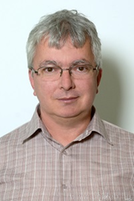
Márk Asztalos is an Associate Professor at the Budapest University of Technology and Economics , affiliated with the Faculty of Electrical Engineering and Informatics and the Department of Automation and Applied Informatics . He leads research in the Visual Modeling Group, focusing on model-driven engineering, graph rewriting systems, and domain-specific languages. Research Interests: Model transformation verification, text-based modeling, graph pattern matching, and cloud/mobile system modeling. Contact: E-mail: Asztalos.Mark@aut.bme.hu , Office: Q.B226, Department of Automation and Applied Informatics, BME. His publications emphasize model transformation verification (2010-2015), graph rewriting techniques for pattern matching (2015-2017), and domain-specific language design (2014). Recent work (2020) analyzes model integration challenges in model-driven methodologies. Contact details: Address: Budapest 1117, Magyar tudósok krt. 2, Hungary Phone: +36 (1) 463-3702
Dr. FÜLÖP Roland is an Associate Professor at the Department of Sanitary and Environmental Engineering, Faculty of Civil Engineering, Budapest University of Technology and Economics. His professional activities focus on urban water infrastructure management, with extensive experience in hydraulic modeling, pipeline failure analysis, and water distribution systems optimization. Current Courses: Dewatering (BMEEOVKMI53) Public water utility systems modelling (BMEEOVKMV63) Public Works I. (BMEEOVKAT42) Research Interests: His work addresses critical challenges in water infrastructure sustainability through advanced modeling techniques and data-driven decision-making. Key research areas include: Hydraulic model calibration for complex networks Probabilistic failure prediction in pipeline systems Optimization of water balance calculations Pressure management in distribution zones Long-term infrastructure rehabilitation planning Integration of mobile technologies for utility management
Attila Juhász serves as an Associate Professor within the Department of Photogrammetry and Geoinformatics at the Faculty of Civil Engineering, Budapest University of Technology and Economics (BME). His academic responsibilities include teaching courses such as Digital Surface Modeling, Geospatial Information, Civil Engineering Informatics, and Monitoring and GIS, alongside supervising thesis work through course BMEEOFTTATZ. He maintains active research in geospatial technologies with emphasis on historical applications. His research program centers on applying geospatial information systems and remote sensing to reconstruct historical military operations, particularly World War II events. He develops methodologies for bomb crater detection, fortification mapping, and battlefield analysis using LiDAR and multi-temporal GIS. A significant contribution involves solving temporal data management challenges in historical reconstructions, enabling accurate modeling of evolving military landscapes. His work bridges technical geospatial innovation with humanities scholarship in archaeology and military history. Analysis of his publication record reveals consistent specialization in automated detection of World War II artifacts through LiDAR and spatial data fusion. His research demonstrates progressive technical sophistication from early 2000s case studies to current AI-enhanced object recognition systems. The work establishes critical frameworks for conflict archaeology and has produced notable reconstructions including Budapest defense lines and the Attila-line fortifications. No scientific awards or major fellowships are documented in the available sources. Dr. Juhász supervises thesis research as evidenced by course BMEEOFTTATZ, but specific student names and research grant details remain unreported in the source material. His teaching portfolio indicates extensive mentorship across undergraduate and graduate geospatial curricula. He maintains operational affiliation with the Endre Németh Measurement Station and Education Center, which provides critical infrastructure for geospatial data collection, LiDAR processing, and field-based historical reconstruction projects. This facility supports both his research initiatives and practical student training in advanced surveying techniques.
László Kovács serves as an Assistant Professor at the Faculty of Informatics, University of Debrecen, where he focuses on data science research and development. He is also recognized as an Nvidia Deep Learning Institute Certified Instructor and Ambassador, contributing to the advancement of AI education. His work is prominently featured through the Autonomous Vehicle Research Lab at the University of Debrecen. His primary research interests include Digital Image Processing , Fusion Systems , and High Performance Computing , with particular emphasis on medical applications. Kovács has developed data-driven solutions that address market, industrial, and social demands of artificial intelligence across various sectors including healthcare. His work demonstrates how the Faculty of Informatics at the University of Debrecen prioritizes data science in both educational and research contexts. Analysis of his publication record reveals a strong focus on medical image analysis, particularly in ophthalmology applications. His research consistently applies advanced computational techniques to solve diagnostic challenges in retinal imaging and melanoma detection. The publications show a progression from foundational algorithm development to practical medical applications, demonstrating his commitment to translating theoretical computer science into real-world healthcare solutions. Scientific Awards and Recognition: Ányos Jedlik PhD candidate scholarship of the National Excellence Program (2014-2015) János Csere Apáczai PhD scholarship of the National Excellence Program (2013-2014) Uiversitas scholarship from University of Debrecen (2012) Special prize at XXX-th National Scientific Students' Associations (2012) Prize of the Dean for Masters Students (2010) Kovács has supervised PhD research projects including OTKA NK101680 on melanoma detection and HURO/1001/283/2.3.1 on image-based recommendation systems. His teaching portfolio is extensive, covering High Level Programming Languages, High Performance Parallel Computing Tools, Parallel Image Processing, and Data Science. He has also established thesis topics in distributed programming, fusion systems, high-performance computing architectures, and medical diagnostic applications. His research group maintains an active GitHub presence through the Autonomous Vehicle Research Lab.
Dr. Attila Kuki is an Associate Professor at the University of Debrecen , affiliated with the Faculty of Informatics , Department of Informatics Systems and Networks . His primary research areas include Queueing Theory , Modeling Infocommunication Systems , Reliability Theory , and Modeling Stochastic Systems . Email: kuki.attila@inf.unideb.hu Research Interests: Queueing Theory Infocommunication Systems Reliability Theory Stochastic Systems Recent Publications focus on retrial queues, two-way communication systems, server reliability, collision handling, and stochastic modeling. These works often integrate simulation and numerical analysis to evaluate system performance under catastrophic breakdowns and impatience scenarios. Departmental Affiliation: The Department of Informatics Systems and Networks explores topics such as real-time communication, sensor networks, and distributed systems, aligning with Dr. Kuki's expertise.
Dr. János Pánovics serves as a Lecturer at the Department of Information Technology, Faculty of Informatics, University of Debrecen. His academic work centers on computer science education and research in programming methodologies, artificial intelligence, and database systems. He actively contributes to the university's educational infrastructure through development of evaluation tools and curriculum design. Research interests span Assembly programming, Functional and multiparadigm programming, Artificial intelligence, and Database security. His innovative work focuses on automatic evaluation systems for programming tasks, particularly the ProgCont platform which utilizes test case annotations to enhance feedback for novice programmers. In AI research, he explores cooperative game theory in incomplete information environments and implements search algorithms using functional programming approaches. Analysis of his 15 most recent publications (2016-2022) reveals three dominant research thrusts: programming education tools (60% of output), artificial intelligence methodologies (27%), and cloud/database technologies (13%). The ProgCont system forms the core of his educational research, with multiple publications addressing error detection, differential education, and gamification techniques. His AI contributions include novel state space representations and game-theoretic approaches, while his technical work extends to Azure cloud applications and database security evaluation. Scientific Awards: No awards or fellowships are documented in available sources. Advising and Grants: Student advising activities and research grant information are not specified in current documentation. Labs and Teams: No laboratory affiliations or research team memberships are indicated in the provided materials.
Dr. Szilvia Szeghalmy is a Lecturer at the University of Debrecen, Faculty of Informatics, Department of Computer Science. She can be contacted at +36 52 512 900 75116 or via email at szeghalmy.szilvia@inf.unideb.hu, located in room I116, floor 1 of the Faculty of Informatics building. Her research focuses on: Digital Image Processing Imbalanced Learning Recent publications highlight trends in: Imbalanced data handling and noise filtering techniques (2024) Medical imaging applications (2024) Driver-assistance systems and traffic sign recognition (2018-2019) Human-computer interaction using sensors (2013-2014)
János Török is an Associate Professor at the Department of Theoretical Physics, Budapest University of Technology and Economics, affiliated with the Morphodynamics group. His research spans granular materials, social network modeling, and morphodynamics of pebbles. Granular materials: Quasi-static shearing, shear band formation, particle shape effects, hopper flow Social science: Conflicts on Wikipedia, consensus modeling, social network dynamics Morphodynamics: Collective abrasion, fragmentation of pebbles His recent publications focus on computational modeling of granular physics and social dynamics, with applications in machine learning for malaria detection. Articles highlight interdisciplinary approaches to phase transitions, network analysis, and material deformation. Shear zones in granular materials Deep learning for social network parameters Malaria detection software He is involved in open-source projects (WWM, Mozi) and teaches courses in mathematical methods, mechanics, and scientific programming.
János Péter Kiss is an Assistant Professor at the Department of Regional Science , part of the Faculty of Science at Eötvös Loránd University. His work spans multiple disciplines including regional science, public health, transportation systems, and environmental science. Institute of Geography and Earth Sciences Center of Geography His research interests focus on spatial analysis, economic geography, healthcare accessibility, and transportation dynamics. Key themes include regional GDP patterns, commuting behaviors, and environmental factors affecting infrastructure and agriculture. Recent publications highlight the interplay between public health and geography, such as mental health risks during postnatal periods and telestroke system optimization. Earlier works address soil mechanics, algorithm behavior in networks, and regional economic transitions.
Margit Makó is a Lecturer at Óbuda University, affiliated with the BUDAi Road Campus (8000 Székesfehérvár, Budai út 45). Her research focuses on electronics engineering, embedded systems, and circuit design, with a particular emphasis on Field-Programmable Analog Arrays (FPAA), control systems, and educational technology. She has published extensively on topics including analog circuit robustness, sensorless motor control, and hybrid feedback circuits. Her work often bridges theoretical concepts with practical applications, such as developing educational measurement laboratories and optimizing pneumatic cylinder control systems. Recent contributions include innovative FPAA-based solutions for circuit testers and hybrid systems. While her primary expertise lies in electronics, she has also explored interdisciplinary areas like mathematical modeling of germination kinetics and comparative pedagogy analysis between Hungary and France. Makó’s articles reflect a strong trend toward real-time systems, fault-tolerant design, and reconfigurable hardware. Her research highlights the integration of microcontrollers with FPAA for enhanced system performance. No scientific awards are explicitly mentioned in the provided materials. Consultation hours are held weekly on Mondays from 10:40 to 11:25 in Room 24 of Building K at the BUDAi Campus. She can be reached at mako.margit@amk.uni-obuda.hu for academic inquiries.
Dr. Bertalan Forstner is an Associate Professor and Deputy Head at the Department of Automation and Applied Informatics , Budapest University of Technology and Economics (BME). He co-leads the Applied Mobile Research Group (AMORG) within the Applied Computer Science Group, where his work bridges robotics, IoT, and cognitive infocommunication. Research Interests: Swarm Robotics & Aerial Systems: uniform dispersal algorithms for large fleets of low-cost flying robots, obstacle avoidance, and area-filling with minimal sensing. Internet of Things & Model-Driven Engineering: multi-domain IoT architectures, model-based unification of heterogeneous mobile platforms, and energy-efficient offloading. Cognitive Infocommunication & Educational Technology: adaptive learning environments, biofeedback-driven serious games, and AI-enhanced assessment tools using item-response theory. Distributed & Peer-to-Peer Systems: semantic overlays, mobile P2P protocols, and performance evaluation simulators. Research Impact & Trends: Across more than 50 peer-reviewed works (2005-2025), a clear evolution is visible: early efforts focused on P2P and mobile networking transitioned into swarm-robotics algorithms, which in turn informed IoT and cognitive-systems research. Recent 2025 papers emphasize quantitative service-level analytics, user-behavior classification, and synthetic data generation for cognitive modeling, underscoring a trajectory toward data-driven, AI-enhanced, human-centric systems. Scientific Awards & Recognitions: No specific awards are listed in the provided text. Advising & Funding: While individual PhD students are not named in the source, Dr. Forstner’s long-running research projects in AMORG and sustained publication output imply active supervision and grant support. Details on specific grants or doctoral candidates are not disclosed. Laboratory & Teams: He leads the Applied Mobile Research Group (AMORG) and collaborates closely with the Applied Computer Science Group at BME, maintaining facilities in building Q, room B227 on the Magyar tudósok körút campus.
Péter Ekler is an Associate Professor at the Department of Automation and Applied Informatics , Budapest University of Technology and Economics (BME) , Hungary. He is affiliated with the Applied Mobile Research Group (AMORG) and the Applied Computer Science Group , focusing on cutting-edge research in AI, IoT, and mobile systems. Research Interests: Artificial Intelligence and Machine Learning Internet of Things (IoT) and Smart Cities Wireless Sensor Networks and Energy-Efficient Routing Network Coding and Mobile Peer-to-Peer Systems Blockchain and Distributed Systems Computer Vision and Sensor Data Analysis His recent work includes the development of AI-based thermal imaging systems, energy-aware IoT routing, and secure authentication mechanisms using JWT. He has published extensively on optimizing IoT performance, enhancing mobile streaming with network coding, and applying machine learning to real-world sensor data. Scientific Contributions: Published over 50 peer-reviewed articles from 2013 to 2023 Active on platforms like Google Scholar, Scopus, ResearchGate, and ResearcherID Research spans both technical systems and historical studies in science Contact & Affiliations: Email: Ekler.Peter@aut.bme.hu Location: Q.B226, Magyar tudósok krt. 2., Budapest 1117, Hungary Phone: +36 (1) 463-3702 LinkedIn: http://hu.linkedin.com/in/peterekler
Zoltán Benedek is an academic at the Budapest University of Technology and Economics, affiliated with the Department of Automation and Applied Informatics. His academic rank is Lecturer, and he works within the Applied Computer Science Group. His research bridges naval engineering and applied informatics, focusing on ship propulsion systems, scale effects in hydrodynamics, and intelligent transportation technologies. Position: Lecturer Institution: Budapest University of Technology and Economics Department: Department of Automation and Applied Informatics Dr. Benedek’s research spans several decades, primarily addressing the hydrodynamics of ship propulsion systems , with a focus on scale effects in small ship models, wake fraction analysis , and thrust deduction modeling . His work also intersects with transportation informatics , particularly in developing frameworks for mobile navigation systems and on-board vehicle controllers . His publications reflect a consistent interest in optimizing propeller efficiency and resolving hydrodynamic discrepancies between ship models and full-scale prototypes. Recent trends in his publications emphasize the integration of computational methods in marine hydrodynamics and transportation systems , including data compression techniques for embedded controllers and .NET-based navigation frameworks. These works highlight his interdisciplinary approach, merging naval engineering principles with software and automation advancements. The Applied Computer Science Group at the Department of Automation and Applied Informatics serves as his primary research hub, linking his contributions to broader informatics and automation initiatives.
Dr. LÓGÓ János is a Professor and Faculty Coordinator at the Department of Structural Mechanics, Faculty of Civil Engineering, Budapest University of Technology and Economics (BME). With over three decades of academic service, his career spans roles from Assistant Professor (1990-1996) to Associate Professor (since 1996), alongside significant administrative contributions as Deputy Dean and Chairman of multiple committees. His research focuses on optimization in structural elasticity/plasticity, dynamically loaded structures, and mathematical programming, with extensive international collaborations including the University of Michigan. Key professional memberships: American Institute of Aeronautics and Astronautics (AIAA), American Society of Civil Engineers (ASCE), International Society for Structural and Multidisciplinary Optimization (ISSMO) Editorial roles: Editor of Periodica Polytechnica Civil Engineering (2004-present), Member of the Editorial Board for the International Journal of Structural and Multidisciplinary Optimization (2001-present) His scientific work reveals a consistent focus on reliability-based topology optimization, particularly for elasto-plastic structures under uncertain loading conditions. Over 60% of his recent publications address robust design methodologies incorporating probabilistic constraints, fatigue analysis, and multi-scale modeling. Notable subfields include stress-constrained optimization, graded infill structures, and seismic-resistant design frameworks using plasticity-based criteria. Dr. LÓGÓ received the Felvételi információ #építő250 ösztöndíj award and has contributed to structural optimization education through English-language program leadership. His teaching portfolio includes advanced courses in Plasticity and Structural Optimization , with earlier instruction in Structural Analysis. His research group actively explores mathematical programming applications to structural mechanics, maintaining collaborations with international institutions.
Dr. Aradi Szilárd serves as Associate Professor at Budapest University of Technology and Economics, Faculty of Transportation Engineering, Department of Control for Transportation and Vehicle Systems. He also holds a Senior Research Fellow position at SZTAKI since 2022. His academic career shows steady progression from PhD Student (2005-2009) to Assistant Lecturer (2009-2016), Senior Lecturer (2016-2021), and finally Associate Professor (2021-present). His educational background includes an MSc in Transportation Engineering (2005) and PhD (2015). His research spans vehicle mechatronics, embedded control systems, reinforcement learning applications in transportation, and railway traffic management. Dr. Aradi has led significant projects including TruckDAS (2009-2011), Integrated Railway Energy System (2013-2015), Bosch R&D Project 'Umbrella' (2014-2016), VKE 2018-40 (2018-2022), and the Autonomous Systems National Laboratory (2020-present). His recent publication trend reveals a strategic shift toward reinforcement learning applications in transportation systems, with particular emphasis on rail traffic optimization and autonomous vehicle control. Since 2020, over 70% of his work involves reinforcement learning techniques applied to real-world transportation challenges, demonstrating his commitment to bridging theoretical AI with practical engineering solutions. Dr. Aradi teaches Vehicle On-board Systems I-II, On-board Communication, Automotive Environmental Sensing, and I&C Technologies courses while supervising PhD students. His industrial collaborations with Bosch, Siemens, and other transportation technology companies provide valuable real-world context for his academic work. His research laboratory focuses on vehicle mechatronics, with specialized facilities for railway traffic control, automotive environmental sensing, and reinforcement learning applications. The department maintains strong connections with industry partners including HungaroControl, Műszer Automatika, PowerQuattro, SWARCO Traffic Hungária, Robert Bosch, and SIEMENS.