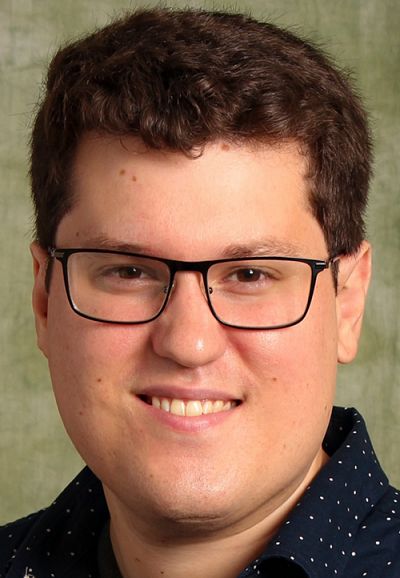
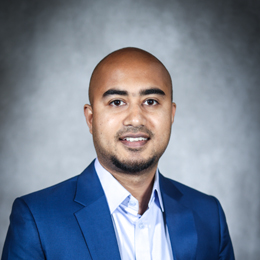
Jayson Boubin is an Assistant Professor of Computer Science at Binghamton University's School of Computing. He joined in 2022 and focuses on autonomous systems, particularly UAVs, edge computing, and machine learning applications in agriculture and infrastructure. His work emphasizes solving real-world challenges through innovative engineering and software solutions. Education: PhD in Computer Science (Ohio State University), BA (Miami University) Research Interests: Autonomous systems, UAVs, edge computing, robotics, and machine learning. Projects include SoftwarePilot (an open-source UAV testing platform), Fleet Computer (Kubernetes-based edge architecture), and PROWESS (a testbed for constrained edge workloads). Key Achievements: NSF Graduate Research Fellowship Developed open-source tools like SoftwarePilot and PROWESS Focus on UAV applications in precision agriculture, search-and-rescue, and infrastructure inspection Labs/Teams: Active in edge computing and UAV research groups, contributing to both academic and open-source communities.
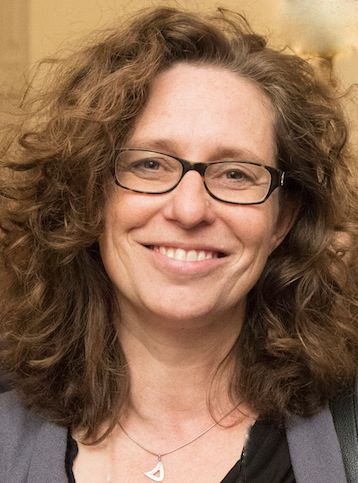
Professor Minh N. Do is the Thomas and Margaret Huang Endowed Professor in Signal Processing & Data Science at the University of Illinois at Urbana-Champaign (UIUC), with primary appointment in the Department of Electrical and Computer Engineering. He holds multiple affiliate appointments across campus including with the Coordinated Science Laboratory, Beckman Institute for Advanced Science and Technology, Department of Bioengineering, Department of Computer Science, Institute for Genomic Biology, College of Medicine, and School of Computing and Data Science. Additionally, he serves as Director of the joint VinUni-Illinois Smart Health Center and holds an Honorary Vice-Provost position at VinUniversity. Professor Do received his B.Eng. in Computer Engineering (First Class Honors) from the University of Canberra, Australia in 1997, followed by his Dr.Sci. in Communication Systems from the Swiss Federal Institute of Technology Lausanne (EPFL) in 2001. His educational journey was marked by exceptional achievement, earning the University Medal from the University of Canberra and a Silver Medal from the 32nd International Mathematical Olympiad. Professor Do's research focuses on developing new multidimensional signal processing tools with applications across several domains. His primary research interests include smart health, data science, computational imaging, and signal processing. His work spans biomedical imaging, machine learning, computer vision, and robotics, with particular emphasis on geometric image representations, integrating image formation and processing, and image processing from multiple sensors. His research bridges theoretical investigations with practical applications, creating impactful solutions in healthcare, diagnostics, and AI systems. His recent publications demonstrate a consistent trajectory toward multimodal AI systems, robust learning frameworks, and healthcare applications. Professor Do's work increasingly integrates signal processing with deep learning approaches to address challenges in medical imaging, cross-modal transfer, and real-world deployment of AI systems. His research shows strong emphasis on practical applications with societal impact, particularly in healthcare diagnostics and smart health technologies. Professor Do's scientific achievements have been recognized with numerous prestigious awards: Member of the National Academy of Artificial Intelligence (2025) Fellow of Asia-Pacific Artificial Intelligence Association (2023) Thomas and Margaret Huang Endowed Professor, UIUC (2020-present) Fellow of IEEE (2014) Young Author Best Paper Award, IEEE Signal Processing Society (2008) CAREER award from the National Science Foundation (2003) Best Doctoral Thesis Award from EPFL (2001) As an educator, Professor Do has taught numerous courses spanning digital signal processing, probability, data science, and image processing. His teaching excellence has been recognized with multiple "Teachers Ranked as Excellent" awards at UIUC. He also maintains active industry connections through tech-transfer efforts, having co-founded Personify and served as Chief Scientist of Misfit. His leadership extends to administrative roles, having served as Vice-Provost for VinUniversity during 2020-2021. Professor Do leads research initiatives at the intersection of signal processing and healthcare applications, with particular focus on the Smart Health Center collaboration between UIUC and VinUniversity. His lab develops innovative solutions for medical diagnostics, point-of-care testing, and neurological assessment using advanced signal processing and AI techniques.
Tor Skeie is a Professor at the University of Oslo's Department of Informatics, specializing in networks and distributed systems. His research focuses on high-performance networking, InfiniBand technologies, and adaptive routing systems. Current investigations include automated parameter tuning for reservoir simulations, adaptive routing in InfiniBand hardware, and modeling WiFi quality attenuation. His work develops efficient solutions for virtualized HPC environments and cloud computing infrastructures. Recent publications demonstrate innovations in network modeling, adaptive routing algorithms, and performance analysis of distributed systems. Research collaborations span European projects on high-performance networking infrastructures. Leads the Networks and Distributed Systems (ND) research group investigating fault-tolerant routing, network virtualization, and congestion control mechanisms.
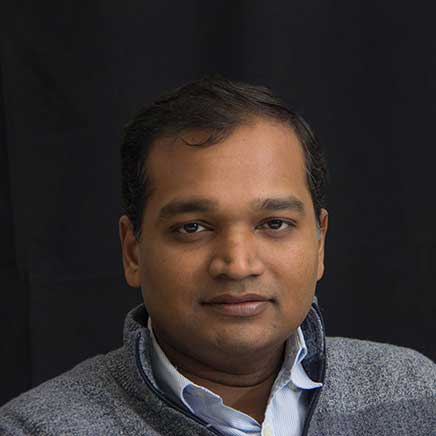
Prashant Shenoy is a Distinguished Professor and Associate Dean in the College of Information and Computer Sciences at the University of Massachusetts Amherst. He has been on the faculty since 1998 and heads the Laboratory for Advanced Systems Software while directing the Center for Smart and Connected Society. His research focuses on systems issues for distributed systems ranging from large server clusters to networks of small sensors. Shenoy received his PhD in Computer Science from the University of Texas at Austin in 1998, following an MS from the same institution in 1994. He earned his BTech in Computer Science and Engineering from the Indian Institute of Technology, Bombay in 1993. His academic progression at UMass Amherst has been from Assistant Professor (1998-2004) to Associate Professor (2004-2009) to Professor (2009-2020) to Distinguished Professor (2020-present). His primary research interests include distributed systems, networking, cloud and edge computing, mobile computing and Internet of Things, and energy and sustainability. Over the past decade, his work has increasingly focused on computational decarbonization, as evidenced by his recent $12 million NSF Expedition award in this area. His research group maintains several important resources including the UMass Trace Repository, UMass CS Weather Station, BenchLab, and Smart* Dataset. Shenoy's publications reflect a progression from foundational distributed systems work to increasingly sustainability-focused research. His recent work centers on carbon-aware computing, energy optimization, and computational decarbonization across various computing domains including cloud, edge, and IoT systems. ACM Fellow (2019) AAAS Fellow (2018) IEEE Fellow (2013) ACM Sigmetrics Test of Time Award (2016) NSF Career Award recipient Conti Research Fellowship recipient Lilly Foundation Teaching Fellow As an educator, Shenoy has consistently taught Distributed and Operating Systems (Compsci 677) and has mentored numerous PhD students who have received awards and gone on to successful careers. He serves as the founding Chair of the ACM Special Interest Group on Energy (SIGEnergy) and has organized numerous conferences including serving as PC chairs for the ACM Symposium on Edge Computing in 2025. His research has secured significant funding, including a recent $12 million NSF Expedition in Computational Decarbonization awarded in May 2024. Shenoy leads the Laboratory for Advanced Systems Software at UMass Amherst and directs the Center for Smart and Connected Society. He serves on editorial boards of several journals including ACM Transactions on IOT (TIOT), ACM Modeling and Performance Evaluation of Computing Systems (TOMPECS), and ACM Transactions on the Web (TWEB).
Sundas Iftikhar is a Teaching Professor at the School of Electronic Engineering and Computer Science, Queen Mary University of London. She specializes in software engineering education and research focused on artificial intelligence, fog/cloud computing, and task scheduling optimization. Her research spans AI applications in distributed systems , including Energy-efficient computing Quality of Service (QoS) optimization Deep learning for healthcare Cloud-fog hybrid architectures Recent publications analyze AI-based fog/edge computing trends , with emphasis on systematic reviews, taxonomy development, and sustainability. She also explores machine learning for serverless computing and smart home applications through fog infrastructure. Teaching duties include the Software Engineering Project module, where students work in teams to solve real-world problems.
George Exarchakos is an Assistant Professor in the Department of Electrical Engineering at Eindhoven University of Technology (TU/e), affiliated with the EAISI High Tech Systems and the Center for Wireless Technology. His research focuses on P2P computing, data mining, machine learning, network optimization, and swarm intelligence. He holds an MSc in Advanced Computing from Imperial College London and a PhD in P2P Computing from the University of Surrey (2008). Prior to his current role, he conducted postdoctoral research on autonomous networks at TU/e before becoming an Assistant Professor in 2011. Key projects include HiCONNECTS: Heterogeneous Integration for Connectivity and Sustainability (2023–2025) and RHIADA: Reliable Hybrid Intra Aircraft Datanetwork Architectures (2021–2025). His work contributes to UN Sustainable Development Goals related to innovation and infrastructure (Goal 9). Research interests span predictive networks, gossip protocols, overlay networks, and network complexity. Notable publications include studies on beyond-5G networks, avionics communication protocols, and edge computing resource management.
Tiziano De Matteis is an Assistant Professor in the @Large Research group at Vrije Universiteit Amsterdam's Faculty of Science, Department of Computer Systems. He also holds an affiliation with the Network Institute. His research focuses on overcoming post-Moore architecture challenges through parallel and distributed computing, high-performance systems, energy efficiency, and FPGA applications. Previously, he was a PostDoc at ETH Zurich's SPCL Group and earned his MSc/PhD from the University of Pisa. Education PhD in Computer Science, University of Pisa MSc in Computer Science, University of Pisa Research Interests Post-Moore architectures for distributed ecosystems Energy-aware parallel computing High-level abstractions for parallel software development FPGA-based hardware acceleration Data stream processing and distributed systems Recent Research Trends Recent work emphasizes: Data center risk analysis and sustainability Optimizing microservices and distributed scheduling LLM model offloading to NVMe storage Python-based data-centric programming productivity GPU interconnect performance in supercomputing Grants & Projects Participates in the EU-funded 'Extreme and Sustainable Graph Processing' project (2023-2025), exploring scalable graph algorithms and energy-efficient computing systems. Teaching Accelerator-Centric Computing Ecosystems Computer Organization Distributed Systems Systems Seminar
Bettina Kemme is a Professor in the School of Computer Science at McGill University, Montreal, Canada. She leads the Distributed Information Systems Lab (DISL) and specializes in large-scale data management, distributed systems, and cloud computing. Her academic roles include teaching COMP 512 (Distributed Systems) and COMP 421 (Database Systems). Education: Diplom (M.Sc. equivalent) in Computer Science, Friedrich-Alexander University, Erlangen, Germany (1996) PhD in Computer Science, Swiss Federal Institute of Technology (ETH), Zurich, Switzerland (2000) Research Interests: Distributed systems, cloud-native data management, in-database analytics (AIDA project), monitoring-as-a-service frameworks, and scalable pub/sub systems for online games. Current projects focus on integrating machine learning with databases, cloud performance monitoring using SDN, and sustainable data systems for data science. Lab & Collaborations: Leads the Distributed Information Systems Lab (DISL) with active projects in distributed databases, cloud computing, and game systems. Collaborates on EU-Canada initiatives like the SustainSys program for sustainable data infrastructure. Advising: Supervises PhD and M.Sc. students in topics like monitoring frameworks (Mona ElSaadawy), in-database ML (Winnie He), and distributed systems (Maximilian Schiedermeier). Alumni include over 50 researchers from PhD candidates to undergraduate researchers.
Mihir Bala is a Research Fellow in the Computer Science Department at Carnegie Mellon University. His research focuses on systems, edge computing, and autonomous drone technologies. He is advised by Mahadev Satyanarayanan and has contributed to projects such as SteelEagle, exploring drone video stream latency and autonomous navigation systems. His work bridges drone autonomy, edge computing, and real-time video analytics, addressing challenges in bandwidth efficiency, latency reduction, and democratizing autonomous systems for industries like construction. Recent efforts emphasize cloudlet-based architectures and OODA loop applications in drone control systems. No scientific awards are explicitly mentioned. His research involves collaborations on live video analytics, lightweight drone design, and distributed edge computing frameworks. While no formal advisees are listed, his academic contributions include advancing drone-based solutions through interdisciplinary systems research. The SteelEagle project highlights his focus on practical, real-world applications of edge computing in autonomous systems.
Christina Delimitrou is an Associate Professor at MIT's Department of Electrical Engineering and Computer Science (EECS) and a Principal Investigator at the Computer Science and Artificial Intelligence Laboratory (CSAIL). Her research focuses on optimizing cloud computing systems, with a strong emphasis on resource management, sustainability, and machine learning-driven solutions. Delimitrou leads projects on carbon-aware scheduling, efficient datacenter operations, and serverless computing frameworks like Ursa and Ditto. Her work bridges theoretical system design with practical deployment challenges, addressing topics such as microservices orchestration, approximation techniques for resource efficiency, and security implications of multi-tenancy in shared cloud environments. Notably, she received the Presidential Early Career Award for her contributions to improving datacenter efficiency through innovative scheduling and resource allocation strategies. Delimitrou's research group develops tools like Sage (ML-driven performance debugging) and Seer (big data analytics for cloud systems), emphasizing reproducibility and scalability. Her lab also explores edge computing, swarm robotics coordination (e.g., Hivemind), and hardware-software co-design for next-generation systems. Her academic affiliations include MIT CSAIL's Systems Community of Research, where she collaborates on large-scale software systems. Key themes in her work include QoS-aware resource management, sustainable computing practices, and leveraging approximation to enhance cloud resource utilization.
Dr. Suranga Seneviratne is a Senior Lecturer in Security at the School of Computer Science, University of Sydney. He holds a PhD from the University of New South Wales (2015) and a Bachelor's degree from the University of Moratuwa, Sri Lanka (2005). Before academia, he worked in telecommunications for six years. His research focuses on cybersecurity, particularly privacy and security in mobile systems, AI applications in security, and behavioral biometrics. He has developed tools like an app security rating system and intrusion-free authentication methods. Key awards include the ACM Mobicom 2015 Gold Prize, NASSCOM Technical Innovation Award, and IESL NSW Engineering Excellence Award (all 2015). Current research students include Pasindu Marasinghe (Multi-Objective Optimization in Flat Glass Cutting Production), Braylon SHU (Efficient Parameter Tuning for Large Language Models), and Gaurav VERMA (Threats and Defenses in IoT Wireless Protocols). Grants include funding from the Australian Research Council, NSW Network for Cyber Security, and Google Research. His work spans collaborations with the NSW Smart Sensing Network and the University of Technology Sydney. Labs/Teams: Collaborates with the Centre for Distributed and High-Performance Computing and the NSW Smart Sensing Network (NSSN).
Prof. Dr. Klaus Schmid is a Professor in the Department of Software Systems Engineering at the University of Hildesheim, part of the Faculty of Mathematics, Natural Sciences, Economics, and Computer Science. His research focuses on Machine Learning Operations (MLOps), software product lines, adaptive systems, and variability modeling. He leads projects such as EXPLAIN and ReGaP, emphasizing explainable AI and industrial MLOps integration. His work addresses challenges in Cyber-Physical Production Systems (CPPS), including data management, model calibration, and domain knowledge integration. Key research interests include MLOps architecture design, variability modeling transformations (e.g., UVL to IVML), and incremental verification techniques for software product lines. He has published extensively in venues like IEEE ETFA, IEEE Software, and SPLC conferences. Notable achievements include a Best Paper Award for work on control patterns in self-adaptive systems. Collaborations with industry partners highlight his focus on bridging academic research and practical industrial applications. Prof. Schmid’s contributions extend to tool development, such as EASy-Producer for variability-aware software ecosystems, and frameworks for environment modeling in adaptive systems. His research addresses both foundational challenges (e.g., syntax-preserving slicing) and applied topics like MLOps platform comparisons and industrial case studies in Industry 4.0.
Dr. Raman Adaikkalavan is a Professor in the Department of Computer and Information Sciences at Indiana University South Bend (IUSB), and serves as Associate Vice Chancellor for Enrollment Management. He holds a Ph.D. in Computer Science and Engineering from the University of Texas at Arlington (2006), and has extensive academic leadership experience. His research focuses on information security (particularly IoT and Android), data streaming, and computer science education. Notable contributions include developing the IU Test web-based assessment tool and advancing secure data stream processing architectures. Education: B.E. (1999) from Bharathidasan University, M.S. and Ph.D. (2002/2006) from University of Texas at Arlington, with additional certificates in online teaching (2013). Research emphasizes practical applications like secure stream processing in cloud environments and improving pedagogical methods through active learning. His work has been supported by NSF grants and institutional funding. Awards include the IU Trustees' Teaching Award (2011) and recognition as a University Scholar (UT Arlington). He advises students on topics like secure data stream processing and software engineering. Collaborations include projects with Dr. Indrakshi Ray (Colorado State) and Dr. Sharma Chakravarthy (UT Arlington). His IU Test system aids in program assessment and accreditation reporting for ABET.
Shweta Jain is a Professor in the Department of Mathematics and Computer Science at John Jay College of Criminal Justice, part of the City University of New York (CUNY). She holds dual roles as Graduate Faculty in the Digital Forensics and Cyber Security program and Doctoral Faculty in Computer Science at CUNY's Graduate Center. With a Ph.D. in Computer Science from Stony Brook University (2007), her expertise spans Cybersecurity, Blockchain, Wireless Networks, and Software Development. Education Background: Ph.D. Computer Science, Stony Brook University, 2007 M.S. Computer Science, Stony Brook University, 2005 B.E. Electronics and Telecommunication Engineering, Indian Institute of Engineering Science and Technology (IIEST) Shibpur, 2005 Research Interests: Cybersecurity frameworks and digital forensics Blockchain applications in social systems Wireless network protocols and security Perceptual hashing for image authentication Network vulnerability analysis Notable Achievements: Recipient of 2014 IEEE Region-1 Award for Outstanding Teaching Senior Member of IEEE Over 30 peer-reviewed publications and patents in networks, forensics, and distributed systems Advising & Grants: Guided multiple student research projects in network security and forensics Developed innovative tools like E-Witness for digital evidence preservation Contributed to NSF-funded projects on wireless simulation realism Labs & Teams: Director of the Cybersecurity Research Lab at John Jay College Collaborates with WINLAB at Rutgers University on wireless protocols
Dr. Khandaker Mamun Ahmed is an Assistant Professor at The Beacom College of Computer & Cyber Sciences, Dakota State University. He teaches undergraduate and graduate courses in artificial intelligence, algorithms, and data structures. He holds a Ph.D. in Computer Science from Florida International University (2024), an M.Sc. from the same institution (2023), and a B.Sc. in Software Engineering from the University of Dhaka (2016). His research focuses on computer vision, federated learning, cybersecurity, explainable AI, vision-language models, and optimization algorithms. He has contributed to peer-reviewed publications and conference presentations, with notable work in federated learning for IoT, anomaly detection in videos, and AI applications in healthcare and agriculture. Recent articles highlight advancements in federated learning frameworks, AI-driven healthcare systems, and real-time object detection using neural networks. His work also addresses cybersecurity challenges in DevOps pipelines and generative AI for educational datasets. Recipient of the 'Best graduate student in research award' (2022), Dr. Ahmed advises on AI ethics and mentors students through academic-industry collaborations. His research bridges theoretical computer science with practical applications in agriculture, healthcare, and infrastructure monitoring.