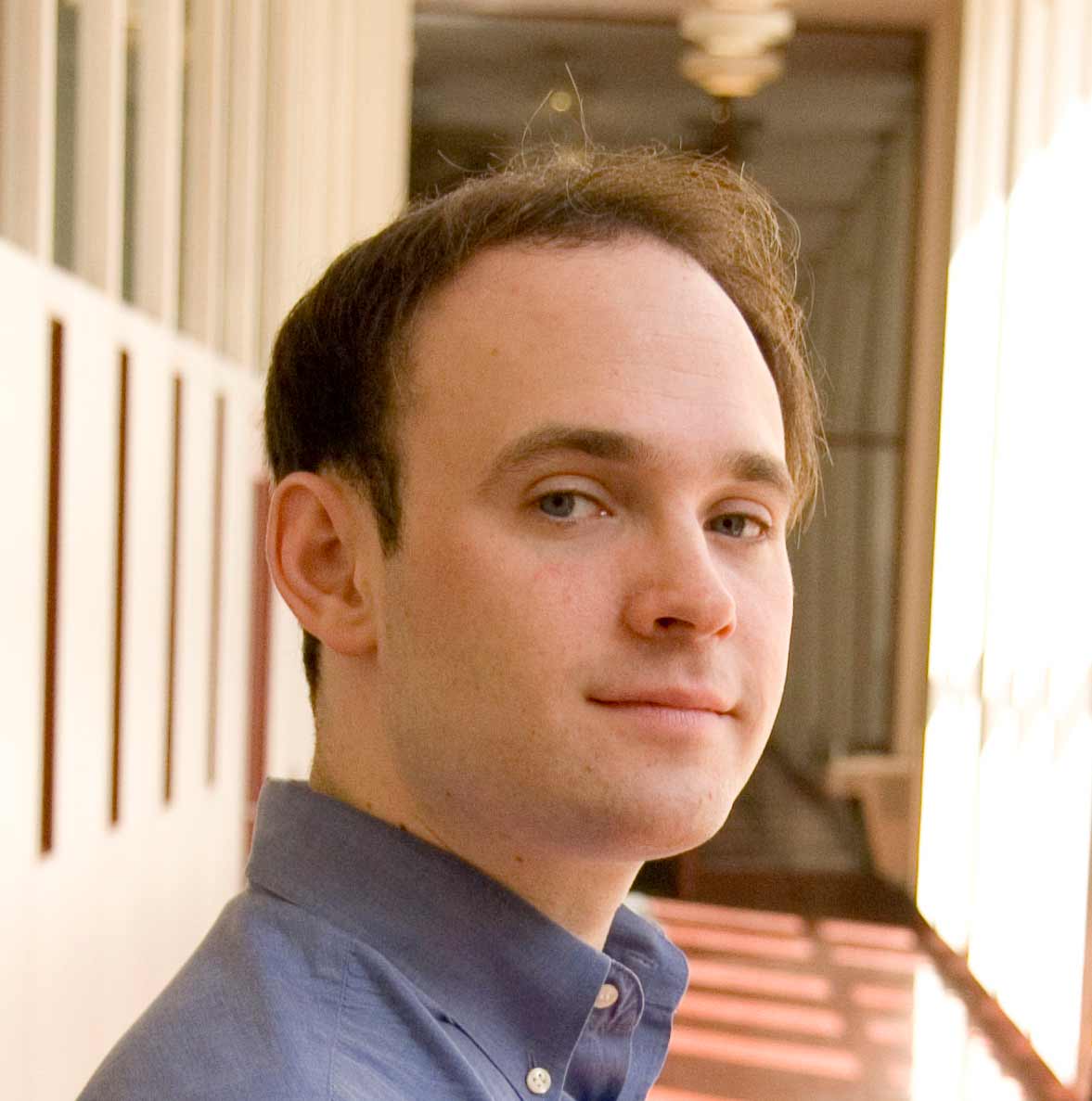
Renjie Feng is a Research Fellow in Mathematics and AI at the School of Mathematics and Statistics and the Sydney Mathematical Research Institute , University of Sydney. His work bridges probability theory, statistics, and applications in machine learning, deep learning, and artificial intelligence. His research interests focus on probability theory and its applications to machine learning , random matrix theory , and statistical physics . He investigates extreme value problems, spectral properties of random matrices, and topological features of random fields over Riemannian manifolds. Recent publications highlight trends in random matrix theory (GUE, GOE, GSE), extreme gap problems , determinantal point processes , and Wiener chaos . Collaborative works with F. Götze, D. Yao, and R. Adler emphasize U-statistics , multivariate linear statistics , and random topology inspired by Poisson point process studies.
Bei Wang Phillips is an Associate Professor in the School of Computing and a faculty member at the Scientific Computing and Imaging (SCI) Institute at the University of Utah. She holds a Ph.D. in Computer Science from Duke University and an undergraduate degree from the University of Bridgeport. Her research focuses on Topological Data Analysis (TDA), data visualization, computational topology, and machine learning, with applications in scientific data exploration and analysis. She has received prestigious awards including the NSF CAREER Award (2022) and the PECASE Award (2025). Her work spans projects funded by NSF, NIH, and DOE, including multiparameter TDA and topology-aware data compression. She advises numerous students and collaborates on interdisciplinary initiatives in astrophysics, climate science, and AI fairness. Education: Ph.D. in Computer Science, Duke University (2010) B.S. in Computer Science and Mathematics, University of Bridgeport (2003) Research Interests: Topological techniques for large-scale data analysis Integration of topological, geometric, and machine learning methods Applications in visualization, bioinformatics, and network analysis Key Projects: NSF-funded TDA research (DMS-2301361, OAC-2313124) DOE project on topology-preserving data compression Collaborations with NASA, Argonne National Lab, and Carnegie Institution of Washington Awards: Presidential Early Career Award for Scientists and Engineers (2025) NSF CAREER Award (2022) DOE Early Career Research Program (2020) Advising and Grants: Mentored over 30 students and postdocs Recipient of multiple NSF and DOE grants totaling millions
Nils Fleischhacker is an Assistant Professor for Cryptography at Ruhr University Bochum, where he leads the Theoretical Cryptography group within the Faculty of Computer Science. His research focuses on foundational aspects of cryptography with particular emphasis on zero-knowledge proofs, digital signatures, and secure computation. Prior to joining Ruhr University, he held postdoctoral positions at Johns Hopkins University and Carnegie Mellon University. Dr. Fleischhacker received his PhD in Computer Science from Saarland University in February 2017, advised by Dominique Schröder. During his doctoral studies, he was a research intern at Microsoft Research with Chris Brzuska and a research visitor at the University of Maryland, College Park with Jonathan Katz and Dana Dachman-Soled. His research spans theoretical cryptography with significant contributions to zero-knowledge proofs, multi-signature schemes, property-preserving hash functions, and security proofs for cryptographic primitives. Fleischhacker's work often addresses fundamental questions about the limits and possibilities of cryptographic constructions, with particular attention to black-box separations and lower bounds. His recent publications demonstrate a strong focus on lattice-based cryptography and post-quantum secure protocols. Fleischhacker's publications over the past five years reveal a consistent research trajectory focused on improving the efficiency and security of cryptographic primitives, with particular emphasis on signature schemes, zero-knowledge protocols, and secure computation frameworks. His work frequently appears in top-tier cryptography venues including CRYPTO, EUROCRYPT, and CCS. Dr. Fleischhacker actively mentors PhD students, with numerous successful graduations spanning from 2010 to 2024. His former PhD students include Önder Askin (2024), Floyd Zweydinger (2023), and Lars Schlieper (2022), among others. His research is supported through various academic channels and collaborations. He is affiliated with several prominent research organizations including the Horst Görtz Institute (HGI) for Information Security, the DFG Excellence Cluster CASA, the EU Marie Curie Network QSI, and the International Association for Cryptologic Research (IACR). These affiliations provide a strong institutional framework for his theoretical cryptography research.
Jose Apesteguia is an ICREA Research Professor at the Department of Economics and Business, Universitat Pompeu Fabra, Barcelona, Spain. His research focuses on behavioral economics, decision theory, experimental economics, and game theory, with particular emphasis on topics such as behavioral heterogeneity, rationality measures, stochastic choice models, and social preferences. Apesteguia has collaborated extensively with scholars like Miguel A. Ballester and Jörg Oechssler, producing influential work on topics ranging from imitation dynamics to the impact of language on moral decisions. His research integrates theoretical frameworks with experimental methods, exploring how individuals make decisions under uncertainty, time preferences, and social contexts. Key contributions include the development of measures of rationality and welfare, as well as analyses of behavioral adaptation and the role of information in competitive environments. His work frequently bridges economic theory with empirical validation, addressing real-world issues such as rule compliance in public institutions and team performance in organizations. Apesteguia’s publications span top journals including the American Economic Journal: Microeconomics , Journal of Economic Theory , and Econometrica . He teaches advanced courses on bounded rationality and behavioral decision theory at the undergraduate and graduate levels. His research has been applied to fields like finance (e.g., copy trading behavior) and public policy (e.g., promoting compliance in libraries).
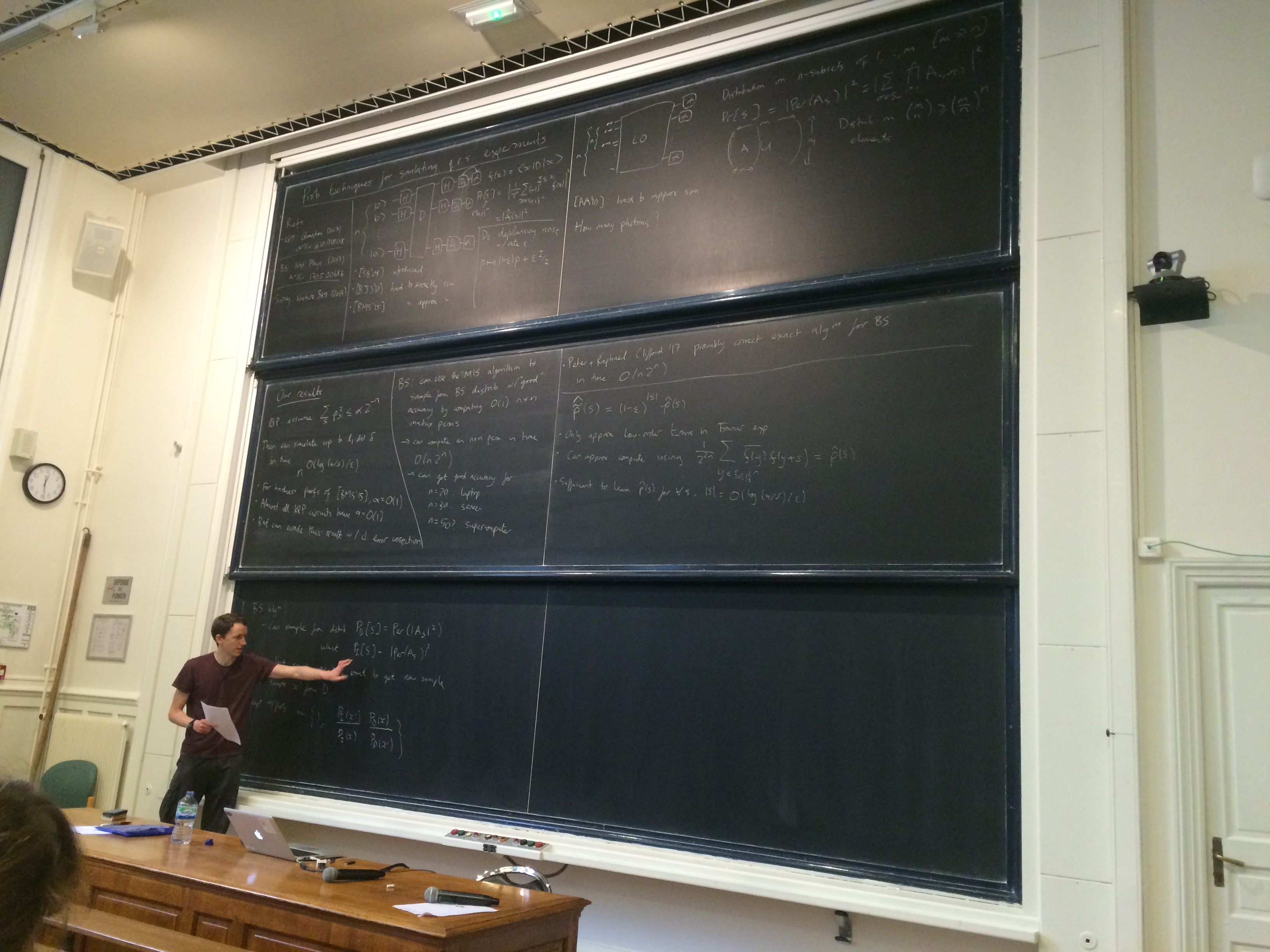
Ashley Montanaro is Professor of Quantum Computation in the School of Mathematics at the University of Bristol, and co-founder of the quantum software startup Phasecraft. He is a member of the Quantum Information Theory research group at Bristol. His research focuses on the theory of quantum computing, with particular interest in quantum algorithms, computational complexity, quantum query and communication complexity, and classical algorithms. His work spans both theoretical foundations and practical applications of quantum computing. Montanaro's research output shows significant trends toward quantum algorithms for optimization problems, quantum computational supremacy, and bridging theoretical advances with practical implementation challenges. His publications span foundational quantum information theory to applied quantum algorithms, demonstrating a versatile research program that connects computer science with quantum physics. Among his professional activities, Montanaro served on the QIP steering committee (2016-2018) and was an editor for the Quantum journal until 2019. He has been active in conference organization, serving on program committees for ITCS 2018, AQIS 2017 and 2015, QIP 2015, and TQC 2014 and 2013, reflecting his standing in the quantum computing research community. He has supervised numerous PhD students including Josh Blake, Jorja Kirk, Sheila Perez Garcia, Sami Boulebnane, Jan Lukas Bosse, Lana Mineh, Joao F. Doriguello, Chris Cade, Sam Pallister, and Stephen Piddock. His teaching includes Quantum Computation (MATHM0023) which he has taught since 2014 and Advanced Quantum Information Theory which he taught in 2015 and 2016. As co-founder of Phasecraft, Montanaro is actively translating theoretical quantum computing advances into practical software solutions, positioning him at the intersection of academic research and quantum technology commercialization.
Ronald Parr is a Professor of Computer Science in the Department of Computer Science at Duke University's Pratt School of Engineering. He has been at Duke since 2000, progressing from Assistant Professor to Associate Professor with tenure, and ultimately to Full Professor. From 2014 to 2017, he served as Department Chair and delivered graduation speeches in 2015, 2016, and 2017. Dr. Parr received his Ph.D. in Computer Science from the University of California, Berkeley in 1998, with a dissertation titled "Hierarchical Control and Learning in Markov Decision Processes" under advisor Stuart Russell. He earned his A.B. in Philosophy, cum laude, from Princeton University in 1990. His primary research focuses on methods for solving large stochastic planning problems using Markov Decision Processes and approximate dynamic programming techniques. His work spans reinforcement learning, value function approximation, game theory, sensing, and robotics. Dr. Parr's research has been consistently funded by major agencies including NSF, DARPA, and ARO, with recent projects focusing on feature encoding for reinforcement learning, neurosymbolic hierarchical reinforcement learning, and reasoning in large, structured, uncertain domains. His publication record demonstrates consistent contributions to top venues including NeurIPS, ICML, and AAAI, with work that bridges theoretical foundations and practical applications. Dr. Parr has received numerous honors including being elected as an AAAI Fellow in 2023, receiving an AAAI Outstanding Paper Honorable Mention in 2013, winning the IJCAI-JAIR Best Paper Award in 2007, receiving an NSF CAREER award in 2006, and being named an Alfred P. Sloan Fellow in 2003. He has advised ten graduate students to completion across various research areas within AI and robotics. His research has been supported by over $1.5 million in direct funding to his lab, with additional collaborative funding from multiple NSF, DARPA, and ARO grants. Dr. Parr has served extensively on program committees for major AI conferences including ICML, NeurIPS, AAAI, and UAI, and has held leadership roles such as Program Co-Chair and General Chair for UAI. Dr. Parr maintains an active research group focused on reinforcement learning and sequential decision making, with ongoing projects in neurosymbolic AI, hierarchical reinforcement learning, and interpretable machine learning models, continuing to bridge theoretical foundations with practical applications in robotics and AI systems.
Nicole Wein is an Assistant Professor in the Computer Science and Engineering Division of the Department of Electrical Engineering and Computer Science (EECS) at the University of Michigan, College of Engineering. Her research lies in theoretical computer science, focusing on graph algorithms, dynamic algorithms, parameterized algorithms, distributed algorithms, online algorithms, and fine-grained complexity. She is part of the Theory of Computation Lab and advises both PhD and undergraduate researchers. PhD, Massachusetts Institute of Technology (MIT), advised by Virginia Vassilevska Williams Postdoctoral Fellow, DIMACS Research Fellow, Simons Institute, UC Berkeley MS, Stanford University BS, Computer Science/Math, Harvey Mudd College Her research explores fundamental algorithmic questions in combinatorial settings, particularly how algorithms handle dynamic data, extract information efficiently (e.g., in linear time), and understand shortest path structures in graphs—especially directed ones. She investigates problems in distance estimation, spanners, hopsets, dynamic graph algorithms, and hardness of approximation. Her work combines theoretical depth with practical implications for algorithm design. The recent publications reflect a strong trend in fine-grained complexity and graph algorithm design, with a focus on proving tight bounds, developing efficient approximations, and understanding structural limitations in directed and dynamic graphs. Her work frequently appears in top venues such as STOC, FOCS, SODA, and ICALP, often in collaboration with leading researchers in the field. Scientific Awards and Recognition: Invited to special issue of SIAM Journal on Computing (SICOMP) (FOCS 2022 paper) Invited to Highlights of Algorithms (HALG) (FOCS 2022 paper) Invited to minisymposium at CANADAM (ESA 2022 paper) Work featured in Quanta Magazine Nicole Wein actively mentors students, including current PhD student Jubayer Nirjhor and former undergraduate researchers like Sam Hiken (now pre-doc at MIT). She has served on program committees for major conferences including SODA, FOCS, ICALP, and ITCS, and co-organized the DIMACS workshop on Modern Techniques in Graph Algorithms (2023). She also contributes to the academic community through outreach, such as her article offering reassurance to early-stage PhD students in theoretical computer science. She leads and participates in collaborative research groups and workshops, emphasizing supercollaboration and interdisciplinary communication in algorithms. Her lab fosters a strong research environment in theoretical computer science at the University of Michigan.
Pan Xu is a tenure-track assistant professor with joint appointments in the Department of Biostatistics & Bioinformatics, Department of Computer Science, and Department of Electrical & Computer Engineering at Duke University. Previously, Xu was a Postdoctoral Scholar Research Associate at Caltech's Department of Computing and Mathematical Science and earned a Ph.D. in Computer Science from UCLA. Xu's research focuses on developing computationally- and data-efficient machine learning algorithms with strong empirical performance and theoretical guarantees. Xu's research interests center around Machine Learning with broad applications in Artificial Intelligence, Data Science, Optimization, Reinforcement Learning, and High Dimensional Statistics. The research specifically targets real-world problems in Bioinformatics and Healthcare, with recent work emphasizing distributionally robust decision making, efficient exploration strategies, and multi-agent systems. Xu has developed novel algorithms that address the challenges of exploration in sequential decision making and robustness to distributional shifts between training and deployment environments. Xu's recent publications demonstrate a strong trend toward developing theoretically grounded yet practical algorithms for reinforcement learning and bandit problems, with particular emphasis on distributionally robust methods, efficient exploration techniques, and applications to healthcare. The work spans both theoretical analysis (providing minimax optimal regret bounds) and practical implementations (validated on benchmarks like Atari games and real healthcare datasets). Whitehead Scholar award from Duke University School of Medicine (2023) Best Paper Award at ACM FAccT 2023 for Queer In AI paper PIMCO Postdoctoral Fellowship in Data Science (2022) TMLR Featured Certification (2023) NSF award on approximate sampling based exploration (2023) Xu actively mentors multiple Ph.D. students across Duke's Biostatistics & Bioinformatics, Computer Science, and Electrical & Computer Engineering programs, with several alumni now pursuing doctoral studies at top institutions. The research group has secured competitive funding including an NSF award for approximate sampling based exploration for sequential decision making. Xu serves as an action editor for TMLR and as an area chair for major conferences including ICML, NeurIPS, AAAI, ICLR, and AISTATS. Xu leads a dynamic research group focused on sequential decision making, with projects spanning theoretical algorithm development, implementation of practical systems, and applications to healthcare and bioinformatics. The group maintains active collaborations across Duke's medical and engineering schools, with recent work applying machine learning to epidemic forecasting during the pandemic.
Jonathan A. Kelner is a Professor of Applied Mathematics in the Department of Mathematics at the Massachusetts Institute of Technology (MIT) and a member of the MIT Computer Science and Artificial Intelligence Laboratory (CSAIL). His research focuses on applying techniques from pure mathematics to solve fundamental problems in algorithms and complexity theory, with the goal of developing practical algorithms for real-world questions. Dr. Kelner received his undergraduate degree from Harvard University and his Ph.D. in Computer Science from MIT in 2006. Before joining the MIT faculty, he spent a year as a member of the Institute for Advanced Study. His educational background has provided a strong foundation for his interdisciplinary research spanning mathematics and computer science. His research interests include combinatorial optimization, mathematical programming, spectral graph theory, distributed computing, machine learning, computational geometry and topology, computational biology, signal processing, and random matrix theory. Kelner's work demonstrates how deep theoretical insights can lead to practical algorithmic improvements, particularly in graph algorithms and optimization problems. His approach often involves connecting seemingly disparate areas of mathematics to create novel algorithmic techniques. Analysis of his recent publications reveals a strong focus on spectral graph theory, optimization algorithms, and the Sum-of-Squares method. His work frequently addresses fundamental questions in theoretical computer science with practical implications for algorithm design. A notable trend in his research is the development of nearly-linear-time algorithms for various graph problems, which represents significant improvements over previous approaches. NSF CAREER Award Alfred P. Sloan Research Fellowship NEC Award for Research in Computers and Communication Sprowls Doctoral Dissertation Award Best Student Paper Award at STOC 2004 Best Paper Award at STOC 2011 Kokusai Denshin Denwa Junior Faculty Chair 2008 Harold E. Edgerton Faculty Achievement Award 2011 School of Science Award for Excellence in Undergraduate Education 2012 Professor Kelner has been actively involved in mentoring students and has received recognition for his teaching excellence, including the School of Science Award for Excellence in Undergraduate Education in 2012. His research has been supported by prestigious grants including the NSF CAREER Award. He has collaborated extensively with researchers across multiple institutions, often working with other leading figures in theoretical computer science to produce groundbreaking results in algorithm design. At MIT, Kelner is part of both the Mathematics Department and CSAIL, positioning him at the intersection of theoretical mathematics and practical computer science. This dual affiliation reflects the interdisciplinary nature of his work, which bridges pure mathematical theory with concrete algorithmic applications.
Vladimir Spokoiny is a Professor at the Departments of Mathematics and Economics of the Humboldt University of Berlin and Head of the Research Group "Stochastic Algorithms and Nonparametric Statistics" at the Weierstrass Institute for Applied Analysis and Stochastics (WIAS) in Berlin, Germany. His research spans multiple areas of statistics, machine learning, and financial mathematics, with significant contributions to nonparametric statistics, high-dimensional data analysis, and statistical methods in finance. Spokoiny received his M.Sc. in applied mathematics from the Moscow Institute of Railway Engineering in 1981 and his Ph.D. in mathematics from Lomonosov Moscow State University in 1988. He completed his Habilitation at Humboldt University in 1996. His academic career includes positions at the All-Union Institute of Railway Transport in Moscow, the Institute for Information Transmission Problems in Moscow, and the Institute for Applied Analysis and Statistics in Berlin before joining the Weierstrass Institute and Humboldt University where he has been a professor since 2002. Spokoiny's research focuses on adaptive nonparametric smoothing and hypothesis testing, high dimensional data analysis, statistical methods in finance, image analysis with applications to medicine, classification, and nonlinear time series. His work often addresses the challenges of nonstationarity in time series data and develops innovative methods for volatility estimation and risk management. He has made significant contributions to the development of adaptive weights smoothing procedures, which have applications in image processing, community detection, and manifold learning. His recent work has expanded into high-dimensional statistics, Bayesian inference, and optimization methods for machine learning, with publications demonstrating novel approaches to Gaussian approximation, Laplace methods, and statistical inference in non-Euclidean spaces. Spokoiny has supervised numerous PhD students including Oliver Reiss, Danilo Mercurio, Ying Chen, Elmar Diederichs, and Mstislav Elagin, whose research has focused on mathematical finance, time series analysis, and statistical methods. He serves as an Associate Editor for The Annals of Statistics (since 2004) and Statistics and Decisions (since 2002), and has previously served on the editorial board of the Journal of Statistical Planning and Inference. His professional activities include reviewing for major statistical journals including Annals of Statistics, Bernoulli, Econometrica, and Journal of American Statistical Association, as well as reviewing grant proposals for the National Science Foundation (USA), German Research Foundation, and Netherlands Organisation for Scientific Research. Spokoiny is a member of several professional societies including the International Statistical Institute, American Statistical Association, Institute of Mathematical Statistics, and Bernoulli Society. He is fluent in Russian (mother tongue), English, and German, and has good knowledge of French. His research group at WIAS focuses on developing novel statistical methodologies with applications across various scientific domains, particularly emphasizing adaptivity and robustness in complex data environments. The group's work has significant implications for financial risk management, medical imaging, and machine learning applications, with recent publications addressing fundamental questions in high-dimensional statistics and nonparametric inference.
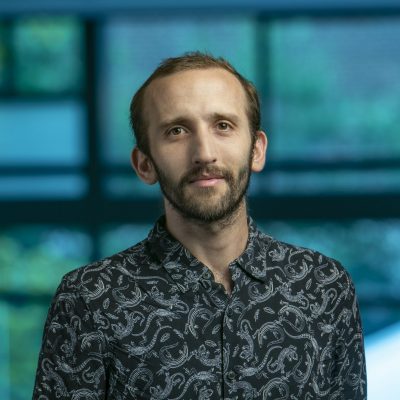
Ivan Dokmanic is an Assistant Professor at the Coordinated Science Laboratory (CSL) within the University of Illinois . His research bridges signal processing , machine learning , and applied inverse problems , with a focus on acoustics, biomedical imaging, and distance geometry. Current Role : Assistant Professor, CSL Email : dokmanic@illinois.edu Research Interests : Dokmanic explores machine learning applications in inverse problems , particularly distance geometry for molecular imaging and acoustics . His work includes unlabeled sensing , where distances between points are known but their arrangement is not. This has implications for powder diffraction , indoor localization , and echo modeling . Article Trends : His recent publications emphasize distance geometry in machine learning , acoustic signal processing , and inverse problem theory . Key areas include molecular imaging , audio encryption , and sensor positioning . Collaborative work spans medical imaging , cyberphysical systems , and geometric invariants . 2016 Google Faculty Award NSF Grant (1 year, $157,079) Students and Grants : Dokmanic mentors PhD students like Puoya, Shuai, and Anadi. His research is funded by the National Science Foundation , Google , VISA , and nVidia .
Dr. Rasmus Ibsen-Jensen is a Lecturer in Computer Science at the University of Liverpool. Previously, he held a Postdoctoral position at IST Austria under Krishnendu Chatterjee and completed his PhD under Peter Bro Miltersen. Research Focus: Algorithmic game theory, strategy complexity in two-player zero-sum games, control flow graph algorithms, edit distance for automata, and theoretical biology applications. Teaching: Module Coordinator for second-year courses in database development (COMP207), C++ programming (COMP282), and industrial placement (COMP299). His work bridges computational game theory and formal verification, with recent publications exploring memory constraints in partial-information games, algebraic path properties in concurrent systems, and evolutionary spatial dynamics. While no scientific awards are explicitly mentioned in the provided text, his contributions to algorithmic complexity and interdisciplinary research (e.g., theoretical biology) highlight his academic impact.
Bo Han is an Associate Professor in the Department of Computer Science at Hong Kong Baptist University's Faculty of Science, where he leads the Trustworthy Machine Learning and Reasoning (TMLR) Group. He also holds a visiting scientist position at the RIKEN Center for Advanced Intelligence Project (RIKEN AIP) in Japan. His research focuses on developing trustworthy and efficient machine learning systems, particularly under imperfect data conditions such as noisy labels, out-of-distribution data, and weak supervision. Bo Han's research interests span Machine Learning , Deep Learning , Foundation Models , Causal Representation Learning , Weakly and Self-supervised Learning , Robustness and Security in Machine Learning , Federated Learning , and AI for Science . His work aims to build intelligent systems that can reliably learn and reason from complex, imperfect real-world data. His recent publications reveal a strong trend toward trustworthy foundation models , robust reasoning with large language models , out-of-distribution detection , privacy-preserving learning , and causal robustness . His research integrates theoretical foundations with practical applications, often published in top-tier venues like NeurIPS, ICML, ICLR, and TPAMI. Notable Awards and Honors: Outstanding Paper Award, NeurIPS Most Influential Paper, NeurIPS IEEE AI's 10 to Watch Award IJCAI Early Career Spotlight INNS Aharon Katzir Young Investigator Award Dean's Award for Outstanding Achievement RGC Early CAREER Scheme Bo Han has been actively involved in the academic community, serving as a Senior Area Chair and Area Chair for NeurIPS, ICML, and ICLR, and as an Associate Editor for IEEE TPAMI, MLJ, and JAIR. He has advised numerous PhD and research students and leads a globally distributed research group. His work is supported by major grants from RGC, NSFC, GDST, RIKEN, and industry partners including Microsoft, Alibaba, Tencent, and Baidu. He also leads research initiatives in Trustworthy Machine Learning , including projects on federated learning, model unlearning, privacy-preserving AI, and robust foundation models, often in collaboration with industry and international institutions.
Erik Waingarten is an assistant professor at the University of Pennsylvania in the Computer and Information Science department. His research focuses on algorithms for massive datasets, including similarity search, streaming/sketching, property testing, and distribution testing. Former postdoctoral researcher at Stanford's CS Department under Moses Charikar PhD from Columbia University advised by Xi Chen and Rocco Servedio Key research areas: High-dimensional geometry Streaming algorithms Property testing Sketching techniques Clustering and metric optimization Recent article trends show expertise in: 2025 publications on monotonicity testing and metric property analysis 2024 work on Earth Mover's Distance and kernel evaluations 2023 papers on clustering, optimal transport, and MST algorithms 2022-2020 foundations in sublinear algorithms and entropy estimation Scientific recognition: NSF CAREER Award (2023) CCC Best Paper Award (2017) Invited to Journal of the ACM (2017) Academic advising includes PhD students: Ashwin Padaki Tian Zhang Nicolas Menand Krish Singal Junkai Song
Aaron J. Elmore is an Associate Professor in the Department of Computer Science and the College of the University of Chicago. His research focuses on cloud computing, databases, and distributed systems, with an emphasis on resource-efficient database execution and collaborative analytics. PhD in Computer Science from University of California, Santa Barbara MS in Computer Science from University of Chicago Research interests include: Elastic databases and multitenancy (Database-as-a-Service) Resource-efficient systems (CrocodileDB, DenseStore, EdgeTSD) Database versioning (Datahub, Decible, OrpheusDB) Data discovery (DataSwamp, Relic) Recent publications highlight advancements in cloud-native query execution, dynamic compression frameworks, and time-series anomaly detection. His work often bridges systems design with practical data science applications. Scientific awards include: NSF CAREER Award (2021) Multiple Google and Intel research grants ACM SIGMOD Best Demo Honorable Mention Aaron has advised multiple PhD students including Jun Hyuk Chang and Riki Otaki, with former advisees now at institutions like MIT, Harvard, and UC Berkeley. He leads the ChiDATA research group and collaborates with Systems Group and CERES Center.