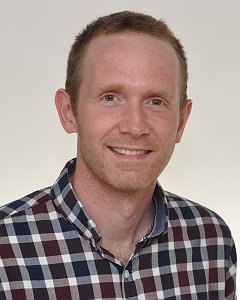
Jacob Croft is a Research Fellow at the University of Washington , affiliated with the School of Pharmacy and the Department of Medicinal Chemistry . He works in the Lee Lab and is part of the Medicinal Chemistry Fellows program. Research Interests: Structural Biology of viral proteins, cellular stress responses, microtubule dynamics, and flagellum biology. His work combines cryo-ET, protein science, and molecular modeling to explore structural variations in HIV virions, nuclear envelope adaptations, and cytoskeletal organization. Publications Trends: Focuses on high-resolution structural analysis of biological systems, particularly in virology and cell biology. Key methodologies include cryo-electron tomography, protein folding dynamics, and microtubule studies. Labs & Teams: Collaborates with the Lee Lab on interdisciplinary projects in medicinal chemistry and structural biology.
Dr. Matthew Hannaford is an Assistant Professor in the Department of Molecular Physiology and Biophysics at the Robert Larner, M.D. College of Medicine, University of Vermont. He joined the faculty in 2025 after completing a postdoctoral fellowship at the National Heart, Lung and Blood Institute in Bethesda, MD. Dr. Hannaford's educational background includes: B.S. in Biology from Bangor University in Wales (2013) Ph.D. from the University of Dundee, Scotland (2018) Dr. Hannaford's research focuses on centrosome biology using live cell microscopy, biochemistry, and Drosophila genetics . His lab investigates how centrosomes - crucial membraneless organelles that organize microtubules - are positioned within cells and how their microtubule nucleating activity is regulated during development and the cell cycle. His work has significant implications for understanding diseases including cancer, microcephaly, ciliopathy, and male sterility. His recent publications demonstrate a strong focus on centrosome and centriole dynamics, with particular emphasis on protein complexes that regulate centriole positioning, growth, and function. His research bridges cell biology, developmental biology, and disease mechanisms, with a consistent use of Drosophila as a model system for studying fundamental cellular processes. Dr. Hannaford leads the Hannaford Lab, which maintains a dedicated website at www.hannafordlab.com. The lab utilizes advanced imaging techniques alongside genetic approaches to unravel the molecular mechanisms underlying centrosome function in diverse cellular contexts. His research program is focused on understanding how centrosome dysregulation contributes to human disease pathology.
Dr. Britta Leise serves as Associate Professor of Equine Surgery and Associate Dean for Staff and Faculty Advancement at the LSU School of Veterinary Medicine, Louisiana State University, where she has been faculty since October 2015. A Diplomate of the American College of Veterinary Surgeons (Large Animal), she integrates clinical expertise with academic leadership in advancing veterinary education and research. Her academic credentials include: PhD, The Ohio State University (2010) DVM, Louisiana State University (2002) MS, Louisiana State University (1997) BS, Virginia Tech (1995) Dr. Leise's research program centers on equine inflammatory conditions , with specialized focus on laminitis pathogenesis , sepsis, osteoarthritis, and wound healing. She pioneers applications of regenerative medicine —particularly mesenchymal stem cell therapies—to modulate inflammatory responses in horses. Her clinical expertise spans equine surgery and lameness, with emphasis on hoof disorders and gastrointestinal conditions. Analysis of her 13 publications (2015-2023) reveals consistent output in high-impact veterinary journals, with increasing focus on molecular mechanisms of laminitis and translational applications of regenerative therapies. Recent work (2023) explores histological comparisons of lamellar tissue, stress responses in laminitis, and pharmacological cytotoxicity. Her professional recognition includes: Diplomate, American College of Veterinary Surgeons (Large Animal) Dr. Leise has secured over $40,000 in research funding since 2015 from sources including LSU internal programs, the Charles V. Cusimano Equine Health Studies Program, and the American College of Veterinary Surgeons Foundation. She mentors veterinary students and residents in surgical skills and clinically relevant topics across musculoskeletal, gastrointestinal, and respiratory systems. Her research group operates within the Department of Veterinary Clinical Sciences, conducting studies on inflammatory pathways and therapeutic interventions without a formally named laboratory entity.
Dr. Paul Guichard is an Associate Professor at the University of Geneva's Department of Molecular and Cellular Biology. His research focuses on deciphering the structural mechanisms governing centriole assembly through multidisciplinary approaches including cryo-electron tomography, expansion microscopy, and in vitro reconstitution assays. Current research projects: Centriole structure/function, Expansion Microscopy developments, Ciliopathy & Eye diseases, Immune Synapse Architecture, Molecular conoid studies, Plankton ultrastructural diversity The lab's recent work (2020-2024) has revealed key insights into centriole cohesion, microtubule organization, and protein complexes critical for ciliogenesis. Their structural analyses of centriole components across species (Paramecium, Chlamydomonas, Trichonympha) highlight evolutionary conservation. Key techniques: Cryo-ET, U-ExM, in vitro assays, 3D reconstruction Funding: Fondation privée des HUG (Plasmodium conoid studies)
Fredrik Kjolstad is an Assistant Professor in the Department of Computer Science at Stanford University, specializing in compilers and programming models for sparse computing and performance engineering. His research focuses on separating algorithms from data representations to enable portable applications across diverse hardware platforms. His research interests span compilers, programming models, performance engineering, and computer architecture, with particular emphasis on sparse tensor algebra, compiler design for heterogeneous systems, and high-performance computing. He has pioneered frameworks like TACO, Simit, and Distal that enable efficient sparse computations across CPUs, GPUs, and specialized accelerators. Dr. Kjolstad's publications demonstrate expertise in compiler optimization techniques for sparse data structures, tensor algebra, and distributed systems. His work consistently addresses the challenge of bridging high-level programming abstractions with efficient hardware execution across diverse architectures. MIT EECS First Place George M. Sprowls PhD Thesis Award NSF CAREER Award Rosing Award Adobe Fellowship Google Research Scholarship Best Paper Awards at EuroMPI 2013, OOPSLA 2017, and OOPSLA 2021 ISCA Distinguished Artifact Award PLDI and OOPSLA Distinguished Paper Awards He advises multiple PhD students including James Dong, Olivia Hsu, and Rohan Yadav, while leading research on compiler technologies that have received significant grant support. His group develops practical tools like the TACO compiler and Legate Sparse that are used in both academic and industrial settings. Current projects focus on programmable accelerators for sparse tensor algebra, distributed sparse computing, and compiler support for emerging hardware architectures.
Yauheni Zhalniarovich is a Professor at the Department of Surgery and X-ray with Clinic within the University of Warmia and Mazury in Olsztyn , Poland. His work focuses on advanced surgical techniques in veterinary medicine, particularly laparoscopic procedures, orthopedic surgery, and diagnostic imaging. Academic Rank: Professor Department: Surgery and X-ray with Clinic University: University of Warmia and Mazury in Olsztyn Research Interests: Zhalniarovich's research spans veterinary surgery, with a focus on minimally invasive techniques for canine and feline reproductive organs, orthopedic interventions like TPLO and TTA CF, and diagnostic imaging modalities such as MRI and ultrasound for musculoskeletal and neurological conditions. He has supervised doctoral students and led projects requiring specialized equipment and funding. Scientific Output: Recent publications highlight innovations in orthopedic surgery, comparative studies on implant designs, and applications of imaging in small and large animals. Trends include the use of sheep and canine models for biomechanical testing, epidemiological studies on equine desmopathy, and postoperative complication analysis. Supervision and Funding: Zhalniarovich has promoted one doctoral student and currently supervises another. Research projects under his guidance are supported by institutional funding and infrastructure, including advanced veterinary imaging and surgical facilities.
Dr. Franziska Turck is a Professor and Research Group Leader in the Department of Plant Developmental Biology at the Max Planck Institute for Plant Breeding Research in Cologne, Germany. Her laboratory focuses on epigenetic mechanisms that regulate plant development, particularly how plants form transcriptional memories based on past experiences through chromatin modifications. Dr. Turck's research centers on epigenetic pathways, particularly Polycomb Group (PcG) protein complexes that establish chromatin compaction leading to gene repression. Her group investigates mechanisms that recruit and stabilize epigenetic repression and how distal enhancers can overcome epigenetic gene repression. Key projects include studying Polycomb Group Proteins in Plant Development and the Regulation of FLOWERING LOCUS T by distal enhancers and epigenetic repressors. Her work has revealed how TELOMERE REPEAT BINDING FACTORs recruit Polycomb Repressive Complex 2 to target regions and how chromatin accessibility at the FLOWERING LOCUS T locus is regulated by distal enhancers within PcG-repressed chromatin. Analysis of Dr. Turck's recent publications shows a consistent focus on plant epigenetics, chromatin structure, and flowering time regulation. Her work bridges molecular mechanisms with developmental outcomes, particularly in how plants integrate environmental cues through epigenetic memory systems. Many publications appear in high-impact journals including Nature Genetics, Nature Plants, and PNAS, with several receiving Faculty of 1000 recommendations. Faculty of 1000 Recommendation for Targeted DNA methylation represses two enhancers of FLOWERING LOCUS T in Arabidopsis thaliana (2019) Faculty of 1000 Recommendation for Telobox motifs recruit CLF/SWN–PRC2 for H3K27me3 deposition via TRB factors in Arabidopsis (2018) Faculty of 1000 Recommendation for H2A monoubiquitination in Arabidopsis thaliana is generally independent of LHP1 and PRC2 activity (2017) Dr. Turck mentors several PhD students including Juanjuan Wang (recently defended), Nicole Ivanov, Maik Mendler, Prathamesh Sannak, and Haoran Zhou. Her lab consists of postdocs, PhD students, and technical staff working on various aspects of plant epigenetics. Current projects include investigating TRB proteins' role in coordinating expression of translational machinery genes and floral organ identity genes, and exploring induced gametophytic embryogenesis through single-cell transcriptomics and epigenomics (EpiHAP project). The Turck lab maintains active collaborations and participates in multiple research initiatives focused on understanding how epigenetic mechanisms control plant development and adaptation. The group utilizes advanced genomic, molecular, and imaging techniques to investigate chromatin dynamics at both whole-genome and locus-specific levels.
Dr. Marna Bouwhuis is an active Researcher in the Department of Emergency Medicine at Erasmus MC, Rotterdam. Her work focuses on critical emergency care challenges including pain management, fracture treatment, and pandemic response systems. With 23 research outputs since 2022, she leads multicentre studies like the CAST trial on distal radius fractures and contributes to major consortia such as EURODEM. Her research spans Emergency department operational efficiency (100% fingerprint match) Distal radius fracture management (50% match) Patient-reported outcome validation (31% match) Splinting techniques (37% match) Recent work analyzes chronic pain development post-ED visit, lockdown impacts on ED utilization, and acute heart failure mortality predictors. Publications show strong emphasis on randomized controlled trials (28% fingerprint) and numeric pain scale validation. Her 2024 studies in BMC Anesthesiology and Bone and Joint Journal demonstrate methodological rigor in trauma care research. No scientific awards are currently documented in her profile. Dr. Bouwhuis actively collaborates across Dutch medical centers and international networks like EURODEM, focusing on practical emergency care improvements. Her work addresses immediate clinical challenges in pain assessment, fracture management, and pandemic resilience without documented grant-specific details. She participates in large-scale data collection through multicentre trials but no dedicated lab or team structure is specified in available materials.