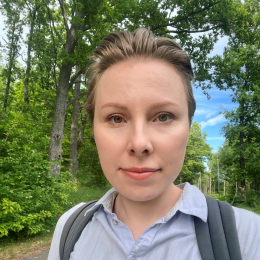
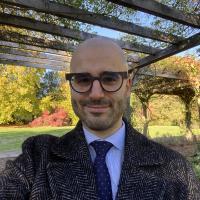
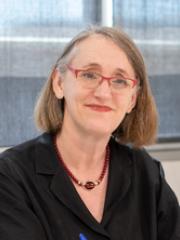
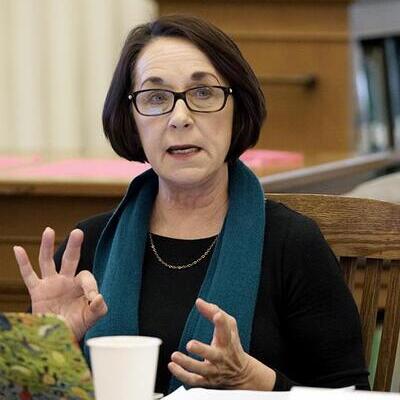
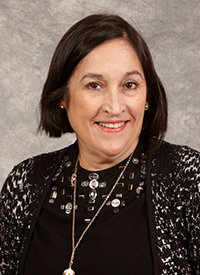
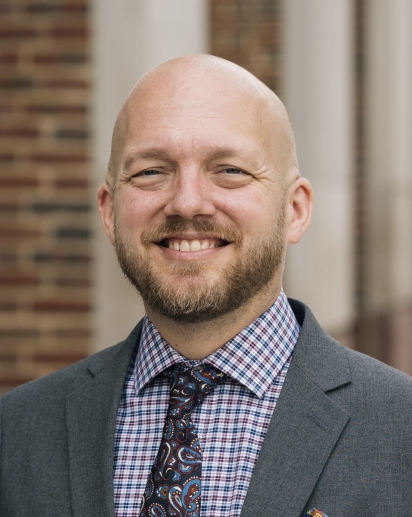
Anna Metreveli is a researcher at the Department of English, Stockholm University , currently conducting doctoral studies on English-medium vocational education and coding bootcamps in Sweden, including their marketing strategies and stakeholder experiences. Her research spans: Discourse analysis of educational marketing Neoliberal influences on educational spaces Family language policies in transnational bilingual autistic households Gendered communication patterns Recent publications analyze: AI integration in vocational training Neoliberal rhetoric in coding bootcamp web presence Critical perspectives on menstruation representation in media Academic background includes an MA in Language Science with Specialisation in Bilingualism from Stockholm University, focusing on transnational family language planning. Contact: anna.metreveli@english.su.se
Dr Carlos Iglesias-Crespo serves as a Stipendiary Lecturer in Spanish at Hertford College and St Peter's College, University of Oxford. His research focuses on the literary, cultural, and intellectual history of the early modern Hispanic world , with particular emphasis on intersections between medical, rhetorical, theological, and political theories of memory within Petrarchan poetry traditions. Education: Universidad de Extremadura (Classics/Spanish Philology), University of Cambridge (MPhil/PhD in Spanish) Previous Affiliation: Affiliated Lecturer at Cambridge Using a transhistorical approach , he investigates embodied cognition and bodily representations in literature. His work connects Aristotle's theories with Viktor Shklovsky's formalism, analyzing poets like Juan Boscán, Fernando de Herrera, and Juan de Jáuregui. Research outputs include peer-reviewed articles on topics ranging from Garcilaso's sonnets to Giulio Camillo's memory theater. Recent publications examine cognitive poetics, rhetorical synthesis, and the translatio imperii et studii in early modern Spanish texts. Scientific support includes grants from: "La Caixa" Foundation Arts and Humanities Research Council (AHRC) Cambridge Trust He teaches preliminary and final honors school papers at Oxford, covering medieval/modern languages, and contributes to academic editing as co-editor of key volumes on Iberoamerican corporeal history and global Spanish poetry.
Dr. Rosemary Ridgway is an Associate Professor in the School of Education at Durham University. She holds leadership roles in teacher education programs, including directing the PGCE International Programme based in Geneva. Her work focuses on evidence-based decision making, special educational needs (SEND), statistical literacy, and inclusive pedagogy. She pioneered the ProCivicStat project to integrate data science into citizenship education and has led policy analysis research on teacher education reforms in England. Education Background: Prior to academia, Dr. Ridgway taught in mainstream and special schools across England's North East, gaining experience across Key Stages 1–3. Her career transition included roles in programme development, policy design for Initial Teacher Training (ITT), and undergraduate/graduate education coordination. Research Themes: Her work bridges educational policy and practice, emphasizing: SEN and disability inclusion strategies Statistical literacy as civic empowerment Critical analysis of educational policies Pre-service teacher preparation for diversity Key Contributions: Developed innovative modules like EDUC1531 and EDUC2431 on disability and education Authored foundational texts in SEND pedagogy and statistics education Co-founded the Civic Statistics curriculum framework Advocates for evidence-informed educational practices Future Work: Currently expanding the PGCE International Programme into an online format and advancing data science CPD initiatives for educators globally.
Associate Professor Rebecca Johinke holds the Chair of Discipline: English and Writing at the University of Sydney's Faculty of Arts and Social Sciences. She has held leadership roles including Associate Dean Student Affairs and Bachelor of Arts Degree Director. Her PhD from the University of Adelaide underpins her interdisciplinary research in literary and rhetorical studies, with a focus on gender, popular culture, and Australian media. Her research interests span Magazine Studies (focusing on Australian editors and digital transitions), Walking Narratives (psychogeography and urban culture), Australian film/ literature (Ozploitation films like Mad Max), and teaching pedagogy (digital writing, student engagement). Recent publications include analyses of Mad Max: Fury Road and the representation of rape revenge in Shame. Dr. Johinke has received awards such as the 2020 Vice Chancellor’s Award for Outstanding HDR Supervision and 2018 SUPRA Supervisor of the Year. She leads four current PhD supervisions and has guided projects on topics like Jane Austen’s reading memoirs and Australian televisual work. Notable grants include a 2018 initiative supporting international students and a 2016 project on digital-age literature education. Her work bridges academic rigor with community engagement, exemplified by the Therapaws therapy dog program. She actively contributes to journals like Antipodes and Tourist Studies, and her edited collection Queens of Print (2019) remains a landmark in Australian media studies.
Joanna Schreiber is an Associate Professor in the English Department at Georgia Southern University, where she has been teaching since 2013. Her academic work focuses on the intersection of technical communication, accessibility, and user experience, with research that contributes to the United Nations Sustainable Development Goals related to quality education and reduced inequalities. Her research interests include: Technical & Professional Communication Usability & User Experience (UX) Business & Management Communication Workplace Studies Technical and Professional Editing Project Management Accessibility Rhetoric Professional Identity Dr. Schreiber's scholarly work demonstrates an evolving trajectory from foundational technical communication studies toward increasingly specialized research on inclusive editing practices and disability studies. Her recent publications (2021-2025) show a strong emphasis on accessibility frameworks and advocacy in technical communication, examining how editing practices can better serve diverse users. She has also made significant contributions to understanding sustainability models for technical and professional communication programs and exploring the integration of project management principles within communication workflows. With 29 research outputs documented between 2010-2025 and an h-index of 7 (94 citations), Dr. Schreiber maintains an active scholarly profile that bridges theoretical frameworks with practical applications in technical communication education and practice.
Mary Bunch is an Associate Professor at York University’s School of the Arts, Media, Performance & Design (AMPD), holding the Canada Research Chair in Critical Media Arts Ecologies. Her work bridges critical theory with media arts creation, focusing on decolonizing frameworks, queer theory, and critical disability studies. Research Focus: Transitional worldmaking via socio-political concepts, emphasizing ethics in extended reality (XR) and collaborative methodologies. Collaborations: Co-directs the Peripheral Visions CoLab, integrating diverse epistemologies through community-based practices. Creative Outputs: Artworks co-created with Dolleen Tisawii’ashii Manning exhibited at Nuit Blanche (2022), ImagineNative (2023), Aga Khan Museum (2024), and UN Water Conference (2023). Leadership: Co-editor of a special issue on Access Aesthetics in the journal Public , with a monograph-in-progress titled Ecstatic Ethics . Research Trends: Combines critical theory (feminist, queer, decolonial, crip frameworks) with media arts practice, exploring XR’s ethical implications, biopolitics, and marginalized subjectivities. Collaborative projects emphasize embodied knowledge and anti-oppressive methodologies. Scientific Awards: Canada Research Chair; SSHRC-funded Pluriversal Worlding with Extended Reality. Advising: Only accepts graduate students aligned with her research in critical theory and media arts. Collaborative grants and community-based projects dominate her funding, prioritizing interdisciplinary and inclusive approaches.
Dr. Kate Power is a Senior Lecturer at the University of Queensland Business School, specializing in discourse analysis applied to issues of justice, sustainability in arts and culture, and crisis communication. She leads research on organizational communication, particularly in the arts sector, and has developed initiatives like the 'Creating out Loud' peer coaching program to support artists. Her work emphasizes ethical communication for societal good, including collaborations with Theatre Network Australia and Queensland Ballet. Recognized with an Advance Queensland Industry Research Fellowship (2021), her research spans topics such as violence against women reporting, gender equality, and policy discourse. She actively engages in interdisciplinary projects, including austerity discourse analysis and pandemic communication strategies. Her academic contributions include over 55 publications across journals, books, and conferences, focusing on discourse analysis methodologies and their applications in religion, media, and public policy. Recent projects highlight her commitment to fostering inclusivity in the arts and addressing systemic challenges faced by cultural workers post-pandemic. Dr. Power frequently presents at international conferences, such as the World Down Syndrome Congress and EGOS, and her work bridges theoretical research with practical industry solutions.
Brenda Jo Brueggemann is a Professor and the Aetna Endowed Chair of Writing in the Department of English at the University of Connecticut. She serves as Co-Editor of Disability Studies Quarterly and is actively involved in multiple research projects focused on disability studies, deaf studies, and writing pedagogy. Her academic affiliations include: Professor, Department of English, University of Connecticut Aetna Endowed Chair of Writing, University of Connecticut Co-Editor, Disability Studies Quarterly Brueggemann's research interests span a broad range of disability-related fields with particular emphasis on: Deaf Studies and Deaf Culture Disability Studies and Disability Rights Disability Art and Creative Expression Universal Design for Learning (UDL) Multimodality and Access to Education Captioning and Communication Access Global Disability Issues Disability and Human Rights Her current major research projects include "Posting Mabel: an epistolary biography of Mabel Hubbard Bell (Alexander Graham Bell's deaf wife)," "AktionT4: Economics, Euthanasia, Eugenics" (a blog about the Nazi's T4 program), "Active & Accessible: Writing Moves for the 21st Century" (a multimodal writing textbook), "The Aesthetics, Bioethics, and Rhetorics of Access in Art and Cultural Museums" (collaborative project with Rosemarie Garland Thomson and Georgina Kleege), and "The Pandemic and Academics Writing Project." Brueggemann's scholarly work demonstrates consistent focus on disability representation, access, and inclusion across academic, cultural, and historical contexts. Her recent publications show increasing attention to multimodal approaches, conference accessibility, disability community building, and intersection of disability with other identity markers. Her notable scholarly contributions include: Co-editing the second expanded edition of "Disability and the Teaching of Writing" Contributing to "The Cambridge History of Rhetoric" with a chapter on "Disability and Rhetoric" Co-editing "MLA Options for Teaching: Disability Studies in Language and Literature" with Georgina Kleege and Rosemarie Garland-Thomson Editing "Disability Studies Quarterly" as Co-Editor Brueggemann is actively engaged in mentoring and academic service, with research that bridges theoretical frameworks with practical applications for creating more accessible academic and cultural spaces. Her work with Rosemarie Garland Thomson and Georgina Kleege on museum accessibility represents significant interdisciplinary collaboration addressing disability representation in cultural institutions.
William J. Brown, Ph.D., is a Professor and Research Fellow in the Journalism & Communication Studies Department at Regent University's School of Communication & the Arts. His research focuses on entertainment-education for social change, health communication, media influence, and C.S. Lewis studies. He has conducted research across 40+ countries over 30 years and held leadership roles including Dean of the School of Communication & the Arts (1992–2002) and Chair of the Department of Strategic Communication & Journalism (2003–2016). Currently, he teaches doctoral research methods, communication theory, and strategic communication courses. Education: B.S. from Purdue University (1978), M.A. (1986), M.A. (1987), and Ph.D. from the University of Southern California (1988). Research interests include media literacy, parasocial interaction, celebrity studies, and disability-inclusive education. He has contributed to interdisciplinary projects such as Fulbright Specialist programs in Norway and the Netherlands. Notable awards include the Chancellor's Award (2003) and recognition through the Fulbright Program (2007–2011). Publications span topics from election social media analysis to C.S. Lewis's theological rhetoric. His work bridges academic theory with practical applications in health communication and media ethics.
Catherine Baroin is a Professor in the 8th Section at the University of Rouen Normandy, affiliated with the UFR Letters and Human Sciences. She holds an HDR (2019) and has been a member of the ERIAC research unit since 1989, initially as an Associate Professor of Classical Letters. Her research focuses on the anthropology of Rome, particularly exploring memory practices, cultural relationships between Rome and Greece, bodily norms, and the semiotics of clothing in antiquity. She has authored influential works including Remembering in Rome (2010), which won the François Millepierres Prize, and co-edited volumes on body studies and gender norms. Her academic contributions span classical literature, Roman social history, and cultural anthropology. Teaching includes courses on Roman religion, art, and anthropology, alongside digital humanities initiatives. She actively participates in international conferences and has organized interdisciplinary research projects on ancient bodily practices and cultural memory. Key affiliations: ERIAC (Member Council), ANHIMA Center (Associate Member) Teaching: Latin literature, classical civilization, digital humanities Research leadership: Co-organized conferences on body studies and ERIAC research axes
Mart Susi is a Professor of Human Rights Law at Tallinn University 's School of Governance, Law and Society. He serves as a Member of the European Union Agency for Fundamental Rights' Management Board (2022–2026) and leads the Global Digital Human Rights Network (2020–2024). His work bridges law, digital society, and international cooperation. Doctor of Juridical Sciences (2008, University of Tartu) MSc in Sociology (1992, University of Wisconsin-Madison) Diploma in Law (1988, University of Tartu) Research Interests: Mart's scholarship focuses on human rights in the digital age , including topics like AI ethics , data protection , and proportionality theory . He pioneered the Internet Balancing Formula to reconcile conflicting rights online and has led EU/Nordic-funded projects on digital governance. Scientific Awards: Doctor of Humane Letters honoris causa, College of New Rochelle (1990) Advising & Grants: Mart has supervised doctoral research and led 14+ projects, including EU-funded Mind the Metaverse (2022) and Global Digital Human Rights Network (2020–2024). His 2023–2028 project Boosting Societal Adaptation in Digitalizing Europe addresses mental health in post-pandemic digital societies. Labs & Teams: He founded and leads the International Research Center of Fundamental Rights at Tallinn University and serves as Editor-in-Chief for East-West Studies and East European Yearbook on Human Rights .
Raysa Amador is a Professor in the Department of Languages, Literatures, and Cultures at Adelphi University’s College of Arts and Sciences. She has served as Chair of the department (2006–2021) and Director of the Latin American Studies Program since 1990. Her academic leadership extends to numerous university committees and advisory roles, including the DACA, International & Immigration Task Force and the International Studies Committee. Ph.D., New York University (1978) M.A., New York University (1973) B.A., Cum Laude, Phi Beta Kappa, New York University (1972) Certificate, Data Processing Programmer, New York University (1979) Her research centers on Hispanic literature, Latina writers and artists, second language acquisition, and the intersection of law and literature in colonial chronicles. She explores themes of identity, gender, transculturation, and narrative power, particularly in the works of Frida Kahlo, Cristina Garcia, Julia Alvarez, and other Latina figures. Her pedagogical focus includes intermediate Spanish curriculum development and cultural literacy. The recent scholarly output reflects a strong trend in feminist and transnational studies, analyzing the female body, self-representation, and cultural identity across literature and visual art. Her work bridges interdisciplinary fields such as law, rhetoric, anthropology, and history, particularly in her studies of the Chronicles of the Indies and colonial legitimacy. Adelphi Presidential Award for Diversity and Inclusion (2020) Distinguished Faculty Excellence Award (2005) Septima Clark Distinguished Faculty Award (1999) President’s Faculty Development Award (multiple) Certificate of Award for Advancing Women's History (1999, 2000) Selected speaker, New York Council for the Humanities (multiple years) Amador has advised numerous undergraduate and graduate students in research and theses, particularly in Hispanic literature, identity, and social justice. She has secured multiple grants, including from the U.S. Department of Education and the New York Council for the Humanities, supporting seminars, speaker programs, and cultural festivals. Her leadership in organizing the Spanish Film Series with Pragda highlights her commitment to public humanities and cultural engagement. She has been instrumental in developing academic programs such as the Latin American Studies Concentration and has served on key search and governance committees. Her long-standing advisory role with Latino Students United (formerly La Unión Latina) underscores her dedication to student support and diversity initiatives.
V. Jo Hsu is an Associate Professor in the Departments of Rhetoric and Writing and Women's, Gender, and Sexuality Studies at the University of Texas at Austin. They are core faculty for the Center for Asian American Studies and a leading scholar in trans, queer, and disability studies. Education: Ph.D. and M.F.A. from Pennsylvania State University Research Focus: Their work examines how stories shape policy and culture, particularly through trans of color critique , crip theory , and racialized medical rhetorics . Current projects analyze anti-trans politics, chronic illness narratives, and intersectional approaches to justice. Recent Article Trends: 75% of their 2021-2024 publications focus on trans health rhetorics , disability justice , and racialized policy analysis . Recurring sub-fields include slow death , non/images of trans bodies , bed activism , anti-carceral frameworks , affective drift , and fractal belonging . Scientific Recognition: 2024 Rhetoric Society of America Book Award 2024 National Communication Association Diamond Anniversary Book Award 2023 Leadership Award for People with Disabilities (NCTE) 2023 Conference on Community Writing Innovations Award
Josh Compton is Professor of Speech at Dartmouth College, where he serves as Chair of the Speech at Dartmouth Steering Committee and is affiliated with the Institute for Writing and Rhetoric. With over 20 years of research experience, he has established himself as a leading scholar in inoculation theory and resistance to influence, with significant contributions across health communication, science communication, and rhetorical studies. Compton earned his Ph.D. from the University of Oklahoma, which formed the foundation for his extensive research career in communication theory. His educational background has prepared him for interdisciplinary work that bridges communication, psychology, and historical analysis. Professor Compton's research centers on inoculation theory, examining how weakened forms of challenges can motivate resistance to stronger persuasive attempts, drawing an analogy to medical vaccination. His work spans multiple domains including image repair theory, public speaking pedagogy, speechwriting, health communication (particularly vaccination rhetoric), science communication (addressing misinformation), environmental communication (focusing on web accessibility), and historical rhetorical analysis of communication artifacts like vintage postcards. Compton has conducted innovative research analyzing historical communication practices to understand how inoculation principles have been applied throughout history, from 18th century smallpox debates to World War II vaccination campaigns. His recent publications demonstrate a strong trend toward applying inoculation theory to contemporary challenges including misinformation resistance, conspiracy theory beliefs, psychological reactance, and improving accessibility in environmental communication. Compton's work shows increasing interdisciplinary integration, connecting communication theory with practical applications in public health, science communication, and digital accessibility. 2022 Distinguished Book Award from the Communication and Social Cognition Division of the National Communication Association for his book on Persuasion As an educator, Compton teaches highly popular courses including Public Speaking (SPEE 20), Image Rhetoric (SPEE 34), Persuasive Public Speaking (SPEE 25), and Speechwriting (SPEE 30). His teaching is uniquely informed by his personal experience as a covert stutterer, which gives him distinctive insights into speech communication. He has mentored undergraduate researchers like Lam, D. on projects examining the analogics of inoculation theory and character assassination. Compton's research on web accessibility revealed that 95.3% of popular environmental websites had critical accessibility errors, highlighting a significant digital divide for people with disabilities. Compton's work bridges theoretical development with practical applications, particularly in the areas of health communication and misinformation resistance. His research on how misinformation interventions decay rapidly without immediate posttests has important implications for designing effective media literacy programs that create lasting resistance to misinformation.
Kimberly Drake serves as Professor of Writing and Chair of the Department of Writing and Rhetoric at Scripps College, where she also directs the Writing Program, advises Environmental Analysis Non-Science Tracks, and liaises with the Scripps College Academy. Her education includes a Ph.D. in English from UC Berkeley with graduate work in Composition Theory and a B.A. with High Honors in English from the same institution. Dr. Drake's research critically examines protest writing, disability literature, and prison narratives through feminist, queer, disability, and critical race frameworks. She investigates how marginalized communities use writing to resist oppression across American literature and subcultures like punk rock, with recurring themes of identity, trauma, and social justice in works ranging from slave narratives to contemporary movements. Her publications reveal consistent engagement with intersections of race, gender, and class in American protest literature, particularly through edited volumes on fear, terror, and slave narratives that highlight marginalized voices and resistance strategies. She has received four Scripps Research Grants (2009-2018), two Mary W. Johnson Teaching Awards (2012-13, 2014-15), a Scholarship Award (2010-11), and the Alliance to Advance Liberal Arts Colleges Grant for Critical Disability Studies. Student recognition as Professor of the Year (2012-13) underscores her pedagogical impact. As an adviser and program director, she mentors students in environmental analysis and writing pedagogy while judging international writing competitions and consulting for AP English Composition. Her leadership extends to curriculum development through the Scripps College Academy outreach program for high school students.