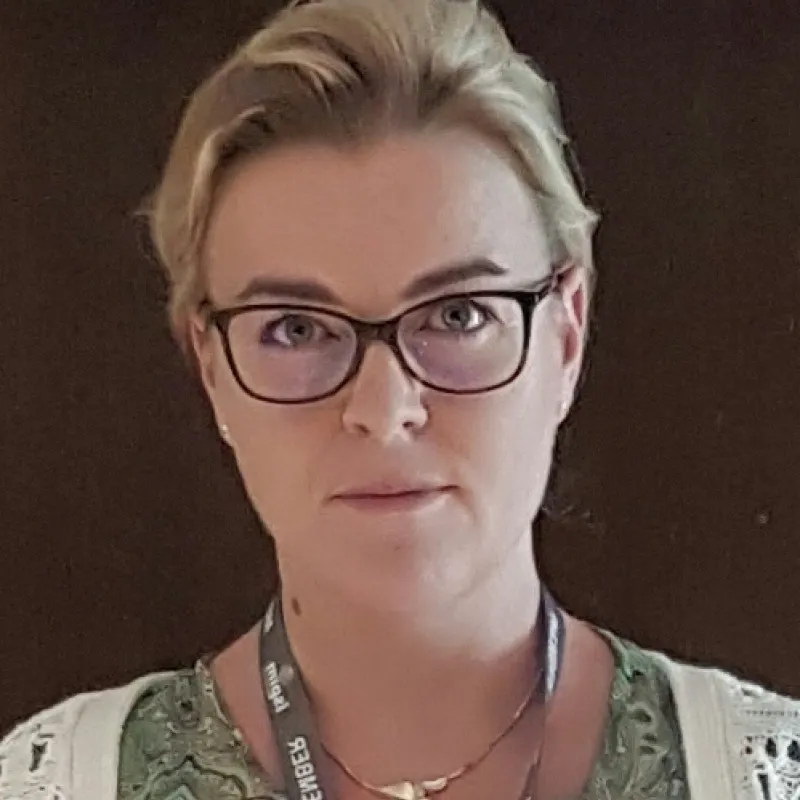
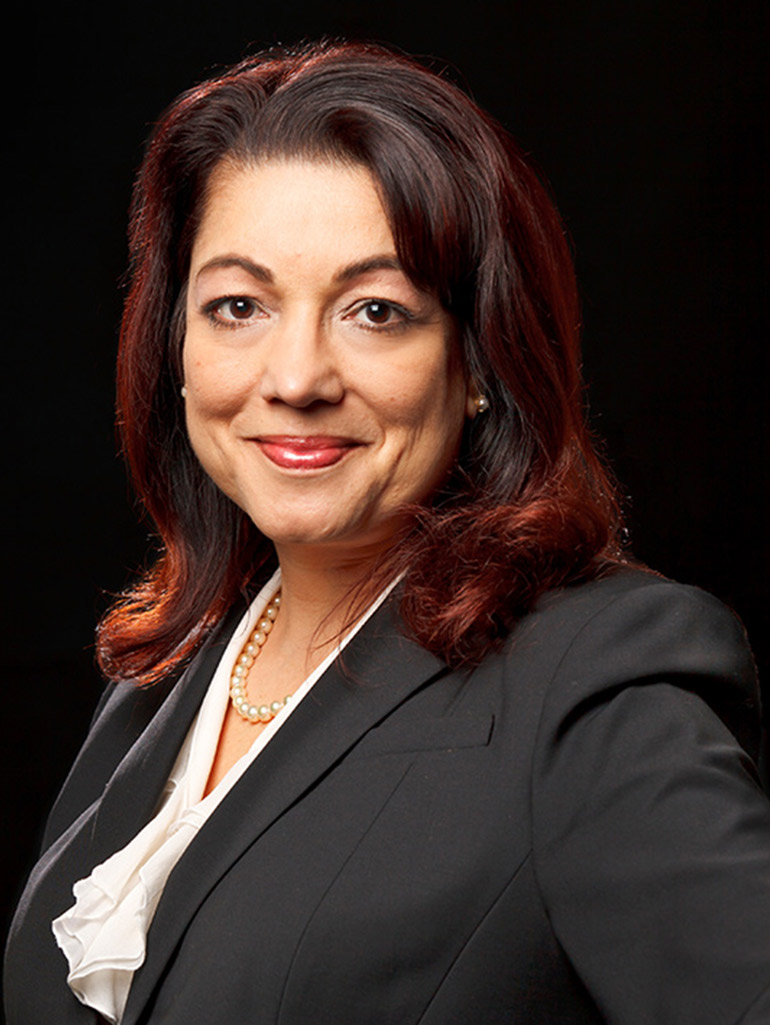
Lea Hannola is a researcher at the LUT School of Engineering Sciences (Lappeenranta–Lahti University of Technology LUT) focusing on digital twins, sustainable manufacturing, and Industry 5.0. Her work bridges technological innovation with eco-conscious business practices. Academic Rank: Researcher Contact: Lea.Hannola@lut.fi Hannola's research emphasizes digital twin applications for sustainability, including circular manufacturing, smart energy systems, and human-centric industrial design. She explores competencies required for Industry 5.0 adoption, workforce empowerment through digital tools, and integration of environmental and data-driven strategies in manufacturing. Her publications span topics like smart building management , quantum computing challenges , and supply chain sustainability , with a recurring focus on simulation, interoperability, and lifecycle value creation. Key trends include AI-driven sustainability, green HRM, and digital ecosystems. As a scholar, Hannola contributes to advancing digitally extended product-service systems and addressing sociotechnical challenges in industrial digitalization. Her work impacts manufacturing competitiveness, energy efficiency, and organizational transformation.
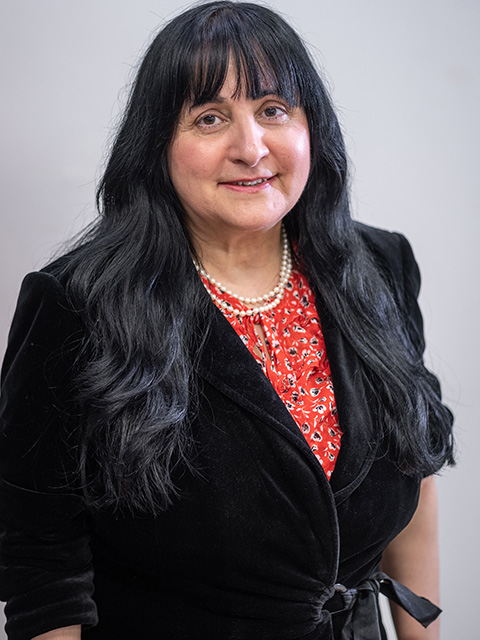
Professor Mahroo Eftekhari is a Professor in Building Services Engineering at Loughborough University, leading the Low Energy Building Services Engineering MSc programme. Her research focuses on energy-efficient building systems, thermal comfort, HVAC optimization, and renewable integration. She has pioneered control systems for airports and buildings, including MPC-based strategies to reduce energy use while enhancing occupant well-being. Notable contributions include the development of BISPA (Building & Industrial Services Pipework Academy), a national center for BIM and pipework training. Education: Holds qualifications including CEng (Chartered Engineer), DPhil (Doctor of Philosophy), FCIBSE (Fellow of Chartered Institution of Building Services Engineers), and SFHEA (Senior Fellow of the Higher Education Academy). Her academic career is marked by collaborations with Tata Steel, Mitsubishi R&D, and Vexo, yielding applied research in sustainable building technologies. Research Interests: Indoor Air Quality, Thermal Comfort Modeling, Zero Energy Buildings, Digital Twins, and Advanced Control Systems. She has developed innovative solutions like AI-driven thermal management for Building Energy Management Systems (BEMS) and interfaces to synchronize airport operations with energy systems. Awards & Grants: Secured funding from diverse bodies for projects such as adaptive thermal comfort models, BISPA infrastructure, and energy-efficient HVAC strategies. Her work emphasizes practical applications, including reducing CO₂ emissions via airport terminal optimization and improving renewable energy use in buildings. Lab & Teams: Leads the Building Energy Research Group, managing projects in closed-loop heating systems, IEQ monitoring, and hydronic system efficiency. The Civil Engineering labs house interactive BIM rigs launched with institutional and industry support.
Professor Min An is a Professor of Construction and Risk Management at the University of Salford, leading the Infrastructure Research Group within the School of Science, Engineering & Environment. He holds an honorary professorship at two overseas universities (China and Portugal) and serves on the editorial boards of 12 international journals. With over 40 years of experience, his career spans academic roles at Heriot-Watt University, Coventry University, and the University of Birmingham, alongside industry roles as a civil engineer and researcher. His research focuses on safety and risk management in construction, transportation systems, and energy sectors, with over 200 publications. Key areas include railway and highway safety, offshore oil & gas risk assessment, and nuclear reliability management. He has secured funding from EPSRC, EU, DfT, and industry partners, leading 20+ projects. Notable achievements include developing methodologies for infrastructure safety and maintaining collaborations with 30+ industrial partners. Professor An has supervised 30 PhD students and over 280 postgraduate projects, contributing to industry workshops and best practices. Awards include multiple science technology prizes and conference best paper/keynote recognitions. His teaching spans risk management, construction safety, and project management across MSc programs.
Dr. Assela Pathirana is a Professor at the IHE Delft Institute for Water Education, specializing in water infrastructure asset management (WIAM), climate resilience of Small Island Developing States (SIDS), and sustainable urban water systems. His work bridges academia, policy, and practice, focusing on digitalization, data-driven decision-making, and nature-based solutions. Key roles include Chief Technical Advisor for the Maldives’ water systems and leadership of a MOOC on SIDS climate adaptation. He holds a BSc (First Class Honours) from the University of Peradeniya and advanced degrees from the University of Tokyo, specializing in hydrology and water resources engineering. Education: Bachelor of Science in Civil Engineering (First Class Honours), University of Peradeniya, Sri Lanka Master’s and Doctoral Degrees in Civil Engineering (Hydrology and Water Resources), University of Tokyo, Japan Research Interests: Dr. Pathirana’s work emphasizes climate resilience, SIDS adaptation, urban flood risk management, and sustainable infrastructure. He develops decision-support tools for flood forecasting, evaluates land-use changes in Jakarta, and promotes equity in water rationing systems. His interdisciplinary approach integrates hydrological modeling, open-source software development, and policy analysis. Advising & Capacity Building: He leads training-of-trainers programs and capacity-building initiatives, enhancing postgraduate education in technical disciplines. His efforts focus on didactics and pedagogy, ensuring graduates gain both theoretical knowledge and practical expertise. Key Projects: Developed the WIAM curriculum at IHE Delft MOOC on SIDS climate adaptation and water security Consultancy for the Maldives’ Ministry of Environment and UNDP Labs & Collaborations: Engages in cross-disciplinary teams addressing urban water challenges, including sponge cities in China and flexible adaptation planning in Melbourne and Pune. His work with UNESCO-ICHARM and UNU underscores global water security and disaster risk reduction.
Dr. Frederic Bosche is a Reader in Construction Informatics at the University of Edinburgh's School of Engineering, leading the CyberBuild Lab. His research focuses on advancing digital construction technologies, including BIM, sensing systems, and digital twinning to enhance infrastructure management and workforce safety. Education: PhD in Civil Engineering (University of Waterloo), M.Sc. from University of Texas at Austin, and M.Eng. from Ecole Centrale de Lille. Research interests include automated construction processes, data-driven infrastructure lifecycle management, and integrating emerging technologies like AI and IoT into construction workflows. His CyberBuild Lab has pioneered projects in defect detection, roof monitoring, and smart construction inspection. Notable contributions include over 100 publications, 12 research projects (e.g., 'Digital Facility' and 'Monitoring Roofs of Traditional Buildings'), and awards such as the Charles M. Eastman Top PhD Paper Award. He actively engages in public outreach through science festivals and collaborates internationally with institutions like ETH Zurich and Heriot-Watt University.
Jan Cudzik is an Assistant professor at the Gdańsk University of Technology's Department of Urban Architecture and Waterscapes, Faculty of Architecture. He leads the Digital Technology Laboratory and focuses on integrating computational methods with architectural design and conservation. His research spans parametric design, generative systems, artificial intelligence, and sustainable construction practices. Education details are not explicitly provided in the texts, but his academic roles indicate advanced training in architecture and engineering. Research interests include: AI-driven design processes Generative design using swarm intelligence 3D printing in construction Energy-efficient building lifecycle assessment Traditional-conservation/digital-fabrication hybrids Key publication trends emphasize: Public space sustainability (lighting, greenery) Machine learning applications in architecture Historical structure preservation He contributes to projects like ENACT 15mC, focusing on urban community development. His work bridges digital innovation with ecological and cultural heritage concerns. Labs/Teams: Director of the Digital Technology Laboratory, active in architectural education reform using AI tools.
Summary Associate Professor Mehrdad Arashpour is an internationally recognized researcher and educator in construction and civil infrastructure, focusing on automation and information technologies. He leads the ASCII Lab at Monash University's Department of Civil and Environmental Engineering. His academic roles include Head of Construction Engineering and membership in the CIB's Working Commission on Off-site Construction (W121) and Infrastructure Task Group (TG91). Education: Ph.D., RMIT University, Australia M.Sc., Grenoble University, France B.Sc., IU University, Iran Research Interests: Digital twins, computer vision, robotics, BIM integration, sustainable construction, and automation in construction processes. His work contributes to UN Sustainable Development Goals, particularly in sustainable cities and communities. Grants & Awards: Over $6M in grants from ARC, Austroads, and industry partnerships. Recognitions include Editor's Choice Paper (ASCE, 2019) and Outstanding Reviewer (Elsevier, 2016). Teaching: Courses like Risk Management in Engineering Projects and Infrastructure Research Project. Advises on PhD topics in computer vision, robotics, and BIM. Labs & Collaborations: ASCII Lab focuses on smart, sustainable solutions for construction. Collaborates with global researchers and organizations like SPARC Hub and Building 4.0 CRC.
Christoph Gehlen is Professor and Chair of Materials and Materials Testing in Civil Engineering at the Technical University of Munich (TUM), based at Franz-Langinger-Str. 10 in Munich. His research group focuses on advanced concrete technologies, materials science, and digital construction methods, with significant contributions to additive manufacturing in civil engineering through the Collaborative Research Center TRR 277. His research spans concrete technology, durability assessment, and sustainable construction practices. Key interests include corrosion mechanisms in reinforced concrete, non-destructive testing methodologies, and additive manufacturing techniques like Selective Paste Intrusion (SPI). Recent work emphasizes 3D concrete printing for structural applications, life cycle assessment of printed elements, and fundamental studies on material behavior under environmental stressors including carbonation, chloride exposure, and freeze-thaw cycles. Analysis of his 15 most recent publications (2024-2025) reveals dominant research trajectories in digital fabrication of concrete structures, particularly SPI-based additive manufacturing. His work integrates materials science with structural engineering to develop functionally graded components, assess sustainability metrics, and solve reinforcement integration challenges. Significant interdisciplinary efforts address durability issues through electrochemical monitoring, coda wave interferometry, and advanced imaging techniques for concrete microstructure characterization. Gehlen leads the Chair of Materials and Materials Testing in Civil Engineering at TUM, which operates advanced laboratories for concrete characterization including confocal laser scanning microscopy and virtual testing environments. His team actively participates in TRR 277 (Additive Manufacturing in Construction), developing fabrication-aware design methods and experimental validation protocols for novel construction technologies.
Christophe Danjou is an Associate Professor in the Department of Mathematical and Industrial Engineering at Polytechnique Montréal . He joined as a professor in January 2018 and serves as Scientific Director of the Poly-Industries 4.0 Laboratory since June 2021. His expertise spans Industrial Engineering , Industry 4.0/5.0 , Manufacturing Systems , and Blockchain . His research focuses on solving interoperability challenges in digital transformation through ontological approaches (OntoSTEP-NC) and blockchain technology. Key themes include strategic positioning frameworks for Industry 4.0/5.0, knowledge management , and smart manufacturing . Recent work explores digital twins for system-of-systems resilience , data integrity in IoT , and AI-driven food processing optimization . He teaches courses like Industry 4.0 and Manufacturing Processes . Under his supervision, 7 PhD and 6 Master’s students are advancing research in areas such as blockchain-based smart maintenance , distributed manufacturing , and carbon emission traceability . He is affiliated with institutions including IVADO (Member), CIRRELT (Member), and Data Intelligence Lab (Member). His publications highlight contributions to digital transformation across construction, agri-food, and SMEs, with 83 total publications (15+ recent articles shown).
Dr. Min Liu is a Professor and the Abdallah H. Yabroudi Endowed Professor in Sustainable Civil Infrastructure at Syracuse University, where she directs the Syracuse University Infrastructure Institute. She holds a Ph.D. in Engineering Project Management from UC Berkeley, and prior degrees from National University of Singapore and Xi’an University of Architecture and Technology. Her research focuses on integrating human and engineering aspects in construction planning, with emphasis on Lean Construction, Digital Twin design, and machine learning applications. She has published over 50 articles in top-tier journals and won prestigious awards such as the 2021 ASCE Thomas Fitch Rowland Award. Dr. Liu advises numerous graduate students and postdocs, offering positions in Construction Engineering and Management. Her lab develops innovative approaches for infrastructure project delivery, worker mental health, and bridge preservation strategies. Education: Ph.D. in Engineering Project Management, UC Berkeley (2007) MSCE, Xi’an University of Architecture and Technology (1997) MSc in Building Science, National University of Singapore (2001) BSc in Civil Engineering, Qingdao University of Technology (1994) Research Highlights: Large language models for construction planning reliability Ontology-based knowledge systems for construction methods Lean techniques for worker mental health improvement Socioeconomic analysis of bridge preservation strategies Awards: 2021 ASCE Thomas Fitch Rowland Award Multiple Best Paper Awards (2017-2018) "Thank a Teacher" awards (2011-2018) Her advising record includes notable students like Chuanni He (2023 Chinese Government Award) and Gongfan Chen (2022 Three-Minute Thesis Award). Current opportunities include Ph.D. financial support and postdoc positions. Dr. Liu’s work appears in journals like ASCE Journal of Management in Engineering and Engineering, Construction and Architectural Management.
Dr. Andrzej Ożadowicz is a University Professor at the Department of Power Electronics and Automation of Energy Conversion Systems within the Faculty of Electrical Engineering, Automatics, Computer Science and Biomedical Engineering at AGH University of Science and Technology in Kraków, Poland. His office is located in room 510, building C-1, with contact details including phone +48 12 617 50 11 and email ozadow@agh.edu.pl. He holds PhD, DSc, and Engineering degrees, reflecting his dual expertise in academic research and practical engineering applications. His research spans Power Electronics, Building Automation, Smart Grids, and IoT-driven energy systems. Key interests include energy efficiency optimization through digital twins and BIM, distributed energy resource integration , and AI-enhanced demand management . Notably, he pioneers applications of deep reinforcement learning in home energy systems and develops frameworks for Smart Readiness Indicator implementation. His work bridges theoretical innovation with practical case studies in building thermal modeling and dynamic façade systems. Recent publications (2021-2025) reveal three dominant trends: (1) Convergence of digital twin technology with building automation for real-time energy management; (2) Critical analysis of IoT security and interoperability in smart infrastructure; (3) Pedagogical innovations in engineering education through blended learning methodologies post-COVID-19. His scholarly output demonstrates consistent focus on energy transition challenges and smart grid evolution. Professor Ożadowicz actively contributes to the Discipline Council for Automation, Electronics, Electrical Engineering and Space Technologies at AGH. He is instrumental in the AutBudNet initiative —a network of certified laboratories for energy efficiency assessment that implements "learning by doing" principles in building automation education. His work with this consortium emphasizes practical validation of smart grid technologies and demand response systems.
Dr. Rama Hart is an Associate Professor in the Department of Management at the Opus College of Business, University of St. Thomas. Previously served as Director of the Master of Arts in Organization Development program in the College of Education, Leadership and Counseling before joining Opus in 2018. Specializes in global/virtual team communication, organizational change leadership, and workplace inclusion issues. Teaches Managing Organizational Behavior in Full-time MBA program Offers courses in Organization & Employee Development (MGMT 360) and Inclusive Leadership (MGMT 385) Active participant in equity, diversity, and intercultural competence initiatives Research Focus: Combines virtual communication studies with organizational change management, emphasizing inclusive leadership practices across domestic and global contexts. Her work examines relationship formation in distributed teams through communication patterns and technological mediation. Teaching Philosophy: Integrates experiential learning through virtual worlds and appreciative inquiry methodology, focusing on practical skill development for navigating modern workplace complexities. Institutional Roles: Involved with multiple academic units including the Schulze School of Entrepreneurship and various research centers like the Behavioral Research Center and Institute for Social Innovation.
Thomas Ertl is a Professor at the University of Natural Resources and Life Sciences, Vienna (BOKU), leading the Institute of Sanitary Engineering and Water Pollution Control. His research focuses on urban water systems, emphasizing sustainable drainage, climate change adaptation, and nature-based solutions. He has coordinated 55 projects, including international initiatives in Albania and Austria, addressing stormwater management, wastewater heat recovery, and sewer infrastructure resilience. Key Projects : Analysing re-activated watercourses for urban resilience (2024–2028) Resilient rainwater management in Austria (2024–2028) Assessing pollutant emissions in Albania (2024–2027) Research Themes : Building Information Modeling (BIM) in wastewater systems Uncertainty analysis under climate change Stormwater pollution and heat island mitigation Awards : 2018: Goldene Ehrennadel des ÖWAV 1993: Best student award at AGIT 93 His recent publications highlight multidisciplinary approaches to wastewater energy recovery, spatial compatibility of nature-based solutions, and prioritization of stormwater management sites. He has supervised numerous theses and contributed to media discussions on urban climate resilience, including articles in Austrian outlets like futurezone.at and Der Kurier.
Jelena Zdravkovic is a Professor and Head of the Department of Computer and Systems Sciences (DSV) at Stockholm University. She leads the PRECIS research group which focuses on Process, Requirements, Enterprise, Capability, and Information Systems modelling. Her work spans theoretical and practical aspects of enterprise and IT solutions with a particular emphasis on digital transformation. Professor Zdravkovic's research interests center around Digital Business Ecosystems , Digital Twins , and Data-driven Requirements Engineering . Her work in Enterprise Modeling explores capability-oriented and consumer-oriented approaches to requirements engineering. She investigates how digital transformation and big data can be leveraged to improve requirements elicitation processes, and how organizations can model and manage complex digital business ecosystems. Her research has significant implications for how businesses can adapt to rapidly changing technological environments while maintaining resilience and competitiveness. Her recent publications reveal a clear trajectory toward integrating artificial intelligence with digital modeling techniques, particularly in the context of smart buildings and business ecosystems. There's a consistent focus on how data-driven approaches can transform traditional requirements engineering practices, making them more responsive to the velocity and variety of digital data sources. Her work bridges theoretical modeling with practical applications across various industries including healthcare, energy, and transportation. Professor Zdravkovic has been actively involved in mentoring PhD students, including supervising research on the Management Framework of Resilient Digital Business Ecosystems. She has participated in numerous national and international projects focused on interoperability and model-driven engineering, securing research funding for innovative work at the intersection of business and technology. She leads the PRECIS research group which deals with theories, methods and tools for analysis and design of organizational and IT solutions in congruence. The group's research covers three key topics – Enterprise Modelling, Business Process Management, and Conceptual Modelling. Their work brings together academic rigor with practical applications to solve real-world business challenges through innovative information systems approaches.
Dr. Andy Nguyen is a Senior Lecturer in Structural Engineering at the University of Southern Queensland, within the School of Engineering. He is an active researcher and educator, specializing in the Structural Health Monitoring (SHM) of critical civil infrastructure such as bridges, buildings, and transport tunnels. Bachelor of Engineering (BEng), NUCE, 1999 Master of Engineering (MEng), NUCE, 2003 Doctor of Philosophy (PhD), Queensland University of Technology (QUT), 2014 Dr. Nguyen's research is at the forefront of integrating advanced technologies into civil engineering. His primary focus is on developing and deploying sophisticated SHM systems that utilize sensors, data analytics, and machine learning to provide real-time insights into the structural integrity of ageing infrastructure. His work aims to enable proactive maintenance, extend the lifespan of structures, and enhance public safety. He has successfully implemented monitoring systems on major bridges and high-rise buildings in Queensland and New South Wales, with systems capable of even detecting distant earthquake events. His research interests span Structural Health Monitoring, Machine Learning for Engineering, Damage Detection, Finite Element Model Updating, Sustainable Building Materials like bamboo, and the application of AI for automated condition assessment of transport infrastructure. The analysis of his recent publications reveals a strong and consistent research trajectory centered on the application of data-driven and AI methods to solve practical problems in civil infrastructure. His work frequently combines signal processing techniques (like Stockwell Transform) with deep learning models for tasks such as crack detection in concrete and pavement. He also conducts significant research on model updating for complex structures like cable-stayed and arch bridges, using vibration data and optimization algorithms. The integration of machine learning for overload classification and the development of cost-effective, automated monitoring systems are key trends in his recent output. Advanced Queensland Fellow (2024-2027) Dr. Nguyen is actively involved in research supervision and collaboration. He is currently supervising several postgraduate students on projects related to AI-powered condition assessment, bamboo as a sustainable building material, and railway track design. He receives research funding from the Queensland Government through his Advanced Queensland Fellowship. His research has direct practical applications, as evidenced by his public engagement, such as writing for The Conversation on safeguarding ageing bridges, and his work with the Australian Network of Structural Health Monitoring. Dr. Nguyen's work embodies the development of a next-generation 'Living' Laboratory for engineering education, where research, teaching, and real-world infrastructure monitoring are integrated. His current projects involve creating smart, automated fault detection systems and advancing 'digital twin'-based monitoring platforms for infrastructure.