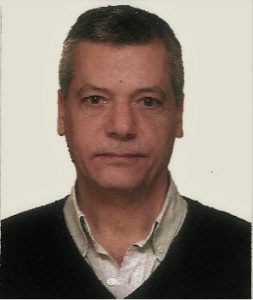
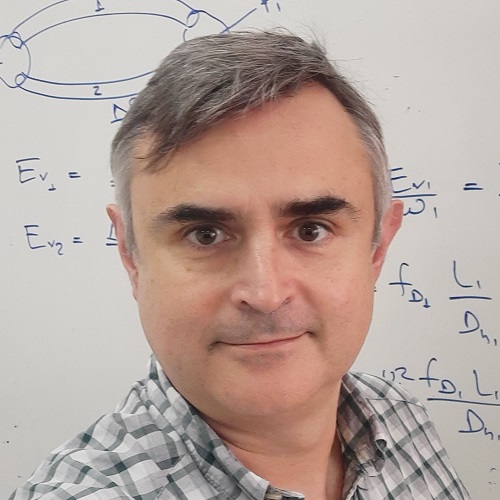
Panagiotis Katsaros is a Professor at the Department of Informatics, Aristotle University of Thessaloniki. His research focuses on Formal Methods, Software Dependability & Security, and Internet of Things (IoT) systems. 1992: Dipl. in Mathematics, Aristotle University 1993: M.Sc in Software Engineering, Aston University 2002: PhD in Informatics, Aristotle University His work integrates model-based design with probabilistic verification to address challenges in embedded systems , IoT , and cloud environments . He has pioneered methodologies for correctness-by-construction and security-aware elasticity in distributed systems. Recent publications (2015-2019) highlight trends in multi-core embedded systems , probabilistic model checking , and logical error detection . His research bridges formal verification with practical system design . Scientific Recognition Best Paper Award at 17th Panhellenic Conference on Informatics (2013) Best Paper Award at 15th Panhellenic Conference on Informatics (2011) He has supervised PhD students Stylianos Basagiannis and Anakreon Mentis , and contributes to the Dependability & Security Group (DSG A.U.Th) . His work impacts spacecraft design , cloud security , and transaction processing systems .
Georgios I. Papadimitriou is a Professor at the School of Informatics , Aristotle University of Thessaloniki , with over 25 years of academic service. He obtained his Ph.D. in Computer Engineering and Informatics (1994) and Diploma in Computer Engineering (1989) from the University of Patras, Greece. Current roles: Deputy Head of School of Informatics Director of Network and Communication Systems Lab Editorial roles: Associate Editor for 6 IEEE journals 4000+ citations and 22 research projects Research Interests span advanced network technologies: Optical networks (switch fabrics, WDM systems) Wireless networks (IoT, nanonetworks, underwater communication) Network security and energy-efficient protocols Learning automata for adaptive network control His 15 most recent publications (2016-2022) focus on optical network optimization, TDMA scheduling, energy-efficient wireless systems, and biomedical nanonetwork modeling, with key subfields including elastic optical networks, IoT protocol design, and machine learning applications in communications. As an academic advisor, he has mentored 8 Ph.D. students who now hold academic and industry positions across Greece. His work appears in 147 refereed journals and 165 conferences , with notable contributions to IEEE Transactions on Networking, Communications, and Wireless Communications.
Anna Visvizi is an Associate Professor at the Department of Management & International Business, Institute of Global Affairs, The American College of Greece, and a Visiting Scholar at Effat University, Saudi Arabia. She holds a Habilitation (dr habil.) in Economics and Finance from SGH Warsaw School of Economics (2019) and a Ph.D. in Politics and International Studies from the University of Warwick (2007). Education : Habilitation (dr habil.) in Economics and Finance, SGH Warsaw School of Economics (2019) Ph.D. in Politics and International Studies, University of Warwick (2007) Her research focuses on the intersection of politics, economics, and information and communication technology (ICT), with emphasis on AI, blockchain, smart cities/villages, and evidence-driven policymaking. She has published extensively on technology diffusion in the EU and Belt and Road Initiative (BRI) contexts. As Editor-in-Chief of the ABS-listed Transforming Government: People, Process and Policy , she bridges academia, think tanks, and policy. Her recent articles explore data-driven innovation in startups and smart city surveillance systems. She has edited key publications including: Managing Smart Cities: Sustainability and Resilience Through Effective Management (Springer, 2022) Artificial Intelligence and Its Contexts (Springer, 2021) Remote Learning in Times of Pandemic (Routledge, 2021)
George Sideridis is a Professor at the University of Western Macedonia , affiliated with the Polytechnic School's Department of Mechanical Engineering. His career spans over four decades, including prior roles at the Technological Educational Institution of Western Macedonia and the University of Thessaloniki. PhD in Experimental Fluid Mechanics (1982) and BSc in Aeronautical Engineering (1977), both from Queen Mary College, London University Specializes in turbulent flows, scalar dispersion, and wake-boundary layer interactions Developed experimental methodologies for atmospheric pollutant dispersion and quasi-2D flow simulations His research focuses on fluid dynamics and thermal engineering , particularly in turbulent flow behavior and environmental applications. Recent work (2024) explores air pollutant dispersion modeling, while earlier studies examine cylinder wake interactions and particle dispersion models like DIPCOT. He has served as a faculty member since 1984 in various Greek institutions, including roles at the Hellenic Aerospace Industry and Greek Airforce Academy.
Prof. Georgios Matsopoulos is a Professor at the Department of Information Transmission Systems and Materials Technology, School of Electrical and Computer Engineering, National Technical University of Athens (NTUA). He holds a Master's in Biomechanics and a PhD from the University of Strathclyde, Glasgow. As Director of the Biomedical Technology Laboratory, his expertise spans biomedical informatics, medical imaging, and healthcare data systems. His research focuses on diagnostic support systems, medical data fusion, biosignal processing, and AI-driven health technologies. Education: Bachelor's: School of Electrical & Computer Engineering, NTUA Master's: Biomechanics, University of Strathclyde PhD: University of Strathclyde Research Interests: Development of decision support systems, medical imaging analysis, health information systems, and AI applications in healthcare. He emphasizes large-scale medical data processing, radiomics, and clinical decision frameworks. His over 300 publications (2025-2021) highlight advancements in AI-driven diagnostics, medical robotics (e.g., HERON ontology), and telehealth systems. He leads projects like TeleRehaB DSS for stroke rehabilitation and the Retention project for heart failure monitoring. Grants/Projects: Extensive experience in managing research programs across public and private sectors, including EU-funded initiatives in medical AI and robotics. Labs & Teams: Oversees the Biomedical Technology Laboratory, focusing on translational research in biomedical engineering and digital health.
George Matsopoulos is a tenured Professor at the Division of Information Transmission Systems and Material Technology, part of the School of Electrical and Computer Engineering at the National Technical University of Athens (NTUA). His research focuses on medical image processing, AI-driven healthcare systems, and telemedicine applications. He holds a diploma in Electrical Engineering from NTUA (1988), an M.Sc. (1989), and a Ph.D. (1993) from the Bioengineering Unit at the University of Strathclyde, U.K. His research portfolio includes over 300 peer-reviewed publications in journals, conferences, and books. Key areas include nonlinear image processing for medical diagnostics, 2D/3D medical image registration, computer vision applications in healthcare, and decision support systems for clinical workflows. He has pioneered frameworks for integrating AI into telemedicine, radiomics analysis for cancer detection, and robotic-assisted rehabilitation systems. Recent work emphasizes healthcare robotics ontologies (HERON), deep learning for MRI/PET analysis, and predictive models for neurological conditions like bipolar disorder. He leads interdisciplinary projects such as TeleRehaB DSS (balance rehabilitation) and the Retention Project (heart failure prediction). His contributions span clinical decision support, medical device design, and AI ethics in healthcare systems. Notable achievements include the development of automated segmentation algorithms for organs at risk in radiotherapy, machine learning models for early-stage disease prediction, and AR/VR tools for stroke rehabilitation assessment. His work bridges electrical engineering, computer science, and biomedical applications, addressing unmet clinical needs through technology innovation.
Papadomanolaki Maria is a Lecturer at the School of Production Engineering and Management at the Technical University of Crete, affiliated with the AMCL (Applied Mathematics & Computer Laboratory). Her work bridges applied mathematics, computational methods, and biomedical research. She focuses on endocrinology and thyroid disorders, particularly Hashimoto's thyroiditis and vitamin D interactions, as well as nutritional interventions like Spirulina's effects on metabolic health. Her research employs mathematical modeling in tumor invasion dynamics and numerical analysis techniques. Key research areas include biomedical engineering applications of mathematical models, computational biology for tumor growth simulations, and clinical studies on vitamin D deficiency impacts. Her recent work examines Spirulina's role in lipid metabolism, non-alcoholic fatty liver disease, and cardiovascular risk factors. The AMCL lab serves as a collaborative platform for interdisciplinary projects. Publications span biomedical modeling, endocrine pathology, and functional food studies, demonstrating a strong focus on translational research. No awards are explicitly mentioned, though her contributions to mathematical methods in medical research are notable.
Giotis Andreas serves as Associate Professor in the Department of Mining Technology at the School of Mineral Resources Engineering, Technical University of Crete. Based in office M3.212 with contact email agiotis@tuc.gr, he maintains student reception hours Monday, Wednesday, and Friday from 14:00-15:00. Research Focus: His work centers on fluid mechanics in porous media with critical applications in petroleum engineering and environmental systems. Key areas include single/multiphase flows in macroporous media, hydrodynamics of pollutant dispersion in subsoil, soil decontamination technologies, geological CO 2 storage, and tertiary water recovery techniques through the Laboratory of Applied Fluid Mechanics and Drilling Techniques. Publication Trends: Recent articles (2015-2022) reveal consistent investigation of pore-scale flow phenomena across energy and environmental domains. His research integrates experimental and computational methods to address multiphase flow dynamics, carbon sequestration challenges, and nanofluid applications for power systems, demonstrating interdisciplinary impact in transport phenomena. Research Leadership: He directs significant projects including 3DMicroPores (Hellenic Foundation 2018-2022) on reactive transport in porous materials, MOZART (Horizon 2020 2015-2018) for drug delivery systems, and GLOW (FP7 2013-2017) on advanced powder coatings.
Giannis Nikolentzos is an Assistant Professor at the Department of Informatics and Telecommunications, University of Peloponnese. His research focuses on graph representation learning, machine learning, and artificial intelligence. Prior to this role, he was a postdoctoral researcher at Ecole Polytechnique and completed his PhD in Computer Science at Athens University of Economics and Business, advised by Michalis Vazirgiannis. He holds an MSc in Artificial Intelligence from the University of Southampton and a Diploma in Electrical and Computer Engineering from the University of Patras. His research interests include learning on graphs, graph mining, and machine learning applications in healthcare and social networks. He has contributed to advancements in graph neural networks (GNNs), adversarial attacks on GNNs, and synthetic data generation using variational graph autoencoders. Recent Publications highlight trends in understanding GNN representations, adversarial robustness, and graph reasoning with large language models. His work has been presented at top conferences like NeurIPS, ICML, and ICLR. Nikolentzos has developed the Grakel Python library for graph kernels and contributed to open-source tools like the repository for 'What Do GNNs Actually Learn?' which includes implementation details, datasets (e.g., IMDB-BINARY), and dependencies such as PyTorch and NetworkX.
Dimitris Katsianis is an Assistant Professor at the Department of Digital Industry Technologies, National and Kapodistrian University of Athens. He also serves as Deputy Chairman of the Board of GRNET S.A., overseeing national research and technology infrastructure. His expertise spans techno-economics, telecommunications network design, and system dynamics modeling. Education: Informatics Degree, National and Kapodistrian University of Athens M.Sc. in Signal Processing and Computational Systems PhD in Network Design with Technoeconomics Aspects (Dept. of Informatics and Telecommunications, NKUA) Research Interests: Dr. Katsianis focuses on techno-economic analysis of telecommunications systems, 5G/6G deployment feasibility, IoT diffusion forecasting, and broadband infrastructure economics. His work integrates quantitative methods like system dynamics and panel data analysis to evaluate market trends and regulatory impacts. Projects & Collaboration: Active in European and national R&D projects, he advises firms on technoeconomic evaluations of telecommunication strategies. His research group explores network modeling, cost-benefit analyses, and regulatory frameworks for next-generation networks. Labs/Teams: Participates in the Management & Economics of Innovation in Telecom Industries Group, advancing interdisciplinary approaches to telecom market dynamics and innovation ecosystems.
George Fikioris is a Professor at the School of Electrical and Computer Engineering, National Technical University of Athens (NTUA). He holds degrees from NTUA and Harvard University, and has held academic positions since 2002, progressing to full Professor in 2017. His research focuses on electromagnetism, antennas, numerical methods, and applied mathematics. He authored/co-authored over 60 peer-reviewed papers and multiple books including 'Cylindrical Antennas and Arrays' and 'Selected Asymptotic Methods with Applications to Electromagnetics.' Education: BEng in Electrical Engineering, NTUA (1986) MS and PhD in Applied Sciences from Harvard University (1987, 1993) Research Interests: Electromagnetic theory and numerical methods Antenna design and analysis Asymptotic and spectral methods Superoscillations and wave phenomena Graphene-based shielding materials Publications trends reflect expertise in computational electromagnetics, antenna theory, and mathematical physics. He contributes to IEEE journals and collaborates internationally. A member of IEEE Antennas & Propagation Society and TEE (Technical Chamber of Greece). Labs/Teams: Active in computational electromagnetics research groups at NTUA, focusing on antenna modeling and numerical methods validation.
Dimitrios Fotakis is a Professor at the School of Electrical and Computer Engineering at the National Technical University of Athens (NTUA), where he has been serving since February 2009. He also collaborates with the "Archimedes" research unit as an experienced researcher since 2023. His academic journey includes previous positions as a Senior Research Scientist at Yahoo Research (2017-2019), Assistant Professor at the University of the Aegean (2004-2009), and Postdoctoral Researcher at the Max-Planck Institut für Informatik (2001-2003). National Technical University of Athens (2009-present): Professor "Archimedes" Research Unit (2023-present): Collaborating Senior Researcher Yahoo Research (2017-2019): Senior Research Scientist University of the Aegean (2004-2009): Assistant Professor Max-Planck Institut für Informatik (2001-2003): Postdoctoral Researcher Education: He holds a Diploma (1994) and a PhD (1999) from the Department of Computer Engineering and Informatics at the University of Patras, Greece. Dimitrios Fotakis specializes in Theoretical Computer Science with a focus on Algorithmic Game Theory and Approximation Algorithms. His research centers on the algorithmic properties of congestion games, the design of approximate mechanisms without monetary exchanges, and direct algorithms with emphasis on service location problems. His work has produced significant results including optimal algorithms for service location problems, potential functions for generalizations of congestion games, and optimal approximate truth-based mechanisms. With over 120 publications in major international conferences and journals and more than 3,000 citations according to Google Scholar, his research has had substantial impact in the field. His recent publications (2023-2025) demonstrate a continued focus on cutting-edge topics at the intersection of algorithms, game theory, and machine learning. These works span diverse areas including learning-augmented algorithms, graph neural networks, facility location problems, mechanism design, opinion dynamics, and fairness in ranking systems. The breadth of his research shows his ability to bridge theoretical computer science with practical applications in energy systems, social networks, and AI ethics. Teaching: Professor Fotakis teaches courses including Algorithms and Complexity, Discrete Mathematics, Computer Programming, Algorithmic Game Theory, Network Algorithms and Complexity, and Convex Optimization with Applications in Machine Learning. Research Leadership: He has served as Principal Investigator for several significant research projects including BALSAM (Beyond Worst-Case Analysis in Approximation Algorithms and Mechanism Design, 2019-2023), LEADAlgo (Learning-Augmented and Data-Driven Online Algorithms, 2020-2022), and Selfish Resource Allocation through Game Theoretic Models (2009-2021). He has also contributed as a Senior Researcher to multiple THALES projects through the years. Mentorship: Professor Fotakis has supervised numerous PhD students who have gone on to prestigious postdoctoral positions at institutions including MIT, Stanford, Yale, and UT Austin. His academic lineage extends through many successful students now working in top universities and research institutions worldwide.
Nikolos Ioannis serves as a Professor at the School of Production Engineering and Management, Technical University of Crete, currently on leave but maintaining active research status. His work spans computational fluid dynamics, aerodynamics, and marine engineering within the Department of Production Engineering and Management. His primary research focuses on computational fluid dynamics with emphasis on ship hull reconstruction from 2D drawings, hypersonic flow simulation, and wind turbine optimization. Recent publications demonstrate expertise in geometric modeling , rarefied gas dynamics , and renewable energy systems . The 2025-2020 article portfolio reveals consistent contributions to naval architecture, aerodynamic shape optimization, and laser-matter interactions with strong methodological focus on B-spline functions, DSMC methods, and differential evolution algorithms. Professor Ioannis maintains an active email contact ( inikolos@tuc.gr ) and office location at D4.107 in the MPD Building. His work shows significant interdisciplinary connections between production engineering, computational physics, and marine applications with particular strength in translating theoretical models to practical engineering solutions.
Papadopoulou Elena is a Professor at the Technical University of Crete (TUC), affiliated with the Department of Mineral Resources Engineering (MRE) within the School of Mineral Resources Engineering. She holds an office in the Science/ECE Building (Λ), 2nd Floor, room 145Β-100. Her research focuses on numerical methods for partial differential equations, groundwater management, and parallel computing, with applications in environmental and biomedical engineering. She can be reached at epapadopoulou@tuc.gr . Her work emphasizes stochastic optimization strategies for coastal aquifer management, numerical solutions of reaction-diffusion systems using Hermite collocation and Runge-Kutta schemes, and high-performance computing techniques on GPUs. Notable contributions include studies on saltwater intrusion modeling and brain tumor invasion dynamics. She has also explored the Fokas method for multi-domain PDEs and parallel iterative algorithms for elliptic equations. Dr. Papadopoulou’s research demonstrates interdisciplinary collaboration between computational mathematics and environmental engineering, addressing real-world problems such as sustainable groundwater management and biomedical modeling. Her publications span over three decades, reflecting a sustained commitment to advancing numerical analysis and its applications.
Prof. Saridakis Yiannis is a Professor in the School of Production Engineering and Management at the Technical University of Crete. His research focuses on stochastic optimization, numerical simulation, and mathematical modeling of environmental systems and biomedical processes. He develops advanced numerical methods such as the Fokas transform, Hermite collocation, and Runge-Kutta schemes for solving reaction-diffusion equations, groundwater management challenges, and tumor growth models. His work integrates computational techniques like GPU acceleration and parallel algorithms for efficient problem-solving. Key research areas include: Stochastic optimization for coastal aquifer management Numerical treatment of discontinuous systems in environmental and biomedical models Development of high-performance computing strategies for complex PDEs Prof. Saridakis has contributed to over 50 peer-reviewed articles since 1985, exploring topics ranging from soliton cellular automata to modern GPU-based iterative methods. His research bridges applied mathematics, environmental engineering, and computational biology. His publications highlight innovative approaches in: Groundwater sustainability through stochastic algorithms Mathematical modeling of tumor invasion dynamics Parallel computing architectures for scientific problems Despite extensive contributions, no scientific awards are explicitly listed in the provided materials. His academic profile emphasizes technical expertise in numerical methods and their applications in interdisciplinary fields.