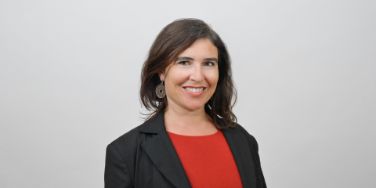
Ledwina Siegrist is a Lecturer and Project Manager at the Lucerne School of Social Work (Hochschule Luzern), affiliated with the Institute for Social Pedagogy and Social Policy. She coordinates the CAS Sexual Pedagogy program and teaches modules on communication, sexuality in social work, and disability studies. Professional Expertise: Sexual health education and counseling Gender studies and violence prevention Inclusive education for diverse relationships Disability and sexuality Youth sexual development
Domingo Valero is a Lecturer at the Lucerne School of Business within the Institute of Business and Regional Economics (IBR) at Lucerne University of Applied Sciences and Arts (HSLU). He holds expertise in Motivation Psychology, Work Values, and Psychological Testing. His research focuses on work motivation dynamics, cross-cultural studies in career development, and methodological innovations using latent profile analysis. Education: Studied Psychology and Economics at the University of Zurich. Conducted doctoral/postdoctoral work at the Chair of Industrial and Organizational Psychology in Lausanne and Bern, investigating adolescent career transitions and motivational indicators. Private-sector experience includes personnel assessment for cockpit crews at Swiss International Airlines. Teaching: Active in the Business Psychology program, specializing in statistical methods (Statistical Methods III/IV) and psychology courses. Research projects include Give me your Hand , DRECAL , and cross-cultural studies on work values. Recent work emphasizes cultural comparisons of entrepreneurial intentions and the impact of work rewards on values. His publications span prestigious journals like Journal of Vocational Behavior and European Journal of Work and Organizational Psychology .
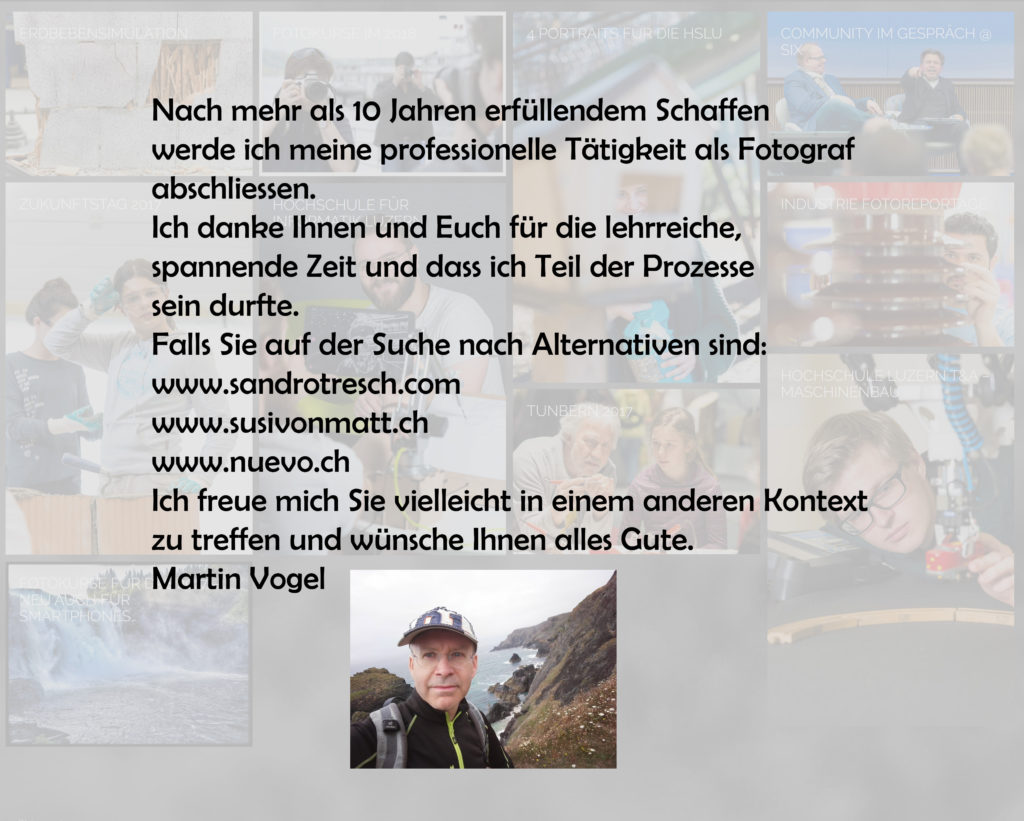
Martin Vogel is a part-time Lecturer at the Lucerne School of Computer Science and Information Technology (HSLU) since 2003. He holds a Master's degree in Electrical Engineering from ETH Zürich (1995). His academic role focuses on teaching subjects like Microcontroller Programming, Algorithms, and Computer Science fundamentals. Alongside his academic duties, he operates as a self-employed professional photographer, offering services for journalism, marketing, and portraits, including work for HSLU. Education: Master of Electrical Engineering, ETH Zürich (1995) Research & Professional Expertise: Vogel specializes in embedded systems, software/hardware development, and project management. His technical competencies include C/C++ programming, microprocessor technology, and Python scripting. His photography work complements his technical skills, with a focus on event, portrait, and architectural photography. Projects: He contributes to research initiatives such as the 'ITC - Big Data HSLU Cloud' and 'Autonomous Low-Cost Emissions Monitoring of Wood-Burning Stoves.' Teaching & Advising: No formal advisees are listed, but he instructs courses like 'PREN Project Module Product Development' and supervises bachelor theses. No grants are explicitly mentioned. Labs/Teams: Engaged in the HSLU's ITC projects, focusing on cloud computing and environmental monitoring systems.
Alexander Reinhold Werbik is a Lecturer at the Institute of Business and Regional Economics (IBR) at Lucerne University of Applied Sciences and Arts, within the Lucerne School of Business. His academic career includes roles at the German Academy of Science and Engineering (2015–2017) and extensive international consulting for IT ventures. He teaches MBA and executive programs focusing on entrepreneurship, innovation, and organizational transformation. Research interests emphasize digital-era economic systems, start-up ecosystems in peripheral regions, and the integration of artistic practices into entrepreneurial contexts. Key projects include Blockchain-based Innovation Governance (BIG) , DISCO , and Digitale Fitnessakte . His work bridges academia, policy, and entrepreneurship through cross-border collaborations. Recent publications explore Industry 4.0 strategies, venture capital's role in global expansion, and eco-innovation drivers. He has presented at forums like the ISPIM Innovation Symposium and the European Association of Work and Organizational Psychology (EAWOP). Guest edited the 2014 SCI Special Issue on Industry 4.0. Advising focuses on fostering entrepreneurial ecosystems and sustainable regional development. Engaged in initiatives like the Geneva & Fribourg Entrepreneurship Forum and the CINet Conference. Active in shaping policies for start-up ecosystems and digital economies worldwide.
Daphne Zeyen is a Lecturer at the Lucerne School of Business (HSLU), part of the Institute of Communication and Marketing (IKM) in the CC Marketing Management department. Her work focuses on enhancing communication competencies in German and French, as well as methodological training for business students. She has been affiliated with HSLU since 2008, contributing to academic programs and research initiatives. Zeyen holds a diverse educational background, including: Maîtrise in Lettres Modernes from the Université de Bourgogne (1996) Diplôme d'Etudes Approfondies in Lettres Modernes from Université de Paris XII and Ecole normale de Fontenay St. Cloud (2000) Certificates in Business Administration and Management from Fernuniversität Hagen (2006/2007) Certificates in Higher Education Didactics from Hochschule Luzern (2010 and 2016) Her research interests revolve around bilingual education, particularly in business contexts, and the integration of digital tools in language learning. She has led projects such as the LuVa initiative, a bilingual E-Learning collaboration with the Haute Ecole du Canton de Vaud, aiming to enhance multilingual competencies among students. Her work emphasizes practical applications of language pedagogy in professional settings. Zeyen has published peer-reviewed articles exploring bilingual education in business programs and the development of institutional tandem learning initiatives. Her work highlights the importance of multilingualism in academic and professional environments. In addition to her role at HSLU, Zeyen serves as a Lecturer at ZHAW (since February 2023), further extending her contribution to higher education in Switzerland. Zeyen focuses on curriculum development and didactic methods. While no formal advising roles are listed, her work engages students through innovative teaching projects and collaborative initiatives. Key collaborations include the LuVa project with the Haute Ecole du Canton de Vaud, emphasizing bilingual E-Learning solutions for business education.
Kai Kruthoff is a Lecturer at the Lucerne School of Business (Lucerne University of Applied Sciences and Arts) under the Institute of Business and Regional Economics (IBR SOM). He holds a Dr. oec. HSG from the University of St. Gallen and a Dipl.-Kfm. from Freie Universität Berlin. His professional roles include Senior CX Specialist at Bank Vontobel AG, Director at Stimmt AG, and Executive Director at Credit Suisse AG. He specializes in Digital Customer Management, Brand Experience Design, and Organizational Resilience. Education: PhD in Marketing Innovation Management (HSG), Dipl.-Kfm. (Berlin) Key Certifications: CAS in Learning & Teaching in Higher Education, Professional Banker Education His research focuses on Customer Experience Management (CEM), Digital CRM, and Crisis Resilience. Recent work emphasizes organizational adaptability and employee-driven brand advocacy. Projects include AI-driven business model innovation and crisis management strategies for SMEs. He has contributed to over 10 publications, including peer-reviewed articles on resilience and brand strategy. His teaching spans CAS Business Excellence programs and executive education in customer-centric leadership.
Julia Kuark is a Lecturer at the Lucerne School of Business within Lucerne University of Applied Sciences. Her career spans over 20 years in academic and organizational development roles, focusing on leadership models like TopSharing and intercultural communication. She holds a Doctorate from ETH Zürich and has taught at multiple Swiss institutions. Education highlights include a PhD from ETH Zürich (1996), graduate studies in Mechatronics at ETH Zürich (1988), and a Bachelor’s from Stanford University (1984). Professional certifications include coaching from Henley Business School and intercultural training from IKUD Seminars. Her research emphasizes organizational leadership, flexible work models, and gender equity in STEM. Notable works include defining TopSharing leadership frameworks and analyzing generational workforce dynamics. She leads JKK Consulting, specializing in organizational innovation and equity initiatives. Key achievements include the 'Top 10 Alumni Women Leaders' award from ETH Zurich (2025) and over 30 publications on leadership, diversity, and workplace flexibility. She regularly presents at international conferences on topics like intergenerational management and collaborative leadership.
Jeannette Küher is a Lecturer at the Lucerne School of Business (HSLU), part of the Institute of Business and Regional Economics IBR CC Management and Law. She holds a lic.iur. from the University of Fribourg and has extensive legal practice experience, including roles in cantonal courts and private legal practice. She joined HSLU in 1998 and specializes in labor law, social insurance law, and business legal frameworks. Education: 1988–1993: lic.iur. in Law, University of Fribourg 2007: Certificate in Higher Education Didactics, HSLU Research Interests: Focuses on legal doctrine, labor law complexities, and the intersection of employment policies with social insurance. Her work addresses modern challenges like hybrid work models, crowdwork, and parental leave regulations. Recent studies include analysis of multi-job employment legalities and recruitment digitalization trends. Key Contributions: Over 15 published works in legal and HR journals, including peer-reviewed articles on labor law and practical guides for Swiss employers. Active in shaping workplace compliance standards through case studies and policy critiques. Professional Experience: 1995–1996: Judicial roles at Zug Canton Court 1997: Prosecution work at Schwyz Criminal Court Long-term collaboration with legal practitioners like RA Hans Hess
Prof. Markus Degen is a Lecturer in medical computer sciences and Dean of the BSc programs in Medical Informatics and Medical Technology at the School of Life Sciences, FHNW University of Applied Sciences and Arts Northwestern Switzerland. He leads the Institute for Medical Engineering and Medical Informatics and oversees courses such as Introduction to Computer Science, Medical Information Systems, and student projects in medical technology. His research focuses on Clinical Information Systems, emphasizing the design and integration of clinical data processing systems. Recent work includes the RWD-Cockpit application for real-world data quality assessment and studies on aphasia diagnosis using speech analysis techniques. He collaborates with researchers in healthcare technology, radiology, and biomedical engineering. Key contributions include a strategic planning tool for hospitals and feasibility studies in orthopedic imaging. His interdisciplinary projects bridge clinical needs with technological solutions, addressing energy efficiency in radiology and mobile emergency decision support systems. Prof. Degen’s publications span medical informatics, neurology, and healthcare management. He actively supervises student research projects and maintains affiliations with institutions like the Institute for Medical Engineering and Medical Informatics in Muttenz.
Prof. Franz Barjak is a Professor for Empirical Social and Economic Research at FHNW's School of Business, leading the Doctoral Advisory Office. He holds a PhD from Ruhr University Bochum (2010) and a Geography diploma from Technical University Munich (1993). His expertise spans innovation policy, technology transfer, and regional economics, with extensive consulting for EU institutions and Swiss/German authorities. He teaches innovation studies and research methods across bachelor/master programs, including international management and entrepreneurship. Education PhD in Geography, Ruhr University Bochum, 2010 Diploma in Geography, Technical University Munich, 1993 Research Interests Barjak focuses on innovation ecosystems, university-industry collaboration, and science policy. His work examines knowledge transfer mechanisms, regional innovation systems, and the impact of digital infrastructure on research. Recent studies include evaluations of Swiss and Austrian space sectors, innovation decline trends in companies, and policy effectiveness in knowledge transfer. Grants & Projects He has led over 20 projects for EU DGs, Swiss authorities, and industry partners, including: Peer review of research programs (ZHAW, HSLU) Swiss Space Sector Survey (2015–2016) Austrian Space Sector Analysis (2022–2023) Innovation policy evaluations for SNSF and SERI Labs & Teams Based at the Institute for Competitiveness and Communication , he collaborates with global partners like ETH Zurich, UNU-MERIT, and the Swiss Space Office. His work emphasizes transnational research networks and policy-driven innovation assessments.
Adam Kurpisz is a Tenure Track Professor at Bern Business School (BFH) and a senior researcher at the Institute for Operations Research (IFOR) at ETH Zürich. He holds a PhD from Wrocław University of Science and Technology and has held postdoctoral and visiting researcher positions at IDSIA and the Max-Planck-Institut für Informatik. His research bridges theoretical computer science and applied optimization, focusing on combinatorial optimization, semi-algebraic proof systems, and robust optimization. He has secured over CHF 600,000 in grants, including leadership in the Ambizione Junior Research Group. His teaching spans convex optimization, polynomial optimization, and discrete mathematics at ETH Zürich and BFH. He co-founded startups Silencions and Deeptale, advancing to international competitions and securing EU grants. Research interests include leveraging algebraic geometry and Fourier analysis to develop algorithms for optimization problems. He has published extensively on sum-of-squares hierarchies, approximation algorithms, and scheduling under uncertainty. His work has been presented at venues like ISSAC, ICALP, and SIAM Conferences.
Professor Elzbieta Pustulka is a faculty member at FHNW University's School of Business, affiliated with the Institute for Business Informatics. Her research centers on databases, NLP, and AI-driven business process optimization. Research explores database pedagogy through gamification (SQL Scrolls), NoSQL implementations for ERPs, and automated information extraction techniques. Recent work emphasizes CI/CD practices in database development and educational game design for programming concepts. She supervises graduate students in projects spanning database indexing, logistics simulations, and AI-driven reporting systems. No scientific awards are noted.
Prof. Lucia Lanfranconi is a Professor at the Business School of Bern University of Applied Sciences, leading the Institute for New Work . Her research focuses on gender equality, social policy implementation, and welfare-to-work programs. She heads projects analyzing equal pay analyses under Swiss law and gender equality in social assistance, emphasizing intersectional perspectives. Her work intersects with global goals like poverty reduction (SDG 1), gender equality (SDG 5), and inequality reduction (SDG 10). Key projects include collaborations with UC Berkeley on racial and gender equity in social assistance, funded by the Swiss National Science Foundation (SNSF). She leads the Diversity, Equity & Inclusion research unit, addressing workplace equity and care work dynamics. Recent studies include analyses of pandemic impacts on gender disparities and policy reforms in Switzerland. Her advisory work includes supporting the Canton of Zurich’s equality plan development and studying LGBTQIA+ equality in Zurich. She actively bridges academic research with practical policy advice, emphasizing mixed-method approaches combining quantitative and qualitative data.
Beatriz Borges is a Researcher at the Natural Language Processing Laboratory (NLP) within the School of Computer and Communication Sciences (IINFCOM) at EPFL. Her work focuses on advancing AI and NLP, particularly in educational technology and language model development. She holds a dual status as an assistant-doctorante (PhD candidate/researcher) and doctoral student in the Computer Science and Communications Program. Her research explores topics such as AI's impact on education, feedback mechanisms for language models, and narrative generation. Borges' contributions include studies on humor detection, persona-based storytelling, and evaluating AI systems' capabilities in academic contexts. Her current affiliations include the Laboratoire de traitement du langage naturel (NLP Lab), where she contributes to cutting-edge NLP research. Her work bridges theoretical advancements in machine learning with practical applications in education and creative writing. She has published influential papers on AI ethics, language model training, and computational linguistics.
Nicolas Boumal is an Assistant Professor in Mathematics at EPFL, Switzerland, holding dual affiliations in the Continuous Optimization Chair (OPTIM) within the Institute of Mathematics (MATH) and the SMA Education Group. He leads research in optimization on Riemannian manifolds, non-convex optimization, and statistical estimation. His work bridges geometry, numerical analysis, and applications in cryo-electron microscopy and synchronization problems. Education: PhD in Mathematical Engineering from UCLouvain (2014), postdoctoral research at Inria Paris and Princeton University. Prior to EPFL, he was an Instructor and Assistant Professor at Princeton’s Mathematics Department. Research Interests : Non-convex optimization landscapes, optimization on manifolds, low-rank matrix optimization, synchronization, phase retrieval, and computational methods in cryo-EM. His ERC Starting Grant (GEOSYM, 2022–2027) focuses on geometric and symmetric optimization techniques. Grants & Awards : ERC Starting Grant (2021), SIAM Optimization Prize (2018 for student co-author), and several conference best paper awards. Teaching : Courses include Continuous Optimization (MATH-329), Algebra Linéaire (MATH-111), and graduate-level Optimization on Manifolds (MATH-512). He authored the textbook An Introduction to Optimization on Smooth Manifolds (Cambridge University Press, 2023). Labs & Teams : Heads the OPTIM lab at EPFL, collaborating with global researchers in optimization and applications. His group develops the Manopt toolbox for manifold optimization.