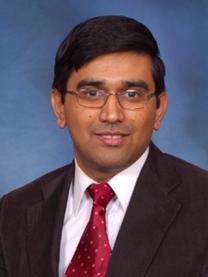
Dr. Manish Kumar is a Professor in the Department of Mechanical Engineering at the University of Cincinnati, leading the Cooperative Distributed Systems (CDS) Laboratory and the UAV MASTER Lab. He specializes in robotics, unmanned aerial systems (UAVs), and swarm systems, with a focus on decision-making, control in complex systems, and multi-sensor data fusion. His research has been supported by grants from the National Science Foundation, Department of Defense, and industry partners. Education: Ph.D. in Mechanical Engineering, Duke University (2004) M.S. in Mechanical Engineering, Duke University (2002) Research Interests: Dr. Kumar's work addresses challenges in autonomous systems, including UAV coordination, swarm robotics, and emergency response technologies. He integrates machine learning, control theory, and optimization to develop robust systems for applications such as wildfire management, telehealth, and industrial automation. Grants & Labs: Directed projects funded by federal agencies (NSF, DoD) and industry, totaling over $5M. Co-directs the Collaboratory for Medical Innovation and Implementation and the UAV MASTER Lab. Key Contributions: Pioneered algorithms for UAV path planning and swarm coordination. Developed PDE-based models for epidemic spread prediction and control.
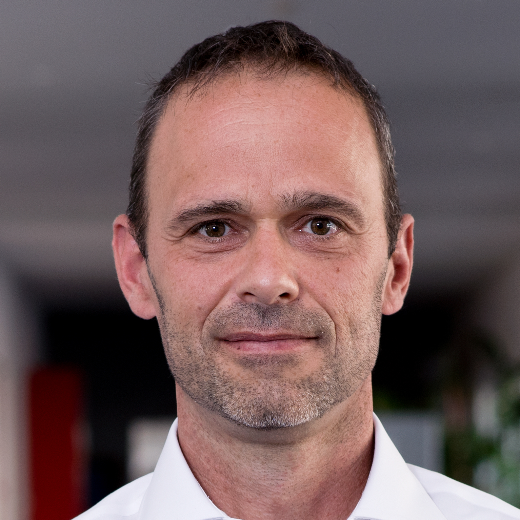
Andrew Markham is a Professor of Computer Science at the University of Oxford , affiliated with Kellogg College . He leads a research group focusing on Cyber Physical Systems (CPS) , specializing in sensors, signal processing, and machine learning to enable machines to better perceive the physical world. His work emphasizes cross-disciplinary collaboration, notably in wildlife tracking and indoor positioning systems. He has held roles as a Postdoctoral Fellow (2008-2012), Associate Professor (2013), and Full Professor (2021). Education : PhD in Electrical Engineering (University of Cape Town, 2008), BSc (Hons) in Electrical Engineering (2004). Research Interests : Tracking and localization in GPS-denied environments (e.g., underground, indoors), magneto-inductive systems, physics-informed machine learning, and data-driven approaches for noisy sensor data. His projects include wildlife monitoring via wireless sensor networks and mmWave radar for human motion capture. Key Projects : CARACAL acoustic monitoring system, mmPoint dense human tracking, and RandLA-Net for large-scale point cloud segmentation. His work spans robotics, environmental sensing, and biomedical applications. Advising & Grants : Supervises over 30 students and collaborates with industrial partners. Research teams include Cyber Physical Systems, Autonomous Ubiquitous Sensing, and Wildlife Monitoring initiatives. Labs/Teams : Leads the CPS research group, focusing on sensor networks, inertial navigation, and multimodal fusion systems. Collaborates with zoology and earth science disciplines on applied projects.
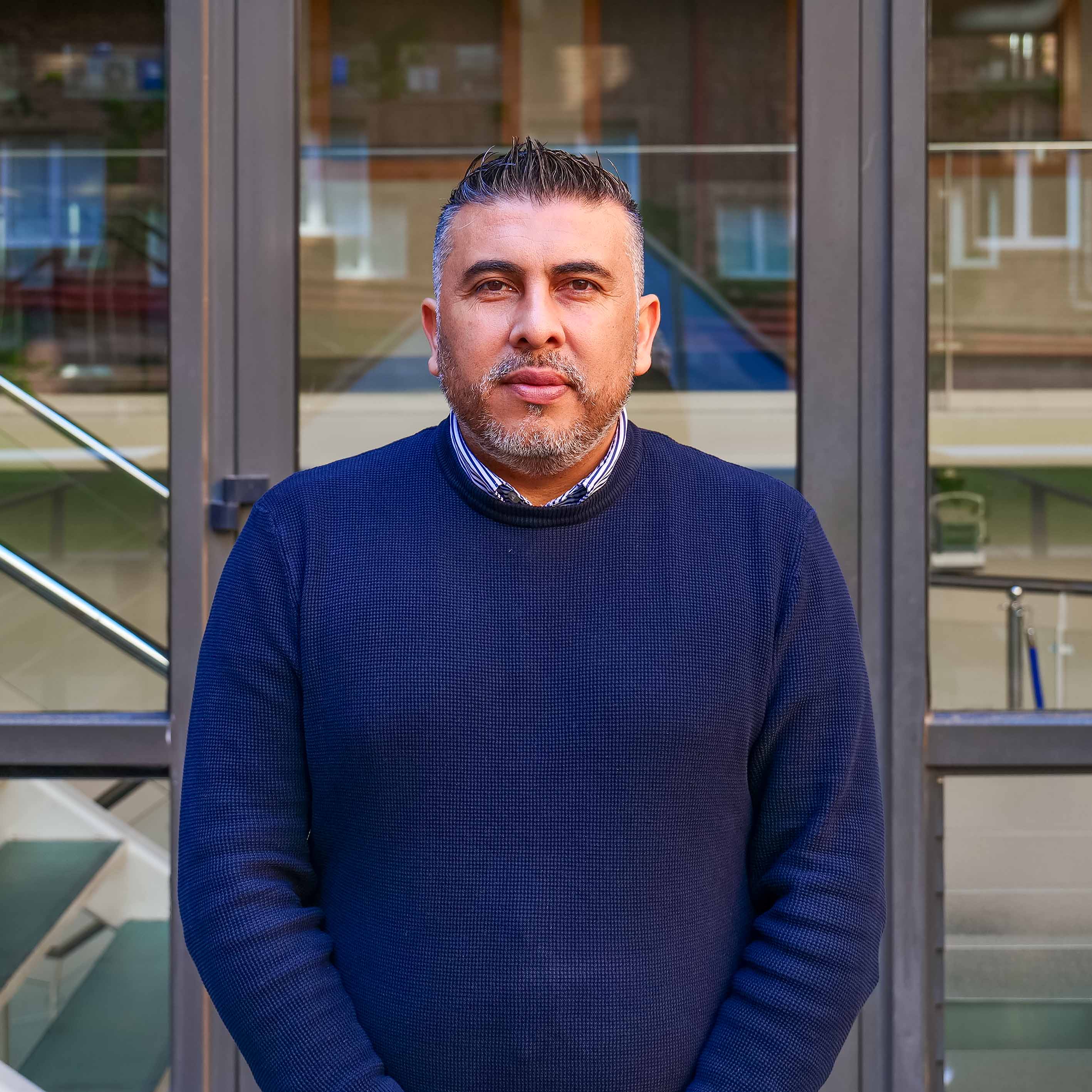
Horacio Rostro González is an Associate Professor in the Department of Industrial Engineering at IQS School of Engineering, Universitat Ramon Llull (URL), Barcelona, Spain. He is an active researcher with a strong international academic background and current affiliations in both research and teaching. Education: PhD in Control and Signal and Image Processing (2011, INRIA & University of Nice – Sophia Antipolis, France) Master’s in Electrical Engineering (2007, University of Guanajuato, Mexico) Electronic Engineer (2003, National Technological Institute of Mexico) His research interests lie at the intersection of Artificial Intelligence, Computational Neuroscience, Neuromorphic Computing, Embedded Systems, and Robotics. He applies advanced techniques in neural networks, machine learning, and control systems to solve complex engineering problems in robotics, biomedicine, and industrial design. His work emphasizes biomimetic approaches, such as spiking neural networks for robot locomotion and AI-driven analysis of physiological signals like ECG and facial expressions. The recent publications highlight a strong trend in interdisciplinary research, combining AI with photonics, robotics, cardiovascular diagnostics, and emotional recognition in children. His work spans from theoretical algorithm development to practical industrial applications, particularly in additive manufacturing and smart systems. Scientific Projects: Offshore Wind Farms: Data analysis using machine learning and power generation prediction (2023–2024) GEPI: Grup Enginyeria de Productes Industrials (2022–2025) He is actively involved in research grants and collaborative projects, with no mention of formal student advising in the provided text. He is a member of the GEPI (Industrial Products Engineering Group), which focuses on additive manufacturing, reverse engineering, and material characterization. His scientific output is robust, with consistent publication activity from 2005 to 2025, including numerous articles in indexed journals.
Professor Carl Edward Rasmussen is affiliated with the University of Cambridge , where he focuses on Machine Learning , Probabilistic Inference , Decision Making , and Reasoning Under Uncertainty . His work bridges theoretical advancements with practical applications in robotics, control systems, and computational biology. Academic Affiliation: University of Cambridge Academic Role: Professor His research emphasizes scalable Gaussian process methods, Bayesian system identification, and reinforcement learning. Recent projects include transfer learning for antibacterial discovery , graph neural processes for molecular functions , and efficient variational inference techniques . Key themes in his publications highlight uncertainty quantification , model generalization , and nonparametric approaches . Notable Scientific Contributions Advancements in sparse Gaussian process hyperparameter estimation Framework for Bayesian system identification in dynamic systems Hybrid models combining transformers and Gaussian processes
Oswald Lanz is a tenured full professor at the Faculty of Engineering of the Free University of Bozen-Bolzano , leading the Visual Computing Lab . He holds a Ph.D. in Computer Science and a Mathematics degree from the University of Trento. Prior to his current role, he was a researcher and head of research at FBK Trento. He is an endowed professor collaborating with Covision Lab , an AI hub in Bressanone, and coordinates the board of professors for the PhD in Computer Science program since 2025. His research focuses on Computer Vision, Deep Learning, and Video Analytics , with applications in sports technology, medical imaging, and industrial automation. Key achievements include the Amazon AWS Machine Learning Research Award (2020) , ACM Multimedia Best Paper (2015) , and Best Student Paper at ICIAP (2007) . He co-organized the ELLIS-VISMAC Winter School (2025) and chaired ICIAP 2019 . His work spans novel view synthesis, action recognition, and anomaly detection, supported by patents in video tracking and detection. He teaches courses like Deep Learning and Artificial Intelligence in undergraduate and graduate programs. Recent projects such as 5VREAL integrate 5G, edge computing, and AI for sports analysis. His collaborations bridge academia and industry, exemplified by his role in Covision Lab and multidisciplinary initiatives like DSS4LCO for food supply chains. Lanz’s publications emphasize spatiotemporal modeling, neural architecture search, and hybrid machine vision systems.
John Zelek is an Associate Professor in the Department of Systems Design Engineering at the University of Waterloo. He co-directs the VIP (Vision & Image Processing) lab and previously served as Associate Graduate Chair (2013-2017). He co-founded two startups: Tactile Sight (haptic navigation for disabled individuals) and Sweep3D (3D modeling technology). His research focuses on autonomous robotics, 3D scene understanding, infrastructure assessment, medical imaging, and sports analytics using AI/deep learning techniques. Education includes a BASc from Waterloo (1985), MASc from Ottawa (1989), and PhD from McGill (1996). He teaches courses like SYDE 283 (Physics), SYDE 572 (Pattern Recognition), and SYDE 675 (Pattern Recognition). Research interests span robotics, computer vision, anomaly detection, and SLAM. His work applies to infrastructure monitoring, sports analytics (hockey/pitcher analysis), medical imaging (OCT/fundus), and assistive technologies. Recent publications emphasize 3D modeling, SLAM enhancements, and sports tracking algorithms. Zelek advises graduate students (SSPS status) and collaborates with companies like Intelligent Health Solutions and EyeCheck through advisory roles. Key innovations include hybrid SLAM systems, puck localization algorithms, and medical robotic swab systems demonstrated on moving phantoms.
Marc Erich Latoschik is a Professor in the Department of Human-Computer Interaction at the University of Würzburg, Germany. He previously held roles at Bayreuth University, Bielefeld University, and FHTW Berlin. His research focuses on virtual and augmented reality, embodiment, human-computer interaction, and applications in health, education, and social systems. Education: Completed his PhD in 2001 at Bielefeld University with a thesis on multimodal interaction in virtual reality. Research Interests: Embodied interaction, virtual embodiment, presence and plausibility in VR/AR, avatar design, social virtual reality, health applications (e.g., VR therapy for body image issues), and XR security/privacy. Active in developing frameworks like Reality Stack I/O and MAIL for VR/AR research. Key Projects: ViTraS study on body image exercises in VR, avatars for mass use via smartphone reconstruction, and motion-based biometrics in XR. Collaborates with medical teams on cybersickness detection and emergency training simulations. Labs/Teams: Leads research groups on immersive technologies and social VR applications. Involved in interdisciplinary projects combining HCI, AI, and healthcare.
Chang S. (CS) Nam is a Professor of Industrial and Systems Engineering at North Carolina State University, with affiliations in the UNC/NCSU Joint Department of Biomedical Engineering and the Department of Psychology. He holds editorial roles as Editor-in-Chief of Brain-Computer Interfaces journal and is a Fellow of the Human Factors and Ergonomics Society. His research focuses on advancing human-centered technologies through neuroergonomics, brain-computer interfaces (BCIs), and rehabilitation engineering, supported by grants from NSF, AFRL, AFOSR, and the Laboratory for Analytic Sciences. Education: Ph.D. in Industrial Engineering, Virginia Tech (2003) MSIE in Industrial Engineering, State University of New York at Buffalo (2000) Research Interests: His work spans neurorehabilitation, haptic interaction design, and BCI applications, aiming to bridge human cognitive and neural processes with technological systems. Key areas include adaptive human-computer interaction, EEG-based emotion recognition, and spatial augmented reality for skill training. Grants & Awards: Recipient of NSF CAREER Award (2010), Air Force Summer Faculty Fellowship (2018), and the Leland S. Kollmorgen Spirit of Innovation Award (2019) Editor of Brain-Computer Interfaces Handbook: Technological and Theoretical Advances (CRC Press) Advising & Labs: Advises students like Lingchao Mao and Priscille Koutouan Leads the Brain-Computer Interface and Neuroergonomics Lab, developing BCI systems for communication in vegetative states and neurorehabilitation
Kim Jae-ho serves as Associate Professor in the Department of Electronic Information and Communication Engineering at Sejong University since September 2020, concurrently directing the Metaverse Autonomous Twin Research Center (ITRC) under the Ministry of Science and ICT. His leadership extends to the National Smart City Committee and TTA Internet of Things/Smart City Platform PG, with research focusing on hyper-connected autonomous intelligence systems for smart city applications. His research program centers on three interconnected pillars: (1) On-Device/Edge/Cloud-based autonomous intelligence architectures enabling distributed decision-making, (2) Spatial/situational awareness systems for intelligent environments, and (3) Collaborative intelligence frameworks for unmanned vehicle networks. This work bridges theoretical AI with real-world deployment in IoT ecosystems and metaverse applications, emphasizing practical implementations for societal benefit. Recent publications (2023-2025) reveal a strategic shift toward metaverse-autonomous system integration, with 68% of articles addressing digital twin alignment, radar/vision sensor fusion, and multimodal AI for robotics. Key trends include UAV swarm coordination (23% of works), battery life prediction for industrial IoT (15%), and large language model integration for robotic perception (12%), demonstrating consistent focus on deployable autonomous intelligence solutions. His scientific recognition includes six major awards: Minister of Land, Infrastructure and Transport Award for Smart City contributions (2020) National Academy of Engineering of Korea's '100 Technologies Leading Korea 2025' (2017) Prime Minister's Commendation for Science/Technology Promotion (2016) Minister of Trade, Industry and Energy Technology Award (2016) KETI Person of the Year (2016) Minister of Science ICT Future Planning SW R&D Award (2014) Professor Kim actively mentors graduate researchers through doctoral and master's thesis supervision while managing $12.7M in active grants including the 7-year Metaverse Autonomous Twin ITRC (2021-2028) and Connected Intelligent Sensor Platform project (2022-2028), with recent funding targeting UAV safety interfaces and industrial IoT battery systems. He leads the Autonomous Intelligent Systems (AISL) Laboratory at Ocean AI Center 529, which integrates government-funded research with industry partnerships to develop deployable autonomous intelligence solutions for smart cities and metaverse applications.
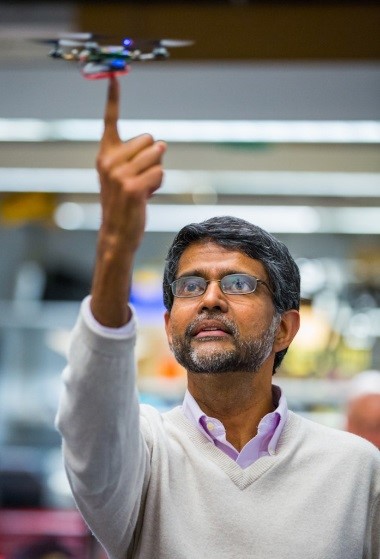
Vijay Kumar is the Nemirovsky Family Dean of Penn Engineering at the University of Pennsylvania, with faculty appointments in the Departments of Mechanical Engineering, Computer and Information Science, and Electrical and Systems Engineering. He is a leading figure in robotics and computer architecture research. Research Interests include robotics, particularly multi-robot systems and micro aerial vehicles (MAVs), as well as computer architecture innovations for machine learning, GPU acceleration, and datacenter efficiency. His work spans theoretical foundations and practical applications in autonomous systems and hardware optimization. Scientific Awards include: 1991 NSF Presidential Young Investigator Award 1996 Lindback Award for Distinguished Teaching 2012 ASME Mechanisms and Robotics Award 2014 Engelberger Robotics Award 2017 IEEE George Saridis Leadership Award Multiple best paper awards at DARS, ICRA, and RSS conferences Editorial Leadership includes serving as Editor of the ASME Journal of Mechanisms and Robotics and Advisory Board Member of AAAS Science Robotics Journal . His GRASP Lab team developed foundational frameworks for micro UAV testbeds and swarm robotics.
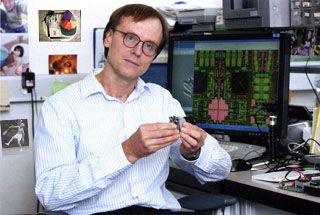
Tobi Delbruck is a titular professor of physics and electrical engineering at ETH Zurich, where he leads the Sensors Group at the Institute for Neuroinformatics (INI) in Zurich, Switzerland. He collaborates closely with Shih-Chii Liu and Giacomo Indiveri as part of the 'hardware groups' at INI. Delbruck has also served as visiting faculty at Caltech and is a Fellow of the IEEE. His work focuses on bio-inspired and neuromorphic event-based sensory processing systems. Professor Delbruck's research spans multiple areas of neuromorphic engineering, with particular emphasis on event-based vision systems and low-power analog VLSI circuits. His work has significantly advanced the field of Dynamic Vision Sensors (DVS), which mimic the human retina's response to changes in brightness rather than capturing full frames. This approach enables extremely low-latency vision processing with minimal power consumption, making it ideal for high-speed applications and robotics. His research has applications in robotics, autonomous systems, and low-power embedded vision. Delbruck is an active contributor to the neuromorphic engineering community, co-organizing the annual Telluride Workshop on Neuromorphic Engineering and serving in leadership roles with IEEE. He has authored numerous influential publications and co-authored books including "Event-Based Neuromorphic Systems" and "Analog VLSI: Circuits and Principles." His jAER (Java Address-Event Representation) project provides open-source tools for real-time event-based sensory processing. Analysis of his recent publications shows a clear trend toward integrating event-based vision with deep learning techniques and applying these systems to practical robotics problems. His scientific achievements have been recognized with multiple awards including: IEEE Fellow Winner of Best Live Demonstration award at ISCAS 2012 Honorable Mention Award from Sensory Systems Technical Committee at ISCAS 2012 Overall Best Student Paper Award and Best Paper Award from Sensory Systems Technical Committee at ISCAS 2010 Winner of the 2006 ISSCC Jan Van Vessem Outstanding European Paper Award Professor Delbruck actively mentors students and has supervised numerous PhD and Master's theses in the areas of neuromorphic engineering and event-based vision systems. His group has secured significant research funding from various sources to support their innovative work in bio-inspired sensory processing. He teaches courses on "Electronics for Physicists II (Digital)" and "Neuromorphic Engineering," helping to train the next generation of researchers in this field. The Sensors Group at INI, which Delbruck leads, operates state-of-the-art facilities for designing and testing neuromorphic vision systems. The group maintains close collaborations with researchers worldwide and has developed several important open-source resources including the jAER project and bias generator design kits. Their work continues to push the boundaries of what's possible with event-based sensory processing, with applications ranging from high-speed robotics to low-power embedded vision systems.
Jiajun Wu is an Assistant Professor of Computer Science and, by courtesy, of Psychology at Stanford University. He holds multiple affiliations including membership in Bio-X, Faculty Affiliate status at the Institute for Human-Centered Artificial Intelligence (HAI), and membership in both the Wu Tsai Human Performance Alliance and Wu Tsai Neurosciences Institute. Dr. Wu earned his Ph.D. and S.M. in Electrical Engineering and Computer Science from the Massachusetts Institute of Technology before joining Stanford. Dr. Wu's research program focuses on creating AI systems that understand and interact with the physical world through the integration of computer vision, machine learning, robotics, and cognitive science. His work emphasizes physics-based modeling combined with deep learning to develop systems capable of perceiving, reasoning about, and predicting physical interactions. Key research areas include 3D scene understanding, neurosymbolic AI approaches, multimodal perception (combining vision, sound, and language), and embodied intelligence for robotics applications. His lab develops novel frameworks that bridge the gap between neural networks and symbolic reasoning to create more interpretable and robust AI systems. Analysis of Dr. Wu's recent publications reveals a strong trajectory toward integrated multimodal understanding for embodied AI. His work increasingly combines vision, sound, and language processing with physical reasoning to create systems that can interact meaningfully with the physical world. There's a clear progression from foundational computer vision research toward practical robotics applications, with significant emphasis on foundation models for robotics, sim2real transfer techniques, and creating comprehensive datasets for embodied AI research. Dr. Wu's exceptional contributions have been recognized with numerous prestigious awards including the NSF CAREER award (2024), Young Investigator Programs from ONR (2024) and AFOSR (2023), the Okawa research grant (2024), and being named to IEEE Intelligent Systems' 'AI's 10 to Watch' (2024). He has received multiple best paper awards at leading conferences including ICRA (2024), SIGGRAPH Asia (2023), and CoRL (2023). Dr. Wu actively mentors a large cohort of students across multiple levels, serving as primary advisor for doctoral candidates, master's students, and numerous independent researchers. His research is supported by substantial funding from major technology companies including Google, Meta, Amazon, Samsung, and J.P. Morgan, as well as government agencies like NSF, ONR, and AFOSR, reflecting the significance and impact of his work in physical AI and multimodal perception systems. Dr. Wu leads a dynamic research group at Stanford that collaborates extensively with the Wu Tsai Neurosciences Institute and Institute for Human-Centered AI. Current projects include developing neurosymbolic models for computer graphics, creating multisensory datasets like OBJECTFOLDER 2.0 for sim2real transfer in robotics, and building foundation models for embodied intelligence that can understand and manipulate objects with human-like physical intuition.
Mats Danielsson is a Professor at KTH Royal Institute of Technology, leading the Medical Imaging research group within the Department of Particle Astrophysics and Medical Imaging. He has coordinated major projects like the ERC Advanced Grant for the Si3 project (starting 2024) and the EIC Pathfinder's 1MICRON project (starting 2025). His work focuses on advancing photon-counting detectors, X-ray technologies, and medical imaging systems. Notable recognitions include the 2024 KTH Innovation Award and the 2022 Hans Wigzell Science Prize. Danielsson has co-founded companies such as Sectra Mamea AB and C-RAD AB, and holds 135 patents with over 150 scientific publications. Education: MSc (1990) and PhD (1996) from KTH, followed by postdoctoral research at Lawrence Berkeley National Lab (1996–1998). He joined KTH in 1999, where he has held his current professorship since then. His research spans medical imaging, detector innovation, and radiation physics applications in healthcare. Research Interests: Development of high-resolution CT detectors, photon-counting technologies, compact X-ray sources, and AI-driven image processing. His recent work emphasizes minimizing radiation exposure while enhancing diagnostic precision through novel detector designs and machine learning algorithms. Key Projects: ERC Si3 project (3D detector for nuclear medicine), EIC 1MICRON (micrometer-scale imaging), and MedTechLabs collaboration with Karolinska Institutet. He has pioneered innovations such as MicroDose mammography and advanced photon-counting spectral CT systems. Awards: KTH Innovation Award (2024), Hans Wigzell Prize (2022), IVA membership (2017), Polhem finalist (2014), and INGVAR Award (2004). Advising & Grants: Over 150 scientific publications, 135 patents, and leadership in multi-institutional projects. Teaches courses on medical imaging and modern physics at KTH. Labs/Teams: Director of the Medical Imaging Group at KTH, co-founder of MedTechLabs, and collaborator across academia and industry in medical imaging innovation.
Surya Ganguli is an Associate Professor in the Department of Applied Physics at Stanford University, with courtesy appointments in Neurobiology and Electrical Engineering. He serves as Senior Fellow at the Stanford Institute for Human-Centered AI and is affiliated with the Stanford Neuroscience Institute , Bio-X , and Wu Tsai Neurosciences Institute . His research spans theoretical neuroscience, machine learning, and statistical mechanics. Ph.D. , UC Berkeley, Theoretical Physics (2004) M.A. , UC Berkeley, Physics (2000) M.A. , UC Berkeley, Mathematics (2004) M.Eng. , MIT, Electrical Engineering and Computer Science (1998) B.S. , MIT, Physics (1998) B.S. , MIT, Mathematics (1998) B.S. , MIT, Electrical Engineering and Computer Science (1998) His lab explores how higher-level cognitive phenomena emerge from neural network dynamics, focusing on perception, memory, attention, and decision-making . Research themes include statistical mechanics of learning , neural representational geometry , and biologically plausible learning rules . Current work examines nonlinear interactions in neural networks through the Schmidt Science Polymath Award (2023). Key article trends reveal expertise in neural coding limits (2022 Nature), synaptic plasticity models (2022 Neural Computation), and deep learning theory (2022 NeurIPS publications). His 2019 Annual Review chapter on statistical mechanics of deep learning established foundational insights into network criticality. Scientific Awards : NSF Career Award (2019) Simons Foundation Investigator (2016) McKnight Scholar Award (2015) James S. McDonnell Foundation Scholar (2014) Sloan Research Fellow (2013) As advisor, he mentors 10+ doctoral students across Applied Physics, Neurosciences, and Computer Science, including Vamshi Balanaga and Mason Kamb. His lab collaborates with experimental teams at Stanford and beyond, supported by grants from NSF , Simons Foundation , and Swartz Foundation . The Neural Dynamics & Computation Lab unites physicists, mathematicians, and neuroscientists to decode cognition through interdisciplinary methods.
Dr. Kevin Kochersberger is an Associate Professor in the Department of Mechanical Engineering at Virginia Tech , with a career spanning academic research, technical innovation, and educational leadership. His work focuses on autonomous aerial systems , robotic control , and applied aerodynamics , particularly through the Uncrewed Systems Laboratory . Kochersberger's research has pioneered UAV-based radiation detection , 3D terrain mapping , and low-resource drone applications , including establishing the African Drone and Data Academy in Malawi . Education: Ph.D., Mechanical Engineering, Virginia Tech (1994) M.S., Mechanical Engineering, Virginia Tech (1984) B.S., Mechanical Engineering, Virginia Tech (1983) A.S., Engineering Science, Jamestown Community College (1981) Kochersberger's publications demonstrate expertise in UAV path planning , smart material actuation , and radiation source localization , with over $9M in research funding. His scientific awards include AIAA Associate Fellow (2009) and Aviation Week Aerospace Laureate (2003). Notable projects involve helicopter-deployable robotic systems and urban canyon navigation without GPS. Recent articles highlight BVLOS drone simulators , 2.5D terrain mapping , and autonomous negative obstacle traversal , reflecting his focus on real-time adaptive control and heterogeneous robotic systems . He teaches Drone Technology and Flight Operations and Advanced Design Projects , emphasizing student-driven innovation and industry collaboration .