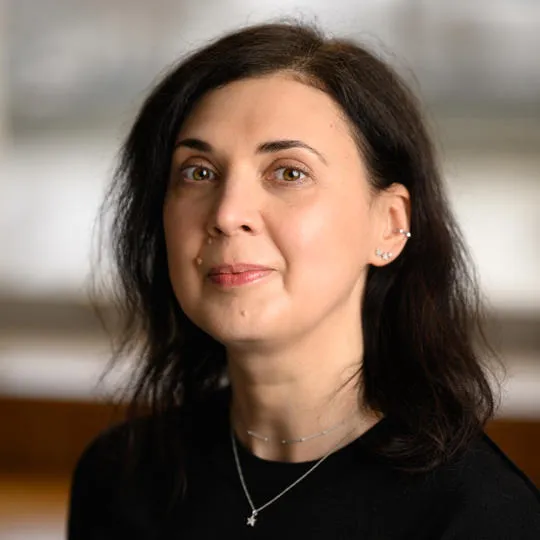
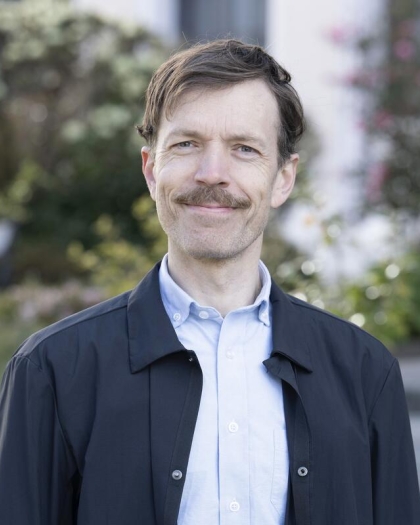
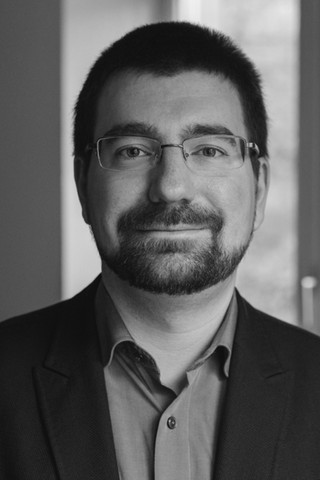
Dr Ana Cristina Vasconcelos is a Senior Lecturer in Corporate Information Management at the School of Information, Journalism and Communication, University of Sheffield. She holds a PhD from Sheffield Hallam University and has held academic roles at multiple institutions, including Leeds Metropolitan University and Sheffield Hallam University. Her research focuses on the intersection of knowledge management, information systems, and organizational adaptation. Education: BA in History, PGDip in Information Science (University of Lisbon), PhD in Information Systems (Sheffield Hallam University) Her research explores organizational learning, absorptive capacity, knowledge sharing, and boundary spanning practices, often applying theoretical frameworks like Arenas/Social Worlds Theory and Practice Theory. Funded by the European Community and AHRC, her work addresses challenges in information systems implementation and knowledge integration across sectors. Recent publications highlight trends in smart city datafication, interdisciplinary knowledge management, and virtual community dynamics. She supervises PhD students in areas spanning economic resilience to knowledge transfer in FinTech ecosystems. Teaching interests include qualitative research methods, organizational culture, and knowledge management systems. She has external examiner roles at multiple universities and serves on editorial boards for journals like Libri and the International Journal of Knowledge-Based Organizations.
Dr. Koen Leurs serves as an Associate Professor in Gender, Media and Migration Studies at the Graduate Gender Program, Department of Media and Culture Studies, Utrecht University, Netherlands. His research centers on digital migration studies, examining how digital technologies intersect with migration experiences, particularly focusing on gender dynamics, youth cultures, and datafication processes. Leurs has established himself as a leading scholar through influential publications including Digital Migration (Sage, 2023) and Doing Digital Migration Studies (Amsterdam University Press, 2024), with his current work focusing on Inclusive Media Education: Critical Media Literacies for Diverse Societies for Routledge. Leurs' research interests span migration studies, digital technology, gender, and youth cultures, with particular attention to how digital platforms shape migrant experiences. His work critically examines both the empowering potential and discriminatory aspects of digital technologies in migration contexts, investigating how migrants use digital tools to connect, resist, and create new forms of belonging while navigating surveillance, datafication, and border control systems. Recent projects have increasingly focused on the ethical implications of digital technologies in asylum procedures and migration management. His scholarly output reveals a consistent trajectory examining the intersection of migration, digital technology, and social justice. Leurs' work demonstrates growing attention to the material consequences of digital migration studies, particularly regarding mobile phone screening in asylum processes, the datafication of migration pathways, and how digital platforms shape the experiences of migrant women and domestic workers. His research combines theoretical innovation with practical engagement, often employing participatory methods that involve migrant communities in knowledge production. Principal Investigator for Co-designing a fair digital asylum procedure (2022-2023), funded by Digital Society program and COMMIT/ Principal Investigator for Young Connected Migrants (2016-2019), funded by Netherlands Organization for Scientific Research Principal Investigator for Media literacy through Making Media (2017-2019), funded by Dutch National Research Agenda Current member of Management Committee for COST Action DATA-MIG CA22135 on European Migration and Border Control Former chair of European Communication Research and Education Association (ECREA) Diaspora, Migration and the Media section (2016-2021) Leurs' research is situated within Utrecht University's strategic themes including Dynamics of Youth (DoY), Governing the Digital Society, and Institutions for Open Societies (IOS), with particular alignment with the IOS focus on Gender, Diversity and Global Justice. His collaborative work spans international institutions including the Chinese University of Hong Kong, National University of Singapore, Charles University, and University of Groningen, reflecting the transnational nature of his research on digital migration.
Dr Matthew Cole is an Assistant Professor in Technology, Work and Employment at the University of Sussex Business School. His research focuses on unpaid labour, technological change, and platform capitalism, with significant contributions to understanding wage theft and AI ethics in workplace contexts. He serves as a Co-investigator on the ESRC Digital Futures at Work Research Centre and is on the editorial board of Work, Employment and Society . PhD in Political Economy from the University of Leeds (2014–2018) Postdoctoral Research Fellow at the University of Oxford and University of Leeds His research explores the political economy of work and technology, emphasizing wage theft in hospitality, algorithmic exploitation, and regulatory frameworks for AI. His 15 most recent publications span debates on digital labor platforms, cloudwork, and the historical evolution of unpaid work. Scientific Awards Associate Fellow of the Higher Education Association Cole leads the masters-level module 'Managing Human Resources' and has developed courses on human-industrial relations. His work intersects with labor unions like the GMB and New York Taxi Workers Alliance, advocating for fair pay and transparency in digitalized labor markets. He is actively involved in public scholarship, contributing to outlets like Jacobin and Tribune, and co-authoring policy briefs for the ESRC Centre for Digital Futures at Work.
Claudia Aradau is Professor of International Politics at King's College London's Department of War Studies. Awarded the 2023 Distinguished Scholar Award by the International Studies Association, she leads the ERC project SECURITY FLOWS on digital border governance. Her research analyzes algorithmic governance, mass surveillance, and border security infrastructures. The monograph Algorithmic Reason (Oxford 2022) received the 2023 Best Book Award from ISA's STAIR section. Current work examines knowledge politics in asylum data systems and digital humanitarianism. Editorial roles include Radical Philosophy collective and Security Dialogue. Teaching covers 'Critical Security Studies' and 'Risk in Global Politics'. Laboratory resources include KingsCAT social media analysis toolkit.
Hallvard Moe is a Professor in Media Studies at the Department of Information and Media Studies , University of Bergen (UiB) , Norway. He is a leading researcher in media and democracy, public service media, and digital media use, leading the Media Use Group and the ERC-funded PREPARE project. He actively teaches and supervises students in media-related fields. His research focuses on the democratic role of media, particularly how public service media adapt to digital platforms, the impact of algorithms and datafication, and citizens’ news use during crises like the pandemic and climate change. He has extensively studied Nordic media systems, social media in political campaigns, and media policy across Europe. The 15 most recent publications highlight a consistent research trajectory centered on public connection, media trust, and digital transformation. Key themes include crisis news consumption, algorithmic perception, media welfare state critique, and evolving citizen roles in datafied societies. Methodologically, he employs qualitative and mixed methods, including diaries and cross-national comparisons. ERC Consolidator Grant (2022) for the PREPARE project Member of the Norwegian Broadcasting Council Member of the Media Diversity Committee (2015–2017) He supervises master’s and PhD students and leads multiple research projects funded by the Research Council of Norway and the European Research Council. He is a frequent contributor to public discourse through lectures, reports, and media appearances, including the Reuters Institute Digital News Report. He is affiliated with research groups such as the Bergen Media Use Research Group and MediaFutures: Research Center for Responsible Media Technology & Innovation , where he contributes to interdisciplinary work on responsible media innovation.
Robert Clements is an Assistant Professor in the Master of Science in Data Science (MSDS) program at the University of San Francisco (USF) and serves as Director of the Center for AI and Data Ethics. After nearly ten years in industry as a data scientist and senior director of data science across Bay-Area companies including Optum, Walmart Labs, UnitedHealthcare, GE Digital, and Verisk Analytics, he returned to academia to focus on education and ethical issues surrounding AI and data. Education PhD in Statistics, University of California, Los Angeles, 2011 MS in Statistics, University of California, Los Angeles, 2009 BA in Mathematics, Humboldt State University, 2006 Research Interests Dr. Clements focuses on data science education , exploring innovative pedagogies that equip students with practical and ethical data skills. He studies the societal impacts of AI and datafication , seeking frameworks to ensure responsible deployment of machine-learning systems. Additional interests include MLOps (the engineering practices that support reliable machine-learning workflows) and applied statistics across diverse domains. His peer-reviewed work to date concentrates on statistical seismology, where he developed advanced residual-analysis and model-evaluation techniques for earthquake-forecast models. These contributions provide rigorous methods for assessing space-time point processes and improve the reliability of seismic hazard assessments. Academic & Professional Service As Director of the Center for AI and Data Ethics, Dr. Clements leads initiatives that create open educational resources, case studies, and student practicum projects centered on ethical AI. He co-hosts the USF Data Science Podcast alongside faculty colleague Cody Carroll, offering guidance to prospective and current MSDS students on program insights, learning strategies, and career development.
Higher School of Economic and Commercial SciencesFrance
Cristina Alaimo is an Associate Professor at ESSEC Business School in France, specializing in Information Systems, Data Analytics, and Operations. She holds a PhD in Management, Information Systems, and Innovation from the London School of Economics (LSE). Her research focuses on data-driven innovation, platform ecosystems, and the societal impact of digital technologies. She has held academic positions at LUISS University (Italy) and the University of Surrey (UK). Alaimo’s work explores the transformation of organizational practices through data objects and algorithmic systems, with publications in leading journals like Organization Science and Journal of Management Information Systems . She co-authored the book *Data Rules: Reinventing the Market Economy* (MIT Press, 2024). Her editorial roles include Senior Editor at Organization Studies and European Journal of Information Systems . She also serves as a visiting fellow at Surrey Business School’s Centre for the Digital Economy. Her research interests span data governance, digital platforms, and the reconfiguration of fields through data-driven practices. Recent work addresses AI’s impact on organizational knowledge and regulatory challenges in digital ecosystems. She advises on PhD theses exploring AI’s societal implications and environmental sustainability strategies.
German National Library of Science and TechnologyGermany
Mayra Russo is an Early Stage Researcher in the Marie Skłodowska-Curie ITN NoBIAS and a research assistant at L3S Research Center. She works in the Scientific Data Management research group at TIB while pursuing her Ph.D. in Computer Science at Leibniz Universität Hannover. Her educational background includes a Master's degree in Data Science and a Bachelor's in Accounting and Finance from the University of Valencia in Spain. This interdisciplinary foundation informs her unique approach to research at the intersection of technology, ethics and social impact. Mayra's research focuses on algorithmic bias and harm, with broader concerns about ethical implications of datafication. Her current work develops bias-centric documentation frameworks for machine learning systems using ontologies and semantic web technologies. This research is funded by the European Union's Horizon 2020 programme under grant agreement no. 860630, highlighting its significance in addressing critical challenges in AI development. Her primary research domains include: Algorithmic Bias identification and mitigation Ethical frameworks for AI development Documentation standards for machine learning pipelines Semantic technologies for bias representation Social impact assessment of datafication processes Responsible innovation in AI systems As part of the Marie Curie training network, Mayra contributes to interdisciplinary research addressing bias in artificial intelligence, with implications for fairer and more transparent AI systems across various application domains. Contact information: Email: mayra.botero@tib.eu Postal address: Welfengarten 1 B, 30167 Hannover Visitor address: Lange Laube 28, 30159 Hannover
Tom DE LEYN is a Tenure Track Assistant Professor at Hasselt University's School of Social Sciences, where he contributes to the Capacity group Social Sciences and the Research group Research for Digitalisation, Diversity and Democracy. His work bridges media studies, sociology, and digital anthropology with a focus on youth experiences in technology-mediated environments. Based at Campus Hasselt in the Faculty of Law building, he actively engages in interdisciplinary research examining the societal implications of digital transformation. His research centers on Digital Media, Media and Communication, and the Sociology of Youth, with particular emphasis on Privacy and Surveillance dynamics across diverse cultural contexts. He investigates how children, adolescents, and ethno-religious minorities navigate digital spaces, parental mediation, and mobile technologies through qualitative and ethnographic approaches. Key themes include digital disconnection practices, intimate surveillance, and the socio-cultural construction of technology use, often comparing Global North and South contexts like Belgium and Liberia. Recent publications (2024-2025) reveal a cohesive trajectory examining digital harms assessment scales, children's perspectives on surveillance, and the paradoxes of digital disconnection policies. His work consistently employs innovative methodologies like the 360° interview technique while addressing critical gaps in understanding racial, gendered, and age-based digital inequalities. This scholarship demonstrates strong thematic continuity across media sociology, youth studies, and critical technology assessment. No scientific awards were mentioned in available sources. Tom DE LEYN actively contributes to academic training as a coordinating lecturer for courses including Media and Communication Studies I, Digital Media and Civil Society, and Qualitative Research Methods. He currently leads the 'Environmental analysis digital skills' research project (2025) focused on community service learning contexts, demonstrating practical engagement with digital inclusion initiatives. Within Hasselt University's research ecosystem, he operates through the Research group Research for Digitalisation, Diversity and Democracy, which examines technology's societal impacts through lenses of diversity, democratic processes, and digital transformation. This affiliation positions his work at the intersection of theoretical innovation and real-world policy relevance, particularly regarding youth digital rights and inclusive technology design.
Trine Rask Nielsen is a researcher at the Department of Computer Science , University of Copenhagen , affiliated with the Human-Centred Computing section and the Confronting Data Co-lab . Her work bridges Computer-Supported Cooperative Work (CSCW) and Critical Data Studies , focusing on how data shapes asylum decision-making practices. Research Interests: Ethnographic analysis of data practices in asylum systems, digital governance, refugee agency, and ethical prototyping. Awards: 2023 David B. Martin Award 2020 award for fictional app design Collaborations: Works with cross-disciplinary teams and external partners in Denmark and internationally. Her publications examine datafication processes, algorithmic transparency, and participatory approaches in asylum casework, emphasizing ethnographic insights and critical design interventions.
Emilia Palonen is an Associate Professor in Political Science at the University of Helsinki, Faculty of Social Sciences. She currently serves as Datafication Research Director at the Helsinki Institute for Social Sciences and Humanities (HSSH) and leads the Helsinki Hub on Emotions, Populism and Polarisation (HEPP) research group. Her academic career spans over 15 years with expertise in interpretive and discoursive approaches to comparative political analysis. Her research focuses on: Populism and democratic governance Political polarization and communication European identity through cultural policy Hungarian and Finnish comparative politics Urban memoryscapes and symbolic politics Radicalization and de-radicalization processes Palonen's recent scholarly work analyzes political developments in Finland, particularly regarding right-wing populism, European Parliament elections, and the impact of social media on political communication. Her research employs discourse theoretical methods and examines political phenomena through both historical and contemporary lenses. She has led multiple large-scale research projects including Whirl of Knowledge (WhiKnow) and Now-Time, Us-Space, which investigate knowledge production and community-building in hybrid media systems across Europe. Her scientific recognition includes being among the top 12 designs out of 1400 in the 'A new symbol for Europe' design competition (2010) and receiving the Dosentti (Adjunct Professor) title in Political Science with specialization in Cultural Policy Research (2016). Palonen actively contributes to academic leadership as Executive Committee member of the International Political Science Association (IPSA), former Chair of the Finnish Political Science Association (2018-2022), and board member of the Finnish Federation of Learned Societies. She has supervised seven PhD theses and currently mentors several doctoral students working on topics including academic capitalism, celebrity politics, and populism in Central and Eastern Europe. Her research team HEPP includes a dozen active researchers, and she has organized multiple international conferences on emotions, populism, and polarization. She is also a recognized media figure who provides expert commentary on political developments in Finland and Europe.
Kathryn Cassidy is a Professor in the Department of Geography and Environmental Sciences at Northumbria University. Her research focuses on political geography, bordering processes, and everyday geopolitics. She holds a PhD in Social Anthropology from the University of Birmingham, with research on Ukrainian-Romanian borderland communities. She has held academic positions at Queen Mary, University of London, and the University of Babes-Bolyai, Romania. Her current work includes a Senior Fellowship with the ESRC's UK in a Changing Europe initiative (2022-2025), analyzing responses to the Ukrainian refugee crisis in Poland, Romania, and the UK. Previous projects include Leverhulme Trust-funded research on dis/order in critical border studies, examining bordering practices in UK healthcare, higher education, and social security. Key research interests include abolitionism, institutional geographies, and the socio-political impacts of bordering. She has contributed to UN Sustainable Development Goals through her work on migration, healthcare, and social inclusion. Awards include the 2019 SAGE Prize for Innovation in Sociology. Her projects and publications explore themes like carceral geographies, refugee policies, and everyday bordering in public institutions. She supervises PhD students in political geography and collaborates internationally on migration and border studies.
Lai Ma is Associate Professor at the School of Information and Communication Studies, University College Dublin (UCD), where she also serves as Director of Research (2022–2025) and previously directed the MLIS and GradDipLIS programmes. She holds a PhD in Information Science from Indiana University Bloomington and a BSc(Econ) from The Chinese University of Hong Kong. Her work bridges philosophy, information science, and science policy. PhD, Information Science, Indiana University Bloomington MLIS, Indiana University Bloomington BSc(Econ), The Chinese University of Hong Kong Her research centers on the epistemology of information and knowledge production, with a focus on open research, scholarly communication, research evaluation, and research infrastructure. Influenced by critical social theory, philosophy of language, and STS, she investigates issues of epistemic injustice, bibliodiversity, and the political economy of academic publishing. A major theme is the critique of metrics and platformisation in research. Her recent publications reveal a strong trend toward analyzing the structural inequalities in global knowledge production, especially through the lens of open access models, citation practices, and research assessment. She critically examines how commercial interests and dominant platforms shape what counts as knowledge, often marginalizing voices from the global periphery. Best Paper Meta Reviewer Award Teaching Excellence Award Best Paper Reviewer Award Lai Ma leads the ERC Consolidator Grant project Sustainable and Collaborative Research Information for Bibliodiverse Ecosystems (SCRiBe) (2025–2030) and has secured other grants on open research culture. She actively mentors PhD students and has coordinated key modules such as Digital Libraries , Scholarly Communication , and Research and Practice in LIS . She serves on editorial boards and review panels for major journals and funding bodies, and has held leadership roles in ASIS&T and the Library Association of Ireland. She is affiliated with the UCD Geary Institute for Public Policy and contributes to policy discussions on research evaluation, ethics, and open science. Her work emphasizes the need for community-governed, equitable, and sustainable research infrastructures.
Stephan Packard is a Professor for Cultures and Theories of Popularity at the Institute for Media Culture and Theatre at the University of Cologne, where he has held a full professorship since 2017. Previously, he served as Junior Professor for Media Cultural Studies at Albert Ludwig University of Freiburg (2010-2017) and was repeatedly an acting professor for Cultures and Theories of Popularity at the University of Cologne (2015-2017). His research focuses on media control (including censorship, surveillance, and propaganda), popular visual cultures with particular emphasis on comics research, and the complex relationships between factuality, fictionality, and virtuality. As a media semiotician and discourse analyst, Packard examines how meaning is constructed across different media forms and how power operates through media systems. Packard's scholarly output shows a clear trend toward examining the intersections of comics studies with broader media theory, political philosophy, and critical social analysis. His recent publications increasingly address digital sovereignty, algorithmic control, and the transformation of media landscapes in the digital age, while maintaining his foundational work in comics theory and media semiotics. His research connects historical analysis of media forms with contemporary concerns about digital media power structures. Heinz Maier-Leibnitz Prize of the German Research Foundation (2015) Packard leads several significant research projects including the OER-Verbundprojekt 'Comicforschung.nrw,' 'The Adventure as a Popular Nomad: Transformations of Adventure Narratives in Comics,' and the 'Glossary of Digital Sovereignty.' He is actively involved in multiple academic networks including the Global South Studies Center (since 2025), the Key Profile Area Skills and Structures in Language and Cognition (since 2024), and was the first chairman of the Society for Comics Research (ComFor) from 2013-2019. His work bridges theoretical media studies with practical concerns about digital citizenship and media literacy in contemporary society.
Dr. Robert Prey is an Associate Professor of Digital Culture at the Oxford Internet Institute (OII) and a Research Fellow at Green Templeton College, University of Oxford. His research focuses on the intersections of technology, capitalism, and culture, particularly examining algorithmic systems, datafication, and platformization's impact on cultural industries and creative labor. He leads the ERC-funded 'PlatforMuse' project (2023-2028), investigating how streaming platforms shape musicians' creative practices globally. Previously, he held positions at the University of Groningen and completed his PhD at Simon Fraser University. His work has been supported by grants from the Academy of Korean Studies, Brazil's National Council for Scientific and Technological Development, and the European Research Council. Education: PhD from Simon Fraser University (Canada), affiliated with the Transnational Culture and Digital Technology Lab. Current teaching includes a course on Digital Ethnography. Research interests span digital economy, cultural work, music industries, and critical theory. He actively collaborates on international projects, including algorithmic mediation studies in Brazil and platformization of music in Nigeria and South Korea. Key projects include analyzing musician adaptation to online platforms, voice biometrics' identity frameworks, and global platform models. His publications address algorithmic power dynamics, datafication in music, and the political economy of digital capitalism. He maintains affiliations with academic networks and serves as a doctoral supervisor on topics like platform capitalism and digital labor.