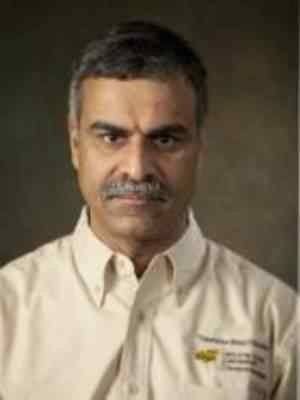
Prakash Ramanan is a Professor at the School of Computing within the College of Engineering at Wichita State University. His research focuses on algorithms, distributed computing, database systems, and XML processing. He holds an office at 208 Jabara Hall on the university's main campus. His academic interests include parallel algorithms, MapReduce frameworks, computational complexity, and query processing in XML databases. His work spans theoretical algorithm analysis to practical implementations in distributed systems. Ramanan's publications emphasize algorithmic efficiency, lower bounds analysis, and optimization techniques. His recent work addresses MapReduce-based matrix multiplication and XPath query evaluation over XML streams. Earlier contributions include foundational studies on tree patterns, join operations, and parallel computing. No scientific awards or grants are explicitly listed in the provided information. He currently advises no listed students or supervisees. His research activities involve collaborations in distributed systems and database query optimization.
Moritz Staudinger is a PreDoc Researcher at the Data Science department of Technische Universität Wien . His research focuses on reproducibility in machine learning and information retrieval, with particular emphasis on query generation, data citation, and evolving database schemas. Current projects: FAIR-AI (2024–2026) , HumRec (2021–2025) , and DoSSIER (2019–2024) Collaborations: Works with Andreas Hanbury , Andreas Rauber, and others Research interests include large language models for scientific applications, temporal information retrieval, and FAIR data principles. His recent publications examine reproducibility challenges across machine learning, systematic literature reviews, and environmental data management. Supervisions : Mentors students working on topics like data sovereignty, multilingual fact-checking, and quality indicators for data management plans. Collaborates on the DBRepo semantic repository framework.
Maxime Jakubowski is a PostDoc Researcher at TU Wien's Faculty of Informatics, affiliated with the Databases and Artificial Intelligence research group. Based in Room HA0320 at Favoritenstrasse 9, he can be contacted at maxime.jakubowski@tuwien.ac.at and maintains an ORCID profile (0000-0002-7420-1337). His research centers on graph data management within the Semantic Web ecosystem, specializing in RDF validation through shape constraint languages like SHACL and ShEx. He investigates formal foundations, expressiveness boundaries, and practical implementations including SQL compilation and neighborhood-based graph description. Current projects include FRESH (2021–2026), KtoAPP (2018–2025), and TARGET (2024–2028), focusing on graph data theory and implementation. Recent publications (2021–2025) demonstrate consistent contributions to RDF validation standards, with 14 articles addressing shape language formalization, compilation techniques, and provenance tracking. His work bridges theoretical database concepts with industrial applications in knowledge graph validation. Dr. Jakubowski supervises bachelor theses and teaches courses including Management of Graph Data (192.161) and Project in Computer Science. His research collaborations span international projects and the Dagstuhl Seminar 24102 on Shapes in Graph Data. He is an active member of the Databases and Artificial Intelligence research group, contributing to TU Wien's leadership in graph data management and Semantic Web technologies through both theoretical research and practical tool development.
Peter Barclay is a Lecturer in the School of Computing Engineering and the Built Environment at Edinburgh Napier University. His research focuses on database systems, human-computer interaction, and the ethical implications of artificial intelligence.
Manuel Wimmer is a Professor affiliated with the Department of Business Informatics at TU Wien's Faculty of Informatics. His main research area is Model-Driven Engineering , focusing on topics such as AutomationML, Cyber-Physical Systems (CPS), and industrial standards like IEC 62264 and ISA-95. He leads the Network Lab and contributes to interdisciplinary projects involving robotics, cloud computing, and blockchain applications. Research Interests: Model Transformation, Tool Interoperability, Industrial Automation, Educational Methodologies in Software Engineering. Key Technologies: UML, ATL, OPC UA, AutomationQL. Recent work emphasizes bridging metamodeling platforms (e.g., ADOxx/EMF integration) and adapting robotic mission planning systems. He has published extensively in workshops like MDE 2023 and conferences on model-driven engineering. Teaching activities include remote-learning strategies for software engineering education, as documented in his 2021 paper. No explicit awards are listed, but his contributions to standards like AutomationML reflect industry recognition.
Carles Farré Tost is an Associate Professor at the Universitat Politècnica de Catalunya (UPC), affiliated with the Facultat d'Informàtica de Barcelona (FIB) and the Departament d'Enginyeria de Serveis i Sistemes d'Informació. He leads research in software engineering, data engineering, and information systems through the inSSIDE and GESSI groups. His work focuses on agile methodologies, software quality, data-driven decision-making, and green AI. With over 92 professional activities, including 39 conference presentations and 17 competitive R&D projects, he has contributed to tools like QaSD and GLiDE for education and industry. Notable awards include the Best Forum Paper Award at RCIS 2023 and the Best Paper Award at CIbSE 2021. His research spans decades, from foundational database query validation (CQC method) to modern applications in gamified learning dashboards and sustainability in AI. Research Interests: Software Engineering: Agile development, quality assurance, and team-based project management Data Engineering: Schema validation, data-driven decision-making frameworks, and API design Green AI: Investigating environmental impacts and ethical considerations in AI systems Educational Technology: Tools for learning analytics and collaborative software education Grants & Projects: "Human-centred collaborative framework for accelerating software development" (2024) "Transición hacia sistemas de software verdes basados en IA" (2023) "Digital and Emerging Technologies for Competitiveness" (EU-funded, 2021) Lab/Teams: Active contributor to the inSSIDE (integrated Software, Services, Information and Data Engineering) and GESSI (Group of Software and Service Engineering) research groups at UPC.
Jaume Baixeries i Juvillà is a Professor in the Department of Computer Science at the Universitat Politècnica de Catalunya (UPC), affiliated with the Escola Politècnica Superior d'Enginyeria de Vilanova i la Geltrú (EPSEVG). He is a core member of the LQMC research group (Lingüística Quantitativa, Matemàtica i Computacional) and has been involved in over 70 academic activities since 2000. His work bridges formal concept analysis, computational linguistics, and data mining, with a focus on dependency structures, quantitative linguistics, and algorithmic methods. Affiliations: LQMC Group, Department of Computer Science (UPC), EPSEVG. Education: PhD in Computer Science (2005, UPC thesis on lattice representations of dependencies). His research interests include formal concept analysis (FCA), dependency modeling, computational linguistics, and applications in quantitative linguistics such as semantic analysis, polysemy studies, and bilingual aphasia analysis. His recent work explores semanticity measures, statistical learning, and clinical applications in language disorders. He has led or participated in projects funded by Spanish and Catalan research programs, including grants focusing on linguistic complexity and interdisciplinary data analysis. He actively contributes to conferences like Formal Concept Analysis (FCA) and International Quantitative Linguistics Conferences, serving on program committees. His publications span journals in computer science (e.g., International Journal of Approximate Reasoning ), linguistics ( Languages ), and interdisciplinary fields ( Computers in Biology and Medicine ). His work on dependency covers, FCA-based algorithms, and language universals (e.g., Zipf’s laws) demonstrates cross-disciplinary impact. Grants & Projects: Includes leadership in projects like ‘Lingüística Quantitativa, Matemàtica i Computacional’ and ‘Semàntica de les paraules del català: teoria i aplicacions clíniques,’ focusing on Catalan language studies and clinical applications. Collaborates with researchers in linguistics, computer science, and medicine. Labs/Teams: Co-leads the LQMC group, which integrates quantitative methods, formal mathematics, and computational tools to study language and data patterns.
Carlo Curino is a researcher at Microsoft Research , focusing on database systems, cloud computing, and machine learning integration. He has collaborated extensively with institutions including MIT, Microsoft, and the University of Wisconsin-Madison. His research spans Geo-distributed data analytics Automated configuration tuning Tensor-based database systems Data lake optimization Spark performance engineering Recent publications highlight his work on AI-driven systems like MotherNet and Rockhopper , alongside contributions to query processing over compressed data and log-structured tables. Collaborators include prominent figures such as Raghu Ramakrishnan and Jesús Camacho-Rodríguez . Key projects involve LST-Bench (cloud storage benchmarking), AutoComp (data compaction), and PyFroid (commodity workstation analytics). His work bridges database optimization with modern machine learning demands in enterprise environments.
Cédric Lammari is a Researcher at the CEDRIC Laboratory of the Conservatoire National des Arts et Métiers (CNAM) . His work spans Cybersecurity , Healthcare Systems Protection , and Information Systems Engineering . Key research themes include Cyber-Physical Security , Ontology Development , and Data Anonymization . Notable contributions: Security Ontology for Healthcare Systems , Threat Analysis Frameworks , and Reverse Engineering for Generalization Hierarchies . Recent publications focus on cybersecurity remediation , attack scenario formalization , and data privacy frameworks . Collaborative work includes threat propagation modeling and semantic-based security analysis .
Jose Baltasar Garcia Perez Schofield is a full-time Professor in the Department of Computer Science at the Higher School of Computer Engineering, University of Vigo. His research focuses on schema evolution, data persistence, and performance optimization in container-based models. Education : PhD from University of Vigo (2002) with thesis on "Persistencia, evolución del esquema y rendimiento en el modelo basado en contenedores" Affiliation : Member of LIA2 Applied Artificial Intelligence Laboratory Contact : jbgarcia@uvigo.es
Nicolas HIOT is a Post-doctoral fellow at the University of Orleans affiliated with the LIFO laboratory (Laboratoire d'Informatique Fondamentale d'Orléans) and the Pamda project. His research bridges database systems, natural language processing, and medical informatics with a focus on text-to-database integration and consistency maintenance. His research interests center on: Database Systems for medical applications with emphasis on consistency and evolution Natural Language Processing for clinical text analysis and relation extraction Knowledge Graph construction from unstructured textual data Medical Informatics applications for healthcare data management Analysis of his 15 most recent publications (2020-2024) reveals a cohesive research trajectory at the intersection of databases and NLP. Key thematic clusters include automated medical database construction from clinical texts, consistency management in evolving RDF/property graph systems, and clinical entity/relation extraction for knowledge graphs. His work consistently addresses real-world challenges in healthcare data integration through tools like DataFix and ArchiTXT, demonstrating strong translational potential. Nicolas HIOT actively contributes to the LIFO research laboratory at the University of Orleans, collaborating extensively with Jacques CHABIN, Mirian HALFELD-FERRARI, and Dominique LAURENT. His technical output includes multiple software systems for database evolution management and clinical text processing, reflecting both theoretical contributions and practical implementations in semantic data management.
Maurizio Lenzerini is a Full Professor at the Department of Computer, Control and Management Engineering Antonio Ruberti , Sapienza University of Rome. He is a leading international expert in Ontology-Based Data Management , Description Logics , and Data Integration , with foundational contributions to Semantic Web technologies and service composition. ACM Fellow (2009) AAAI Fellow (2021) Peter P. Chen Award (2022) ACM Recognition of Service Award (2008) His research spans Artificial Intelligence , Database Theory , and Service-Oriented Computing , focusing on inference mechanisms, query rewriting, and knowledge graph ecosystems. He has pioneered MASTRO , a tool for ontology-based data access, and led European projects in data interoperability. Recent publications highlight advancements in knowledge graph lifecycle management , semantic classifier explanations , and quality-aware data integration . As PODS 2024 Executive Committee Chair , he shapes database theory research agendas. Teaching includes courses on Databases , Data Management , and Logic in Computer Science , with materials on SQL, ER modeling, and relational algebra.
Jim Nelson is an Associate Professor and Analytics Program Coordinator at the College of Business, Southern Illinois University Carbondale (SIU), where he also directs The Pontikes Center for Advanced Analytics and Artificial Intelligence. Joining SIU in 2005 after over a decade in industry and fifteen years of academic experience, he holds a Ph.D. in Information Systems from the University of Colorado, Boulder. Nelson's educational background includes: Bachelor of Science in Computer Science from California Polytechnic State University Master's Degree in Information Systems from University of Colorado, Boulder Ph.D. in Information Systems from University of Colorado, Boulder His research specializes in conceptual modeling and cognitive science, focusing on behavioral aspects of modeling through real-world field studies. He pioneered "hunch mining" for cognitive analytics and explores object-oriented/fuzzy data models, text mining, and telecommunications. His work bridges cognitive theory with practical software engineering challenges. Nelson's publications (2005-2012) reveal a consistent focus on conceptual modeling quality, agile development documentation, and IT workforce dynamics. His studies examine human-model interactions across domains including credit unions and telecommunications policy, demonstrating how cognitive principles enhance modeling effectiveness and organizational IT strategy. Nelson's academic honors include: Dean's Summer Research Fellowship for 'Preconscious Quantum Shift Learning' (2004) Nomination for SIU College of Business Undergraduate Teacher of the Year (2005-2006) Fisher College of Business Undergraduate Teaching Award (2003) Finalist for Columbus Technology Council's TopCAT Award (2003) Nomination for Fisher College of Business Pace Setters Award (2003) His research funding comprises: Boeing Commercial Aircraft: $525,000 (2001) for "Studies of IT Effectiveness and E-Business Performance" Pontikes Center: $2,300 (2007) for "Objective Quantification of IT Job Definitions Through Latent Semantic Categorization" University of Utah: $6,000 (2000) for "The Business Value of Information Technology" As Pontikes Center Director, Nelson coordinates analytics curriculum across all business programs and liaises with the Center's Board of Advisors—comprising Midwest corporate analytics executives—to drive industry-academic collaboration in AI and advanced analytics education.
Privatdozent Dr. Dr. Ingo Feinerer serves as the Head of Faculty of Engineering at the University of Applied Sciences Wiener Neustadt in Austria. With two doctoral degrees and the Habilitation qualification (indicated by Privatdozent), he holds a senior academic position equivalent to Associate Professor in many systems. His research interests span multiple disciplines: Text Mining and Computer Science (class diagrams, schema mapping, domain constraints) Radiobiology and Ion Therapy for advanced cancer treatment Social Network Analysis and digital media History of Psychology and academic journal evolution Prof. Feinerer's work demonstrates exceptional interdisciplinary breadth, connecting technical computer science with medical physics applications and historical analysis. His current major research initiative is the PAIR project (2022-2026), which focuses on expanding radiobiological understanding of ion beams for cancer treatment. This project recognizes ion therapy using protons and carbon ions as the most advanced radiation-based cancer treatment due to its physical and biological advantages over conventional photon beams. His publication record spans from 2007 to 2025, with 36 publications including 18 journal articles and 15 conference papers. Recent publications show a shift toward medical physics applications while maintaining connections to his computer science expertise, as evidenced by the 2025 paper on an open-source framework for pre-clinical ion-beam research. As Head of Faculty, Prof. Feinerer oversees academic programs and research activities within the Faculty of Engineering, contributing to both educational leadership and active research in his diverse fields of expertise. His ORCID identifier (0000-0001-7656-8338) provides a persistent link to his scholarly work across these interdisciplinary domains.
Professor Zbyszko Królikowski is a faculty member at Poznań University of Technology, where he works in the Faculty of Computer Science and Telecommunications, specifically in the Institute of Computer Science. He holds the academic title of Professor (indicated by "prof. dr hab. inż.") and has been actively contributing to the field of computer science, particularly in database systems and data warehousing. His scientific work spans multiple disciplines, with 75% focus on Computer and Information Sciences and 25% on Information and Communication Technology. Professor Królikowski has established himself as an expert in data warehousing, having authored a comprehensive monograph titled "Data warehouses: logical and physical data structures" published in 2007. His research interests primarily revolve around database systems, with specific focus on: Data warehousing and OLAP analysis Logical and physical data structures for databases Sequential data analysis Materialized views and query optimization Database performance evaluation Evolution of data warehouse systems Professor Królikowski has maintained an active research profile with publications spanning nearly two decades, from the early 2000s to 2021. His work shows a consistent focus on database technologies, evolving from traditional relational database systems to more contemporary approaches including in-memory architectures and graph databases. Analysis of his publication trends reveals a progression from theoretical database modeling to practical applications in production planning and modern database technologies. He has contributed to the academic community not only through his publications but also by supervising doctoral research. Notably, he supervised Mikołaj Morzy's dissertation on "Advanced database structures supporting effective association discovery" in 2004 and has served as a reviewer for numerous other doctoral dissertations in related fields. Professor Królikowski has collaborated extensively with other researchers in the database community, particularly with scholars from Poznań University of Technology including Tadeusz Morzy, Bartosz Bębel, and Robert Wrembel. These collaborations have resulted in numerous joint publications that have contributed significantly to the field of data warehousing and database systems.